Silicon is the second most abundant element in the Earth’s crust, yet one of the least known minerals on our plates. Found in bone, skin, hair and the artery wall, it supports collagen production and the mineralization of the skeleton. Since 2002, several cohorts and a few clinical trials have measured its effects in humans. Here is what the studies show on bones, skin and arteries, the average intakes in Europe and the forms the body actually absorbs.
In brief – Silicon is a trace element found in connective tissues (bone, cartilage, skin, arteries), where it takes part in the synthesis of collagen and glycosaminoglycans. In the Framingham Offspring cohort (2,847 adults), intakes above 40 mg per day go with a hip bone density 10% higher than intakes below 14 mg. This gap applies to men and to women before menopause. Two randomized trials with 10 mg per day reduced skin roughness by 16 to 19% in 20 weeks and preserved the strength of fine hair over 9 months. For the arteries, the protective hypothesis dates from 1977 and rests on animal and ecological data, with no human clinical trial. An adult takes in 25 to 33 mg per day, mostly from whole grains, green beans, bananas and some mineral waters.
Silicon: definition and forms present in the body
The silicon the body uses is orthosilicic acid, a small water-soluble molecule written Si(OH)4. This form crosses the intestinal wall unchanged, circulates in the blood, then leaves through the kidneys within a few hours. Solid, polymerized forms (silica, sand, quartz) are hardly absorbed at all and have no nutritional value, as the review by Martin 2007 points out.
The human body contains about 7 grams (a quarter of an ounce) of silicon, which is more than iron. The highest concentrations sit in collagen-rich tissues: bone, cartilage, tendons, skin, hair, nails and, above all, the inner layer of the arteries, the intima. The official status of this mineral remains cautious. The European Food Safety Authority (EFSA) has set no dietary reference value for it and could not establish a safe upper limit for lack of data. The American researcher Forrest Nielsen suggests in his 2014 review an intake of around 25 mg per day as a reasonable benchmark (Nielsen 2014), though this figure carries no weight as an official recommendation.
How silicon acts on collagen and mineralization
Silicon acts first as a cross-linking agent: it ties together the chains of collagen and glycosaminoglycans that form the framework of connective tissues. This function was demonstrated as early as 1972 in chicks, whose bones and cartilage develop poorly when the mineral is lacking (Carlisle 1972, Science). In humans, the review by Jugdaohsingh 2007 sums up four documented mechanisms:
- Type I collagen synthesis: orthosilicic acid stimulates collagen production by cultured osteoblasts and fibroblasts, and raises the activity of prolyl hydroxylase, an enzyme essential to collagen stability.
- Bone mineralization: the mineral concentrates in the zones of active calcification in young bone, where calcium settles onto the collagen framework.
- Protection against aluminum: orthosilicic acid binds aluminum in the gut and limits its absorption, which reduces its build-up in tissues.
- Cell differentiation: in the laboratory, physiological concentrations of orthosilicic acid encourage the maturation of osteoblasts, the cells that build bone.
These data explain why the effects observed in humans concern the three tissues where collagen dominates: bone, skin and the artery wall. They do not, however, justify talking about deficiency in healthy adults, because no clinical picture of deficit has ever been described in humans.
What the science says about bones, skin and arteries
The evidence is not of the same level for the three organs. Bones have two large cohorts and one randomized trial, skin two small controlled trials, arteries only hypotheses and animal data. The table sums up the reference human studies.
| Tissue | Study (year) | Participants | Measured result |
|---|---|---|---|
| Bone | Jugdaohsingh 2004, Framingham Offspring cohort | 2,847 adults aged 30 to 87 | Hip density up to 10% higher in the top intake quintile (men and premenopausal women) |
| Bone | Macdonald 2012, Aberdeen cohort | 3,198 women aged 50 to 62 | Femoral neck 2% denser in the top intake quartile, effect visible only in the presence of estrogen |
| Bone | Spector 2008, 12-month randomized trial | 136 osteopenic women | Rise in the bone collagen formation marker (PINP) at 6 and 12 mg per day, lumbar density unchanged |
| Skin, nails, hair | Barel 2005, 20-week randomized trial | 50 women with photoaged skin | Skin roughness reduced by 16 to 19%, nails and hair less brittle |
| Hair | Wickett 2007, 9-month randomized trial | 48 women with fine hair | Loss of break load limited to 2.2% versus 10.8% on placebo, thicker hair shaft |
| Arteries | Schwarz 1977, Lancet | Animal and ecological data | Hypothesis of a protective role, never tested in a human clinical trial |
Bones: a solid association, a causal effect still to confirm
Bone density rises with silicon intake in men and in women before menopause, according to the analysis of 2,847 Framingham participants (Jugdaohsingh 2004). The gap reaches 10% at the hip between intakes above 40 mg per day and those below 14 mg per day. This result holds after adjustment for calcium, vitamin D, physical activity and alcohol. The Scottish Aberdeen study, conducted on 3,198 women aged 50 to 62, adds a decisive point: after menopause, the association persists only in women on hormone therapy (Macdonald 2012). Estrogen appears necessary for this mineral to act on bone.
These cohorts describe associations, not proof of causation. The only randomized trial of reasonable size followed 136 osteopenic women already taking calcium and vitamin D3 for 12 months. It showed a rise in PINP, the bone collagen formation marker, but no significant change in lumbar density (Spector 2008). A secondary analysis suggested a benefit at the femoral neck in the most fragile women, at the 6 mg dose. This mineral therefore joins the bone-health levers described in the NHS osteoporosis guide, without replacing calcium, vitamin D, protein and weight-bearing exercise.
Skin, nails and hair: two small controlled trials
Ten milligrams of silicon per day for 20 weeks reduced forearm skin roughness by 16 to 19% in 50 women with photoaged skin (Barel 2005). On placebo, roughness increased by 8 to 11%. The participants also reported less brittle nails and hair. The second trial, on 48 women with fine hair followed for 9 months, measured a loss of break strength limited to 2.2% versus 10.8% on placebo (Wickett 2007). The hair shaft had also thickened. These results fit its role in the collagen framework, but they rest on about a hundred women in total and on a single supplement form. To understand what the skin actually needs from that collagen, our article on collagen and the skin details the available data.
Arteries: an old hypothesis, still without a human trial
No clinical trial has shown that silicon protects the arteries in humans. The hypothesis goes back to Klaus Schwarz’s paper in the Lancet (Schwarz 1977). He noted exceptionally high concentrations of the mineral in the arterial intima, and lower ones in atheromatous arteries. He proposed that this mineral was the active agent behind protective dietary fiber. Since then, animal studies have reported a more elastic artery wall and fewer lipid deposits with orthosilicic acid intake, and the review by Jurkić 2013 treats it as a research avenue. The mechanisms of atherosclerosis described by the National Heart, Lung, and Blood Institute (inflammation, LDL oxidation, stiffening of the wall) leave a plausible place for collagen and elastin, and therefore for silicon. But plausibility is not proof: the validated measures for the arteries remain control of blood pressure, LDL, smoking and physical activity.
In practice: where to find silicon in the diet
Men take in 30 to 33 mg of silicon per day on average and women 24 to 25 mg, according to the two Framingham cohorts (Jugdaohsingh 2002). This intake falls with age. The top sources there were beer and bananas in men, bananas and green beans in women. In France, whole grains, legumes, green vegetables and silica-rich mineral waters cover most of the intake. The content of a food does not tell the whole story, however: what counts is the fraction actually absorbed, measured in volunteers by Sripanyakorn 2009.
| Source | Form of silicon | Measured absorption | Comment |
|---|---|---|---|
| Alcohol-free beer | Orthosilicic acid from barley and hops | 64% | Most absorbable source, without the drawback of alcohol |
| Green beans | Orthosilicic acid | 44% | Blood peak within 30 minutes |
| Silica-rich mineral water | Dissolved orthosilicic acid | 43% | Content shown as silica (SiO2) on the label, the element itself accounts for a little under half |
| Bananas | Partly polymerized silica | 4% | Rich in total Si, but very poorly absorbed |
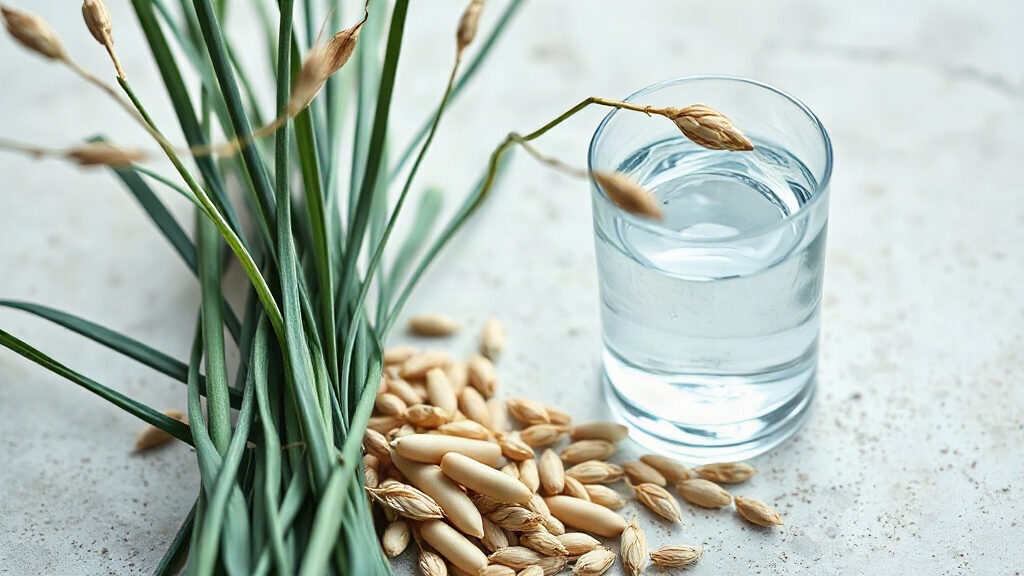
| Whole grains, oats, brown rice | Silica bound to fiber | Variable, partly released during digestion | Refining removes most of the mineral (white flour) |
These figures guide choices without dictating a diet. A diet built around whole grains, legumes and green vegetables, with a mineral water that states its silica content, effortlessly supplies the 25 mg daily benchmark mentioned by Nielsen. This logic of nutrients that interact with the cell’s metabolic sensing pathways is detailed on our pillar page on deregulated nutrient sensing.
Silicon supplements: forms, studied doses and precautions
Supplements are not all equal, because absorption depends on the chemical form. In the 2009 comparative study, monomethylsilanetriol reached 64% absorption, choline-stabilized orthosilicic acid 17%, and colloidal silica 1%. The positive clinical trials on skin and bone all used the choline-stabilized form at doses of 6 to 10 mg per day. Horsetail and bamboo extracts, though widespread, have not been tested in any randomized trial published on PubMed.
| Form | Absorption | Clinical evidence | Point to watch |
|---|---|---|---|
| Choline-stabilized orthosilicic acid | 17% | 3 randomized trials (bone, skin, hair), 6 to 10 mg per day | Best documented form in humans |
| Monomethylsilanetriol (organic silicon) | 64% | Absorption measured, no clinical efficacy trial | Authorized by EFSA in 2009 up to a limit of 10.5 mg per day |
| Colloidal silica, silica gel | 1 to 4% | No efficacy trial | Almost not absorbed |
| Horsetail, bamboo (plant extracts) | Not measured in humans | No randomized trial | Horsetail contains a thiaminase, to avoid in prolonged courses |
A few benchmarks before considering supplementation:
- Put food first: average dietary intakes already meet the 25 mg benchmark, and the positive cohorts looked at dietary intakes, not supplements.
- Stick to the studied doses: 6 to 10 mg per day, over 5 to 12 months in the trials. No adverse effect was reported at these doses among the participants of Spector 2008.
- After menopause: the effect on bone appears to depend on estrogen. Without hormone therapy, the value of a supplement has not been demonstrated.
- Kidney impairment: the mineral is cleared by the kidneys, so medical advice is required before any course if kidney function is reduced.
- Do not expect an effect on the arteries: this use rests on no human data.
The longevity angle fits in one sentence: silicon is not a treatment, it is a marker of a diet low in refined foods. The people who consume the most eat more whole grains and vegetables. It is this overall profile, more than any single trace element, that the cohorts measure.
Frequently asked questions about silicon
Which foods are richest in silicon?
Whole grains (oats, barley, brown rice), green beans, lentils, bananas, beer and some silica-rich mineral waters provide most dietary silicon. Absorption varies widely: 64% for alcohol-free beer, 44% for green beans, 43% for mineral water, but only 4% for bananas, whose silica is partly polymerized. Refining grains removes most of the mineral.
Does silicon really strengthen bones?
The Framingham (2,847 adults) and Aberdeen (3,198 women) cohorts show higher bone density in the biggest consumers, by 2 to 10% depending on the site measured. These are associations. The only 12-month randomized trial (Spector 2008) raised a marker of bone collagen formation without changing lumbar density. Silicon complements calcium, vitamin D and exercise, it does not replace them.
What is the difference between organic and mineral silicon?
So-called organic silicon refers to molecules in which the element is bound to carbon, such as monomethylsilanetriol, which is very well absorbed (64%). Mineral silicon covers silica and silicates, which are poorly soluble and weakly absorbed (1 to 4% for colloidal silica). Orthosilicic acid, the natural form found in water and plants, is mineral but soluble, with an absorption of about 43%. The chemical form therefore matters more than the label.
Does silicon have an effect on skin and hair?
Two randomized double-blind trials, on 50 and 48 women, tested 10 mg per day as choline-stabilized orthosilicic acid. After 20 weeks, skin roughness had dropped by 16 to 19%, and after 9 months fine hair resisted breakage better and had thickened. These results remain limited to about a hundred participants and a single supplement form.
Does silicon protect the arteries?
No human clinical study has demonstrated it. The hypothesis, put forward by Schwarz in the Lancet in 1977, rests on the high concentration of silicon in the wall of healthy arteries and on animal data. The validated levers for the arteries remain blood pressure, LDL cholesterol, quitting smoking and physical activity. A silicon supplement taken for this purpose alone has no scientific justification to date.
Medical disclaimer. The information on this page is provided for informational purposes only and does not constitute medical advice. It does not replace a consultation. Ask a healthcare professional before changing your diet, taking dietary supplements or starting a new practice, especially if you have a medical condition, are pregnant or are under treatment. Dietary supplements do not replace a balanced diet or medical follow-up.