BPA, or bisphenol A, was found in the urine of almost every French person tested by the national public health agency between 2014 and 2016. This synthetic molecule, used for more than 50 years in polycarbonate plastics and epoxy resins, mimics estrogen and scrambles several hormonal signals at very low doses. In April 2023, the European Food Safety Authority divided the daily dose it considers tolerable by 20,000. Here is how it acts on your hormones, what human studies have measured, and the habits that actually reduce exposure.
In brief – BPA (bisphenol A) is a synthetic endocrine disruptor that binds to estrogen receptors and also interferes with androgen, thyroid and insulin signaling. More than 80% of it enters the body through food, mainly from canned goods and polycarbonate containers, and then through the skin when handling thermal receipts. The French Esteban study detected it in almost every urine sample tested. In the NHANES cohort, each one standard deviation rise in urinary bisphenol was associated with 39% more diabetes and cardiovascular disease (Lang et al., 2008, n=1,455). In 2023, the European Food Safety Authority lowered the tolerable daily intake to 0.2 nanograms per kilo, 20,000 times less than in 2015, because of an effect on Th17 lymphocytes. Cutting back on canned food, banning heated plastic and not handling receipts lowers its urinary concentration by 66% in 3 days.
Definition: what is BPA and where is it found?
BPA, or bisphenol A, is an industrial chemical manufactured since the 1950s to harden polycarbonate plastics and to form the epoxy resins that line the inside of food cans. The National Institute of Environmental Health Sciences lists it among the environmental agents under active study, and France’s food safety agency has counted some sixty industrial sectors that use it: food containers, cables, sealants, automotive optics, printing inks, medical devices. The thermal paper of cash register receipts contained it as a color developer until its ban in the European Union on January 2, 2020.
Food accounts for more than 80% of the population’s exposure, and canned products alone represent half of that dietary share, according to France’s food safety agency. The molecule migrates from the lining into the contents, all the more so when the food is hot, fatty or acidic. In the United States, the NHANES 2003-2004 survey detected BPA in the urine of 92.6% of 2,517 participants, with children showing higher levels than adults (Calafat et al., 2008, PubMed). In France, the national Esteban biomonitoring program, the counterpart of the CDC’s National Biomonitoring Program, measured bisphenols A, S and F in 500 children and 900 adults aged 6 to 74. All three were found in almost every sample. The average reached 2.25 µg per gram of creatinine in children and 2.69 in adults.
Bisphenol A is cleared quickly, in about 6 hours, by the liver and kidneys. Its constant presence in urine therefore does not reflect storage, but repeated exposure throughout the day.
Mechanism: how BPA acts on your hormones
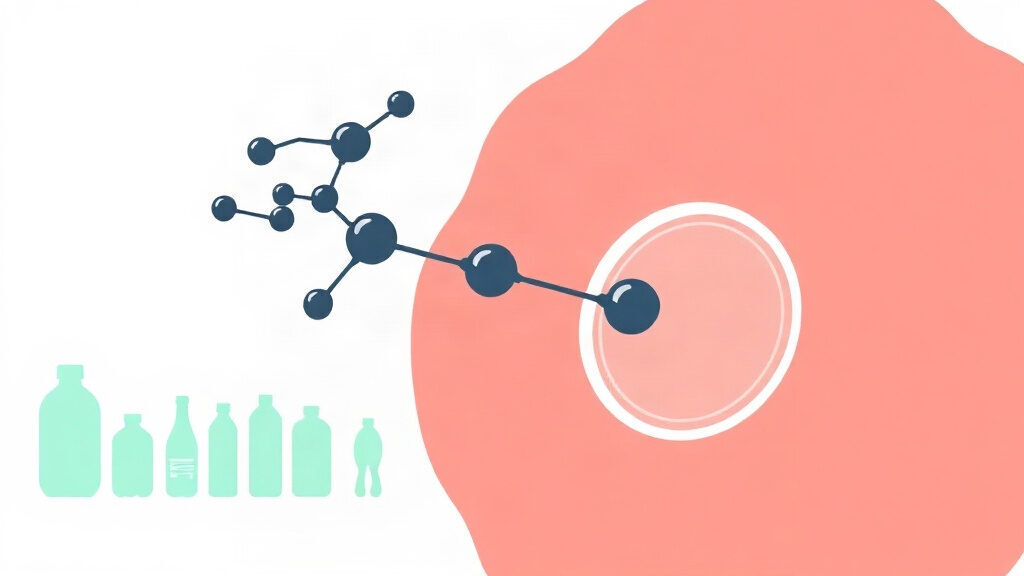
BPA resembles estradiol closely enough to slot into its receptors and trigger, block or derail the hormonal message. The expert panel convened in Chapel Hill in 2006 reviewed the mechanisms demonstrated in the laboratory. It retained several of them, which go beyond the mere imitation of estrogen (Wetherill et al., 2007, PubMed).
- Nuclear estrogen receptors (ERα and ERβ): BPA activates them with an affinity 1,000 to 10,000 times weaker than estradiol, but it circulates constantly.
- Membrane receptor GPER (GPR30): there it triggers rapid responses within minutes, at concentrations close to those of estradiol itself.
- ERRγ receptor: the bisphenol binds to it strongly, and this orphan receptor is highly expressed in the placenta and the fetal brain.
- Androgen receptor: antagonist action: it holds back the action of testosterone.
- Thyroid hormone receptor: it blocks the binding of T3, which can alter the expression of thyroid-dependent genes.
Two characteristics set this disruptor apart from a classic toxin. First, the dose-response relationship is not linear. A review of more than 100 animal studies showed effects at doses below the so-called no-effect dose. These effects were sometimes absent at higher doses (vom Saal and Hughes, 2005, PubMed). Second, the window of exposure matters as much as the dose. The National Institute of Environmental Health Sciences notes that fetal life, early childhood and adolescence are the periods when developing tissues are most sensitive to stray hormonal signals.
| Target | Type of action | Function disrupted |
|---|---|---|
| Estrogen receptors ERα and ERβ | Weak agonist | Development of reproductive organs, menstrual cycle, breast tissue |
| Membrane receptor GPER | Rapid agonist | Cell proliferation, insulin secretion |
| ERRγ receptor | Strong binding | Placenta, developing brain |
| Androgen receptor | Antagonist | Testosterone, sperm production |
| Thyroid receptor | T3 antagonist | Metabolism, brain maturation |
| Pancreatic beta cells | Overstimulation | Insulin, blood sugar |
What the science says: 5 effects of BPA measured in humans and animals
Human studies on bisphenol A are mostly observational: they describe associations, not proven causation. Animal experiments supply the mechanism. The five results below are the best documented.
1. Insulin and blood sugar. In adult mice, a single dose of 10 µg/kg of BPA, in the same range as human exposure at the time, made blood sugar drop and insulin climb within minutes. After 4 days, the animals showed chronic hyperinsulinemia and insulin resistance (Alonso-Magdalena et al., 2006, PubMed).
2. Diabetes and cardiovascular disease. In the NHANES 2003-2004 survey of 1,455 American adults, each one standard deviation rise in urinary bisphenol was associated with a 1.39-fold higher risk of a cardiovascular diagnosis. The risk of diabetes was likewise multiplied by 1.39 after full adjustment. Liver enzymes were also more often abnormal (Lang et al., 2008, PubMed).
3. Coronary heart disease over 10 years. The prospective EPIC-Norfolk cohort followed 758 future cases of coronary heart disease and 861 controls for 10.8 years. Each additional urinary standard deviation was associated with 13% more risk. This link is weaker than in NHANES and borderline significant after full adjustment (Melzer et al., 2012, PubMed).
4. Reproduction and development. A review of 91 epidemiological studies linked exposure to this bisphenol to perinatal, childhood and adult effects: sperm quality, puberty, child behavior, metabolic diseases. The authors stress that a causal link remains hard to establish, but that the convergence with animal data, primates included, strengthens the body of evidence (Rochester, 2013, PubMed).
5. Immune system. This is the effect that tipped the European assessment. In April 2023, EFSA retained the increase in Th17 lymphocytes, which are involved in inflammation and autoimmunity, as the critical effect of BPA. The tolerable daily intake went from 4 µg per kilo of body weight to 0.2 nanograms per kilo, 20,000 times less. The average exposure of Europeans exceeds this threshold, which led the European Commission to adopt, on December 19, 2024, its ban in all food contact materials.
| Effect studied | Key study | Measured result | Level of evidence |
|---|---|---|---|
| Insulin resistance | Alonso-Magdalena 2006 (mice) | Hyperinsulinemia after 4 days at 10 µg/kg | Solid animal mechanism |
| Diabetes, cardiovascular disease | Lang 2008 (NHANES, n=1,455) | Risk x 1.39 per urinary standard deviation | Cross-sectional association |
| Coronary heart disease | Melzer 2012 (EPIC-Norfolk, 10.8 years) | +13% per standard deviation | Weak prospective association |
| Reproduction, development | Rochester 2013 (91 studies) | Repeated associations, causation not established | Body of evidence |
| Immunity (Th17) | EFSA 2023 | TDI lowered to 0.2 ng/kg/day | Regulatory assessment |
In practice: where BPA hides in everyday life
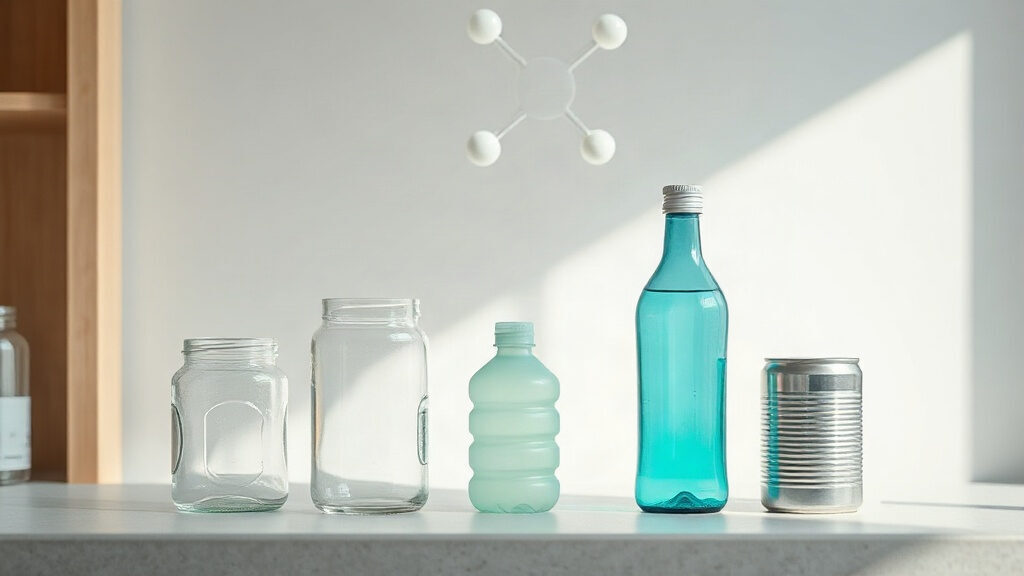
Canned food, rigid polycarbonate bottles and containers, and older receipts are the three sources that weigh most in daily exposure. Polycarbonate can be recognized by the recycling code 7 or the letters PC. Plastic-lined disposable cups, described in our article on plastic-lined paper cups, mainly release microplastics, another carrier of bisphenols.
Two experiments illustrate the share of each source. In 75 volunteers, 5 days of canned soup raised urinary BPA by 1,221% compared with 5 days of fresh soup (Carwile et al., 2011, PubMed). In 24 volunteers, handling thermal receipts for 2 hours without gloves raised urinary levels, while gloves prevented this rise (Ehrlich et al., 2014, PubMed). BPA belongs to the Altered intercellular communication pillar: it scrambles the messages that cells exchange through hormones, just like the endocrine disruptors in household cleaning products.
The substitutes raise a problem. Since the French ban of 2015, many manufacturers have replaced BPA with bisphenol S (BPS) or bisphenol F (BPF). A systematic review of 32 studies concluded that these two molecules have hormonal activity of the same order of magnitude as the original compound, both estrogenic and anti-androgenic (Rochester and Bolden, 2015, PubMed). A “BPA-free” label therefore does not guarantee the absence of an endocrine disruptor.
| Source | Why it migrates | Alternative |
|---|---|---|
| Food cans (vegetables, fish, soups) | Epoxy resin lining, acidic or fatty food | Glass jars, frozen food, fresh produce |
| Polycarbonate bottles and boxes (code 7, PC) | Heat, scratches, repeated washing | Glass, stainless steel, polypropylene (code 5) for cold use |
| Plastic dishes heated in the microwave | Heat multiplies migration | Reheat in glass or ceramic |
| Thermal receipts (before 2020 or outside the EU) | Skin absorption, amplified by wet hands or hand sanitizer | Digital receipt, do not keep it in hand |
| Water coolers and polycarbonate jugs | Prolonged storage, exposure to sunlight | Filtered tap water, glass carafe |
Protocol: 6 habits that lower the BPA measured in urine
Three days of fresh, lightly packaged food are enough to reduce urinary bisphenol A by 66% on average and by up to 76% for the highest values. That is the result obtained in 20 people from 5 Californian families fed for 3 days without cans or plastic, in a study published in Environmental Health Perspectives (Rudel et al., 2011, PubMed). The habits below take up the levers that carried the most weight in that work.
- Replace canned food with glass jars, frozen food or fresh produce, starting with tomatoes, soups and fish, whose acidity and fat promote migration.
- Never heat food in plastic, neither in the microwave nor by pouring a hot drink into a polycarbonate cup or bottle.
- Sort your containers: set aside code 7 and scratched or old PC, and prefer glass and stainless steel for storage and transport.
- Decline the receipt or put it away without keeping it in hand, especially after using hand sanitizer, which increases skin absorption, and wash your hands before eating.
- Drink tap water, filtered if you wish, rather than water from polycarbonate jugs exposed to heat.
- Protect the sensitive windows: pregnancy, breastfeeding and early childhood justify applying these habits with the greatest rigor, as health agencies advise.
These measures reduce exposure, they do not eliminate it, and none of them corrects a hormonal effect that is already established. The good news lies in the molecule’s short half-life: its urinary concentration reflects the last 24 hours, and each habit produces a measurable effect as early as the following week. Microplastics also carry bisphenols, and several of these habits act on both exposures at once.
Frequently asked questions about BPA and hormones
Why is BPA considered an endocrine disruptor?
BPA meets the World Health Organization definition: an exogenous substance that alters one or more functions of the endocrine system and causes an adverse health effect. It activates estrogen receptors, blocks androgen and thyroid hormone T3 receptors, and stimulates the beta cells of the pancreas. In June 2017, the European Chemicals Agency listed it among substances of very high concern for these properties.
What is the difference between BPA and BPS or BPF?
BPS and BPF are bisphenols with a similar structure, used to replace BPA after its ban in food containers in France in 2015. A systematic review of 32 studies (Rochester and Bolden, 2015) showed that they have estrogenic and anti-androgenic activity of the same order of magnitude as the original compound. A product labeled “BPA-free” may therefore contain a hormonally active substitute.
How does BPA enter the body?
More than 80% comes through food, according to France’s food safety agency, with canned goods leading the way. Five days of canned soup raised urinary BPA by 1,221% in 75 volunteers (Carwile et al., 2011). Skin absorption when handling thermal receipts and, to a lesser extent, inhaling dust complete the exposure. It is then eliminated in urine in about 6 hours.
Is BPA banned in France and in Europe?
France banned BPA in all food containers on January 1, 2015, after baby bottles in 2010. The European Union removed it from thermal receipts on January 2, 2020. The Commission then adopted, on December 19, 2024, its ban in all food contact materials, with transition periods. It remains authorized in other industrial uses, which is why exposure persists.
How can you quickly reduce your BPA exposure?
Three days without canned food or heated plastic reduce urinary BPA by 66% on average (Rudel et al., 2011). The most effective habits: replace cans with glass, frozen or fresh food, and never reheat in plastic. Also set aside polycarbonate (code 7), decline receipts and wash your hands before eating. Pregnant women and young children have the most to gain.
Medical disclaimer. The information provided here is for informational purposes only and does not constitute medical advice. It does not replace a consultation. Ask a healthcare professional before changing your diet, taking dietary supplements or starting a new practice, especially if you have a medical condition, are pregnant or are under treatment. Dietary supplements do not replace a balanced diet or medical follow-up.