
Napping for 10 to 20 minutes restores alertness for close to three hours, whereas a daily nap of more than one hour is linked to an 82% higher cardiovascular risk in a meta-analysis of 151,588 adults. Between these two extremes, the length, the time of day and the sleeper’s profile change everything. Here is what the studies published since 2003 allow us to say: how long to aim for, what time to lie down, who gains a measurable benefit and for whom a nap should instead raise concern.
In brief – Napping is a short episode of daytime sleep that offsets a sleep debt and restores alertness without harming the following night, provided it stays brief and early. Ten minutes of sleep immediately improve alertness, fatigue and cognitive performance, with effects measured up to 155 minutes after waking, whereas 30 minutes first cause sleep inertia (Brooks and Lack, 2006, 24 participants). The most favorable window falls between 1 p.m. and 3 p.m., at the afternoon circadian dip. Beyond 60 minutes a day, cohorts link napping to 27% higher all-cause mortality and 82% higher cardiovascular risk (Yamada et al., 2015, 151,588 adults). One or two naps a week, by contrast, are associated with half as many cardiovascular events (Häusler et al., 2019). A nap is useful after a short night, for night-shift workers and before a long drive. It should raise concern when it becomes long, daily and involuntary, especially after age 65.
Definition: what counts as napping and what forms it takes
A nap is any episode of voluntary sleep taken during the day, most often in the early afternoon, on top of nighttime sleep. It never replaces the night: an adult needs 7 to 9 hours of sleep per 24 hours according to the NHS sleep and tiredness guidance, and daytime sleep covers only a fraction of that need. In France, the national public health agency estimates that adults’ average sleep time has dropped below 7 hours a night, which explains the interest in daytime sleep as a recovery tool.
Researchers classify naps by the sleep stage reached, which depends directly on how long they last. A 5 to 10 minute nap stays in light sleep (stages 1 and 2). Between 20 and 30 minutes, the brain shifts into deep slow-wave sleep (stage 3), which is hard to wake from. A 60 to 90 minute nap runs through a full cycle, REM sleep included. Each of these forms has different effects on alertness, memory and, over the long term, on the heart.
Mechanism: what happens in the brain during a nap
Two clocks explain the urge to sleep in the early afternoon, and therefore why napping works so well at that precise moment. The first is homeostatic sleep pressure: adenosine builds up in the brain with every hour spent awake and is cleared only by sleep. The second is the circadian clock, which marks a dip in alertness between 1 p.m. and 3 p.m., independent of lunch. The mechanisms that set this clock are detailed in our article on the circadian clock and its five levers.
- Light sleep (stages 1 and 2): it sets in within 5 to 10 minutes and is enough to clear part of the adenosine. This is what explains the almost immediate effect of a 10 minute nap on alertness.
- Deep slow-wave sleep (stage 3): it appears after 20 to 30 minutes. Waking in the middle of this stage produces sleep inertia, that feeling of heaviness and impaired performance that lasts 15 to 35 minutes.
- REM sleep: it comes at the end of the cycle, around 60 to 90 minutes. It contributes to consolidating certain kinds of learning, but starting it during the day lowers sleep pressure for the following night.
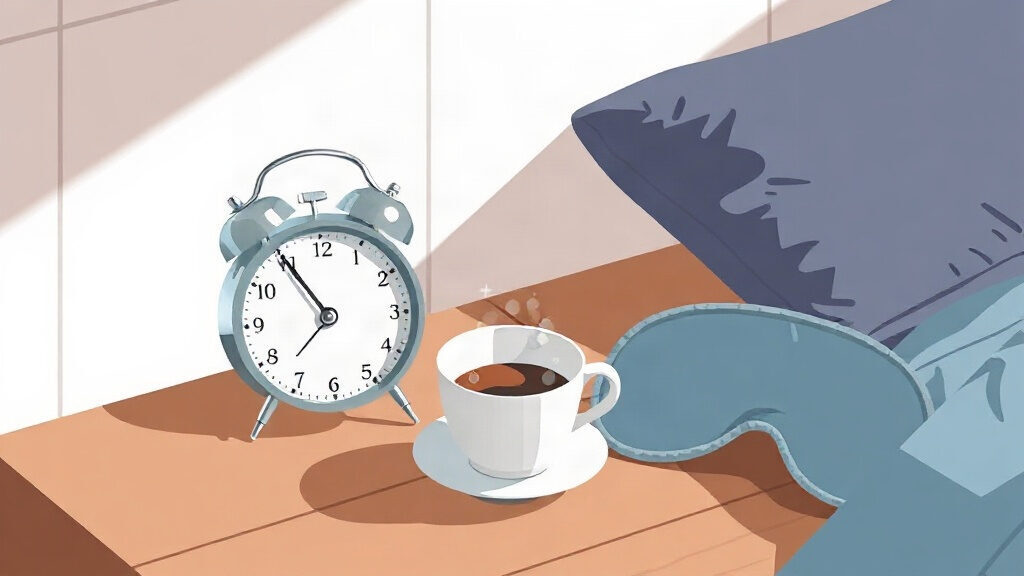
- Caffeine: it blocks adenosine receptors, but its action takes 20 to 30 minutes to kick in. Drinking a coffee just before closing your eyes makes its peak effect coincide with waking: that is the principle of the coffee nap.
What the science says: length, alertness, heart and brain
On alertness and memory
Ten minutes of sleep is the most effective length measured in the laboratory. After a night restricted to 5 hours, 24 young adults tested four lengths of daytime sleep, 5, 10, 20 and 30 minutes, at 3 p.m. Only the 10 minute nap immediately improved every indicator (sleep latency, sleepiness, fatigue, vigor, cognitive performance), with benefits lasting up to 155 minutes. The 30 minute version first impaired alertness during sleep inertia before catching up to the same level (Brooks and Lack, 2006).
The meta-analysis by the Clermont-Ferrand team confirms this gain across 11 studies and 381 working-age adults. Cognitive performance improves after the nap (effect size 0.18), especially alertness (0.29). Naps taken before 1 p.m. give better results than later ones (Dutheil et al., 2021). For learning, a 60 to 90 minute nap containing slow-wave and REM sleep produced, on a visual discrimination task, an improvement comparable to a full night (Mednick et al., 2003).
Behind the wheel, coffee followed by a nap beats either one taken alone. In 12 sleepy drivers on a simulator, 200 mg of caffeine followed by a nap of under 15 minutes brought driving incidents down to 9% of the placebo level, compared with 34% for caffeine alone (Reyner and Horne, 1997).
| Length | Stage reached | Measured effect | Inertia on waking |
|---|---|---|---|
| 5 minutes | Stage 1 | Little benefit compared with no rest | None |
| 10 minutes | Stages 1 and 2 | Alertness, fatigue and performance improved immediately, for up to 155 minutes | None |
| 20 minutes | Stage 2 | Benefits appearing 35 minutes after waking, lasting up to 125 minutes | Slight |
| 30 minutes | Start of stage 3 | Performance first impaired, then improved for up to 155 minutes | Marked |
| 60 to 90 minutes | Full cycle | Learning consolidation comparable to a night (perceptual task) | Variable, following night delayed |
On the heart and mortality
Frequency and length separate the favorable data from the unfavorable. In the Greek EPIC cohort, 23,681 adults with no cardiac history were followed for 6.3 years: those who napped systematically had 37% lower coronary mortality, especially among working men (Naska et al., 2007). In Lausanne, 3,462 adults followed for 5.3 years saw their risk of a cardiovascular event halved when they slept during the day once or twice a week (HR 0.52). No benefit or risk appears for daily napping after adjustment (Häusler et al., 2019).
Length pulls in the other direction. The meta-analysis of 11 cohorts and 151,588 participants describes a J-shaped curve: cardiovascular risk falls slightly up to 30 minutes, then climbs sharply beyond 45 minutes. A nap of 60 minutes or more a day is associated with 82% higher cardiovascular risk and 27% higher all-cause mortality. Below 60 minutes, no association appears (Yamada et al., 2015). The PURE study, conducted in 116,632 people across 21 countries, adds context. Daytime sleep raises the risk of death and cardiovascular events only in people who already sleep more than 6 hours at night, not in those whose nights are short (Wang et al., 2019).
A causal signal exists for blood pressure. Among 358,451 UK Biobank participants, people who report “usually” sleeping during the day have a 12% higher risk of hypertension and a 24% higher risk of stroke. Mendelian randomization (a genetic analysis) supports a causal effect of this frequency on hypertension (Yang et al., 2022). Frequent napping often reflects poor-quality nights or undiagnosed sleep apnea, two risk factors for hypertension in their own right.
| Study | Population | Exposure | Result |
|---|---|---|---|
| Naska et al., 2007 | 23,681 Greek adults, 6.3 years | Systematic napping | Coronary mortality reduced by 37% |
| Häusler et al., 2019 | 3,462 Swiss adults, 5.3 years | 1 to 2 naps a week | Cardiovascular events reduced by 48% |
| Yamada et al., 2015 | Meta-analysis, 151,588 adults | 60 minutes or more a day | Cardiovascular risk up 82%, mortality up 27% |
| Wang et al., 2019 | 116,632 adults, 21 countries, 7.8 years | Nap with a night of more than 6 h | Higher risk; no risk if the night is short |
| Yang et al., 2022 | 358,451 adults, UK Biobank | Habitual napping | Hypertension up 12%, stroke up 24% |
On the aging brain
Habitual, short napping is associated with a slightly larger brain. A Mendelian randomization analysis of 378,932 UK Biobank participants links the genetic tendency to sleep during the day to a total brain volume 15.8 cm³ (just under one cubic inch) larger. No effect appears on the hippocampus, reaction time or visual memory (Paz et al., 2023). A systematic review of 35 studies describes an inverted U-shaped relationship in people over 60. Short or moderate naps are associated with better cognitive function than no nap at all or prolonged episodes (Li et al., 2023).
A gradual lengthening of daytime sleep, on the other hand, deserves to be taken seriously after 65. In the Rush Memory and Aging Project, 1,401 older adults wore an actigraph for up to 14 years. Longer and more frequent daytime sleep is associated with a higher risk of Alzheimer’s disease. The disease itself more than doubles the yearly increase in nap time. The relationship runs both ways: a nap that stretches out year after year may be an early symptom rather than a cause (Li et al., 2022).
In practice: who benefits from napping, and when it should raise concern
The benefit of a nap depends on the sleep debt it offsets. People who sleep less than 6 hours a night, shift workers, new parents and drivers before a long trip gain a measured boost in alertness with no identified cardiovascular downside. Conversely, someone who sleeps 7 to 8 hours and still feels the need to sleep every afternoon should first look for the cause: sleep apnea, insomnia, depression, a sedative medication or iron deficiency.
- Short or fragmented night: a 10 to 20 minute nap before 3 p.m. restores alertness without adding debt to the following night.
- Night work: a 20 to 30 minute nap before the shift reduces sleepiness in the second half of the night. Waking inertia means waiting 30 minutes before any high-risk task.
- Long drive: coffee then a 15 minute nap at a rest area, following the Reyner and Horne protocol, then back on the road once the inertia has passed.
- Chronic insomnia: napping keeps the disorder going by lowering evening sleep pressure. Cognitive behavioral therapy for insomnia rules it out for the duration of treatment.
- After 65: keep naps short and at a fixed time, and tell your doctor about any gradual lengthening or any new sleepiness.
| Profile | Nap recommended | Point to watch |
|---|---|---|
| Adult sleeping less than 6 h a night | Yes, 10 to 20 minutes before 3 p.m. | Do not make it a lasting substitute for a full night |
| Night or shift worker | Yes, 20 to 30 minutes before the shift | Allow for the inertia delay before a safety task |
| Driver before a long trip | Yes, coffee then 15 minutes | Get back behind the wheel only once the inertia has cleared |
| Person with insomnia | No during treatment | Daytime sleep lowers evening sleep pressure |
| Person with hypertension or sleep apnea | Short only, with medical advice | A long daily nap is a warning sign, not a remedy |
| Over 65 | Yes if short and voluntary | A gradual lengthening warrants a cognitive and sleep assessment |
Nighttime sleep remains the main lever: its nine rules are detailed in our guide better sleep: 9 keys to sleeping well. Insufficient sleep also sustains low-grade inflammation and disrupts hormonal signals between organs, a mechanism described in the pillar altered intercellular communication. A short nap acts as a one-off correction for these disruptions, not as their underlying treatment.
Protocol: a successful short nap in 6 steps
- Pick the time slot: between 1 p.m. and 3 p.m., never after 4 p.m., so as not to delay falling asleep in the evening. The data from Dutheil et al. (2021) favor naps taken before 1 p.m. when the schedule allows.
- Set an alarm for 20 minutes: this window includes the 5 to 10 minutes needed to fall asleep and guarantees 10 to 15 minutes of light sleep, without reaching deep sleep.
- Drink a coffee just before if a demanding task follows: the caffeine kicks in on waking, 20 to 30 minutes later. Our article on coffee and longevity details reasonable doses and the latest time to drink it.
- Cut light and noise: a dark room or a sleep mask, phone on silent, a semi-reclined position if you fear sleeping too long.
- Get up at the alarm, without snoozing: the extra minutes tip you into deep sleep and trigger inertia.
- Expose your eyes to light after waking: daylight or bright lighting for 5 minutes, to restart alertness and stabilize the circadian clock.
A nap that regularly runs past 30 minutes despite the alarm, or that happens without you deciding to take it, signals a sleep debt or a disorder that warrants an assessment. In that case, the right response is not to lengthen the nap but to see a doctor.
Frequently asked questions about napping
What is the ideal length for a nap?
Ten to twenty minutes of sleep, which means an alarm set for 20 to 25 minutes to allow for falling asleep. In the trial by Brooks and Lack (2006), the 10 minute nap was the most effective of the four lengths tested, with benefits on alertness lasting up to 155 minutes and no sleep inertia. At 30 minutes, performance first drops for a quarter of an hour before improving.
What time of day should you nap?
Between 1 p.m. and 3 p.m., at the afternoon circadian dip in alertness. The meta-analysis by Dutheil et al. (2021) observes better cognitive performance for naps taken before 1 p.m. After 4 p.m., a nap lowers evening sleep pressure and delays falling asleep, which harms the following night and cancels out the benefit.
Is napping bad for the heart?
Only when it is long and daily. The meta-analysis by Yamada et al. (2015) of 151,588 adults observes no association below 60 minutes a day, but an 82% higher cardiovascular risk beyond that. One or two naps a week are even associated with half as many cardiovascular events in the Lausanne cohort (Häusler et al., 2019).
Why do naps get longer with age?
Nighttime sleep becomes fragmented after 60, which increases daytime sleepiness. In the Rush Memory and Aging Project (1,401 participants), daytime sleep time lengthens naturally with age, but Alzheimer’s disease more than doubles this yearly increase (Li et al., 2022). A nap that stretches out year after year therefore warrants a sleep and cognitive assessment.
How does a coffee nap work?
You drink a coffee, then sleep for 15 to 20 minutes: caffeine takes 20 to 30 minutes to act and takes over on waking. In 12 sleepy drivers, 200 mg of caffeine followed by a nap of under 15 minutes reduced driving incidents to 9% of the placebo level, compared with 34% for caffeine alone (Reyner and Horne, 1997). The method suits a demanding task ahead, not the end of the day.
Medical disclaimer. The information on this page is provided for informational purposes only and does not constitute medical advice. It does not replace a consultation. Ask a healthcare professional before changing your diet, taking dietary supplements or starting a new practice, especially if you have a medical condition, are pregnant or are under treatment. Dietary supplements do not replace a balanced diet or medical follow-up.