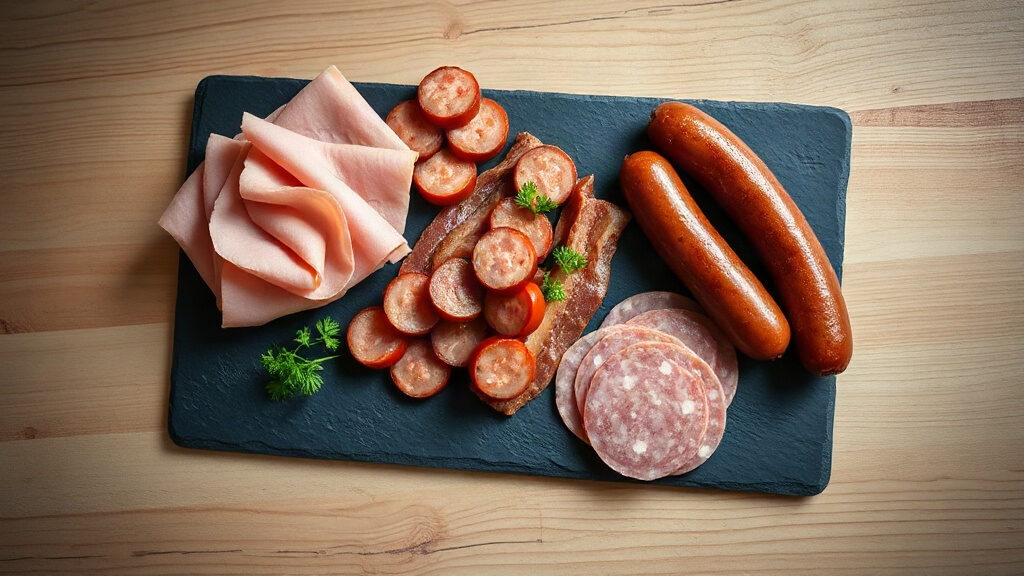
Processed meat raises the risk of colorectal cancer, type 2 diabetes and coronary heart disease from modest daily amounts, and dose-response studies have found no threshold below which the effect disappears. Ham, sausages, bacon bits, salami, bacon: since the International Agency for Research on Cancer (IARC) classified processed meat as carcinogenic in 2015, the question is no longer “is it harmful?” but “from what quantity?”. Here is what the large cohorts measure, serving by serving, and the benchmarks that follow from them.
In brief – Processed meat is meat preserved by salting, curing, smoking or fermentation (ham, sausages, bacon bits, salami, bacon, pâtés, corned beef) that the IARC has placed since 2015 in Group 1, the category of agents proven to cause cancer in humans. The unit used in the studies is a 50 g (1.8 oz) serving per day, about one thick slice of ham or one sausage: each daily 50 g serving is associated with 18% more colorectal cancer (Chan 2011, meta-analysis of prospective cohorts), 42% more coronary heart disease and 19% more type 2 diabetes (Micha 2010, 1.2 million participants). The most recent work (Haile 2025, Nature Medicine) identifies no no-effect threshold: risk rises from the first grams, in a roughly linear way. In France, the official benchmark is to stay under 150 g (5.3 oz) of cured meats per week, about three slices of ham. Unprocessed red meat carries a lower and distinct risk.
Processed meat: definition and concrete examples
Processed meat is meat whose preservation or flavor has been modified by salting, curing, smoking, drying or fermentation, most often with nitrite additives. The World Health Organization gives the reference definition: most of these products contain pork or beef, but the category also includes poultry, offal and by-products such as blood. The processing method matters more than the animal of origin: sliced, brined turkey breast counts, a home-roasted chicken fillet does not.
In practice, the category covers most of the deli counter and part of the ready-meal aisle:
- Cooked ham, cured ham, shoulder ham, sliced brined turkey or chicken breast.
- Frankfurters, chipolatas, merguez, hot dogs and other sausages.
- Bacon bits, bacon, smoked pork belly, pancetta.
- Dry-cured sausage, chorizo, saucisson, coppa, mortadella.
- Pâtés, rillettes, terrines, liver mousse, corned beef, canned meat.
- Ground-meat preparations with added salt and preservatives (some nuggets, cordon bleu, industrial meatballs).
Fresh red meat (unprocessed beef, pork, lamb, veal) belongs to a different category, classified “probably carcinogenic” (Group 2A) by the IARC. Fresh red meat and cured meats have similar effects on colorectal cancer but very different effects on the heart and metabolism, as the section on the studies explains.
Why processed meat is more harmful than fresh meat
Four mechanisms, well described in animals and consistent with human data, explain the extra risk of cured and smoked meats compared with a steak or a fresh pork chop.
- Added nitrites and nitrates (E249 to E252). In the stomach and colon, they react with the amines in meat to form N-nitroso compounds, several of which are genotoxic: they create direct lesions in the DNA of colon cells, one of the gateways to cellular aging described on our pillar page Genomic instability. In 2022, France’s food safety agency confirmed the association between nitrite exposure and colorectal cancer; more than half of French dietary nitrite exposure comes from cured meats, and the NHS advises anyone eating more than 90 g of red or processed meat a day to cut down to 70 g. In the NutriNet-Santé cohort, Srour et al. (2023) also link nitrite additives, and sodium nitrite E250 in particular, to 53% more type 2 diabetes among the heaviest consumers (104,168 adults followed for 7 years).
- Heme iron. It catalyzes the endogenous formation of N-nitroso compounds and lipid peroxidation, which releases cytotoxic aldehydes. The meta-analysis by Bastide et al. (2011), covering 566,607 people, associates the highest heme iron intakes with 18% more colon cancer.
- Salt. A 50 g serving of cured meat often provides 1 to 2 g of salt: salt explains a good share of the excess cardiovascular risk specific to these products, which is absent for fresh meat in the Micha (2010) meta-analysis cited below.
- Smoking and high-temperature cooking. They produce polycyclic aromatic hydrocarbons and heterocyclic amines, two families of mutagenic molecules described in the National Cancer Institute fact sheet on meat cooked at high temperatures. Meat that is smoked and then grilled accumulates both sources.
Fresh red meat shares the heme iron and some of the cooking by-products, but not the nitrites or the added salt. It also provides a specific sugar, Neu5Gc, whose link with arterial inflammation is presented in our article Neu5Gc, the red meat sugar, and artery health.
What the science says: the figures from 7 studies
Each 50 g serving eaten daily is associated with 18% more colorectal cancer (relative risk 1.18, confidence interval 1.10 to 1.28). This figure, adopted by the IARC in 2015, comes from the meta-analysis of prospective cohorts by Chan et al. (2011). The same analysis shows a roughly linear relationship up to about 140 g per day of red and processed meat combined, followed by a plateau. The World Cancer Research Fund update by Vieira et al. (2017), based on 111 cohorts, confirms the order of magnitude: 12% additional risk for each 100 g per day of red and processed meat.
The heart and metabolism react more strongly than the colon to cured meats. The meta-analysis by Micha et al. (2010), published in Circulation and covering 1,218,380 people, associates each daily 50 g serving with 42% more coronary heart disease and 19% more type 2 diabetes. Unprocessed red meat, in the same analysis, was not significantly associated with either coronary heart disease (relative risk 1.00) or diabetes. This dissociation is the strongest argument for treating cured meats separately.

On mortality, the European EPIC cohort analyzed by Rohrmann et al. (2013) followed 448,568 adults in ten countries, including France, and recorded 26,344 deaths. The heaviest consumers (160 g or more per day) had 44% higher all-cause mortality than those who ate 10 to 20 g per day. After correction for measurement error, the excess remained 18% per 50 g daily serving, and the authors estimated that 3.3% of deaths would have been avoided if all participants had stayed under 20 g per day. In the United States, Zhong et al. (2020) followed 29,682 adults for 19 years: two extra servings per week were associated with 7% more cardiovascular disease and 3% more mortality, an absolute excess of 1.74 percentage points over 30 years.
The trajectory of consumption matters as much as the level. In the Harvard cohorts analyzed by Zheng et al. (2019) in the BMJ (14,019 deaths, 1.2 million person-years), increasing intake by at least half a serving per day over eight years was associated with 13% more mortality in the following eight years. Finally, the meta-analysis by Farvid et al. (2021), based on 148 publications, extends the finding beyond the colon: the heaviest consumers have 18% more colorectal cancer, 12% more lung cancer and 6% more breast cancer than the lightest consumers.
| Study | Population | Quantity compared | Effect measured |
|---|---|---|---|
| Chan 2011, PLoS One | Meta-analysis of prospective cohorts | +50 g per day | +18% colorectal cancer |
| Micha 2010, Circulation | 20 studies, 1,218,380 people | +50 g per day | +42% coronary heart disease, +19% type 2 diabetes |
| Rohrmann 2013, EPIC | 448,568 Europeans, 26,344 deaths | 160 g or more versus 10 to 20 g per day | +44% all-cause mortality |
| Vieira 2017, WCRF | 111 cohorts | +100 g per day (red and processed) | +12% colorectal cancer |
| Zheng 2019, BMJ | Harvard cohorts, 14,019 deaths | +0.5 serving per day over 8 years | +13% mortality |
| Zhong 2020, JAMA Internal Medicine | 29,682 Americans, 19 years of follow-up | +2 servings per week | +7% cardiovascular disease, +3% mortality |
| Haile 2025, Nature Medicine | Burden of Proof meta-regression | 0.6 to 57 g per day versus zero | At least +11% type 2 diabetes, +7% colorectal cancer |
These results are associations observed in cohorts, not randomized trials: nobody can randomly assign volunteers to eat ham for twenty years. Their strength comes from the convergence across continents, the dose-response relationship and the biological mechanisms identified. The authors of the 2025 Burden of Proof study themselves give the link two stars out of five for robustness, a level they consider sufficient to maintain the recommendation to limit consumption.
How much processed meat really increases the risk?
No quantity is associated with zero risk in the available data, and the excess becomes measurable at around 20 g per day, or 150 g per week. The Burden of Proof analysis by Haile et al. (2025) modeled the dose-response curve in a deliberately conservative way: compared with zero consumption, eating between 0.6 and 57 g per day is already associated with at least 11% more type 2 diabetes and at least 7% more colorectal cancer. There is therefore no “no-effect dose” comparable to what is seen for some contaminants. Risk climbs from the first grams, then roughly in proportion to the quantity.
Two independent benchmarks nevertheless converge on the same order of magnitude. The EPIC cohort places at 20 g per day the level below which excess mortality becomes small, and France’s national nutrition program (PNNS) sets the limit at 150 g of cured meats per week, an average of 21 g per day. In France, nearly 5,600 new cases of colon and rectal cancer each year are attributed to the consumption of red and processed meat, according to the national cancer institute, in line with the WHO healthy diet fact sheet, which advises limiting these products. Applying the Chan (2011) slope, a consumption of 150 g per week would correspond to a relative excess of about 7 to 8% for colorectal cancer, against 18% at 350 g per week (50 g per day) and 36% at 700 g per week: the risk is real at low doses, but it remains four times lower than at the level of a daily ham sandwich.
| Food | Average weight of one unit | Equivalent of 50 g | Equivalent of 150 g per week (PNNS benchmark) |
|---|---|---|---|
| Cooked ham | About 45 g per slice | 1 thick slice | 3 slices in the week |
| Frankfurter | About 35 g | 1 and a half sausages | 4 sausages in the week |
| Bacon bits | About 50 g per handful | 1 handful | 3 handfuls in the week |
| Dry-cured sausage | About 6 g per thin slice | 8 slices | 25 slices in the week |
| Bacon | About 15 g per rasher | 3 rashers | 10 rashers in the week |
| Pâté, rillettes | About 30 g per spread portion | 1 and a half portions | 5 portions in the week |
Reading these figures in absolute terms helps put them in perspective without minimizing them. Zhong (2020) puts the absolute excess linked to two extra weekly servings at 1.74 percentage points of cardiovascular disease over thirty years: for a given person, the effect remains modest; at the scale of a population of tens of millions of adults, it represents tens of thousands of cases. This dual view, individual and collective, is the one taken by official recommendations.
| Source | Year | Position |
|---|---|---|
| IARC / WHO | 2015 | Processed meat classified Group 1 (carcinogenic to humans), red meat Group 2A (probably carcinogenic) |
| PNNS / Santé publique France | 2019 | Less than 150 g of cured meats per week, less than 500 g of red meat per week |
| Anses (French food safety agency) | 2022 | Confirmed association between nitrites, nitrates and colorectal cancer; reduce nitrite additives in cured meats |
| EPIC (Rohrmann) | 2013 | 3.3% of deaths avoidable if everyone stayed under 20 g per day |
What replaces deli meats on the plate weighs as much as what is removed. The Vieira (2017) meta-analysis associates each 90 g daily serving of whole grains with 17% less colorectal cancer, and 400 g of dairy products per day with 13% less. Protein from legumes, eggs, fish and unprocessed poultry was not associated with any excess risk in these same cohorts. Our comparison of plant protein versus animal protein details the best-documented alternatives, and the Mediterranean diet remains the eating pattern that naturally builds in these substitutions.
In practice: 6 tips to cut processed meat without frustration
Going from 50 g per day to 150 g per week means cutting consumption by more than half, and this is the step where the studies locate the biggest gain. The following levers draw on the data from these cohorts, not on prohibition.
- Count in weekly servings, not in “meat-free” days. Three slices of ham or four frankfurters a week are enough to reach the 150 g weekly benchmark. Save them for the moments that really matter (a convivial meal, a regional dish) rather than for the Monday lunchtime sandwich.
- Replace breakfast and sandwich deli meats first. These are the most repetitive and least flavorful uses. Eggs, sardines, hummus, fresh cheese, leftover roast chicken or home-roasted pork fill the same role without nitrites or added salt.
- Choose “no added nitrite” versions with clear eyes. They reduce exposure to additives E249 to E252, a lever endorsed by the French food safety agency, but they remain salty, rich in heme iron and often smoked. They do not take the product out of the category.
- Protect the colon with fiber and dairy. Whole grains, legumes and yogurt are associated with lower colorectal risk in the World Cancer Research Fund cohorts. Fiber also feeds the bacteria that limit the formation of N-nitroso compounds, a theme developed in our feature on the gut microbiome and longevity.
- Avoid combining smoking and grilling. Smoked bacon bits seared over high heat or crispy bacon concentrate polycyclic aromatic hydrocarbons and heterocyclic amines. Gentle cooking, or adding them at the end of cooking, limits this double exposure.
- Watch the trajectory rather than perfection. Zheng (2019) shows that a rise in consumption over eight years weighs on mortality in the following eight years. Not increasing, then gradually reducing, is already a measurable strategy. Cured meats also feed a chronic inflammatory state, whose other levers are described in our article on chronic inflammation (inflammaging).
After 60, the issue doubles as a protein question: cured meats are not a good protein source for muscle (too much salt and fat for little useful protein), and replacing it with eggs, fish, legumes or poultry improves both nutrient density and the risk profile.
Frequently asked questions about processed meat
How much processed meat can you eat without risk?
No quantity is associated with zero risk in the available cohorts: the 2025 Burden of Proof analysis already finds an excess of diabetes and colorectal cancer between 0.6 and 57 g per day. The pragmatic benchmark is the one set by France’s PNNS nutrition program, less than 150 g (5.3 oz) of cured meats per week (about three slices of ham), a level close to the 20 g per day below which the EPIC cohort observes a small excess mortality.
Why is processed meat classified as carcinogenic and not red meat?
The IARC classified processed meat in Group 1 in 2015 because the human epidemiological evidence of a link with colorectal cancer was judged sufficient, with a clear dose-response. For fresh red meat, the evidence was described as limited, hence Group 2A (probably carcinogenic). Added nitrites, salt and smoking, absent from fresh meat, explain the gap.
Is “nitrite-free” ham really safer?
It removes an identified source of N-nitroso compounds, which is in line with the 2022 recommendations of France’s food safety agency. But it remains a cured product: salty, rich in heme iron, sometimes smoked or treated with nitrate-rich plant extracts that convert into nitrites. No cohort has yet measured a specific benefit of these products on cancer or mortality. Treat them as a lesser evil, not as a neutral food.
What is the difference between relative and absolute risk in these studies?
Relative risk compares two groups: +18% colorectal cancer per 50 g daily serving (Chan 2011). Absolute risk measures the real difference in cases: Zhong (2020) puts the excess cardiovascular disease linked to two extra weekly servings at 1.74 percentage points over 30 years. The individual effect is modest, the collective effect is counted in thousands of cases, hence recommendations to limit rather than to ban.
How does processed meat promote type 2 diabetes?
Nitrite additives appear to be involved: in the NutriNet-Santé cohort (104,168 adults, Srour 2023), the heaviest consumers of sodium nitrite (E250) had 53% more type 2 diabetes than non-consumers. Salt, saturated fat and heme iron, which promote insulin resistance and oxidative stress, complete the picture. Micha (2010) puts the excess at 19% per 50 g daily serving.
Medical disclaimer. The information provided here is for informational purposes only and does not constitute medical advice. It does not replace a consultation. Ask a healthcare professional before changing your diet, taking dietary supplements or starting a new practice, especially if you have a medical condition, are pregnant or are under treatment. Dietary supplements do not replace a balanced diet or medical follow-up.