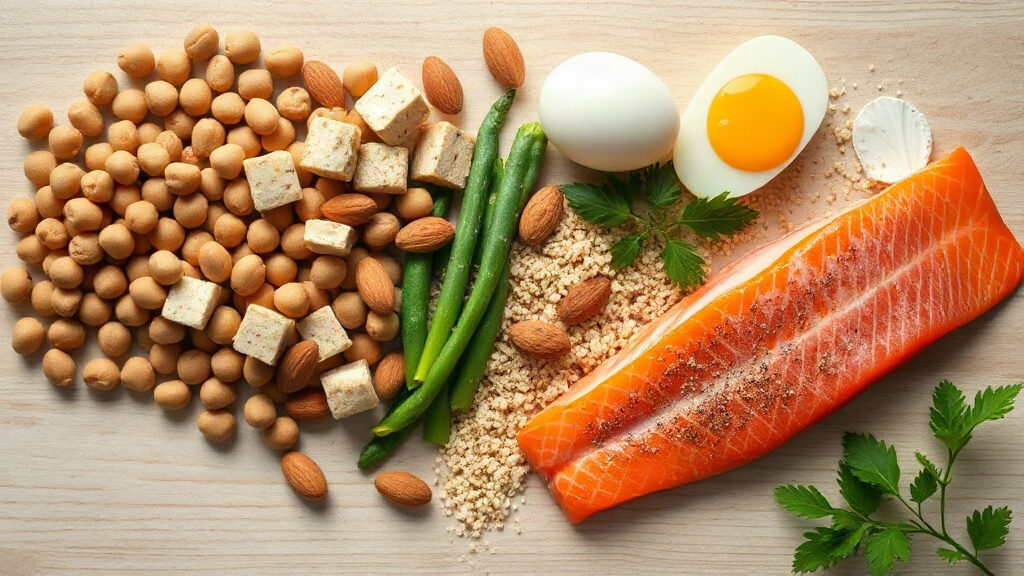
Plant protein supplies all nine essential amino acids, but in different proportions than animal protein, a nuance that affects muscle, heart health and life expectancy. Legumes, whole grains, tofu, meat, fish, eggs: the question of the right balance comes up at every meal, in France as in the large international cohorts that have tracked the diets of hundreds of thousands of adults since the 1980s.
In brief – Plant protein comes from legumes, whole grains, nuts and seeds, tofu and other soy-based foods, a category that covers every essential amino acid but with a different profile than animal protein (meat, fish, eggs, dairy). In adults, large American and Japanese cohorts link a higher share of plant protein in total intake to lower all-cause mortality, while the same amount of animal protein shows no such advantage, and even the opposite for red and processed meat among 50 to 65 year olds. On the muscle side, animal protein generally triggers faster protein synthesis thanks to its leucine content and better digestibility, a gap that closes with a higher total intake or a combination of complementary plant sources. Neither family needs to be avoided altogether: combining both remains the best-documented approach.
Definition: what is plant protein?
Plant protein refers to the dietary nitrogen supplied by plants: legumes (lentils, chickpeas, beans), whole grains, nuts and seeds, tofu, tempeh and textured soy products. Contrary to a common belief, these foods contain all nine essential amino acids; the imbalance lies in their proportion, not their absence. Soy, quinoa and buckwheat are among the rare plant sources that are complete on their own, with an amino acid profile close to that of meat. Other legumes and grains are limiting in one or two amino acids (lysine for grains, methionine for legumes), which a classic pairing such as rice and lentils or bread and hummus corrects over the course of a day.
Mechanism: what sets plant and animal protein apart
The difference between plant and animal sources comes down to three biological factors: leucine content, digestibility and the compounds that travel alongside the protein.
- Leucine: animal protein contains 8 to 10%, compared with 6 to 8% for most plant sources (soy comes close to the animal profile). This amino acid directly triggers the mTOR muscle-synthesis pathway.
- Digestibility: the DIAAS score (Digestible Indispensable Amino Acid Score) places animal protein and soy around 90 to 120, versus 60 to 80 for most legumes and grains, because fiber and antinutritional factors slow intestinal absorption.
- Associated compounds: plant protein comes with fiber, polyphenols and no cholesterol; animal protein supplies heme iron, vitamin B12 and, for red and processed meat, more saturated fat.
This digestibility gap explains why trials on muscle protein synthesis often favor animal protein at an equal dose, without prejudging its effect on long-term health.
What the science says
Two large prospective cohorts link a higher share of plant protein in total protein intake to lower mortality. Among 131,342 American health professionals followed for up to 32 years (Nurses’ Health Study and Health Professionals Follow-up Study), replacing 3% of energy from animal protein with the same amount of plant protein cut all-cause mortality by 10% and cardiovascular mortality by 12% (Song et al., 2016, JAMA Internal Medicine, n=131,342). A meta-analysis pooling 32 cohorts and 715,128 participants confirms the trend: each 3% rise in energy from plant sources is linked to 5% lower all-cause mortality (Naghshi et al., 2020, BMJ, n=715,128), with no matching effect for animal protein taken alone.
A Japanese cohort of 70,696 adults adds nuance: animal protein intake was not linked to excess mortality there, except for red and processed meat eaten in large amounts (Budhathoki et al., 2019, JAMA Internal Medicine, n=70,696). Age also changes the picture: among 50 to 65 year olds, a high animal protein intake is linked to a 1.75-fold increase in mortality and a fourfold increase in cancer death risk over 18 years, a link that eases when the protein comes from plants; after 65, the relationship reverses, and higher protein intake is linked to lower mortality (Levine et al., 2014, Cell Metabolism). On the muscle side, a literature review shows that isolated plant sources (soy, wheat) trigger lower muscle protein synthesis than animal protein at an equivalent dose, a gap attributed to slower digestion and greater splanchnic extraction of amino acids (van Vliet et al., 2015, Journal of Nutrition). These associations do not establish direct causation and do not replace individualized medical advice.
In practice: how to balance your protein intake
The choice between plant and animal protein mostly depends on the goal: preserving muscle mass, lowering cardiovascular risk or diversifying the plate. In France, the food safety agency Anses sets the nutritional reference for adults at 0.83 g of protein per kilogram of body weight per day (about 0.38 g per pound), whatever its origin, close to the roughly 0.8 g per kilogram (0.36 g per pound) benchmark used by the NIH Office of Dietary Supplements, a figure detailed further in our guide to daily protein intake. After age 50, progressive muscle loss makes the choice of protein sources more important, as shown in our article on muscle loss and our strength-training guide for after 50.
The table below compares the two families on the criteria that matter day to day.
| Criterion | Plant protein | Animal protein |
|---|---|---|
| Essential amino acids | Present, profile varies by source | Present, complete and stable profile |
| Leucine content | 6-8% (soy close to 8%) | 8-10% |
| Digestibility (DIAAS) | 60-80 (soy up to 90-100) | 90-120 |
| Associated nutrients | Fiber, polyphenols, zero cholesterol | Heme iron, vitamin B12, zinc |
| Mortality association (cohorts) | Favorable inverse association | Neutral to unfavorable depending on source |
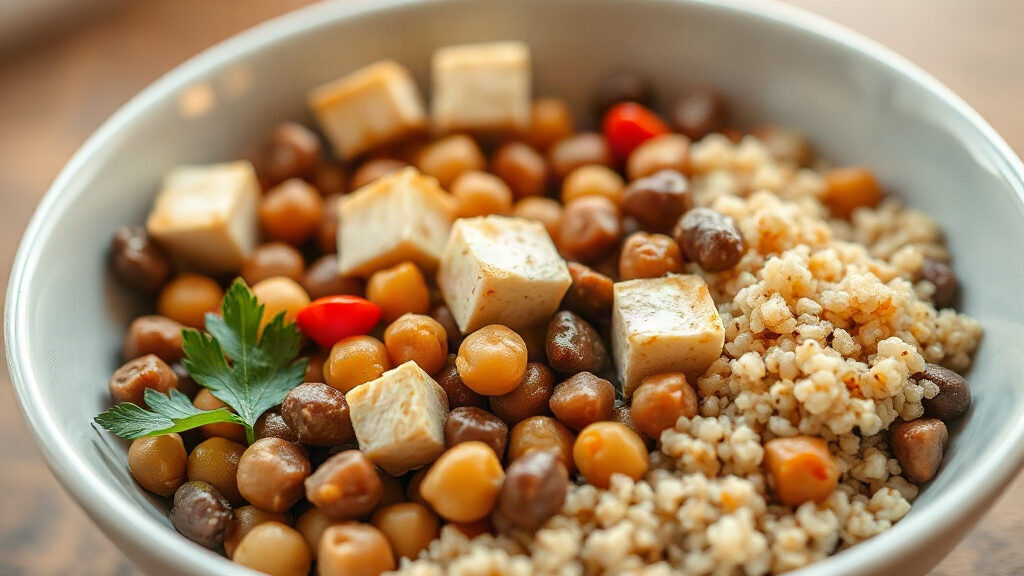
Tofu, tempeh, lentils and quinoa cover most of an active adult’s needs when varied throughout the day. Animal protein remains useful for covering vitamin B12, nearly absent from the plant kingdom, and heme iron, which is better absorbed than plant-derived iron.
Protocol: how to balance your plate
Combining both families day to day remains the best-documented strategy, rather than pitting one against the other.
- Spread protein intake across 3 meals rather than concentrating it in the evening, to better stimulate muscle protein synthesis throughout the day.
- Pair grains and legumes on the same day (rice and lentils, bread and hummus, couscous and chickpeas) to offset their respective limiting amino acids.
- Favor soy, tofu and tempeh as the plant sources closest to the animal profile on a vegetarian or vegan diet.
- Monitor vitamin B12 and iron on a very largely plant-based diet, two nutrients for which a blood test can guide possible supplementation.
- Limit red and processed meat rather than all animal protein, since the unfavorable cohort signal mostly concerns these two categories.
After age 65, adequate protein intake, whether plant or animal, matters more than its origin alone for limiting age-related muscle loss.
Frequently asked questions
Does plant protein cover all essential amino acids?
Yes. All these proteins supply the nine essential amino acids, but in different proportions than animal protein. Soy, quinoa and buckwheat have a complete profile on their own. Legumes and grains are each limiting in one amino acid, which pairing them over the course of a day corrects.
Why does animal protein stimulate muscle more?
Animal protein contains more leucine, the amino acid that triggers muscle synthesis, and digests faster thanks to a higher DIAAS score. Isolated sources like soy or wheat produce a weaker anabolic response at an equal dose, a gap that closes with a higher total intake or by combining several sources.
What is the difference between plant and animal protein for longevity?
Several cohorts totaling hundreds of thousands of participants link a higher share of plant protein to lower all-cause mortality, while animal protein, especially red and processed meat, shows no such advantage. This data is observational: it shows an association, not proof of direct causation.
Can a vegetarian meet their needs with plant protein alone?
Yes, provided sources are varied throughout the day: legumes, whole grains, tofu, tempeh and nuts and seeds. The NIH Office of Dietary Supplements benchmark of about 0.8 g of protein per kilogram of body weight per day for an adult (0.83 g in France) applies whatever the protein’s origin. A blood test for vitamin B12 and iron remains useful on a very largely plant-based diet.
Should animal protein be replaced entirely with plant protein?
No, no study justifies eliminating it altogether. Animal protein remains the most reliable source of vitamin B12 and heme iron. The best-documented strategy combines both families, reserving caution for red and processed meat rather than all animal protein.
Medical disclaimer. The information provided here is for informational purposes only and does not constitute medical advice. It does not replace a consultation. Ask a healthcare professional before changing your diet, taking dietary supplements or starting a new practice, especially if you have a medical condition, are pregnant or are under treatment. Dietary supplements do not replace a balanced diet or medical follow-up.