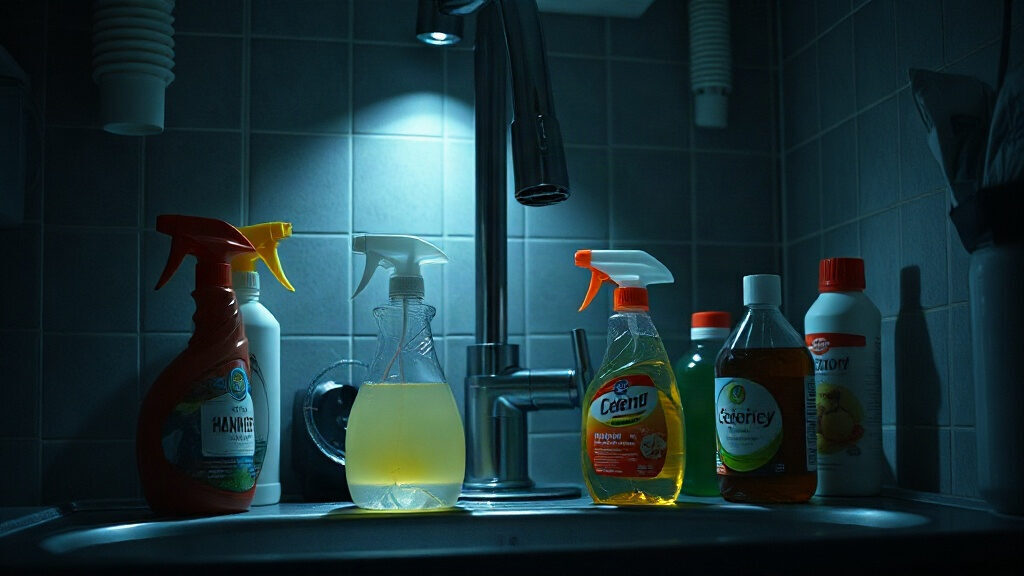
The household cleaning products under your kitchen sink often contain more than a simple scent of clean. Since the 2000s, several families of molecules used as surfactants, preservatives or disinfectants in these formulas have been studied for their capacity to interfere with the hormonal system. This article details five documented substances, their precise household sources, and the habits that meaningfully reduce exposure.
In brief – Household cleaning products are a direct, everyday source of endocrine disruptors: phthalates in synthetic fragrances, quaternary ammonium compounds in disinfectants, triclosan in antibacterial soaps, alkylphenols in laundry surfactants, and parabens in some cleaning liquids. These molecules mimic, block or disrupt the action of natural hormones, with documented effects on the thyroid and fertility in animals, and associations reported in humans. Exposure happens through inhaling fumes, skin contact and residue on surfaces. Airing out rooms during and after cleaning, limiting scented products and choosing formulas with shorter ingredient lists all meaningfully reduce exposure, without requiring any special equipment.
Definition: what are endocrine disruptors in household cleaning products
An endocrine disruptor is an external substance that alters one or more functions of the hormonal system and, as a result, causes a harmful effect on the health of an individual or their offspring, according to the definition used by the National Institute of Environmental Health Sciences. In cleaning formulas, these substances do not always appear on the label under their own name: they hide behind generic terms such as “fragrance,” “foaming agent” or “preservative.”
Five families come up most often in the cleaners, laundry detergents, disinfectants and fabric softeners sold in supermarkets: phthalates, quaternary ammonium compounds, triclosan, alkylphenols and parabens. Each acts through a distinct mechanism, but all converge on the same target: hormone receptors.
Mechanism: how these substances act on hormones
These molecules interfere with the endocrine system in three main ways: by mimicking a hormone, by blocking its receptor, or by altering how the liver synthesizes and clears it. A 2024 review published in Environment International lists cleaners and disinfectants among the major household sources of hormonally active compounds, alongside cosmetics (Salonen et al., 2024).
- Hormone mimicry: some molecules bind to estrogen receptors and trigger a response similar to the natural hormone, at low intensity but repeatedly.
- Receptor blocking: others occupy the receptor without activating it, preventing the real hormone from binding at the right moment.
- Disrupted hormone metabolism: several substances speed up the liver’s breakdown of thyroid hormones, lowering their circulating concentration.
What the science says: five substances under scrutiny
Phthalates, used to fix synthetic fragrances in cleaners and laundry detergents, are among the most studied hormonally active compounds in indoor air (Salonen et al., 2024, cited above). They are linked to reproductive disruptions in animal studies and to altered hormone markers in human cohorts exposed through skin contact and inhalation.
Quaternary ammonium compounds (ADBAC, DDAC), found in most multi-surface disinfectants and antibacterial wipes, reduce fertility in mice exposed by ambient air: fewer litters, longer time to pregnancy, and declining fecundity across several generations (Melin et al., 2014). Their use has risen sharply since 2020 with the wider adoption of surface disinfectants.
Triclosan, an antibacterial agent in soaps and some detergents, is structurally similar to thyroxine (T4) and disrupts the thyroid in animals by speeding up its breakdown in the liver. A systematic review of seventeen human studies found inconsistent but recurring associations between urinary triclosan exposure and changes in thyroid hormones (Homburg et al., 2022). An analysis of the US NHANES 2007-2008 cohort linked urinary concentrations of triclosan and parabens to variations in serum thyroid markers (Koeppe et al., 2013).
Alkylphenols, including nonylphenol from the breakdown of laundry surfactants, activate hormone receptors in vitro at concentrations comparable to those measured in the home environment (Ji et al., 2019). Nonylphenol has been banned in textiles and certain industrial uses in Europe since 2005, but persists in older or imported formulas.
Parabens, preservatives in some cleaning liquids and wipes, were the first substances on this list identified as estrogenic, as early as 1998, with a measurable uterine response in rodents about one hundred thousand times weaker than that of estradiol (Routledge et al., 1998). Their use has declined markedly in cosmetics since 2014, less so in cleaning products.
In practice: where these substances hide and how to spot them
The table below summarizes the household sources most affected by each substance, along with a simple alternative to reduce everyday exposure.
| Substance | Household cleaning products affected | Documented hormonal effect | Simple alternative |
|---|---|---|---|
| Phthalates | Scented cleaners, laundry detergents, fabric softeners | Reproductive disruption (animal studies), altered hormone markers (human studies) | Products without added synthetic fragrance |
| Quaternary ammonium compounds | Multi-surface disinfectants, antibacterial wipes | Reduced fertility in exposed mice | Soap and hot water for routine cleaning |
| Triclosan | “Antibacterial” soaps and detergents | Thyroid interference (animal), associations in humans | Plain soap, without antibacterial claims |
| Alkylphenols / nonylphenols | Laundry surfactants and degreasers | Activation of hormone receptors in vitro | Detergents certified with the European ecolabel |
| Parabens | Cleaning liquids, some wipes | Weak but measurable estrogenic activity | Check for a short ingredient list |
The consistency of these findings with other families of household pollutants supports broad vigilance rather than chasing a single substance in isolation: microplastics and pesticide residues share similar mechanisms of action on cell signaling. For the thyroid in particular, exposure to antibacterial cleaning products adds to other nutritional factors detailed in our article on iodine and the thyroid. The altered intercellular communication pillar gathers all these chemical exposures that interfere with hormonal signaling.
Protocol: reducing exposure without changing everything at once
A few simple adjustments lower the chemical load linked to household cleaning products without requiring a complete change in household habits.
- Air out the room while cleaning and for at least fifteen minutes afterward, especially when using scented cleaners or disinfectants.
- Reserve “antibacterial” products for situations that genuinely call for them (illness in the household, raw food) rather than routine use.
- Read the ingredient list when available and avoid the longest formulas, which tend to contain more preservatives and synthetic fragrances.
- Wear gloves when using concentrated disinfectants, to limit skin absorption.
- Favor mechanical cleaning (hot water, microfiber) for everyday upkeep, reserving chemical products for tasks that truly require them.
These habits reduce cumulative exposure without aiming for “zero products,” a goal that is rarely realistic and not necessarily warranted for every substance on this list.
Frequently asked questions
Are “eco-friendly” household cleaning products automatically free of endocrine disruptors?
Not automatically. An eco label generally governs biodegradability and certain aquatic toxicity thresholds, not necessarily the presence of synthetic fragrances or hormonally active preservatives. Checking the ingredient list remains more reliable than a logo alone, even on a certified product.
Is triclosan still allowed in household cleaning products in Europe?
Its use has been restricted in several product categories in Europe since the 2010s, but it remains present in some antibacterial soap and detergent formulas, particularly imported ones. The word “antibacterial” on a label is a reason to check the composition before buying.
Should you throw out all your current cleaning products as a precaution?
No, a one time or occasional exposure to these substances does not justify an urgent replacement of every product in the household. The real issue is cumulative, repeated exposure over time: gradually cutting back on the products of greatest concern has more impact than a single, one time clear out of the cabinet.
Are children more vulnerable to these substances from household cleaning products?
Children inhale proportionally more air per kilogram of body weight and spend more time in contact with cleaned floors, which increases their relative exposure to residues. Their hormonal system, still developing, is also considered a period of heightened vulnerability by health agencies, which calls for particular caution with scented cleaners and disinfectants in households with young children.
Medical disclaimer. The information provided here is for informational purposes only and does not constitute medical advice. It does not replace a consultation. Ask a healthcare professional before changing your diet, taking dietary supplements or starting a new practice, especially if you have a medical condition, are pregnant or are under treatment. Dietary supplements do not replace a balanced diet or medical follow-up.