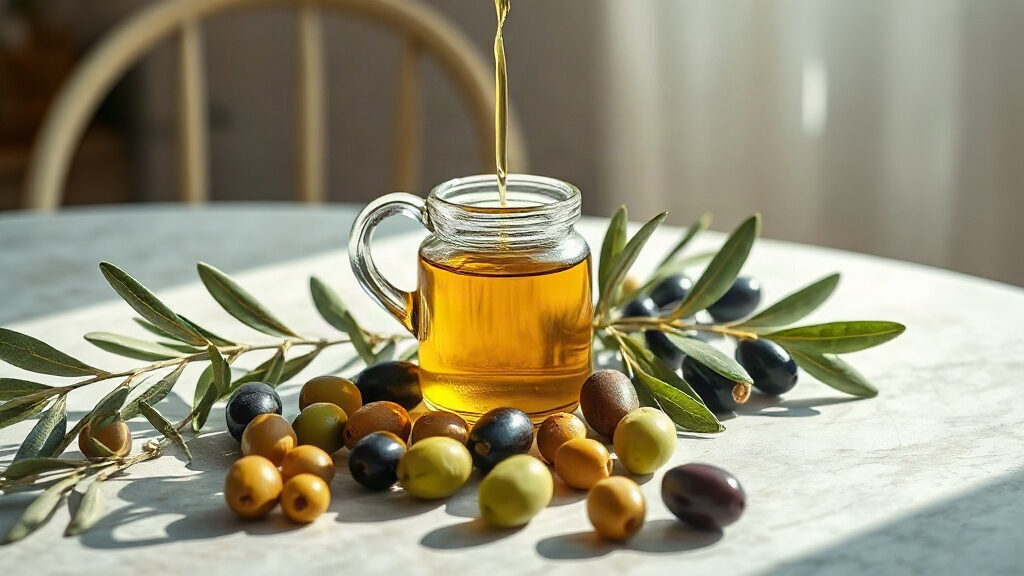
Olive oil is the only dietary fat whose effect on heart attacks and strokes has been tested in a large randomized trial, PREDIMED, among 7,447 Spanish adults at high cardiovascular risk. Since then, US cohorts followed for 28 years and controlled trials on polyphenols have clarified what this fat changes for the arteries, blood pressure, inflammation and the aging brain. Here are five measured effects, the studies that document them and the daily amount that emerges from this research.
In brief – Olive oil is a plant fat rich in oleic acid and in polyphenols (hydroxytyrosol, oleuropein, oleocanthal) that protects the arteries through two pathways: the lipid profile and inflammation. In the PREDIMED trial (7,447 participants, 4.8 years of follow-up), a Mediterranean diet enriched with extra virgin oil cut the combined risk of heart attack, stroke and cardiovascular death by 31% (Estruch et al., 2018). Among 92,383 Americans followed for 28 years, consuming more than 7 g a day, about half a tablespoon, is associated with 19% lower total mortality and 29% lower mortality from neurodegenerative disease (Guasch-Ferré et al., 2022). In controlled trials, the polyphenols lower oxidized LDL and blood pressure. Useful dose: 20 to 30 g a day, extra virgin, in place of butter or margarine, not as a supplement.
Definition: extra virgin, virgin or refined olive oil
The extra virgin grade is the juice of the fruit obtained by simple mechanical pressing, cold, without solvents or refining. Its free acidity stays below 0.8%, and it keeps the full range of the olive’s phenolic compounds. The label “virgin” (without “extra”) tolerates an acidity of up to 2% and slight sensory defects. The label “olive oil” on its own refers to a blend of refined oil and virgin oil: refining removes the taste, but also nearly all of the polyphenols.
Nutritionally, 100 g (3.5 oz) provides about 73 g of oleic acid (monounsaturated), 14 g of saturated fatty acids and 10 g of polyunsaturated fats, mostly linoleic acid. The polyphenol content of an extra virgin oil ranges from 50 to 800 mg per kg depending on the variety, the ripeness of the fruit and the delay before pressing. The European Food Safety Authority (EFSA) approved a precise claim in 2011: the oil’s polyphenols contribute to the protection of blood lipids from oxidative stress, provided the oil delivers at least 5 mg of hydroxytyrosol and its derivatives per 20 g. Not every bottle reaches that level.
Mechanism: how olive oil acts on the arteries
Two families of compounds act in complementary ways, and their effects have been measured separately.
- Oleic acid replaces saturated fatty acids in the diet when the oil stands in for butter. This swap lowers LDL cholesterol and makes lipoprotein membranes less prone to oxidation. The NHS advises replacing saturated fats with unsaturated ones, with a ceiling of 30 g of saturated fat a day for men and 20 g for women.
- Polyphenols (hydroxytyrosol, oleuropein) trap free radicals in contact with LDL particles and improve the production of nitric oxide by the endothelium, the inner lining of the vessels. The arteries dilate better and pressure falls.
- Oleocanthal, responsible for the peppery sting in the throat of a young oil, inhibits the COX-1 and COX-2 enzymes in the same way as ibuprofen. According to Beauchamp et al. (2005), 50 g of extra virgin oil contains up to 9 mg of oleocanthal, the equivalent of 10% of the adult analgesic dose of ibuprofen (PubMed).
This last point links the oil to chronic low-grade inflammation, or inflammaging, which Furman et al. (2019) identify as a common factor in the cardiovascular, neurodegenerative and metabolic diseases of aging (PubMed). The dietary levers of this inflammation are detailed in our guide to the 7 levers against inflammaging.
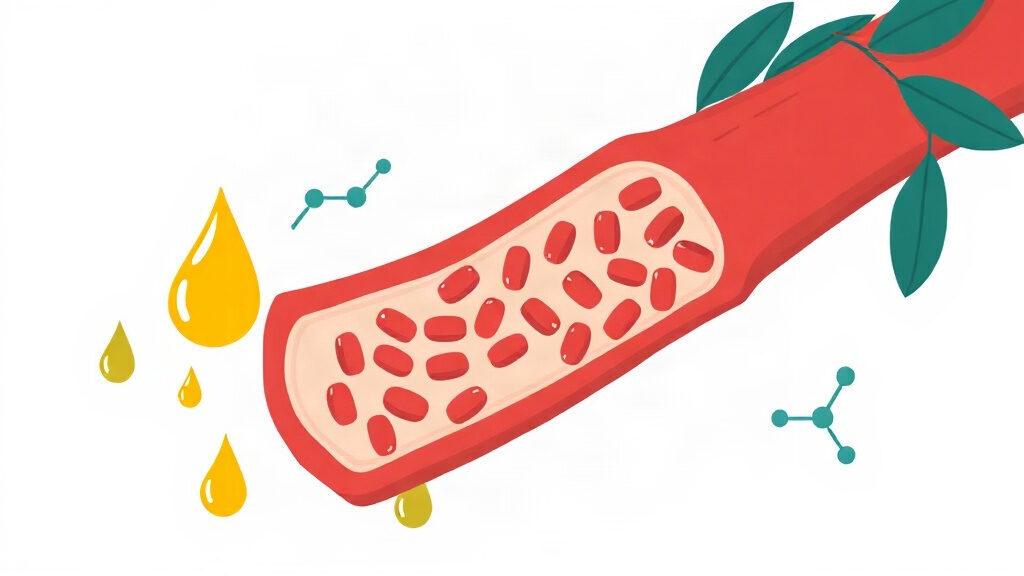
What the science says: 5 proven effects of olive oil
1. Fewer heart attacks and strokes in a randomized trial
The PREDIMED trial cut major cardiovascular events by 31% in 7,447 people at high risk, followed for 4.8 years, with a Mediterranean diet enriched with about 50 g a day of extra virgin oil (Estruch et al., 2018, PubMed). A secondary analysis of the same cohort quantifies the dose-response relationship: each additional 10 g a day is associated with a 10% lower cardiovascular risk and 7% lower mortality (Guasch-Ferré et al., 2014, PubMed).
2. Lower total mortality over 28 years of follow-up
In the Nurses’ Health Study and Health Professionals Follow-up Study cohorts (92,383 adults, 28 years), people consuming more than 7 g of olive oil a day have 19% lower total mortality than those who never consume it. The reduction reaches 19% for cardiovascular mortality, 17% for cancer and 18% for respiratory disease (Guasch-Ferré et al., 2022, PubMed). Replacing 10 g of butter, margarine or mayonnaise with the same amount of the oil is associated with 8 to 34% lower mortality depending on the fat replaced. A meta-analysis of 32 cohorts (841,211 participants) confirms the association: 11% lower all-cause mortality and 18% fewer cardiovascular events (Schwingshackl et al., 2014, PubMed). These data remain observational: they show a consistent association, not causation.
3. LDL protected from oxidation and higher HDL
The EUROLIVE crossover trial compared, in 200 healthy men, three oils with low, medium or high polyphenol content, 25 mL (about 0.8 fl oz) a day for three weeks each. HDL cholesterol rose and oxidized LDL fell in proportion to the polyphenol content, with an identical intake of oleic acid (Covas et al., 2006, PubMed). This trial is the basis of the claim approved by EFSA.
4. Blood pressure lowered by the polyphenols
In 24 young women with mild hypertension, two months of polyphenol-rich oil (30 mg a day) lowered systolic pressure by about 8 mmHg and diastolic pressure by about 7 mmHg compared with the same oil stripped of its polyphenols. Endothelial function improved in parallel (Moreno-Luna et al., 2012, PubMed). The sample is small, but the crossover design isolates the role of the polyphenols well.
5. A brain that ages better
In the PREDIMED cognitive substudy (447 volunteers aged 67 on average, 4.1 years of follow-up), the extra virgin oil group scored better on global cognition and frontal functions (attention, executive functions) than the control group, whose scores declined (Valls-Pedret et al., 2015, PubMed). In the same 92,383 Americans, consuming at least 7 g a day is associated with 28% lower dementia-related mortality, independently of overall diet quality (Tessier et al., 2024, PubMed).
| Effect | Study | Population | Measured result |
|---|---|---|---|
| Heart attack, stroke, cardiovascular death | Estruch 2018 (PREDIMED, randomized trial) | 7,447 high-risk adults, 4.8 years | Risk reduced by 31% |
| Total mortality | Guasch-Ferré 2022 (cohorts) | 92,383 adults, 28 years | Reduced by 19% above 7 g a day |
| Oxidized LDL and HDL | Covas 2006 (EUROLIVE, crossover trial) | 200 men, 25 mL a day | Oxidized LDL down, HDL up in line with polyphenols |
| Blood pressure | Moreno-Luna 2012 (crossover trial) | 24 women with mild hypertension | About 8 mmHg less systolic pressure |
| Cognition and dementia | Valls-Pedret 2015; Tessier 2024 | 447 seniors; 92,383 adults | Cognition preserved; dementia-related mortality reduced by 28% |
In practice: which oil to choose and for what use
For the documented effects, only extra virgin will do: it was this oil, not refined oil, that was used in PREDIMED, EUROLIVE and the blood pressure trial. Polyphenols can be recognized by taste: bitterness and a peppery sting in the throat signal a young oil rich in oleocanthal. A mild, round oil contains little. The words “cold extracted”, a recent harvest date and an opaque bottle are the three useful markers on the shelf.
This oil belongs to a wider dietary pattern, the Mediterranean diet, of which it is the main source of fat. Its effect on the lipid profile complements the levers described in our article on cholesterol and longevity. And its action on low-grade inflammation directly touches one of the twelve mechanisms of aging, altered intercellular communication.
| Fat | Oleic acid | Polyphenols | Omega-3 | Recommended use |
|---|---|---|---|---|
| Extra virgin olive oil | About 73% | 50 to 800 mg per kg | Low | Raw and gentle cooking, daily base |
| Refined olive oil | About 73% | Almost none | Low | Occasional frying |
| Canola (rapeseed) oil | About 60% | Low | High (9%) | Raw, as a complement for omega-3 |
| Butter | About 25% | None | Traces | Occasional, to be replaced for the heart |
| Coconut oil | About 6% | None | None | High in saturated fat, no proven cardiovascular benefit |
Protocol: how much olive oil a day and how to store it
The dose associated with the benefits sits between 20 and 30 g a day, two to three tablespoons, always in place of another fat. A benefit appears from 7 g in the US cohorts, and PREDIMED used about 50 g. Each tablespoon brings 90 kcal: added without removing anything, it leads to weight gain, which cancels out part of the benefit.
- Replace, do not add: butter on bread, margarine in cooking, mayonnaise and cream in sauces.
- Cook without worry over medium heat: the smoke point of an extra virgin oil sits between 190 and 210 °C (374 to 410 °F), above usual pan temperatures. Some of the polyphenols are lost, while the oleic acid remains stable.
- Store away from light and heat, bottle closed, and use within 12 to 18 months of harvest: the polyphenols decline over time.
- Alternate with an oil rich in omega-3 (canola, walnut) for raw use, as the WHO recommends in its healthy diet guidance, which favors unsaturated fats.
| Daily amount | Study | Observed effect |
|---|---|---|
| More than 7 g (half a tablespoon) | Guasch-Ferré 2022, cohorts | Total mortality reduced by 19% |
| Each 10 g increment | Guasch-Ferré 2014, PREDIMED | Cardiovascular risk reduced by 10% |
| 25 mL, polyphenol-rich | Covas 2006, crossover trial | Oxidized LDL down, HDL up |
| About 50 g (4 tablespoons) | Estruch 2018, PREDIMED | Cardiovascular events reduced by 31% |
Frequently asked questions about olive oil
Can olive oil be used for cooking?
Yes, for everyday cooking. The smoke point of an extra virgin oil sits between 190 and 210 °C (374 to 410 °F), above the temperature of a pan over medium heat. Oleic acid, a monounsaturated fat, withstands heat better than the omega-3 in canola or walnut oil. Some of the polyphenols break down during cooking, which is why it is worth keeping a raw use as well, as a dressing.
How much olive oil a day to protect the heart?
Two to three tablespoons, or 20 to 30 g, in place of butter or margarine. In the US cohorts, the benefit appears from 7 g a day (Guasch-Ferré et al., 2022). The PREDIMED trial used about 50 g. Beyond that, the calorie surplus takes over: 10 g brings 90 kcal, and the protective effect comes from substitution, not addition.
Olive oil or canola oil: which one to choose?
Both, for different reasons. The extra virgin grade provides the polyphenols and oleic acid studied in PREDIMED and EUROLIVE. Canola oil provides 9% alpha-linolenic acid, an omega-3 absent from olives. A common approach is to cook with olive and to dress with a blend of the two, which covers essential fatty acid needs.
Does olive oil lower cholesterol?
It lowers LDL when it replaces saturated fats, through a fatty acid exchange, and it makes that LDL less prone to oxidation thanks to the polyphenols. In the EUROLIVE trial (Covas et al., 2006), 25 mL a day of a polyphenol-rich oil raised HDL and reduced oxidized LDL. The effect is modest and does not replace a prescribed treatment for high cholesterol.
How to recognize a polyphenol-rich oil?
By taste first: bitterness and a peppery sting in the throat come from oleuropein and oleocanthal. A mild oil contains little. On the label, three markers count: the words extra virgin, a recent harvest date (under a year) and an opaque bottle. Some producers display the polyphenol content, useful if it exceeds 250 mg per kg, the threshold of the EFSA claim for 20 g.
Medical disclaimer. The information presented here is provided for informational purposes only and does not constitute medical advice. It does not replace a consultation. Ask a healthcare professional before changing your diet, taking dietary supplements or starting a new practice, especially if you have a medical condition, are pregnant or are under treatment. Dietary supplements do not replace a balanced diet or medical follow-up.