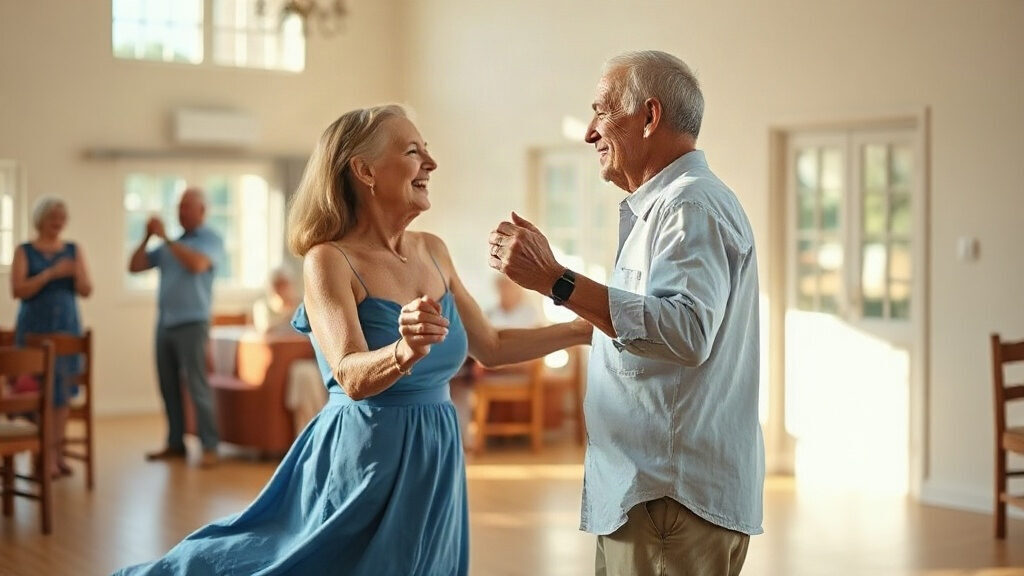
The benefits of dancing for people over 60 are measurable: it improves balance, leg strength and exercise capacity, and it helps maintain some memory functions. These effects come from randomized trials conducted in Europe, Australia and North America, most often with two one-hour classes a week for six months or longer. Two promises often attributed to dancing remain unproven: fewer falls and protection against dementia. The largest trial devoted to falls, involving 522 older Australians, showed no reduction.
In brief – Dance is a rhythmic physical activity that trains balance, step memory and the cardiovascular system at the same time. In people over 60, a meta-analysis of 29 randomized trials links it to better balance, steadier walking and stronger legs. In 11 trials with 1,412 participants, dancing improves global cognition by 1.58 points on the MMSE. MRI scans show a larger hippocampus after 18 months of practice. For the heart, 8 weeks of waltzing increased exercise capacity in people with heart failure as much as conventional aerobic training (+18% versus +16%). Two benefits of dancing remain unproven for dance alone: fewer falls and the prevention of dementia. The most studied schedule: two one-hour classes a week for at least six months.
Dance and health: what the studies actually cover
In aging research, dance means any activity in which learned steps are strung together to a rhythm, alone, with a partner or in a group. Trials have tested the waltz, the foxtrot, Argentine tango, folk dance, line dance, aerobic dance and choreographies designed for the study. The Zurich team behind the reference meta-analysis speaks of “dance-based mind-motor activities.” These are standing, coordinated movements centered on dynamic balance, guided by music and practiced with other people.
This definition also takes in tai chi, which changes how the figures on falls should be read. Yoga, built around static postures, is excluded, as are the light-up dance mats of video games, for lack of social interaction. What sets dance apart from walking or cycling is a set of simultaneous demands: remembering a sequence, following the music, handling unstable footing and keeping in step with a partner.
Mechanism: why dancing works the body and the brain at once
Dancing combines moderate cardiovascular effort with constant motor learning, two stimuli that the brain processes through different circuits. The researchers in Magdeburg, Germany, start from an observation made in animals. In them, exercise combined with an environment rich in novelty produces the most lasting effects on the plasticity of the adult brain. In humans, dance may be the closest equivalent of this double stimulus. A one-hour class engages several systems:
- Dynamic balance: weight shifts, half turns, backward steps and single-leg support train the inner ear, ankle sensitivity and the stabilizing muscles of the trunk.
- Dual tasking: moving forward while counting the beats and anticipating the next step reproduces the situations in which falls happen, when attention is divided.
- Working memory and spatial memory: remembering a sequence and finding your bearings in the room engage the hippocampus, the brain structure behind memory and orientation.
- Intermittent cardiovascular effort: alternating slow and fast passages raises the pulse, up to an average of 113 beats per minute during the waltz in people with heart failure.
- Growth factors: a choreography program was accompanied by a rise in plasma BDNF, a protein that supports the survival and connections of neurons.
- Enjoyment and social connection: the music and the group help people come back every week, which is the condition for every other effect.
What the science says: the 5 measured benefits of dancing
Five benefits of dancing rest on controlled trials in older adults: balance, mobility, cognition, brain structure and cardiovascular capacity. Their level of evidence varies, from the strongest (balance) to the most preliminary (brain imaging).
1. Steadier balance
Balance is the best-established effect. The meta-analysis by Mattle et al. (2020, JAMA Network Open) pools 29 randomized trials and 4,239 healthy older adults. Across 15 trials (1,476 participants), dance-based activities improve balance with an effect size of 0.62, rated as moderate. For dance proper, tai chi excluded, the effect reaches 0.86, a level considered large. Programs followed at least three times a week get the best results.
The team of Rehfeld et al. (2017) compared 18 months of dance with 18 months of conventional fitness training in 26 older adults with an average age of 68. Only the dance group improved its composite balance score, measured on a platform. An earlier German trial had already recorded better postural performance after 6 months, with one hour of class a week.
2. Stronger legs and safer walking
Dancing also improves mobility and lower-body strength. In the Mattle meta-analysis, the Timed Up and Go test (standing up from a chair and walking) improves across 13 trials and 1,379 participants, with an effect size of 0.56. Leg strength improves across 13 other trials (1,613 participants, 0.57), while the arms gain nothing significant. The meta-analysis by Liu et al. (2021) finds, across 13 trials and 1,029 older adults, better mobility and better endurance, with no change in gait.
Against other structured programs, dance holds its own. Fong Yan et al. (2018, Sports Medicine) analyzed 28 studies and 1,276 participants. Choreographed classes did better on body composition, blood markers and musculoskeletal function, and performed equally well on cardiovascular function.
3. Slightly sharper memory and global cognition
The cognitive gain from dancing is real but modest. The meta-analysis by Hewston et al. (2021, Age and Ageing) covers 11 trials and 1,412 participants aged 55 and over. It measures a gain of 1.58 points on the MMSE, the screening test scored out of 30, with a moderate level of certainty. The gain in learning and memory (+3.02 points on the Wechsler scale) rests on low-certainty evidence.
Chan et al. (2020) pool 5 trials involving 358 people with mild cognitive impairment. Dancing improves immediate recall (effect size 0.54), delayed recall (0.33) and global cognition (0.48). The Greek trial by Lazarou et al. (2017) followed 129 older adults with mild memory impairment. After 10 months of ballroom dancing, the dance group outperformed the control group on most neuropsychological tests.
Dancing does not beat walking, however. The Australian Dancing Mind trial by Merom et al. (2016, Frontiers in Aging Neuroscience) compared 8 months of ballroom dancing with a walking program in 115 active older adults. The main analysis shows no difference, with only a nonsignificant signal on visuospatial memory (effect size 0.34).
4. A brain that keeps its volume
Imaging studies suggest that dancing changes the structure of the brain, but in small samples. In the Rehfeld trial (2017), the hippocampus grew in both groups after 18 months. Only the dancers gained volume in the left dentate gyrus and the right subiculum, two subregions involved in encoding memories.
The second trial by Rehfeld et al. (2018, PLoS One) compared, in 38 volunteers aged 63 to 80, six months of constantly changing choreographies with fitness training of equivalent intensity. Physical fitness improved just as much in both groups. Dancing nevertheless increased the volume of a larger number of regions (cingulate cortex, insula, corpus callosum, sensorimotor cortex), and only dancing raised plasma BDNF. Cognitive scores did not differ between the groups after six months.
The American team of Burzynska et al. (2017) followed 174 inactive adults aged 60 to 79 for 6 months. White matter integrity declined in most brain regions, whatever the program, except in the fornix of the dance group, where it improved. The fornix connects the hippocampus to the rest of the memory circuit. The growth factor measured in Magdeburg is covered in our feature on BDNF and how to increase it naturally.
5. A fitter heart and lower blood pressure
At moderate intensity, dancing trains the heart like conventional aerobic exercise. In the Italian trial by Belardinelli et al. (2008, Circulation: Heart Failure), 130 patients with stable heart failure were split into three groups. The first did supervised aerobic training, the second did 21-minute waltz sessions alternating slow and fast passages, and the third had no program. After 8 weeks, peak oxygen consumption (VO2 max) rose by 18% with the waltz and by 16% with conventional training. Endothelium-dependent dilation of the arteries went from about 2% to 5% in both active groups.
In people with high blood pressure, the meta-analysis by Conceição et al. (2016) pools 4 studies. Systolic pressure falls by 12 mmHg and diastolic pressure by 3.4 mmHg compared with control groups. Heterogeneity between studies is high (92% for systolic pressure): this figure gives an order of magnitude rather than a promise.
Over the long term, a cohort of 48,390 British adults aged 40 and over was analyzed by Merom et al. (2016, American Journal of Preventive Medicine). Moderate-intensity dancing was associated with a 46% lower risk of cardiovascular death (hazard ratio 0.54). Moderate walking did slightly less well (0.67), and light-intensity dancing was associated with no reduction. This is an association: regular dancers may differ from other people in factors that were not measured.
What is not yet proven: falls and dementia
Falls carry a heavy toll in older age, as the NHS points out. In France, more than 20,000 people aged 65 and over died in connection with a fall in 2024, and about 175,000 were hospitalized, according to French national public health data. The World Health Organization ranks falls as the second leading cause of unintentional injury death worldwide, with 842,000 deaths in 2023.
The figure of 37% fewer falls, often linked to dancing, calls for a careful reading. It comes from the Mattle meta-analysis (8 trials, 1,579 participants), in which 6 trials were about tai chi. The other two tested Turkish folk dance and Jaques-Dalcroze eurhythmics, a set of walking and coordination exercises performed to piano music. That last trial, conducted in Geneva by Trombetti et al. (2011) in 134 people at risk, reduced the number of falls by 54% over 6 months.
The largest trial of dance alone (folk and ballroom) showed no reduction. In Merom et al. (2016, PLoS Medicine), 522 residents of Australian retirement villages, with an average age of 78, attended two dance classes a week for a year. Their fall rate (1.03 per person per year) did not differ significantly from that of the controls (0.80), and average attendance topped out at 51%. The Cochrane review by Sherrington et al. (2019) rates the effect of dance on falls as uncertain. Balance and functional exercises, on the other hand, reduce the rate of falls by 24%, with high certainty.
For dementia, the most cited data come from a New York cohort. Verghese et al. (2003, New England Journal of Medicine) followed 469 people over 75 for a median of 5.1 years. Dancing was one of four leisure activities associated with a lower risk of dementia, along with reading, board games and playing a musical instrument. Reviews that cite this work report a 76% lower risk in frequent dancers, but this is an observation, not a trial. No randomized trial has yet shown a drop in the number of dementia diagnoses.
| Effect | Key figure | Source | Level of evidence |
|---|---|---|---|
| Balance | Effect size 0.62 (0.86 excluding tai chi), 15 trials | Mattle 2020 | Strong |
| Mobility and leg strength | 0.56 and 0.57, 13 trials each | Mattle 2020 | Strong |
| Global cognition | +1.58 points on the MMSE, 1,412 participants | Hewston 2021 | Moderate |
| Memory (mild cognitive impairment) | Immediate recall 0.54, 358 patients | Chan 2020 | Moderate to low |
| Brain structure | Hippocampus, fornix, plasma BDNF | Rehfeld 2017 and 2018, Burzynska 2017 | Preliminary (26 to 174 participants) |
| Exercise capacity | VO2 max +18% in 8 weeks | Belardinelli 2008 | Moderate |
| Blood pressure | Systolic -12 mmHg, 4 studies | Conceição 2016 | Low (high heterogeneity) |
| Cardiovascular mortality | Hazard ratio 0.54, 48,390 adults | Merom 2016 | Association |
| Falls (folk and ballroom only) | No reduction in 522 residents | Merom 2016 | Not proven |
| Dementia | Association in a cohort of 469 people | Verghese 2003 | Not proven |
In practice: which dance to choose for your goal
The most useful style is the one you will keep up twice a week for months, but the studies can guide the choice. For balance, favor styles built on weight shifts and half turns: ballroom, tango, line dance. For memory, choose a class that often renews its choreographies. For the heart, look for passages fast enough to leave you slightly out of breath.
| Style | What it mainly trains | Available data | Best suited to |
|---|---|---|---|
| Waltz and ballroom | Weight shifts, moderate endurance | VO2 max +18% in 130 patients with heart failure (Belardinelli 2008) | Beginners, couples, supervised cardiac rehabilitation |
| Argentine tango | Walking backward, pauses, postural control | Balance and 6-minute walk improved in 58 people with Parkinson’s disease after 20 lessons (Hackney and Earhart 2009) | Fragile balance, Parkinson’s disease with supervision |
| Folk and line dance | Sequences to memorize, spatial orientation | Folk: more falls than in controls (ratio 1.68) in an exploratory analysis (Merom 2016) | People with no history of falls |
| Aerobics, choreographed fitness | Endurance, higher intensity | Included in the trials on mild cognitive impairment (Chan 2020) | People in good physical shape |
| Constantly changing choreographies | Ongoing motor learning | Increased brain volume and BDNF (Rehfeld 2018) | Memory goal |
| Jaques-Dalcroze eurhythmics | Dual tasking, walking | Falls -54% in 6 months in 134 people at risk (Trombetti 2011) | Risk of falling |
Head-to-head comparisons with other activities show where dancing adds something. It comes out ahead for balance and some brain markers, on a par for the heart, and no better than walking for executive functions.
| Comparison | Study | Result |
|---|---|---|
| Dance versus conventional fitness, 18 months | Rehfeld 2017, 26 older adults | Larger hippocampus in both groups, balance improved only in the dance group |
| Choreographies versus fitness of the same intensity, 6 months | Rehfeld 2018, 38 older adults | Same fitness gain, increased brain volume and BDNF only with choreographies |
| Ballroom versus walking, 8 months | Merom 2016, 115 older adults | No overall difference, nonsignificant signal on visuospatial memory |
| Waltz versus aerobic training, 8 weeks | Belardinelli 2008, 130 patients | VO2 max +18% versus +16%, nonsignificant difference |
| Moderate dancing versus moderate walking | Merom 2016, 48,390 adults | Cardiovascular hazard ratio 0.54 versus 0.67 (association) |
| Dance classes versus various structured exercise programs | Fong Yan 2018, 28 studies | Advantage for dance classes on body composition, equivalent cardiovascular function |
| Balance exercises versus no program | Sherrington 2019, 108 trials, 23,407 people | Falls -24% (high certainty), effect of dance classes uncertain |
On the psychological side, the meta-analysis by Fong Yan et al. (2024) covers 27 studies. It finds dance classes as effective as other physical activities on anxiety and depressive symptoms, with preliminary data that look more favorable for motivation and some aspects of memory. Music plays its own part: our article on music, the brain and memory details the mechanisms. To fit dancing into a complete routine, our guide to physical activity for longevity explains how to combine endurance, strength and balance. These levers belong to the mitochondrial dysfunction pillar, which brings together our content on endurance and cellular energy.
Protocol: how to practice for the full benefits of dancing
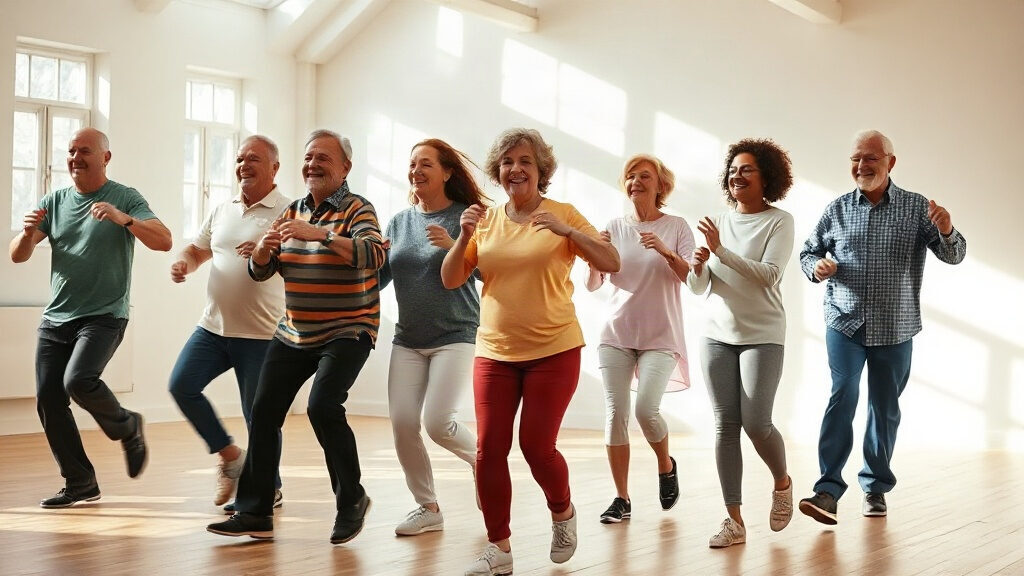
The programs that produced measurable effects share four features: two to three sessions a week, six months or more, moderate intensity and new steps to learn. In the Hewston meta-analysis, classes lasted 35 to 60 minutes, one to three times a week, for 3 to 12 months. Worldwide, 31% of adults do not reach the 150 minutes of moderate activity a week recommended by the World Health Organization. Two classes a week already cover 120 of those minutes.
- Aim for two one-hour classes a week, the schedule used in the Magdeburg and Sydney trials. Add a third session if you can: programs with three weekly sessions achieve the best effects on balance.
- Stick with it for at least six months: brain changes were measured after 6 to 18 months of practice, and mobility gains after 12 to 24 weeks.
- Look for novelty: a class that regularly adds new figures challenges memory more than a routine repeated the same way every time.
- Stay at moderate intensity: you should be able to talk but not sing. In the British cohort, only moderate dancing was associated with fewer cardiovascular deaths.
- Add strength work: the WHO guidelines published by Bull et al. (2020) call for people aged 65 and over to do varied balance and strength activities at least three days a week.
- Take care of safety: shoes with thin, grippy soles, a non-slip floor, a warm-up of 5 to 10 minutes and water within reach.
Three situations call for particular caution. If you have heart disease, have your cardiologist approve the activity: the patients in the waltz trial were stable and supervised. After several falls, a balance program supervised by a physical therapist should come before fast styles, since folk dance was associated with more falls in this group. With knee or hip osteoarthritis, choose styles without jumps or sudden pivots.
To receive the studies that matter on movement and healthy aging every month, subscribe to our health newsletter.
Frequently asked questions about the benefits of dancing
Which dance is most effective for balance in older adults?
Styles that require weight shifts, half turns and backward steps challenge balance the most: Argentine tango, waltz, line dance. In a meta-analysis of 29 trials published in 2020, dance-based activities excluding tai chi improved balance with an effect size of 0.86, considered large. The style matters less than regularity: two to three classes a week for several months.
Does dancing protect against Alzheimer’s disease?
No trial has shown this. A New York cohort of 469 people over 75 associated dancing with a lower risk of dementia, but an association does not prove causation. Randomized trials show a modest gain in global cognition, 1.58 points on the MMSE on average, and better memory in people with mild cognitive impairment.
How many sessions a week does it take to see the benefits of dancing?
Most positive trials use two one-hour classes a week for at least six months. Programs with three or more weekly sessions give the best results for balance. For the heart, the WHO recommends 150 to 300 minutes of moderate activity a week: two classes cover 120 of them, to be topped up with walking or cycling.
Is dancing as good for the heart as walking?
The data point that way, at moderate intensity. In a cohort of 48,390 British adults, moderate dancing was associated with a 46% lower risk of cardiovascular death, versus 33% for moderate walking. In 130 patients with heart failure, 8 weeks of waltzing improved exercise capacity by 18%, as much as conventional aerobic training. Light-intensity dancing was associated with no benefit.
Can you dance with high blood pressure or heart failure?
Yes, in most cases, after medical advice. A meta-analysis of 4 studies in people with high blood pressure found a 12 mmHg drop in systolic pressure compared with control groups, a figure to read as an order of magnitude. In stable heart failure, the waltz was practiced with few incidents in a supervised trial of 130 patients. The cardiologist sets the intensity and the heart rate not to exceed.
Do you need dance experience to get the benefits of dancing?
No. In a six-month German trial with one hour of class a week, the participants who were weakest at the start improved the most, in posture as well as in cognition. The authors of the Australian Dancing Mind trial also believe that inactive beginners have the most to gain. A beginners’ class, taken at your own pace, is enough to get started.
Medical disclaimer. The information on this page is provided for informational purposes only and does not constitute medical advice. It does not replace a consultation. If you have heart disease, uncontrolled high blood pressure, repeated falls, dizziness or joint pain, ask your doctor for advice before starting a physical activity such as dancing. Stop immediately if you feel chest pain, unusual shortness of breath or faintness. Ask a healthcare professional before changing your diet, taking dietary supplements or starting a new practice, especially if you have a medical condition, are pregnant or are under treatment. Dietary supplements do not replace a balanced diet or medical follow-up.