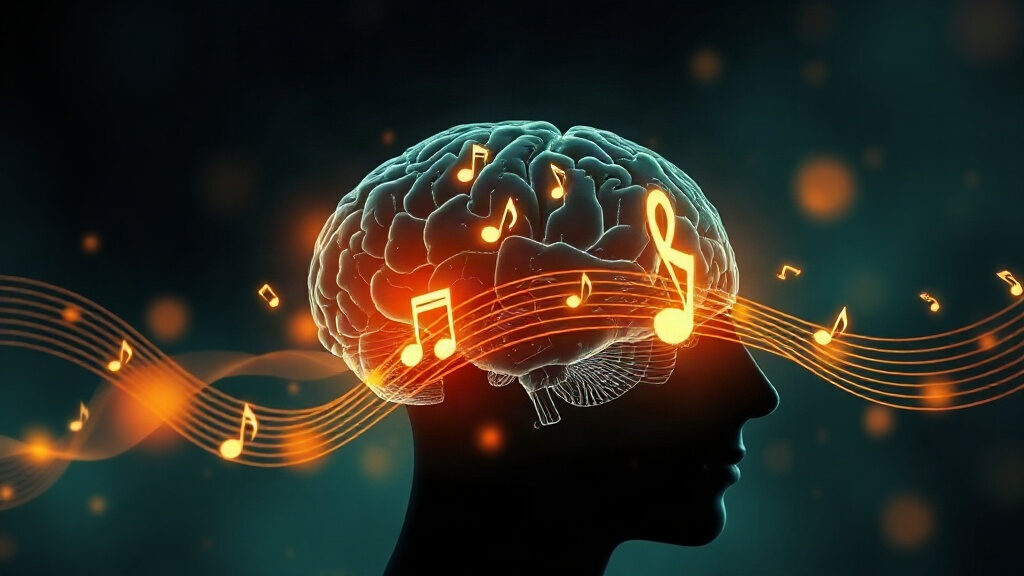
Music and the brain share a measurable link visible on brain imaging: each listening session activates the auditory areas, memory and reward circuits within seconds. Five effects are now documented by controlled trials and scientific reviews, from stroke recovery to the comfort it brings to people living with Alzheimer’s disease.
In brief – Music is a structured auditory stimulus that activates the brain’s attention, memory and emotion networks at the same time. Daily listening improves verbal memory recovery after a stroke. It also triggers a measurable release of dopamine on brain scans, lowers cortisol during everyday stress and brings out autobiographical memories in people with Alzheimer’s disease, even at a stage where spontaneous language is already impaired. A Cochrane review also finds a favorable effect on emotional well-being in dementia. These effects stay within what the trials actually measure: help with recovery and psychological comfort, not a treatment for the neurological diseases themselves.
Definition: What Happens in the Brain When You Listen to Music?
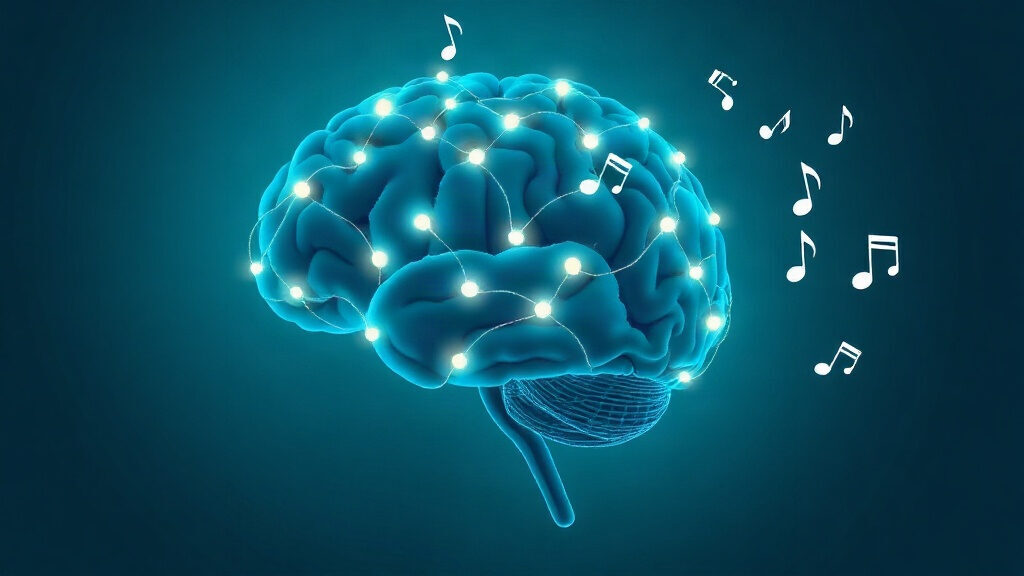
It engages the auditory cortex, the hippocampus and the reward circuits at the same time, unlike most sensory stimuli, which stay confined to a single specialized area. This distributed activation explains why it remains accessible even as language or episodic memory declines with age or disease. Neuropsychologists speak of a dedicated network rather than a single area, because no isolated brain lesion ever fully erases this perception or memory.
Mechanism: How Music Engages the Brain
The right auditory cortex processes spectral information, frequencies and timbre first, while the left side focuses on the temporal processing of speech. A team led by Benjamin Morillon confirmed this hemispheric specialization with functional MRI in 49 participants, separately degrading the temporal and spectral components of sounds that blended speech and melody (Albouy et al., 2020).
This network is not limited to hearing. It also recruits:
- The hippocampus, involved in encoding and recalling memories tied to a song.
- The striatum and nucleus accumbens, activated during listening pleasure and anticipation of an expected passage.
- The prefrontal cortex, engaged for sustained attention and executive control while listening.
- The amygdala, which attaches an emotional tone to the memory of a song.
What the Science Shows: 5 Proven Effects
Five effects of music on the brain and memory rest on published, reproduced data, summarized in the table below.
| Effect observed | Reference study | Key result |
|---|---|---|
| Post-stroke cognitive recovery | Sarkamo et al., 2008, Brain | Verbal memory and focused attention significantly better in patients listening to songs they chose every day for two months |
| Dopamine release | Salimpoor et al., 2011, Nature Neuroscience | Striatal dopamine measured by PET at the emotional peak of a song |
| Reduced everyday stress | Linnemann et al., 2015, Psychoneuroendocrinology | Lower salivary cortisol in students who listened for relaxation |
| Recall of autobiographical memories | El Haj, Fasotti & Allain, 2012, Consciousness and Cognition | Personal memories involuntarily triggered in Alzheimer’s patients on hearing a familiar song |
| Emotional well-being in dementia | van der Steen et al., 2018, Cochrane review | Likely improvement in mood and reduced anxiety with regular listening interventions |
The details of each trial clarify the real scope of the results. Among 60 patients who had suffered a middle cerebral artery stroke, the group listening to their favorite music improved more in verbal memory and attention. The group listening to audiobooks showed no such progress (Sarkamo et al., 2008). In healthy volunteers, the intensity of pleasure felt at the peak of a song coincides with dopamine release in the striatum, visible on positron emission tomography (Salimpoor et al., 2011).
In everyday life, 55 participants followed through a week of classes and a week of exams saw their salivary cortisol drop after listening to music with the intention of relaxing. This effect disappeared when the music was used to pass time or stay awake (Linnemann et al., 2015). In patients with mild to moderate Alzheimer’s disease, a familiar song brings out personal memories involuntarily. Voluntary recall, by contrast, remains very difficult for this same population (El Haj, Fasotti and Allain, 2012). Finally, a Cochrane review covering several randomized trials concludes there is a probable improvement in emotional well-being and quality of life among people with dementia regularly exposed to music interventions. The level of evidence is still rated low to moderate under GRADE criteria (van der Steen et al., 2018).
In Practice: When and How to Use Music for the Brain
The choice of song matters as much as the listening itself. Self-selected music that feels familiar and enjoyable produces stronger effects than an imposed background track, both in post-stroke recovery and in autobiographical recall among Alzheimer’s patients. Our article on Alzheimer’s prevention details the other cognitive longevity levers to combine with this listening habit. The National Institute on Aging also lists such non-drug activities among the everyday approaches that can support people living with dementia.
| Goal | Type of music | Recommended time |
|---|---|---|
| Reduce stress | Slow tempo, no prominent lyrics | End of day or before a demanding task |
| Support stroke recovery | Familiar songs chosen by the patient | Daily listening, starting in the acute phase |
| Stimulate autobiographical memory | Songs from adolescence or early adulthood | In a guided session or with a loved one |
| Support attention while studying | Instrumental, no lyrics | During a short cognitive task |
The brain mechanism described above also applies to hearing itself: people with reduced hearing perceive a poorer version of the audio signal, which lines up with the findings detailed in our article on hearing loss and the brain. For memory more broadly, our guide to bacopa monnieri and memory offers another complementary angle, this time a nutritional one.
Protocol: Bringing Music Into Daily Life
No standardized protocol exists to precisely replicate a clinical trial’s conditions at home. A few reasonable guidelines nonetheless emerge from the studies cited above:
- Choose the songs yourself rather than accepting an imposed selection, the factor that stands out in nearly all the positive trials.
- Set aside a short daily listening session, fifteen to thirty minutes, rather than continuous background exposure all day.
- Avoid music during tasks that require memorizing new text, where it can instead distract attention.
- Pair listening with a social moment, with a loved one or in a group, to reinforce the mood effect observed in the Cochrane review.
For a loved one with cognitive impairment, favoring songs tied to adolescence or early adulthood increases the likelihood of triggering a memory, since this is the period when musical attachment forms most durably according to the available clinical data.
Frequently Asked Questions
Can music replace medical treatment for memory?
No. Studies show a supportive effect on cognitive recovery, stress or emotional well-being, never a curative treatment for neurological diseases. It complements medical care, it does not replace it.
What type of music stimulates memory the most?
Familiar songs chosen by the person themselves produce the clearest effects, whether in post-stroke recovery or in bringing out autobiographical memories in Alzheimer’s patients. The genre matters less than the personal connection to the song.
Does listening to music while working help concentration?
It depends on the task. Familiar instrumental tracks can support attention during repetitive activities, but they can distract during the learning of new information or reading, where silence often remains preferable.
Does music therapy work for all patients with dementia?
A Cochrane review covering several randomized trials concludes there is a probable effect on emotional well-being and anxiety, with a level of evidence rated low to moderate. Individual responses vary according to disease stage and each person’s own history of listening.
At what age does music start affecting brain development?
The documented effects span the whole lifespan, from childhood to old age. Short-term training already improves executive functions in young children, while listening remains beneficial late in life, even at an advanced stage of cognitive impairment.
Medical disclaimer. The information provided here is for informational purposes only and does not constitute medical advice. It does not replace a consultation. Ask a healthcare professional before changing your diet, taking dietary supplements or starting a new practice, especially if you have a medical condition, are pregnant or are under treatment. Dietary supplements do not replace a balanced diet or medical follow-up.