Sulforaphane is the broccoli molecule most studied by prevention researchers: more than 3,000 publications and about fifty clinical trials since its discovery in 1992 at Johns Hopkins University. It is credited with effects on detoxification, blood sugar, the prostate and autism. Human trials give more nuanced results, often modest and sometimes null. Here is what has been shown, the doses actually tested, how to get the most from your plate and the precautions to know before taking a supplement.
In brief – Sulforaphane is a sulfur compound from cruciferous vegetables, formed when broccoli is cut or chewed, that activates Nrf2, the cellular switch for antioxidant defenses and detoxification enzymes. Its precursor, glucoraphanin, is 10 to 100 times more concentrated in 3-day-old broccoli sprouts than in the mature plant. In humans, the best-established effect concerns the elimination of pollutants: benzene excretion rose 61% in a Chinese trial of 291 people (2014). Results on blood sugar, the prostate and autism remain preliminary or contradictory. Cooking destroys the enzyme that releases it: raw broccoli provides about 10 times more than well-cooked broccoli. No official dose exists, and a supplement replaces neither a vegetable-rich diet nor medical treatment.
Sulforaphane: definition and origin
It belongs to the isothiocyanate family, sulfur molecules responsible for the sharp taste of cabbage, mustard and radish. Paul Talalay and Yuesheng Zhang isolated it from broccoli in 1992 while looking for the compound in this vegetable that switched on enzymes protecting against carcinogens. Among the derivatives tested on mouse hepatoma cells, it was the most potent inducer of quinone reductase and glutathione S-transferases (Zhang et al., 1992).
The plant contains almost no ready-made sulforaphane. It stores an inactive, stable precursor, glucoraphanin, which is a glucosinolate. The active molecule only appears when plant cells are damaged: by cutting, chewing or blending. This system serves as the plant’s chemical defense against insects.
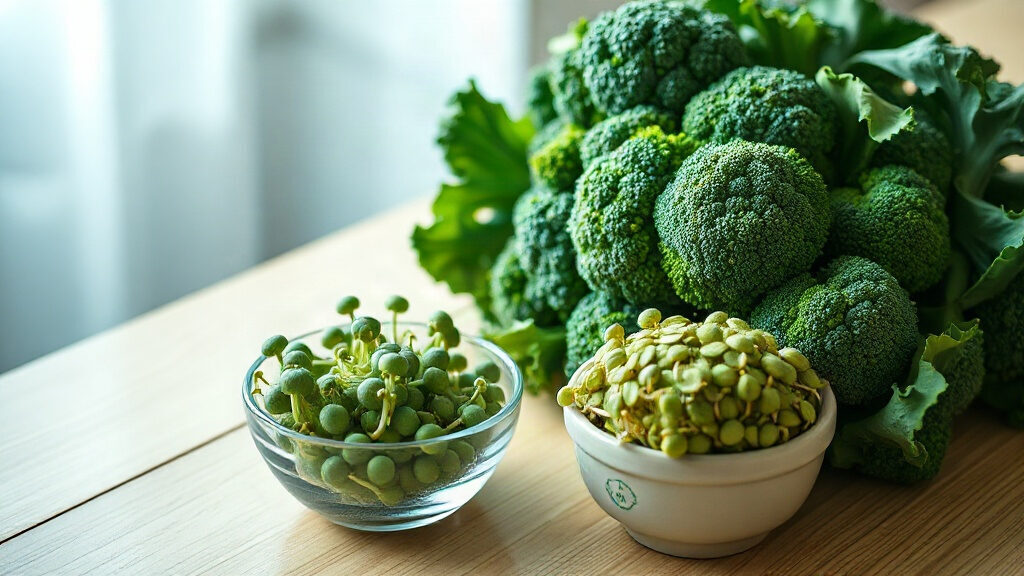
The best dietary sources of glucoraphanin are broccoli sprouts and seeds. In 1997, the Johns Hopkins team measured that 3-day-old sprouts contain 10 to 100 times more than the mature plant of the same variety (Fahey et al., 1997). Cauliflower, Brussels sprouts, kale and red cabbage also provide it, in smaller amounts.
How sulforaphane works in the body
It acts mainly as a signal rather than as a direct antioxidant: it switches on a defense pathway the cell already has. Its chain of action follows four steps:
- Myrosinase, a broccoli enzyme stored separately, comes into contact with glucoraphanin when the vegetable is cut or chewed, and converts it into the active molecule.
- If this enzyme has been destroyed by cooking, some gut bacteria take over, with a yield that varies widely from one person to another.
- Once absorbed in the small intestine, the compound modifies the Keap1 protein, which usually keeps the Nrf2 factor outside the cell nucleus.
- Released, Nrf2 enters the nucleus and activates many protective genes: phase 2 detoxification enzymes, glutathione synthesis and antioxidant enzymes.
This Keap1-Nrf2 pathway explains why prevention researchers are interested: it helps the cell neutralize toxic substances and free radicals (Kensler et al., 2013). It links this broccoli compound to glutathione, the main antioxidant made by our cells, and to the fight against oxidative stress. Nrf2 activation is a mechanism measured in the laboratory. On its own, it does not guarantee a clinical benefit in humans.
The conversion yield determines the dose actually received. In two populations (rural Chinese residents and people living in Baltimore), the share of glucoraphanin converted by gut flora ranged from about 1% to more than 40% depending on the individual. With ready-formed sulforaphane, it reached 70 to 90% in almost everyone (Fahey et al., 2012).
Sulforaphane: what the science says in humans
The best-demonstrated benefit of sulforaphane in humans concerns the elimination of certain air pollutants. In Qidong, China, 291 adults exposed to heavy pollution drank a broccoli sprout beverage (600 µmol of glucoraphanin and 40 µmol of the active form per day) or a placebo for 12 weeks. Urinary excretion of benzene derivatives rose by 61% and that of acrolein by 23%, from the first days and with no loss of effect over the weeks (Egner et al., 2014). These figures measure increased elimination, not a proven reduction in cancers or respiratory diseases.
On blood sugar, the results are encouraging but limited. A Swedish team identified the compound by computer screening of 3,800 molecules: it curbs glucose production by the liver. In obese patients with poorly controlled type 2 diabetes, a concentrated broccoli sprout extract lowered fasting blood glucose and HbA1c (Axelsson et al., 2017). The follow-up trial, in 74 people with prediabetes over 12 weeks, missed its primary goal: -0.2 mmol/L (about 3.6 mg/dL) in fasting glucose instead of the targeted -0.3 (about 5.4 mg/dL). Responders had gut flora richer in bacteria able to convert glucoraphanin (Dwibedi et al., 2025).
On the prostate, a French multicenter trial followed 78 men (average age 69) whose PSA was rising again after prostate removal. With 60 mg per day of a stabilized form for 6 months, the primary endpoint was not met. PSA doubling time was nevertheless longer on the active treatment: 28.9 months versus 15.5 on placebo (Cipolla et al., 2015). In the United Kingdom, in 49 men under active surveillance, a weekly soup of glucoraphanin-enriched broccoli dampened the activation of inflammation-related genes in prostate tissue over 12 months. The study was not designed to measure cancer progression (Traka et al., 2019).
Autism shows why caution is needed. In 44 young men aged 13 to 27, 18 weeks of the compound (50 to 150 µmol per day) improved the ABC behavior score by 34%, versus less than 3.3% on placebo. Scores drifted back toward baseline once treatment stopped (Singh et al., 2014). In children, two later trials did not reproduce the effect on the primary endpoint: 57 children aged 3 to 12 in the United States (Zimmerman et al., 2021) and 40 children aged 3 to 7 in Prague (Magner et al., 2023).
| Area | Trial | Participants | Main result |
|---|---|---|---|
| Air pollution | Egner, 2014 | 291 adults, 12 weeks | Benzene excreted +61%, acrolein +23% |
| Prediabetes | Dwibedi, 2025 | 74 adults, 12 weeks | -0.2 mmol/L, goal not met |
| Prostate cancer (PSA recurrence) | Cipolla, 2015 | 78 men, 6 months | Primary endpoint not met, slower PSA doubling |
| Autism, young adults | Singh, 2014 | 44 men, 18 weeks | ABC score -34%, effect lost after stopping |
| Autism, children | Zimmerman, 2021; Magner, 2023 | 57 and 40 children | No significant effect on the primary endpoint |
| Schizophrenia | Kassar meta-analysis, 2025 | 4 trials, 369 patients | Total PANSS score unchanged |
In psychiatry, a 2025 meta-analysis pooled 4 trials and 369 patients with schizophrenia treated in addition to antipsychotics. The overall PANSS score did not change, with a slight improvement in negative symptoms at 12 weeks that was not maintained afterward (Kassar et al., 2025). On longevity, large cohorts observe that people who eat cruciferous vegetables live longer. Among 134,796 adults in Shanghai, the highest-intake quintile had 22% lower total mortality (HR 0.78), mainly cardiovascular (Zhang et al., 2011). This association does not prove that this molecule is the cause.
Sulforaphane in practice: foods, cooking and supplements
How broccoli is prepared changes the dose of sulforaphane received more than the amount eaten. In the Netherlands, 8 men ate 200 g (7 oz) of crushed broccoli, raw or cooked. Bioavailability reached 37% with raw broccoli versus 3.4% with cooked broccoli, and the blood peak came after 1.6 hours instead of 6 hours (Vermeulen et al., 2008). Heat destroys myrosinase, and conversion then depends on gut flora.
A simple trick makes up for cooking: add mustard, which is rich in active myrosinase. In Reading, in the United Kingdom, 12 adults ate 200 g of cooked broccoli with or without 1 g of powdered brown mustard seeds. Urinary metabolites of the molecule rose from 9.8 to 44.7 µmol per gram of creatinine, more than 4 times higher (Okunade et al., 2018). A 2026 crossover trial in 16 people confirms the value of adding mustard to a broccoli seed extract: 39.8% conversion versus 8.0% without the enzyme (Mastaloudis et al., 2026).
| Source | What it provides | Measured conversion | Point of attention |
|---|---|---|---|
| Raw broccoli, chewed (200 g) | Glucoraphanin and active myrosinase | 37% | Chew well, or chop and wait a few minutes |
| Well-cooked broccoli (200 g) | Glucoraphanin only, enzyme destroyed | 3.4% | Adding 1 g of mustard powder multiplies the yield by more than 4 |
| 3-day-old broccoli sprouts | 10 to 100 times more glucoraphanin than the mature plant | High if eaten raw | Raw sprouts not advised for vulnerable people |
| Glucoraphanin extract without enzyme | Precursor only | 1% to more than 40% depending on gut flora | Unpredictable yield |
| Extract with myrosinase or stabilized sulforaphane | Active molecule or guaranteed conversion | 70 to 90% (ready-formed sulforaphane) | Dosage varies from one brand to another |
For most adults, the plate is enough to benefit from cruciferous vegetables. Vegetables from this family have their place in any list of foods associated with longevity after 50. The World Health Organization recommends at least 400 g (14 oz) of fruit and vegetables a day in its healthy diet fact sheet. This compound fits into the pathway that protects mitochondria and cells against oxidation, detailed on our pillar page on mitochondrial dysfunction.
Sulforaphane supplements raise a dosing problem. Glucoraphanin capsules without the enzyme depend entirely on your gut flora, which explains the wide variability in responses. The free form is unstable: only a few stabilized forms have been tested in trials. The NIH Office of Dietary Supplements points out that a supplement is not a medicine and advises talking to a healthcare provider before taking one for a long period (NIH guidance on dietary supplements).
Sulforaphane dose and safety precautions
No official dose of sulforaphane exists: neither France’s ANSES nor EFSA has set a recommended intake. Trials only make it possible to place the amounts tested. A Johns Hopkins review stresses that doses vary widely from one study to another and that their equivalence between animals and humans remains poorly established (Yagishita et al., 2019).
| Form | Daily dose tested | Duration | Observed tolerance |
|---|---|---|---|
| Sulforaphane from sprout extract | 50 to 150 µmol | 18 weeks | Good, a few cases of insomnia and irritability in children |
| Broccoli sprout beverage | 600 µmol of glucoraphanin and 40 µmol of the active form | 12 weeks | Good, thyroid unchanged |
| Stabilized sulforaphane | 60 mg | 6 months | Very good |
| Broccoli sprout extract | 1 dose per day | 12 weeks | Digestive complaints, no serious effects |
The tolerance profile is reassuring at the doses studied. A phase 1 trial found no abnormality across 32 blood tests, including liver enzymes and thyroid hormones, after 21 doses over 7 days (Shapiro et al., 2006). In 45 women followed for 84 days, TSH, free T4 and thyroglobulin did not change with a broccoli beverage (Chartoumpekis et al., 2019). These trials remain short: safety beyond one year is not documented.
Several situations call for medical advice before taking a supplement:
- Cancer under treatment: France’s ANSES advises against combining antioxidant supplements with chemotherapy or radiotherapy without the oncologist’s approval.
- Pregnancy and breastfeeding, for lack of safety data.
- A thyroid condition under follow-up, as a precaution, even though published trials are reassuring.
- A sensitive stomach: concentrated extracts sometimes cause nausea, bloating or loose stools.
- Children: pediatric autism trials are contradictory and do not justify self-medication.
Raw sprouts deserve a separate precaution. They grow in a warm, humid environment that favors bacteria, and have already caused serious food poisoning outbreaks in Europe. Pregnant women, young children, frail older adults and people with weakened immunity are better off avoiding them raw.
Our tips for getting sulforaphane every day
The most reliable way to get it is still how you prepare cruciferous vegetables, before any supplement. A few simple habits are enough:
- Eat part of your broccoli raw, in a salad or as florets to snack on: this is the form that releases the most active molecule.
- Chop the broccoli and let it rest for a few minutes before cooking: conversion starts as soon as it is cut.
- Sprinkle cooked broccoli with a pinch of ground mustard seeds, or add a spoonful of mustard to the sauce.
- Vary your cruciferous vegetables: cauliflower, kale, Brussels sprouts, arugula and radish provide other isothiocyanates.
- Add a few broccoli sprouts to a salad if you do not belong to a group at risk from bacteria.
Keep in mind that sulforaphane does not act like a drug. Clinical trials measure real but modest effects on biological markers, over periods of 3 to 12 months. To follow upcoming studies on plant molecules and longevity, sign up for La lettre santé, our free newsletter.
Frequently asked questions
Which foods contain the most sulforaphane?
Three-day-old broccoli sprouts are the richest source: they contain 10 to 100 times more glucoraphanin, the precursor of sulforaphane, than mature broccoli. Next come raw broccoli, cauliflower, Brussels sprouts, kale and red cabbage. The molecule only forms when the vegetable is cut, chopped or chewed.
Does cooked broccoli still contain sulforaphane?
Much less. In a Dutch trial, the bioavailability of sulforaphane fell from 37% with 200 g of raw broccoli to 3.4% with cooked broccoli, because heat destroys myrosinase. Adding 1 g of mustard powder to cooked broccoli multiplies the amount absorbed by more than 4.
What dose of sulforaphane should you take per day?
No health authority has set a dose of sulforaphane. Clinical trials have tested 50 to 150 µmol per day for 18 weeks, or 60 mg of a stabilized form for 6 months, under medical supervision. These amounts are not a recommendation. Medical advice is essential before any supplementation, especially if you are under treatment or pregnant.
Does sulforaphane have side effects?
At the doses studied, sulforaphane is well tolerated. Reported effects are mostly digestive (nausea, bloating, loose stools), with rare cases of insomnia and irritability in children. A phase 1 trial and an 84-day trial found no liver or thyroid abnormality. Safety beyond one year of use has not been studied.
What is the difference between sulforaphane and glucoraphanin?
Glucoraphanin is the inactive, stable precursor stored in broccoli. Sulforaphane is the active molecule, formed when the vegetable’s myrosinase or certain gut bacteria cleave glucoraphanin. A glucoraphanin supplement without the enzyme converts at 1% to more than 40% depending on the person, versus 70 to 90% for ready-formed sulforaphane.
Medical disclaimer. The information on this page is provided for informational purposes only and does not constitute medical advice. It does not replace a consultation. If you are being treated for cancer, do not take any sulforaphane or broccoli extract supplement without your oncologist’s approval. Ask a healthcare professional before changing your diet, taking dietary supplements or starting a new practice, especially if you have a medical condition, are pregnant or are under treatment. Dietary supplements do not replace a balanced diet or medical follow-up.