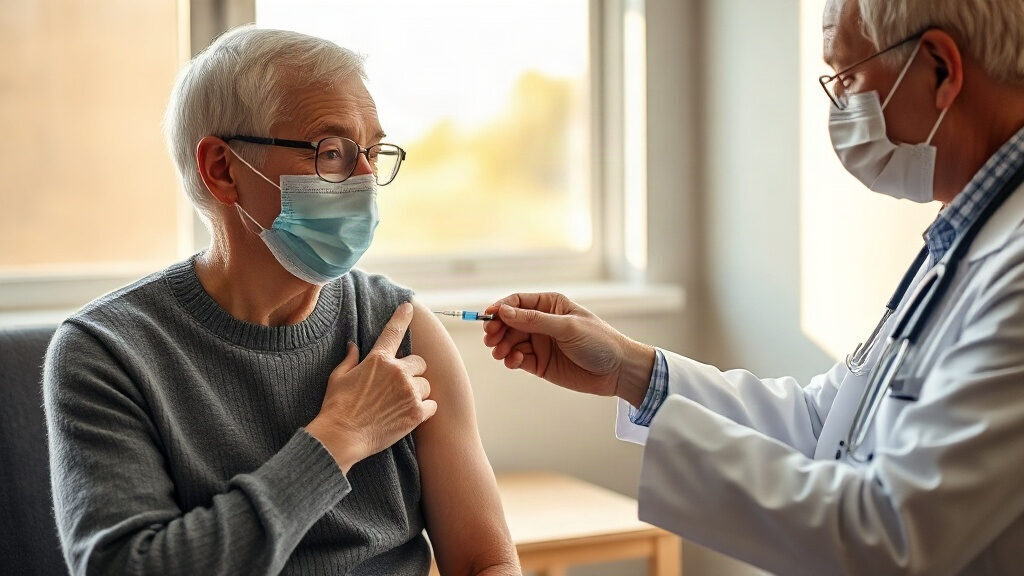
Vaccination protects less well after age 65, and the reason lies in the immune system itself. Since the 1980s, immunology has documented a progressive decline in defenses with age, called immunosenescence. This phenomenon explains why flu, shingles or pneumococcal pneumonia hit seniors harder, despite vaccine coverage equivalent to that of younger adults.
In brief – Vaccination is a preventive act whose effectiveness depends directly on the immune system’s ability to respond to the injected antigen. With age, the thymus shrinks, naive T cells become scarcer in favor of less reactive memory cells, and B cells produce fewer and lower-quality antibodies. A review of 31 studies measured the result: seroprotection after flu vaccination drops sharply in people over 65 compared with young adults. Solutions exist: high-dose vaccines, adjuvanted formulations and an adapted vaccination schedule offset part of this loss, without canceling it out.
Definition: what immunosenescence means for vaccination
Immunosenescence refers to the progressive remodeling of the immune system with advancing age, a process distinct from a simple overall drop in immunity. It relies on the body’s ability to recognize an antigen, memorize it and mount a rapid response upon later exposure. This three-step mechanism (presentation, memorization, recall) degrades at different rates depending on the immune compartment.
In a young adult, the body holds a large reservoir of naive T cells able to recognize a new antigen. This reservoir shrinks over the decades, reducing the range of possible responses to a new virus or a vaccine variant.
Mechanism: how age changes the response to a vaccine
Three biological processes combine to weaken the vaccine response in older people, often together rather than in isolation.
- Thymic involution: the thymus, the organ that produces T cells, loses most of its functional tissue as early as puberty and keeps shrinking afterward, limiting the renewal of naive T cells.
- Exhaustion of memory B cells: work by Frasca and Blomberg shows that aging impairs antibody class switching and reduces their affinity, through increased local inflammation in the bone marrow and lymph nodes.
- Inflammaging: the low-grade chronic inflammation that accompanies aging blurs the signals needed for a targeted immune response, a mechanism already detailed in our article on chronic inflammation.
- Narrowed immune repertoire: cumulative lifelong exposure to infections and vaccines occupies a growing share of memory lymphocytes, leaving less room for new responses.
What the science says about vaccine effectiveness after 65
The numbers confirm a measurable gap, not just a clinical impression. A quantitative review covering 31 studies established the odds ratio for seroconversion and seroprotection after flu vaccination, comparing seniors with younger adults. It ranges between 0.24 and 0.59 depending on the antigen tested (Goodwin et al., 2006). In other words, the odds of achieving adequate serological protection can be two to four times lower in an older person than in a young adult receiving the same standard vaccine.
In response, a randomized trial in about 32,000 participants aged 65 and older compared a high-dose flu vaccine (four times more hemagglutinin) with the standard vaccine. The high-dose formulation proved 24.2% more effective at preventing laboratory-confirmed flu (DiazGranados et al., 2014). For shingles, the ZOE-50 trial showed that an adjuvanted recombinant vaccine reaches over 90% effectiveness in adults 50 and older (Lal et al., 2015). The older live attenuated vaccine plateaued markedly lower in older people. These results illustrate the strategy chosen by health authorities: offset age-related immune loss through vaccine formulation rather than giving up on vaccine protection.
At the cellular level, the review by Weinberger and Grubeck-Loebenstein notes that this loss of effectiveness also affects vaccines against pneumococcus and tetanus, with a magnitude that varies by antigen (Weinberger & Grubeck-Loebenstein, 2012). A separate article by Frasca and Blomberg details the mechanism on the B cell side. Excess TNF-alpha production in aging bone marrow disrupts antibody maturation, confirmed in cohorts vaccinated against flu (Frasca & Blomberg, 2020). These data remain robust statistical associations, not an individual prediction: vaccine response varies widely from person to person depending on overall health.
In practice: which vaccines and indications after 65
The NHS recommends, from age 65, an annual flu vaccination, a shingles vaccination and a pneumococcal vaccination, precisely because the weakening of the immune response makes these infections more frequent and more severe at this age. This approach echoes the explanations detailed in our article on immune system aging, and complements the mechanisms described in our feature on the lymphatic system, through which the cells involved in the vaccine response circulate.
The table below compares standard formulations and senior-adapted formulations for three common vaccines, based on the trials cited above.
| Vaccine | Standard formulation | Senior-adapted formulation | Observed gain |
|---|---|---|---|
| Seasonal flu | Standard dose, one injection | High dose (4x antigen) or adjuvanted | +24.2% effectiveness vs standard dose |
| Shingles | Live attenuated vaccine (older generation) | Adjuvanted recombinant vaccine | Over 90% effectiveness from age 50 |
| Pneumococcus | Simple polysaccharide vaccine | Conjugate vaccine in adapted sequence | Antibody response better sustained over time |
This choice of formulation does not remove the need for an up-to-date immunization schedule: a delayed booster leaves a window of exposure during which protection remains absent, whatever the age.
Protocol: how to support your immune response around a vaccination
A few levers, documented separately from the vaccine’s own effect, favor a more robust immune response at the time of vaccination.
- Schedule your vaccination early in the season: the antibody response takes two to three weeks to build up, a delay to anticipate before the epidemic peak.
- Tell your doctor about any recent infection or fever: vaccination during an acute inflammatory episode can reduce the quality of the response.
- Maintain adequate zinc and vitamin D status, two micronutrients involved in lymphocyte maturation, described in our article on selenium intake and immunity.
- Limit low-grade chronic inflammation through sleep, physical activity and an anti-inflammatory diet, a topic detailed in our feature on inflammaging.
- Explicitly ask for the senior-adapted formulation (high dose, adjuvanted) rather than the default standard formulation, when it is available and covered.
None of these levers replaces the vaccine itself: they optimize its effect, without guaranteeing it for any one individual.
Frequently asked questions about vaccination and age
Why is vaccination less effective in older people?
Aging of the immune system, or immunosenescence, reduces the number of available naive T cells and impairs the maturation of antibodies produced by B cells. A review of 31 studies measured an odds ratio for seroprotection after flu vaccination of between 0.24 and 0.59 in seniors compared with young adults, depending on the antigen.
Are there vaccines specifically designed for seniors?
Yes. The high-dose flu vaccine contains four times more antigen and proved 24.2% more effective than the standard dose in people over 65. The adjuvanted recombinant shingles vaccine exceeds 90% effectiveness from age 50, against markedly lower protection with the older live attenuated vaccine in older people.
At what age does the vaccine response start to weaken?
Thymic involution begins as early as puberty and continues throughout life. The measurable drop in vaccine effectiveness becomes clinically significant around age 65, the age used by official recommendations for high-dose formulations against flu, shingles and pneumococcus.
Can you strengthen your immune response before a vaccination?
Adequate zinc and vitamin D status, sufficient sleep and controlled chronic inflammation favor a more reactive immune terrain. These measures do not replace any vaccination and have not shown an effect equivalent to that of a senior-adapted vaccine formulation.
Does vaccination carry more risk after age 65?
The formulations recommended for seniors (high dose, adjuvanted) have been evaluated in randomized trials including tens of thousands of older participants, with a safety profile broadly comparable to standard formulations. Individual medical advice remains necessary in case of chronic disease or ongoing immunomodulatory treatment.
Medical disclaimer. The information provided here is for informational purposes only and does not constitute medical advice. It does not replace a consultation. Ask a healthcare professional before changing your diet, taking dietary supplements or starting a new practice, especially if you have a medical condition, are pregnant or are under treatment. Dietary supplements do not replace a balanced diet or medical follow-up.