Slow wound healing after 60 often causes worry, yet in most cases it reflects a normal slowing of the skin. Past sixty, the epidermis renews itself more slowly, fibroblasts produce less collagen and inflammation takes longer to switch off. The point that really matters: telling this physiological delay apart from a wound that stalls because of diabetes, poor circulation, malnutrition, smoking or a medication. Here are the 5 causes of slow wound healing documented by research, the figures measured in studies, and the signs that justify seeing a doctor.
In brief – Wound healing is a four-phase repair process (hemostasis, inflammation, proliferation, remodeling) that slows with age without losing final quality. After 60, five causes explain most healing delays: diabetes, poor venous or arterial circulation, a lack of protein, zinc or vitamin C, smoking, and the trio of stress, lack of sleep and medications (corticosteroids, anti-inflammatory drugs). An ordinary wound should show visible progress within two weeks. Beyond four to six weeks without improvement, it becomes chronic and needs medical assessment. Spreading redness, discharge, odor, fever or a foot wound in a person with diabetes call for a consultation without delay.
Wound healing: definition and normal phases
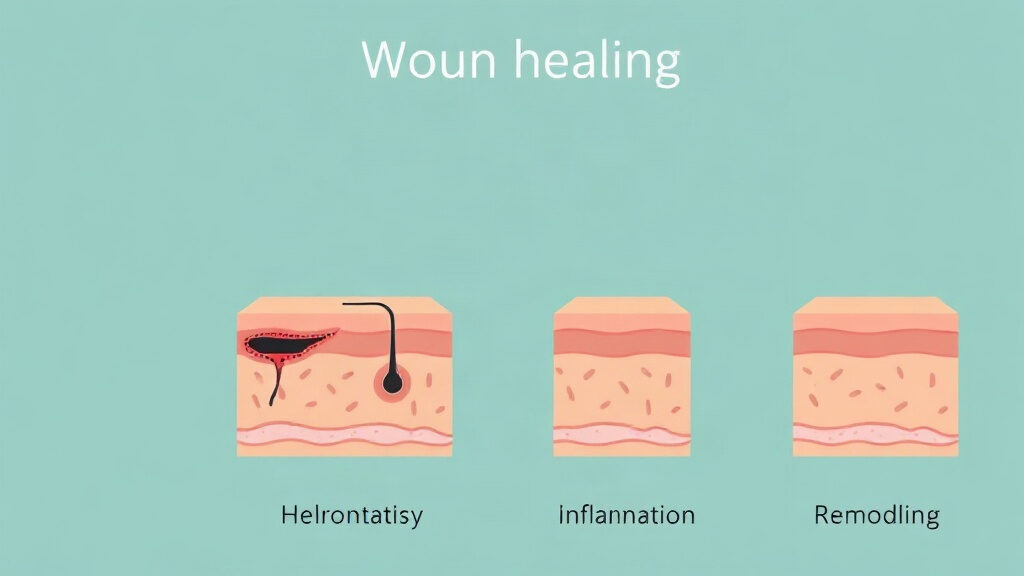
Wound healing closes a wound in four overlapping phases, detailed in the review by Wilkinson and Hardman 2020. Hemostasis stops the bleeding within minutes thanks to platelets. Inflammation, from roughly day one to day four, recruits neutrophils and macrophages to clear damaged tissue and bacteria. Proliferation, from day four to week three, builds new tissue: blood vessels, collagen, then an epidermis that covers the surface. Remodeling then reorganizes this collagen over several months, sometimes more than a year.
Normal wound healing follows this sequence in an orderly way. A chronic wound stays stuck, most often in the inflammatory phase, as explained in the review by Demidova-Rice 2012. In clinical practice, the NHS describes a leg ulcer as a wound on the leg that has not healed after more than a month. The systematic review by Olsson 2019 estimates that between 1.5 and 2.2 people per 1,000 live with a chronic wound, a proportion that climbs sharply with age.
Why wound healing slows with age
Aging delays every phase of healing, but the final result remains of comparable quality, according to the synthesis by Gosain and DiPietro 2004. In other words, the skin of a 70-year-old repairs itself well, it simply repairs itself more slowly. The mechanisms involved, summarized by Sgonc and Gruber 2013, affect every cell type involved in healing:
- Slower epidermis: keratinocytes divide more slowly, so the wound surface takes longer to cover over.
- Less active fibroblasts: fewer in number and partly senescent, they synthesize less collagen and respond less well to growth factors.
- Fewer blood vessels: angiogenesis, which supplies the new tissue with oxygen and nutrients, declines.
- Inflammation that drags on: macrophages have more difficulty switching from “clean-up” mode to “repair” mode.
- Reduced regenerative reserve: the skin’s stem cells, fewer and less responsive, are one of the twelve hallmarks of aging described on our stem cell exhaustion page.
Hormones play a bigger role in healing than once thought. The genomic study by Hardman and Ashcroft 2008, published in Genome Biology, concludes that the drop in estrogen, more than chronological age itself, explains most of the healing delay seen in older people. This concerns women after menopause, but also men, whose circulating estrogen levels decline over the years.
The 5 causes of slow wound healing after 60
Five factors, often combined, turn a simple delay into a wound that stalls. The reference review by Guo and DiPietro 2010 in the Journal of Dental Research sorts them into local factors (oxygenation, infection) and systemic factors (age, diabetes, nutrition, stress, medications, smoking).
1. Diabetes and chronic high blood sugar
Diabetes is the first cause of slow wound healing to look for after 60. According to the World Health Organization, 14% of adults were living with diabetes in 2022, compared with 7% in 1990, and the CDC notes that type 2 accounts for more than 90% of cases. Excess glucose damages small blood vessels, impairs white blood cell function and stiffens collagen through glycation. Neuropathy adds a trap: a foot wound that cannot be felt keeps being loaded with every step. Undiagnosed diabetes is often spotted by a raised fasting blood glucose on two separate samples.
2. Poor venous or arterial circulation
Without an oxygen supply, no healing can progress. Venous insufficiency causes typical ulcers just above the ankle, on a swollen leg, with brown, hardened skin. Peripheral arterial disease, on the other hand, tends to affect the foot and toes, with a pale or blackish wound, pain when walking and cold skin. Smoking, diabetes and high blood pressure are its main risk factors. The doctor confirms the origin by checking the pulses and with a Doppler ultrasound.
3. Malnutrition: protein, zinc and vitamin C
Effective healing needs building materials. Protein supplies the amino acids for collagen, vitamin C is essential to its production, and zinc is involved at every stage, as detailed in the review by Lin 2017 in Nutrients. Yet appetite often declines with age, and malnutrition affects a notable share of people over 70 living at home. The Cochrane review by Langer and Fink 2014 concludes that mixed nutritional supplements may reduce pressure ulcers in people at risk, with evidence rated as low quality. Daily protein intake and zinc status therefore deserve a proper assessment before any supplementation.
4. Smoking and alcohol
Nicotine constricts blood vessels and carbon monoxide reduces the oxygen available to tissues. The meta-analysis by Sørensen 2012, covering 140 cohorts and 479,150 surgical patients, measured in smokers a 3.6-fold higher risk of wound necrosis and a 2-fold higher risk of delayed healing or wound dehiscence. Excess alcohol worsens the picture by disrupting immunity and clotting.
5. Stress, lack of sleep and certain medications
Psychological stress measurably slows healing. In the landmark study by Kiecolt-Glaser 1995 published in The Lancet, 13 women caring for a relative with dementia took 48.7 days to close a small skin biopsy, compared with 39.3 days in 13 controls, or 24% longer. Cortisol and dysregulated inflammatory cytokines are the cause. On the medication side, the review by Wang 2013 confirms that long-term corticosteroids slow healing, and Guo and DiPietro also flag high-dose nonsteroidal anti-inflammatory drugs and chemotherapy.
| Cause | Main mechanism | Telltale sign | Lever for action |
|---|---|---|---|
| Diabetes | Glycation, microangiopathy, neuropathy | Painless foot wound, thirst, fatigue | Blood sugar testing, daily foot care |
| Circulation | Lack of tissue oxygen | Ankle ulcer, cold foot, pain when walking | Doppler ultrasound, compression or revascularization |
| Malnutrition | Lack of protein, zinc, vitamin C | Weight loss, loss of appetite | Nutritional assessment, adjusted protein intake |
| Smoking and alcohol | Vasoconstriction, hypoxia, impaired immunity | Necrosis of the wound edges, infection | Quitting, at least 4 weeks before surgery |
| Stress, sleep, medications | Cortisol, dysregulated cytokines, corticosteroids | Fatigue, insomnia, long-term treatment | Medication review, stress management |
What science says about wound healing in older adults
Physical activity speeds up skin healing in people over 55, and this is one of the most concrete findings in the literature. In the trial by Emery 2005, 28 healthy adults (mean age 61) received a small standardized wound. Those following a three-month aerobic exercise program closed it in 29.2 days, compared with 38.9 days for the sedentary group, a gain of ten days.
The relational climate matters too. In the study by Kiecolt-Glaser 2005 conducted on 42 married couples, small wounds closed more slowly after a conflictual discussion than after a supportive exchange, and the most hostile couples healed at 60% of the speed of the others. The review by Gouin and Kiecolt-Glaser 2011 gathers some twenty studies that converge on this same effect of stress.
| Study | Population | Measured result |
|---|---|---|
| Emery 2005 | 28 adults, mean age 61 | Closure in 29.2 days with exercise versus 38.9 days without |
| Kiecolt-Glaser 1995 | 13 caregivers and 13 controls | 48.7 days versus 39.3 days, a 24% delay under chronic stress |
| Kiecolt-Glaser 2005 | 42 couples | Closure speed reduced to 60% in hostile couples |
| Sørensen 2012 | 479,150 surgical patients | Wound necrosis x 3.6 and delayed closure x 2 in smokers |
| Hardman and Ashcroft 2008 | Genomic analysis of human wounds | The drop in estrogen explains most of the age-related delay |
These results concern small experimental wounds and specific populations. They do not guarantee the same benefit for an established leg ulcer, but they show that lifestyle weighs as much as age on the speed of healing.
When to see a doctor: the warning signs
An ordinary wound should show visible progress within two weeks: edges drawing closer, surface covering over, redness fading. If it has not changed after two weeks, medical advice is needed. Beyond four to six weeks without closure, it enters the category of chronic wounds that require a full workup (blood sugar, circulation, nutritional status) and specialized care, as recommended by Gould 2015 in the Journal of the American Geriatrics Society.
| Sign observed | What it may indicate | Timeframe |
|---|---|---|
| Spreading redness, warmth, swelling | Early infection | Within 24 to 48 hours |
| Thick discharge, odor, increasing pain | Established infection | The same day |
| Fever, chills, feeling unwell | Infection spreading through the body | Emergency |
| Black or gray area on the wound | Necrosis, poor circulation | The same day |
| Foot wound in a person with diabetes | Risk of a deep wound that cannot be felt | Without delay, even without pain |
| No improvement after 2 weeks | Underlying cause to look for | Within the week |
| Wound open for more than 4 to 6 weeks | Chronic wound | Full workup and specialist follow-up |
In a person with diabetes, any foot wound, however small, warrants a prompt consultation. The diabetic foot remains the leading cause of non-traumatic amputation, and the loss of sensation means the wound is often discovered late.
Protocol: 7 steps to support wound healing after 60
Good habits for healing start with local care and continue on the plate, in movement and in sleep. These tips apply to everyday minor wounds and complement, without replacing, medical follow-up of a chronic wound.
- Clean with water and mild soap or saline solution, then pat dry. Repeated use of harsh antiseptics (alcohol, hydrogen peroxide) damages the cells that are multiplying.
- Keep the wound in a moist environment under a suitable dressing rather than open to the air: keratinocytes migrate better in a hydrated environment. Change the dressing as instructed, without pulling off the scab.
- Eat protein at every meal: geriatric recommendations aim for 1 to 1.2 g per kilo per day after 65, or about 70 to 85 g for a person weighing 70 kg (154 lb), from eggs, fish, legumes and dairy products.
- Cover zinc and vitamin C through food: seafood, meat and pumpkin seeds for zinc; citrus fruit, kiwi, bell pepper and cabbage for vitamin C. A supplement is only justified when a deficiency is confirmed by a blood test.
- Walk or cycle 30 minutes a day, unless the wound itself rules it out: aerobic exercise cut healing time by ten days in the Emery 2005 trial.
- Stop smoking, ideally at least four weeks before planned surgery, the point from which Sørensen 2012 observes a drop in wound complications.
- Sleep 7 hours and ease stress: slow breathing, walking outdoors or regular social activity lower cortisol, which slows healing.
- To avoid: popping blisters, applying non-sterile home remedies (non-medical honey, toothpaste, butter), exposing a recent scar to the sun without protection for at least six months.
- To check every day in a person with diabetes: the soles of the feet and the spaces between the toes, with a mirror if needed.
- To report to the doctor: any ongoing treatment with corticosteroids, anticoagulants, immunosuppressants or chemotherapy, because it changes how the wound is managed.
Slower wound healing after 60 remains, in the vast majority of cases, complete healing. The only real signal not to brush aside is a lack of progress after two weeks.
Frequently asked questions about wound healing after 60
Why is wound healing slower after 60?
With age, keratinocytes divide more slowly, fibroblasts produce less collagen and new blood vessels form more slowly. The initial inflammation also takes longer to switch off. The drop in estrogen, in women as in men, explains a large part of this delay according to Hardman and Ashcroft 2008. The final quality of the scar, however, remains comparable to that of a younger adult.
How long before a wound that is not healing should cause concern?
A superficial wound should show signs of healing within two weeks. Without visible progress by then, medical advice is justified. Beyond four to six weeks, the wound is considered chronic and requires a full workup: blood sugar, circulation examination, nutritional status and medication review. Fever, discharge, odor or a black area call for a consultation the same day.
What is the difference between an acute wound and a chronic wound?
An acute wound goes through the four phases of healing in order and closes within a few weeks. A chronic wound stays stuck, most often in the inflammatory phase, because of an underlying factor such as diabetes, venous insufficiency, peripheral arterial disease or malnutrition. Leg ulcers, pressure ulcers and diabetic foot wounds are the most common forms after 60.
Which foods support wound healing in older adults?
Protein first of all: eggs, fish, poultry, legumes and dairy products, at 1 to 1.2 g per kilo per day after 65. Zinc (seafood, meat, pumpkin seeds) and vitamin C (citrus fruit, kiwi, bell pepper, cabbage) contribute to collagen synthesis. Adequate hydration counts too. Supplements are only useful when a deficiency has been measured by a blood test.
Does diabetes really slow wound healing?
Yes, and through several pathways. Excess glucose damages small blood vessels, reduces the effectiveness of white blood cells and stiffens collagen through glycation. Neuropathy erases the warning pain, so a foot wound can worsen without being noticed. Well-controlled diabetes limits these effects, which is why any slow wound after 60 justifies a blood sugar measurement.
Medical disclaimer. The information on this page is provided for informational purposes only and does not constitute medical advice. It does not replace a consultation. Ask a healthcare professional before changing your diet, taking dietary supplements or starting a new practice, especially if you have a medical condition, are pregnant or are under treatment. Dietary supplements do not replace a balanced diet or medical follow-up.