
Loss of smell affects one adult in four after age 53 and more than six people in ten after 80, according to the population study by Murphy published in JAMA in 2002 (2,491 participants). Coffee that no longer smells of anything, or a burnt dish that nobody notices, is often written off as a detail of getting older. Cohorts followed for twenty years tell a different story. The nose is a direct window onto the brain, and a loss of smell that settles in after 60 sometimes precedes cognitive decline or Parkinson’s disease by several years. This overview details what these studies measure, the benign causes to rule out first, and the steps whose effect has been quantified.
In brief – Loss of smell is a measurable decline in the ability to detect and identify odors which, after age 60, reflects the state of the olfactory neurons and of the brain regions next to those of memory. It affects more than half of people aged 65 to 80 (Doty 1984, 1,955 people), but 9 people in 10 do not notice it themselves (Murphy 2002). In the Columbia cohort (Devanand 2015, 1,037 participants), a low smell score predicted cognitive decline better than a verbal memory test. People with the lowest scores had twice the risk of being diagnosed with dementia five years later (Adams 2018, 2,906 participants) and five times the risk of Parkinson’s disease within four years (Ross 2008, 2,267 men). An isolated loss of smell is not a diagnosis: rhinitis, polyps and medication explain a large share of cases. It warrants a standardized smell test and, if the nose is healthy, a cognitive assessment.
Loss of smell: what exactly are we talking about?
Smell loss covers three levels that doctors tell apart with a standardized test. Hyposmia is a partial decline: you can still smell, but less strongly and with confusion between similar odors. Anosmia is an almost complete disappearance of perception. Presbyosmia is the gradual decline linked to age itself, with no identified disease. These three levels are measured with odor identification tests such as the Sniffin’ Sticks, whose age-band norms rest on 9,139 subjects (Oleszkiewicz 2019), or the American 40-odor UPSIT test.
How common smell loss is was first quantified in 1984 in Science by Doty and colleagues in 1,955 people aged 5 to 99. Performance peaks between 20 and 50, then drops sharply after 70: more than half of 65 to 80 year olds show a major impairment, and more than three quarters after 80. The Beaver Dam study (Murphy 2002) found a prevalence of 24.5% between ages 53 and 97, rising to 62.5% among those aged 80 to 97. Men were almost twice as affected as women (ratio 1.92). The most striking point concerns awareness of the problem: only 9.5% of participants reported any difficulty, and among those over 80 the sensitivity of self-reporting fell to 12% in women and 18% in men. Smell loss is therefore a silent disorder, one that family members often spot before the person concerned.
Why the sense of smell fades after 60
The olfactory system is the only sense whose receptor neurons are renewed throughout life, and it is precisely this renewal that runs out of steam with age. Olfactory neurons line the top of the nasal cavity, directly exposed to air, viruses and pollutants. They live for a few weeks to a few months, then are replaced by basal stem cells. An analysis of 28,726 cells from adult human olfactory epithelium (Durante 2020, Nature Neuroscience) confirms that this production of neurons continues for decades. But in aged mice, the team of Child (2018) describes “neurogenic exhaustion”: whole areas of the epithelium lose both their neurons and their stem cells, and turn into ordinary respiratory lining. The same picture is seen in samples from older humans.
The review by Doty and Kamath (2014) lists the factors that add up to explain age-related smell loss:
- Exhaustion of basal stem cells: fewer receptor neurons replaced, reduced sensory surface. This mechanism belongs to the stem cell exhaustion pillar, shared by many aging tissues.
- Cumulative damage: repeated viral infections, tobacco, solvents and fine particles damage the epithelium faster than it can repair itself.
- Ossification of the cribriform plate: the bony openings through which olfactory fibers reach the brain narrow and sever axons.
- Loss of receptor selectivity: the remaining neurons respond less precisely, hence the confusion between odors.
- Decline in mucosal enzymes and reduced nasal moisture, which change how odor molecules reach the receptors.
- Abnormal proteins in the olfactory bulb: aggregates of tau, beta-amyloid or alpha-synuclein, the same ones found in Alzheimer’s and Parkinson’s disease.
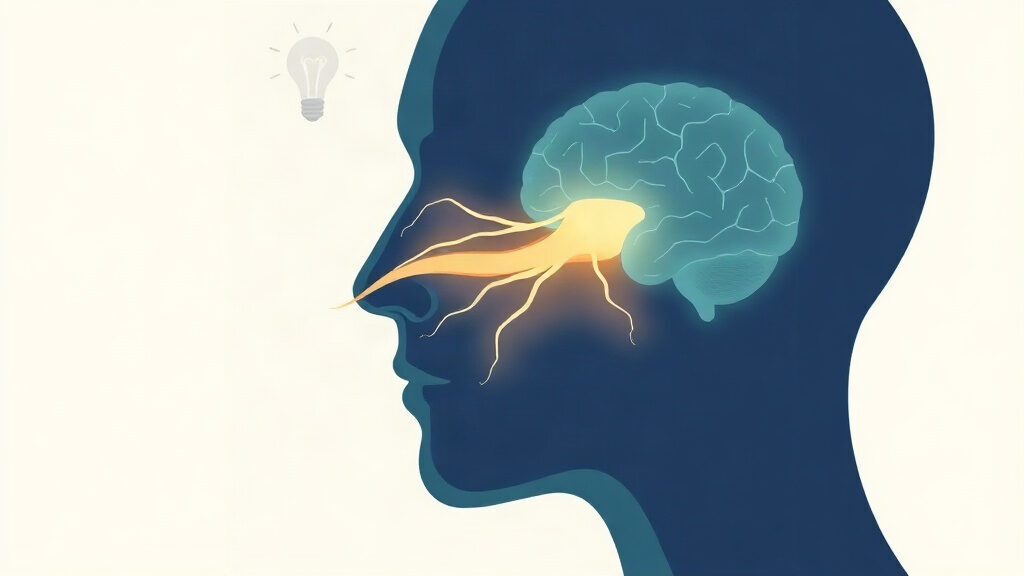
This last point explains the link between the sense of smell and the brain. The olfactory bulb projects directly onto the entorhinal cortex and the hippocampus, two memory structures affected very early in Alzheimer’s disease. In Parkinson’s disease, the olfactory bulb is one of the first areas where alpha-synuclein builds up, well before the movement neurons. A loss of smell can therefore be the first visible sign of a process that has not yet reached memory or movement.
What the science says: loss of smell, memory and Parkinson’s
Smell loss measured with a standardized test predicts cognitive decline better than a memory test in people who are still intact. That is the finding of the multiethnic North Manhattan cohort (Devanand 2015, Neurology): among 1,037 older adults tested with the UPSIT, each point lost on the smell score raised the risk of cognitive decline at 4 years by 7% and the risk of conversion to Alzheimer’s dementia by 10%. The verbal recall test, by contrast, predicted nothing in participants with no initial impairment. At the Mayo Clinic (Roberts 2016, 1,430 people with an average age of 79), the quarter of participants with the worst smell score had a 2.18 times higher risk of amnestic mild cognitive impairment within 3.5 years. Among those who already had this impairment, the risk of progression to Alzheimer’s dementia was multiplied by 5.2.
Two representative cohorts confirm the association between smell loss and dementia. In the US national NSHAP survey (Adams 2018, 2,906 people aged 57 to 85), those who failed a 5-odor test had a 2.13 times higher risk of a dementia diagnosis five years later, after adjustment for age, comorbidities and baseline cognition. In the Health ABC cohort (Yaffe 2017, 2,428 people followed for 12 years), the third with the lowest smell scores had a dementia risk multiplied by 3.34 among white participants and by 2.03 among Black participants. Imaging sheds light on the mechanism: in the Rush Memory and Aging Project (Dintica 2019, 380 people followed for up to 15 years), smell loss went hand in hand with a smaller hippocampus and entorhinal cortex on MRI, and with faster cognitive decline. These data echo those in our article on memory loss after 60.
For Parkinson’s disease, olfactory loss is an even earlier signal. In the Honolulu-Asia Aging Study (Ross 2008), 2,267 men aged 71 to 95 without Parkinson’s took a smell test. Over the following four years, the incidence of the disease reached 54.5 cases per 10,000 person-years in the quarter with the poorest sense of smell, against 8.4 in the best quarter: a risk multiplied by 5.2 after adjustment. Beyond four years, the association disappeared, which places smell loss in the 4-year window before diagnosis. The other warning signs of this disease are detailed in our feature on Parkinson’s disease risk factors.
The link between smell loss and overall mortality is the most discussed finding. In the NSHAP cohort (Pinto 2014, 3,005 people aged 57 to 85), people with anosmia had a 3.37 times higher risk of dying within five years than people with a normal sense of smell, after adjustment for disease, nutrition, cognition and smoking. The Health ABC cohort (Liu 2019, Annals of Internal Medicine, 2,289 people aged 71 to 82) found a 46% higher risk of death at 10 years. Neurodegenerative diseases explained only 22% of this excess, and weight loss 6%. The authors see it as a global marker of cellular aging, not a cause of death: an association, not causation.
| Study (year, PMID) | Participants | Main result | Time frame |
|---|---|---|---|
| Devanand 2015 (25471394) | 1,037, North Manhattan | Alzheimer’s dementia risk +10% per UPSIT point lost | 4 years |
| Roberts 2016 (26569387) | 1,430, Mayo Clinic | Mild cognitive impairment x 2.18; progression to Alzheimer’s x 5.2 | 3.5 years |
| Adams 2018 (28944467) | 2,906, NSHAP | Dementia diagnosis x 2.13 | 5 years |
| Yaffe 2017 (28039314) | 2,428, Health ABC | Dementia x 3.34 (white participants), x 2.03 (Black participants) | 12 years |
| Dintica 2019 (30651382) | 380, Rush MAP | Smaller hippocampus and entorhinal cortex on MRI | 15 years |
| Ross 2008 (18067173) | 2,267 men, Honolulu | Parkinson’s disease x 5.2 | 4 years |
| Pinto 2014 (25271633) | 3,005, NSHAP | All-cause mortality x 3.37 in people with anosmia | 5 years |
| Liu 2019 (31035288) | 2,289, Health ABC | Mortality +46% | 10 years |
In practice: when loss of smell should raise concern
Smell loss after 60 first calls for an examination of the nose, because local causes are common and often reversible. In the 5-year follow-up of Beaver Dam (Schubert 2011, 1,556 people), 12.5% of participants developed smell loss. A history of nasal polyps multiplied the risk by 2.33, a deviated septum by 2.05 and heavy alcohol consumption by 1.84. Each additional five years of age added 79% to the risk. Chronic rhinitis, sinusitis, head injury or a recent infection (including Covid-19) round out the list of causes to rule out. Several medications also cause smell loss, including some blood pressure drugs and antidepressants.
The pattern of the smell loss guides the next step. An impairment that fluctuates, is worse in the morning or during colds, and comes with a blocked nose, points to a nasal cause. A gradual, painless impairment with no obstruction, accompanied by unusual forgetfulness, new constipation, restless dreams or a tremor, deserves a neurological opinion. The early signs of Alzheimer’s disease and Parkinson’s disease are described in the MedlinePlus pages of the National Institutes of Health on Alzheimer’s disease and on Parkinson’s disease. The World Health Organization counts 55 million people living with dementia and stresses the value of early diagnosis (WHO dementia fact sheet). These exchanges between nose, olfactory bulb and brain illustrate the pillar of altered intercellular communication, which describes how signals between cells deteriorate with age.
| Profile | Associated signs | Probable cause | What to do |
|---|---|---|---|
| Fluctuating, blocked nose | Rhinitis, discharge, snoring, worse in the morning | Polyps, chronic sinusitis, deviated septum | ENT consultation, nasal endoscopy, local treatment |
| Sudden, after an infection | Recent cold or Covid-19, altered taste | Viral damage to the epithelium | 12 weeks of smell training, reassessment at 6 months |
| Gradual, clear nose | Forgetfulness, new constipation, restless dreams, tremor, mood change | Possible early neurodegenerative process | Standardized smell test, cognitive assessment, neurological opinion |
Smell training and the steps that count
Sniffing four strong odors twice a day for twelve weeks improves the smell score in people with smell loss. The protocol was tested at the Dresden clinic by Hummel (2009) in 40 trained patients and 16 controls: rose, eucalyptus, lemon and clove, each for 10 to 20 seconds, morning and evening. The Sniffin’ Sticks score improved in the trained group and not in the controls. The meta-analysis of 13 studies by Sorokowska (2017) confirms a large effect on odor identification and discrimination, and a more modest one on the detection threshold. The effect is documented mainly for post-infectious loss of smell. In older people with no identified cause, it is weaker, but the practice costs nothing and has no known drawback.
Day to day, here are the measures whose effect has been quantified or that are a matter of basic safety:
- Practice smell training with four essential oils or kitchen spices, naming the odor each time: paying attention to the name reinforces learning.
- Exercise at least once a week: in Beaver Dam (Schubert 2011), weekly exercise was associated with a 31% lower risk of smell loss.
- Cut back on alcohol: heavy drinking multiplied the risk by 1.84 in the same cohort.
- Look after the nose: saline rinses, treatment of polyps and allergic rhinitis, quitting smoking.
- Make the home safe: a smoke detector and a gas detector are a must, because people over 65 are overrepresented in accidental gas poisonings (Doty 1984).
- Keep an eye on the plate: losing the pleasure of eating lowers food intake, and weight loss explained 6% of the excess mortality in Health ABC (Liu 2019). Liven up dishes with textures, warmth and acidity rather than salt.
- Ask for a smell test from your doctor as soon as family members notice a change in smell: a 12-odor test takes five minutes and gives a numbered starting point.
To receive this kind of decoding of the signals of aging every week, the UltraSanté newsletter “The Health Letter” brings together the landmark studies and their practical implications.
Frequently asked questions about smell loss
Why is loss of smell after 60 linked to the brain?
The olfactory bulb, which receives the signal from the nose, projects directly onto the entorhinal cortex and the hippocampus, two memory regions affected first in Alzheimer’s disease. It also accumulates alpha-synuclein very early in Parkinson’s disease. In the Rush Memory and Aging Project (Dintica 2019, 380 people), smell loss went hand in hand with a smaller hippocampus and faster cognitive decline.
Does a loss of smell mean I will develop Alzheimer’s?
No. Smell loss multiplies the statistical risk, it does not make a diagnosis. In the NSHAP survey (Adams 2018, 2,906 people), those with a low smell test score had a 2.13 times higher risk of dementia at 5 years, but most of them did not develop it. Nasal causes, viral infections and several medications explain a large share of smell loss after 60.
How can I tell whether my smell loss is nasal or neurological?
An impairment that fluctuates, gets worse in the morning or during colds, with a blocked or runny nose, points to a nasal cause, to be confirmed by an ENT examination. A gradual impairment with no obstruction, associated with unusual forgetfulness, new constipation, restless dreams or a tremor, warrants a standardized smell test and a neurological opinion. Only a medical examination can settle it.
Does smell training work after 60?
Yes, with a measurable effect mainly after a viral infection. The Hummel (2009) protocol consists of sniffing four odors (rose, eucalyptus, lemon, clove) for 10 to 20 seconds each, morning and evening, for 12 weeks. The Sorokowska meta-analysis (2017, 13 studies) finds a large effect on odor identification. In older people with no identified cause, the effect is more modest, but the practice has no known drawback.
What is the difference between hyposmia, anosmia and presbyosmia?
Hyposmia is a partial smell loss: odors are perceived more faintly and sometimes confused. Anosmia is an almost complete disappearance of odor perception. Presbyosmia is the gradual decline linked to age, with no identified disease of the nose or the brain. All three are measured with a standardized identification test, such as the Sniffin’ Sticks, whose age norms rest on 9,139 subjects (Oleszkiewicz 2019).
Medical disclaimer. The information provided here is for informational purposes only and does not constitute medical advice. It does not replace a consultation. Ask a healthcare professional before changing your diet, taking dietary supplements or starting a new practice, especially if you have a medical condition, are pregnant or are under treatment. Dietary supplements do not replace a balanced diet or medical follow-up.