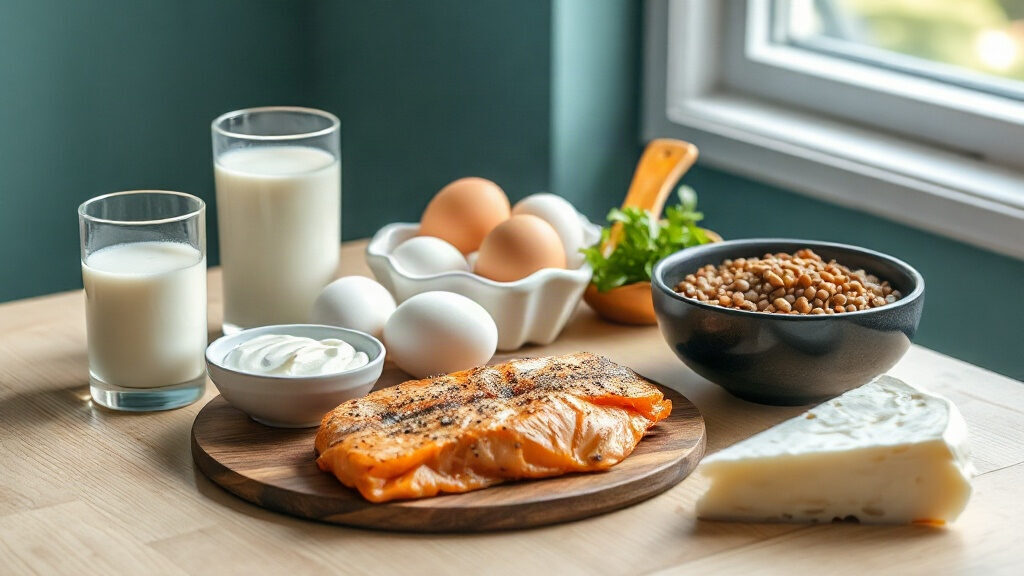
Leucine is the amino acid researchers watch most closely when the goal is to keep your muscles after 60. Found in every dietary protein, it acts as the trigger signal for building new muscle fibers. Trials run since 2006 in Galveston, Hamilton and Maastricht answer three practical questions. What dose should you aim for at each meal, when should you eat it, and who actually benefits?
In brief – Leucine is an essential branched-chain amino acid that activates mTORC1, the cellular switch for muscle protein synthesis. In adults over 65, this signal becomes blunted. It takes about 2.5 to 3 g of leucine per meal, or 25 to 30 g of good-quality protein, to get the response of a young adult. The most useful timing is an intake spread over three meals, and within two hours after a strength training session. On its own, without protein or exercise, a supplement of 7.5 g a day for 3 months did not increase muscle mass in healthy older adults. The people who gain the most are older adults who eat little protein and those with sarcopenia.
Leucine: definition of a signaling amino acid
It is one of the 9 “essential” amino acids described by MedlinePlus, meaning the body cannot make it and must get it from food. Together with isoleucine and valine, it forms the trio of branched-chain amino acids, or BCAAs. What makes it special is less its role as a building block than its role as a messenger: it tells the muscle cell that a protein-rich meal has just arrived.
In an animal protein, this amino acid makes up a large share of the essential amino acids. It reaches 26% in the reference whey composition used by Katsanos’s team in 2006. Plant proteins usually contain a little less, and the French food safety agency Anses points out that they are also less digestible, which matters when you calculate a dose per meal.
Mechanism: how leucine switches on muscle synthesis
It works by binding to a sensor called Sestrin2, which then releases the mTORC1 complex, the master regulator of cell growth. David Sabatini’s team at MIT measured this binding in 2016. It occurs at 20 micromolar, exactly the concentration that half-activates mTORC1 (Wolfson et al., Science, 2016). In practice, the sequence unfolds in four steps:
- after a protein-rich meal, the blood level of leucine rises within 30 to 60 minutes;
- it enters the muscle fiber and binds to Sestrin2;
- mTORC1 is activated and starts translating new contractile proteins;
- the other essential amino acids, supplied by the same meal, provide the building blocks for this construction.
That last point explains why a signal without materials achieves little. With age, muscle responds less well to the same stimulus, which specialists call “anabolic resistance”. Muscle mass is estimated to drop by 1 to 2% a year after 50, and MedlinePlus describes this age-related loss of muscle tissue, hence the value of making better use of every meal.
The same mTOR switch has a less favorable side for longevity. In mice, restricting BCAAs throughout life extended the lifespan of males by 30%, with no gain in females (Richardson et al., Nature Aging, 2021). In humans, high blood levels of BCAAs are associated with insulin resistance in people with obesity (Newgard et al., Cell Metabolism, 2009). This is an association, not proof that this amino acid, supplied by food, causes the disorder.
What the science says about leucine dose
Studies converge on a threshold of about 2.5 to 3 g per meal in older people, clearly more than in young adults. The landmark Katsanos study gave volunteers 6.7 g of essential amino acids. With 26% leucine, muscle synthesis in older adults did not budge. With 41%, it rose from 0.038 to 0.056% per hour (Katsanos et al., 2006). In young people, the enrichment changed nothing.
Stuart Phillips’s team pooled its data. The synthesis plateau sits at 0.40 g of protein per kilogram per meal in men aged 71, compared with 0.24 g/kg at age 22 (Moore et al., 2015). For an older adult weighing 70 kg (154 lb), that means 28 g of protein per meal. In 2018, the same team tested 22 women aged 69. A drink of 10 g of milk protein enriched with 3 g of leucine produced the same response as 25 g of whey, which also contains 3 g (Devries et al., 2018).
Synthesis measured over a few hours does not always translate into muscle gained over several months. The table below summarizes the main trials.
| Study | Population | Protocol | Main result |
|---|---|---|---|
| Verhoeven 2009 | 30 healthy men aged 71 | 2.5 g with each meal, 3 months | No gain in mass or strength |
| Murphy 2016 | 20 men aged 65 to 85 | 5 g per meal, 3 days | Muscle synthesis from 1.48 to 1.57% per day at rest |
| Bauer 2015 (PROVIDE) | 380 older adults with sarcopenia | Whey enriched with leucine and vitamin D, twice a day, 13 weeks | +0.17 kg of limb muscle, chair rise faster by 1 second |
| Komar 2015 (meta-analysis) | 16 studies, 999 participants | Leucine-rich supplements | +0.99 kg of lean mass, no effect on strength |
| Xu 2015 (meta-analysis) | 9 randomized trials | Supplementation alone | Higher synthesis, unchanged lean mass |
The Maastricht trial remains the negative benchmark: 7.5 g a day for 3 months changed neither mass, nor strength, nor blood sugar (Verhoeven et al., 2009). The same protocol did no better in older men with type 2 diabetes (Leenders et al., 2011). By contrast, the Austrian meta-analysis finds a gain of 0.99 kg of lean mass, mostly in people who already had sarcopenia (Komar et al., 2015). A Chinese meta-analysis sees no effect on mass (Xu et al., 2015). The PROVIDE trial, funded by a medical nutrition company, shows a modest effect of 0.17 kg in 13 weeks (Bauer et al., 2015).
In practice: who is leucine useful for?
It mainly helps people over 65 who eat little protein, are losing muscle or cannot exercise. In young adults who meet their protein needs, this extra brings no measurable benefit. Morton’s meta-analysis of 49 trials shows that above 1.6 g of protein per kilogram per day, lean mass gains level off (Morton et al., 2018).

| Profile | Value | Documented approach |
|---|---|---|
| Adult under 50, varied diet | Low | Meet protein needs, with no specific add-on |
| Healthy older adult over 65 | Moderate | Aim for 25 to 30 g of protein per meal, or about 2.5 to 3 g of this amino acid |
| Older adult with sarcopenia or a small appetite | Higher | Enriched meals, under medical or dietitian supervision |
| Vegan diet | Moderate | Increase plant protein portions and vary the sources |
| Kidney or liver disease | Medical advice required | No supplement without your doctor’s approval |
For an older adult, total protein intake remains the benchmark. The PROT-AGE group recommends 1.0 to 1.2 g per kilogram per day after 65 (Bauer et al., 2013). That is more than the 0.83 g/kg set by the French agency Anses for adults. Our guide on protein intake per day details these calculations, and the one on muscle loss helps you spot the warning signs. For people who eat plant-based, our comparison of plant protein vs animal protein explains how to make up for a lower leucine content. This mechanism belongs to the broad family of deregulated nutrient sensing, one of the hallmarks of aging.
Protocol: when to take leucine
The best time is at every main meal, with particular attention to the meal that follows a strength training session. In Murphy’s trial, 5 g added to each of 3 meals raised muscle synthesis from 1.71 to 1.87% per day in the trained leg (Murphy et al., 2016). In the Devries study, exercise amplified the response by 58 to 63% compared with the resting leg. The guidelines drawn from these trials:
- spread protein over 3 meals rather than concentrating it at dinner, which is often the only hearty meal after 70;
- aim for real protein at breakfast (eggs, quark or cottage cheese, Greek yogurt), since it is the poorest meal for many older adults;
- have a protein-rich snack or meal within two hours after a resistance training session;
- favor dairy proteins, meat, fish and eggs, which are richer in branched-chain amino acids per gram of protein;
- never replace a meal with an isolated amino acid powder.
On the safety side, leucine oxidation saturates at 431 mg per kilogram per day in older men. Blood ammonia rises above normal beyond 550 mg/kg (Elango et al., 2016). A cautious estimate sets the limit at about 24.5 g a day for 70 kg, from all sources combined. An international panel proposed 500 mg/kg as the upper limit in older adults (Cynober et al., 2016). These thresholds come from acute studies in healthy men, with no long-term data. The NHS also sets out general precautions on dietary supplements.
Frequently asked questions about leucine
How much leucine per meal after 65?
Trials place the useful threshold at around 2.5 to 3 g of leucine per meal in older people. That corresponds to about 25 to 30 g of good-quality animal protein, or 0.40 g of protein per kilogram of body weight. Below that, muscle synthesis in older adults responds poorly, whereas a young adult’s gets going with less.
Should you get leucine from supplements or from food?
Food remains the best-supported route. An isolated supplement of 7.5 g a day for 3 months did not increase mass or strength in healthy older adults. The benefits observed mostly involve enriched protein meals or drinks, in people with sarcopenia, ideally combined with exercise and medical follow-up.
What is the best time to take leucine?
The most useful time is each of the three main meals, with an adequate portion of protein every time. After a strength training session, the response is stronger. In Murphy’s 2016 trial, muscle synthesis in the trained leg went from 1.71 to 1.87% per day with 5 g per meal.
Is leucine dangerous at high doses?
At dietary doses, no adverse effect is documented in healthy adults. Acute studies show a rise in blood ammonia beyond 550 mg per kilogram per day. A cautious limit lies at around 24.5 g a day for 70 kg. If you have kidney or liver disease, medical advice is essential before taking any supplement.
What is the difference between leucine and BCAAs?
BCAAs are a group of three branched-chain amino acids: leucine, isoleucine and valine. It is the only one of the three that strongly activates mTORC1, the signal for muscle synthesis. A BCAA blend, however, does not supply the six other essential amino acids, which are needed to actually build new proteins.
Medical disclaimer. The information on this page is provided for informational purposes only and does not constitute medical advice. It does not replace a consultation. Ask a healthcare professional before changing your diet, taking dietary supplements or starting a new practice, especially if you have a medical condition, are pregnant or are under treatment. Dietary supplements do not replace a balanced diet or medical follow-up.