Cellulite affects 80 to 90% of women after puberty, yet most products sold to reduce it have never been tested against a placebo. One systematic review screened 67 studies and kept only 19 that were randomized and controlled. Here is what clinical trials actually measure: shock waves, injections, subcision, retinol creams, oral collagen and weight loss, with their figures and their limits.
In brief – Cellulite is a normal change in the tissue under the skin that gives the thighs and buttocks an “orange peel” look, in 80 to 90% of women after puberty. It mainly comes from vertical fibrous bands that hold the skin down while fat lobules push toward the surface. The strongest clinical trials concern procedures that act on these bands: shock waves (severity score improved by 2.5 points in 12 weeks versus 0 with placebo), collagenase injections (39.4% responders versus 14.6% with placebo, 843 women) and subcision. Retinol creams improve skin elasticity, but do little for the dimples. Oral collagen shows a modest effect in women of normal weight. Weight loss improves the appearance in most women, but worsens it in some. No result is permanent without maintenance.
Definition: what is cellulite?
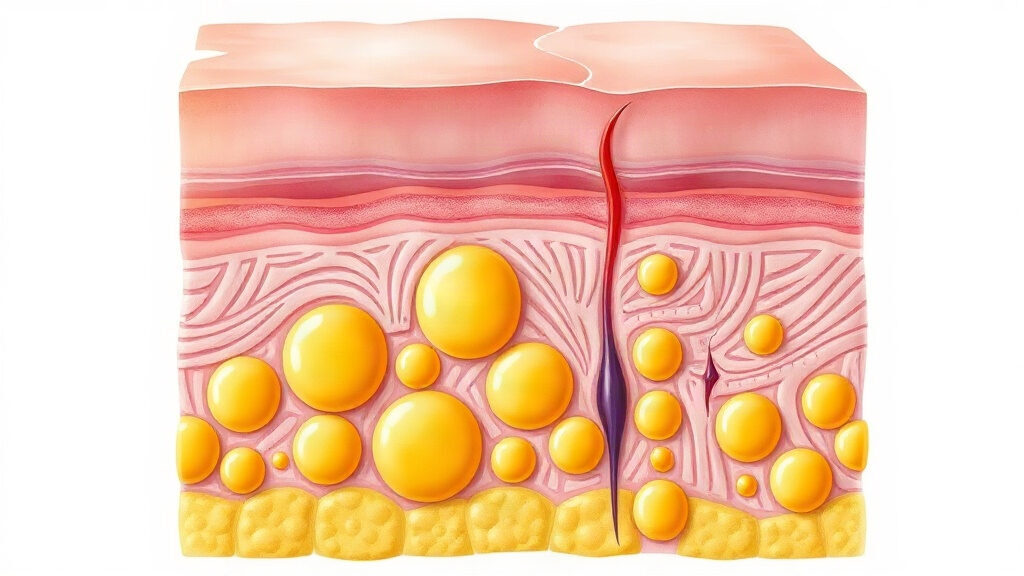
Cellulite is a change in the structure of the hypodermis, the layer of fat beneath the skin, that creates visible dips and bumps on the surface. Dermatologists call it gynoid lipodystrophy or edematous fibrosclerotic panniculopathy. Cellulite mostly appears on the thighs and buttocks, and sometimes on the belly or upper arms.
Cellulite is not a disease. As early as 1978, Nürnberger and Müller described it as an “invented disease”: a normal anatomical feature of women, linked to hormones and almost unavoidable (Nürnberger and Müller, 1978). It has nothing to do with cellulitis, a bacterial skin infection that does require prompt medical attention.
Clinicians distinguish two forms. The “mattress” pattern only shows when the skin is pinched or when standing. Dimples visible at rest correspond to moderate to severe forms, the ones most recent trials have studied.
Mechanism: why cellulite forms
Cellulite results from an imbalance between two forces: fat lobules pushing toward the surface and fibrous bands (septae) pulling the skin downward. In women, these bands tend to be vertical and widely spaced. In men, they form a tight, oblique mesh that holds fat in place more effectively.
- Weaker bands in women: in 20 donors, it took 38.5 newtons to break a band in men, versus 23.3 in women (Rudolph et al., 2019).
- Fewer compartments: men had on average 10 fat lobules under the dermis, women 7.5, a sign of more numerous fibrous connections in men.
- Taller lobules as body mass index rises, which accentuates the uneven surface.
- A dermis that thins with age, regardless of sex, and holds the lobules back less well.
- A hormonal influence: estrogens favor fat storage on the thighs and buttocks, which explains why cellulite appears after puberty.
A 2020 review concludes that the fibrous bands play the central role: treatments that target only fat or the dermis give inconsistent, short-lived results, whereas those that release these bands are the most promising (Bass and Kaminer, 2020). Poor circulation and water retention, often put forward, remain secondary hypotheses.
What clinical studies say about cellulite
The evidence on cellulite remains thin: the review by Luebberding et al. analyzed 67 articles and found “no clear evidence of good efficacy” for any of the treatments assessed. Only acoustic waves and a minimally invasive laser showed an early benefit (Luebberding et al., 2015). Since then, a few better-designed trials have shifted the picture.
In 2025, a systematic review included 24 randomized trials covering 2084 patients. Shock waves emerged as the most consistent option, and the overall quality of evidence was rated moderate. Yet average follow-up did not exceed 3.3 weeks, which says nothing about how long the effects last (Lim et al., 2025).
Extracorporeal shock wave therapy has the most telling trial. Women aged 18 to 65 followed a daily glute-strengthening program for 12 weeks, with 6 sessions of real or sham shock waves. The severity score fell from 10.9 to 8.3 with real sessions, and stayed stable (10.0, then 10.1) with placebo and exercise alone (Knobloch et al., 2013). A meta-analysis of 11 studies (297 women) confirms the trend, but without any data beyond one year (Knobloch and Kraemer, 2015).
Collagenase injections, using an enzyme that cuts the fibrous bands, were tested in two phase 3 trials (RELEASE-1 and RELEASE-2) involving 843 women. An improvement of at least one level on both the physician and patient scales was seen in 37.1% and 41.6% of treated women, versus 17.8% and 11.2% with placebo (Kaufman-Janette et al., 2021). A clear two-level improvement remained rare: 7.6% and 5.6%. Bruising at the injection site was common. This product was never approved in Europe, and its manufacturer stopped selling it in the United States at the end of 2022.
Subcision, which cuts the bands under local anesthesia, showed a 1.5-point gain on the severity scale maintained at 12 months in the CONFFIRM study (Stevens et al., 2023). The study had no control group and was conducted with the device manufacturer.
In practice: which cellulite options, and how strong is the evidence?
Procedures that act on the fibrous bands behind cellulite have the best measured results, but they are medical procedures, paid for out of pocket and needing repetition. Everyday approaches have more modest effects, and sometimes no measurable effect on the skin’s appearance.
| Option | What was measured | Level of evidence | Main limitation |
|---|---|---|---|
| Shock waves (6 sessions) | Severity score from 10.9 to 8.3 in 12 weeks, placebo unchanged | Several randomized trials, small samples | No follow-up beyond one year |
| Collagenase injections | 39.4% responders versus 14.6% with placebo | Two phase 3 trials, 843 women | Not available in Europe, bruising |
| Subcision of the bands | 1.5-point gain maintained at 12 months | Study without a control group | Medical procedure, funded by the manufacturer |
| Retinol cream | Elasticity +10.7% in 6 months, dimples little changed | Small placebo-controlled trial, 15 women | Acts mainly on the skin, not on the dips |
| Oral collagen peptides | Reduced severity in women of normal weight | One placebo-controlled trial, 105 women | Smaller effect in overweight women, single trial |
| Weight loss | Improvement in most women, worsening in some | Observational study | Unpredictable result if starting BMI is low |
Creams have a real but limited effect. In a Belgian trial comparing one leg with the other to cancel out the effect of massage, retinol increased skin elasticity by 10.7% in 6 months, without clearly changing the lumpy appearance (Piérard-Franchimont et al., 2000). A cream combining retinol, caffeine and ruscogenin did better than placebo on skin relief in 46 women, in a trial run by the manufacturer (Bertin et al., 2001).
Oral collagen has been the subject of only one solid trial: 105 women aged 24 to 50 took 2.5 g of peptides a day or a placebo for 6 months. Cellulite severity and skin waviness decreased in women of normal weight, less so in overweight women (Schunck et al., 2015). To place this result among other uses, our analysis of collagen for skin and joints details the evidence. Before taking any supplement, the NHS outlines the precautions to take with vitamins and dietary supplements.
Weight cuts both ways. In women followed during a medically supervised weight-loss program, appearance improved in most, especially when starting BMI was high and thigh fat loss was large. It worsened in those who started with a lower BMI and lost little, with skin becoming looser (Smalls et al., 2006). The causes of weight gain and obesity and the way the body stores energy, the subject of our pillar Deregulated nutrient sensing, shed light on this link.
Tips: tackling cellulite without aiming at the wrong target
No routine makes cellulite disappear, but a few realistic habits improve the skin and the figure without spending on untested products. The realistic goal is to soften the appearance, not to regain perfectly smooth skin.
- Aim for a stable weight rather than repeated diets: yo-yo dieting loosens the skin, and modest weight loss in a slim woman can deepen the dips.
- Strengthen your thighs and glutes 2 to 3 times a week. On its own, this training did not change the severity score in 12 weeks, but it remains useful for body shape and metabolism. The WHO recommends 150 to 300 minutes of moderate physical activity per week.
- Protect your skin from the sun: UV rays speed up thinning of the dermis, as our article on the factors that accelerate wrinkles shows.
- If you use a cream, choose it for its tested active ingredient (retinol) and apply it for at least 6 months, the length of the trials. Expect a gain in elasticity, not the disappearance of dimples.
- Before a medical procedure (shock waves, subcision), ask the practitioner which studies support the technique, how many sessions are planned and what happens at one year.
Be wary of numerical promises about thigh circumference: 1 cm (0.4 in) lost after a massage often reflects a simple shift of water. Warm, swollen and painful redness is not cosmetic cellulite but possibly a skin infection, which warrants a medical opinion the same day.
Frequently asked questions about cellulite
Why do women have more cellulite than men?
Women have vertical, widely spaced fibrous bands under the skin, whereas men’s bands form a tight, oblique mesh. In anatomical donors, it took 23.3 newtons to break a band in women versus 38.5 in men (Rudolph et al., 2019). Estrogens also favor fat storage on the thighs and buttocks.
Do anti-cellulite creams work?
Their effect is modest. In a 6-month placebo-controlled trial, a retinol cream increased skin elasticity by 10.7%, but the lumpy appearance changed little (Piérard-Franchimont et al., 2000). Caffeine creams have mostly been tested by their manufacturers. No cream acts on the fibrous bands, the main cause of dimples.
Does exercise get rid of cellulite?
Exercise alone does not get rid of cellulite. In a randomized trial, 12 weeks of daily glute strengthening did not change the severity score, which went from 10.0 to 10.1 (Knobloch et al., 2013). Physical activity remains useful for weight, body shape and metabolic health, but it does not release the fibrous bands.
What is the difference between cellulite and cellulitis?
Cosmetic cellulite is a benign anatomical feature, with no pain or fever. Cellulitis is a bacterial infection: the skin becomes red, warm, swollen and painful, often with fever. It requires prompt medical attention, sometimes antibiotics. The two only share a similar name.
Does losing weight reduce cellulite?
Most often yes, but not always. In women followed during medically supervised weight loss, appearance improved in most, especially with a high starting BMI and substantial thigh fat loss. It worsened in those who started with a lower BMI and lost little, as the skin became looser (Smalls et al., 2006).
Every week, our health newsletter sums up the studies that help you take care of your skin and your long-term health.
Medical disclaimer. The information on this page is provided for informational purposes only and does not constitute medical advice. It does not replace a consultation. Ask a healthcare professional before changing your diet, taking dietary supplements or starting a new practice, especially if you have a medical condition, are pregnant or are under treatment. Dietary supplements do not replace a balanced diet or medical follow-up. Cosmetic procedures (shock waves, injections, subcision) must be performed by a physician and carry possible side effects.