A fever after 60 does not look like a fever in a young adult: it is missing or mild in 20 to 30% of infections in older people, according to the landmark review published in Clinical Infectious Diseases. A temperature of 37.6 °C (99.7 °F) in an 80-year-old can therefore signal pneumonia, a urinary tract infection or the early stage of sepsis. Here is why the thermometer becomes misleading with age, which thresholds to remember and which signs call for a same-day medical visit.
In brief – A fever after 60 is a rise in body temperature that is often weaker and later than in a young adult, which delays the diagnosis of serious infections. Baseline temperature falls with age: about 36.3 °C (97.3 °F) in the morning among nursing home residents. Guidelines from the Infectious Diseases Society of America therefore set lower thresholds: 37.8 °C (100 °F) once, 37.2 °C (99 °F) repeatedly, or a rise of 1.1 °C (2 °F) above the usual value. In more than half of residents with a serious infection, a classic fever is absent. Conversely, when it is present in the emergency department, it accompanies a serious illness in 76% of cases. Sudden confusion, a fall, refusing to drink or shortness of breath should prompt a medical visit, even without a high reading on the thermometer.
Definition: what counts as a fever after 60?
In older adults, fever is defined by thresholds lower than the usual 38 °C (100.4 °F), because normal body temperature declines with age. The Infectious Diseases Society of America (IDSA) guideline for older adults living in long-term care facilities uses three criteria. The first is a single oral temperature above 37.8 °C (100 °F). The other two are repeated readings above 37.2 °C (99 °F) and a rise of more than 1.1 °C (2 °F) above baseline temperature (High et al., 2009, PubMed). These thresholds were designed for nursing homes, but they also serve as a useful benchmark at home for the frailest people.
The key idea is therefore the change, not the absolute number. A person whose usual temperature is 36.2 °C (97.2 °F) and who reaches 37.4 °C (99.3 °F) shows a rise of 1.2 °C (2.2 °F): that is already a warning sign. The same 37.4 °C in a 30-year-old would not catch anyone’s attention. Knowing the baseline temperature of an older parent changes how you read the thermometer.
| Criterion | Young adult (common benchmark) | Frail older adult (IDSA 2009) |
|---|---|---|
| Single reading | 38 °C (100.4 °F) or higher | Above 37.8 °C (100 °F) orally |
| Repeated readings | Not used | Above 37.2 °C (99 °F) orally, or above 37.5 °C (99.5 °F) rectally |
| Rise above baseline | Rarely taken into account | More than 1.1 °C (2 °F) above usual temperature |
| Typical baseline temperature | About 36.6 °C (97.9 °F) | About 36.3 °C (97.3 °F) in the morning in a nursing home |
Mechanism: why a fever after 60 is misleading
A fever after 60 is misleading because the aging body mounts a weaker thermal response, starting from a baseline temperature that is already lower. In a young person, an infection releases inflammatory messengers (interleukin 1, interleukin 6, TNF alpha) that act on the hypothalamus and raise the body’s internal “thermostat.” With age, this fever chain becomes blunted at several levels. Immunosenescence, meaning the aging of the immune system, is one of its main drivers.
Several mechanisms combine to mask both the fever and the infection:
- Baseline temperature decreases: 0.021 °C lower per decade in a cohort of 35,488 patients (Obermeyer et al., 2017, PubMed), and the gap adds up over the years.
- Aging immune cells produce certain pyrogenic (fever-inducing) signals less efficiently, and the hypothalamus responds to them more slowly.
- Heat production by the muscles declines with sarcopenia, and the narrowing of skin blood vessels that conserves heat works less well.
- Common medications alter the temperature curve: acetaminophen (paracetamol) taken for pain, anti-inflammatory drugs, corticosteroids, and beta-blockers, which also curb the rise in heart rate.
- Dehydration, frequent because the sense of thirst fades, worsens overall condition without necessarily raising the temperature.
The result: without a clear fever, the infection shows up somewhere other than on the thermometer. It appears as confusion, a fall, loss of appetite or a decline in independence. Geriatricians call this an atypical presentation of infection.
What the science says about fever in older adults
Studies agree: fever is often absent or blunted in older adults with an infection, but when it is clear-cut, it signals a serious illness more often than in younger adults. Norman’s review in Clinical Infectious Diseases estimates that this cardinal sign is missing or modest in 20 to 30% of infections in older people (Norman, 2000, PubMed). The author stresses that this delay in detection weighs on a population already more exposed to complications.
A lower baseline temperature with age
Among 150 people with an average age of 80.7 years, the mean oral temperature was 36.3 °C (97.3 °F) at 6 a.m. in a nursing home. Among participants living at home, 90% stayed below 37 °C (98.6 °F) at noon (Gomolin et al., 2005, PubMed). The oldest participants no longer even showed the usual late-day rise. A large Stanford study of 126,705 patients confirms the trend: the mean normal oral temperature did not reach 37 °C in any subgroup. The 99th percentile dropped to 36.81 °C (98.3 °F) in a tall, thin 80-year-old man measured at 8 a.m. (Ley et al., 2023, PubMed).
Nearly one infection in two without a clear fever in long-term care
In a Los Angeles nursing home, 69 infections were analyzed in 26 residents whose mean baseline temperature was 36.3 °C. Nearly half of the episodes (47%) never reached a fever of 38.3 °C (100.9 °F). Yet a quarter of these “blunted” cases showed a rise of at least 1.3 °C (2.3 °F) above baseline (Castle et al., 1991, PubMed). By contrast, 89% of infections exceeded 37.2 °C. Hence the recommendation to lower the alert threshold and to track the gap from the usual temperature.
Fewer symptoms, even with pneumonia
Among 1,812 adults with community-acquired pneumonia, 17 of the 18 symptoms assessed (cough, chills, chest pain and sweats, among others) were reported less often as age increased. The gap persisted even after adjusting for severity and coexisting illnesses (Metlay et al., 1997, PubMed). In an older adult, pneumonia may come down to fatigue, loss of appetite and slightly rapid breathing, with no marked fever.
A clear-cut fever often signals a serious illness
In the emergency department of a Baltimore hospital, 470 patients over 65 who arrived with an oral temperature of at least 37.8 °C were followed. Of these, 76% met a criterion for serious illness: a positive blood culture, a hospital stay of 4 days or more, surgery or death within a month (Marco et al., 1995, PubMed). The most frequent diagnoses were pneumonia (24%), urinary tract infection (21.7%) and sepsis (12.8%). Strikingly, 49.6% of patients with no sign of severity on examination still had a serious illness.
Sepsis strikes people over 65 first
Of 10.4 million hospitalized sepsis cases in the United States between 1979 and 2002, people aged 65 and over made up 12% of the population but 64.9% of cases. Their relative risk reached 13.1 (Martin et al., 2006, PubMed). Age remained an independent risk factor for death. According to the WHO, sepsis affected 48.9 million people and caused 11 million deaths worldwide in 2017, and older people are among the most exposed groups. Acute confusion, or delirium, is often its first sign. The Lancet review by Inouye and colleagues describes delirium as common, serious, underdiagnosed and often fatal in people aged 65 and over (Inouye et al., 2014, PubMed).
In practice: when to see a doctor for a fever after 60
After 60, a fever combined with a sudden change in overall condition warrants medical advice the same day, and some signs require calling emergency services (911 in the US, 999 in the UK, 112 in Europe). The most useful criterion is a break from the person’s usual state: someone who no longer gets up, no longer recognizes loved ones or refuses to drink is unwell, whatever the thermometer says. The review by Chester and Rudolph points out that repeated readings, compared with personal values, detect illness better than a single measurement (Chester and Rudolph, 2011, PubMed).
| Situation | What it may hide | What to do |
|---|---|---|
| Sudden confusion, unusual drowsiness, incoherent speech | Sepsis, urinary tract infection, pneumonia, dehydration | Call emergency services |
| Rapid breathing (30 breaths per minute or more), bluish lips, shortness of breath | Pneumonia, respiratory failure | Call emergency services |
| Mottled skin on the knees, cold hands, very fast pulse (120 or more) | Early septic shock | Call emergency services |
| Temperature of 39.4 °C (102.9 °F) or higher | Serious bacterial infection | Urgent medical visit |
| Rise of more than 1.1 °C (2 °F), a fall, refusing to drink or eat | Early infection with atypical presentation | Primary care doctor the same day |
| Burning on urination, wet cough, red and warm wound | Localized infection | Medical visit within 24 hours |
| Isolated mild fever, overall condition preserved, eating and drinking normally | Probable mild viral infection | Monitor, measure again twice a day |
Certain situations lower the alert threshold even further: diabetes, heart or kidney failure, chemotherapy, long-term corticosteroids, a urinary catheter, recent surgery or known cognitive impairment. Alzheimer’s disease can mask new confusion, and our article on memory loss after 60 helps tell a gradual decline from a sudden change. To understand why the body’s defenses weaken with age, read our feature on immunity and aging and the pillar page devoted to intercellular communication, where inflammaging belongs.
Tips: measuring and monitoring a fever after 60 in a loved one
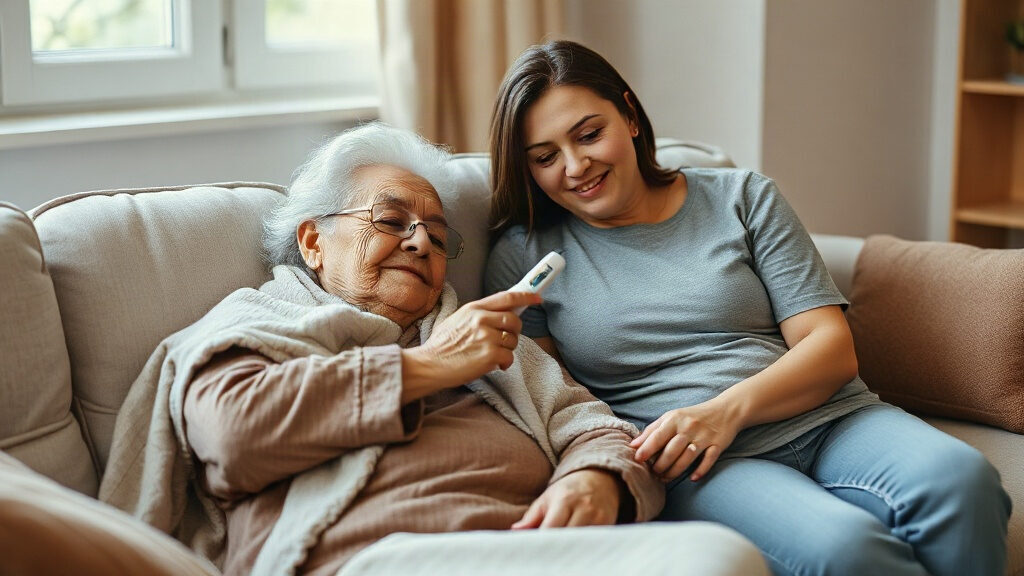
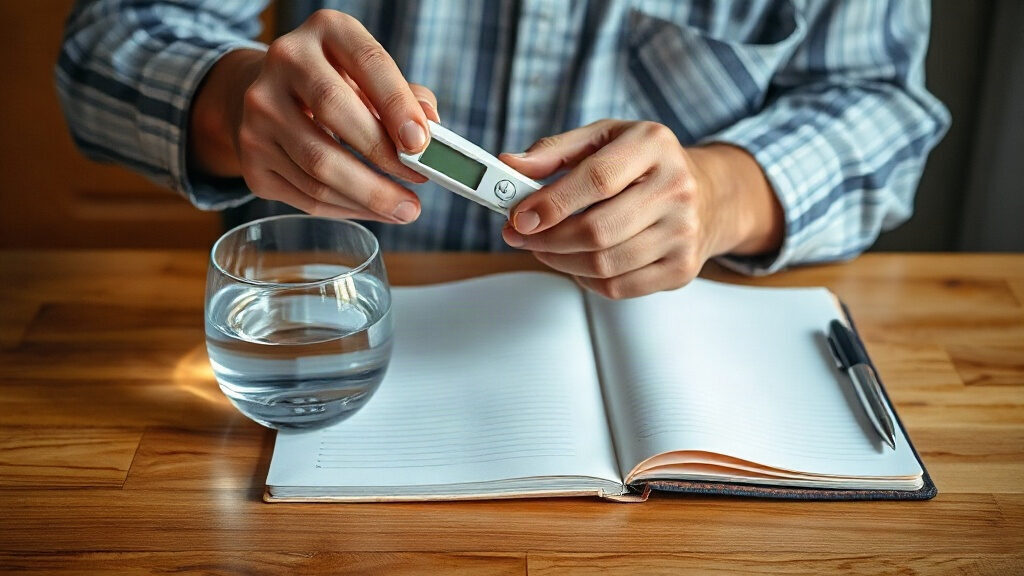
The best tool against a misleading fever is a known baseline temperature, recorded in advance while the person is healthy. Take it three mornings in a row at the same time, with the same thermometer, and write the average in the health record or on a phone. If a fever occurs, you will have a reliable point of comparison.
- Use an electronic thermometer by mouth, rectum or armpit, and always stick to the same route: non-contact forehead readings are less accurate.
- Wait 30 minutes after a meal, a hot or cold drink, a shower or physical effort before taking an oral reading.
- Measure morning and evening for as long as the fever lasts, and write down the time, the reading and any medications taken.
- Also take the pulse and count breaths over one minute: a high breathing rate is one of the most telling signs.
- Offer small amounts of fluid regularly, even without thirst, to limit dehydration (our article on hydration after 60 details daily needs).
- Follow the acetaminophen (paracetamol) label and check that no other medication in the cabinet contains it, to avoid an overdose.
Acetaminophen improves comfort but masks fever: always tell the doctor when the last dose was taken. Avoid self-medicating with anti-inflammatory drugs after 65, because of the risk to the kidneys and the digestive tract. For prevention, vaccination against influenza, pneumococcus, COVID-19 and RSV reduces the risk of serious respiratory infections, as explained in our feature on vaccination and age. Detailed recommendations depend on each person’s profile: talk to the primary care doctor or the pharmacist. To receive our monthly summaries on healthy aging, subscribe to our health newsletter.
Frequently asked questions about fever after 60
At what temperature is an older person considered to have a fever?
In a frail older adult, the Infectious Diseases Society of America guideline (2009) uses an oral temperature above 37.8 °C (100 °F) once, above 37.2 °C (99 °F) on repeated readings, or a rise of more than 1.1 °C (2 °F) above the usual value. These thresholds are lower than the classic 38 °C (100.4 °F), because baseline temperature declines with age, to around 36.3 °C (97.3 °F) in the morning in long-term care.
Why can an older person have an infection without a fever?
The aging immune system produces a weaker inflammatory response, the hypothalamus reacts more slowly and the starting temperature is lower. Some medications, such as acetaminophen, corticosteroids or anti-inflammatory drugs, also flatten the curve. Norman’s review (2000) estimates that a fever after 60 is missing or modest in 20 to 30% of infections, which then reveal themselves through confusion or a fall.
Which signs in a feverish older adult mean calling emergency services?
Call emergency services (911 in the US, 999 in the UK, 112 in Europe) in case of sudden confusion or unusual drowsiness, rapid or labored breathing, bluish lips, mottled skin, cold hands with a very fast pulse, or a person who has barely urinated all day. These signs may point to sepsis. The WHO lists older people among the groups most exposed to this life-threatening emergency.
What is the difference between a mild fever and a worrying fever after 60?
A mild fever comes with a preserved overall condition: the person drinks, eats, gets up and stays alert. A worrying fever changes behavior or independence, or comes with rapid breathing. The number alone is not enough: in a Baltimore emergency department, 49.6% of patients over 65 with no sign of severity on examination still had a serious illness (Marco et al., 1995).
How can you find out an older parent’s normal temperature?
Measure their temperature three mornings in a row while they are healthy, at the same time, with the same thermometer and the same route. Write the average in their health record. Among nursing home residents with an average age of 80.7 years, it averaged 36.3 °C (97.3 °F) in the morning (Gomolin et al., 2005). During an infection, a rise of more than 1.1 °C (2 °F) above this value is a warning sign, even below 38 °C (100.4 °F).
Medical disclaimer. The information on this page is provided for informational purposes only and does not constitute medical advice. It does not replace a consultation or a diagnosis. In an older person, sudden confusion, difficulty breathing, mottled skin or unusual drowsiness require calling emergency services (911 in the US, 999 in the UK, 112 in Europe) without delay, even if the temperature seems normal. Do not give an anti-inflammatory drug without medical advice, and follow the acetaminophen (paracetamol) doses stated on the label. Ask a healthcare professional before changing any treatment, especially if you have a chronic condition or are currently under treatment.