The blue light from screens is blamed for ruining our nights, but research paints a far more nuanced picture. Since the 2002 discovery of the retinal cells that inform the body clock, dozens of laboratory trials have measured its effect on melatonin and on falling asleep. The result: the effect is real, it depends mostly on the intensity and timing of exposure, and the products on sale (filtering glasses, night mode) deliver less than simply dimming the lights in the evening.
In brief – Blue light is the part of the visible spectrum around 446 to 477 nanometers, the band that most strongly suppresses melatonin secretion in the evening (Brainard et al., 2001). It acts through melanopsin, a pigment found in retinal cells wired to the biological clock. In the laboratory, ordinary household lighting is enough to delay melatonin: 24.6 lux on average cuts its production by half (Phillips et al., 2019), with a sensitivity that ranges from 6 to 350 lux between individuals. Reading on a backlit e-reader delays sleep onset compared with a printed book (Chang et al., 2015). By contrast, the iPhone’s night mode did not improve the sleep of 167 young adults, and the 2023 Cochrane review rates the effect of filtering lenses as uncertain. The best-supported lever: plenty of light during the day, and less than 10 melanopic lux in the 3 hours before bedtime.
Definition: what is blue light?
The term refers to the short wavelengths of the visible spectrum, between roughly 400 and 500 nanometers. The sun is its main source: midday light contains a lot of it, which gives it its “cool” appearance. White LEDs also emit it, because they are built from a blue diode coated with a layer of yellow phosphor, and Harvard Health Publishing notes that LED lights produce a fair amount of light in the blue spectrum. The higher the share of blue, the higher the color temperature and the cooler and whiter the lighting looks.
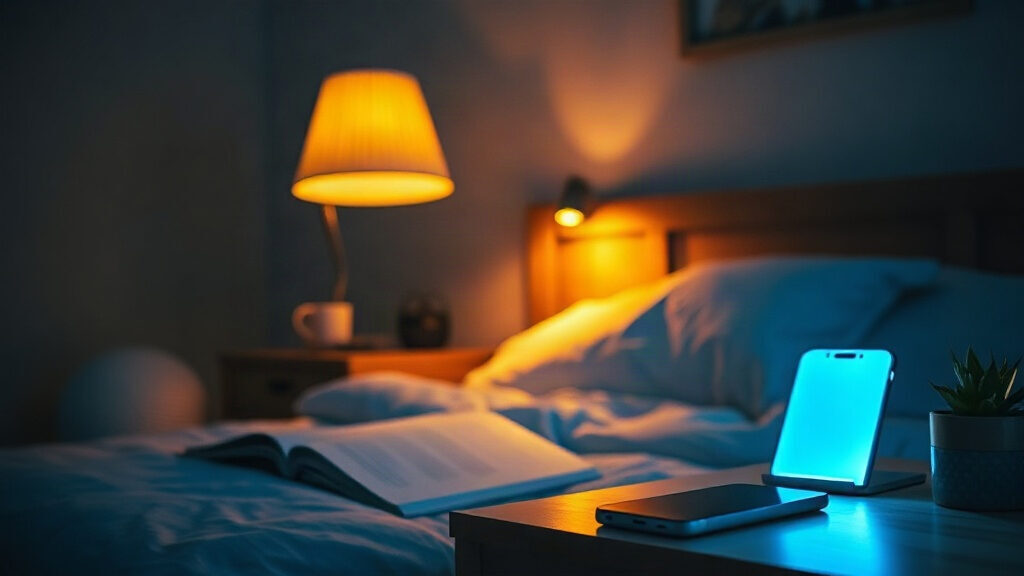
Smartphone, tablet, computer and television screens are backlit by LEDs. They therefore emit some of it, but at a far lower intensity than the outdoor sky. This difference in intensity explains much of the confusion: the glow of a screen is not dangerous in itself, and what matters for sleep is the time of day you are exposed to it.
| Source | Typical illuminance at the eye | Share of blue | Critical time for sleep |
|---|---|---|---|
| Outdoor daytime sky | Over 1,000 lux, even when cloudy | High | None, this is the signal you want in the morning |
| Cool white LED indoor lighting | 100 to 500 lux | High | The 3 hours before bedtime |
| Warm white indoor lighting | 100 to 500 lux | Medium | The 3 hours before bedtime |
| Smartphone or tablet held close to the face | A few tens of lux | High | In bed, with the lights off |
| Candle or amber lamp | A few lux | Very low | Little measured effect |
Mechanism: how blue light acts on the sleep clock
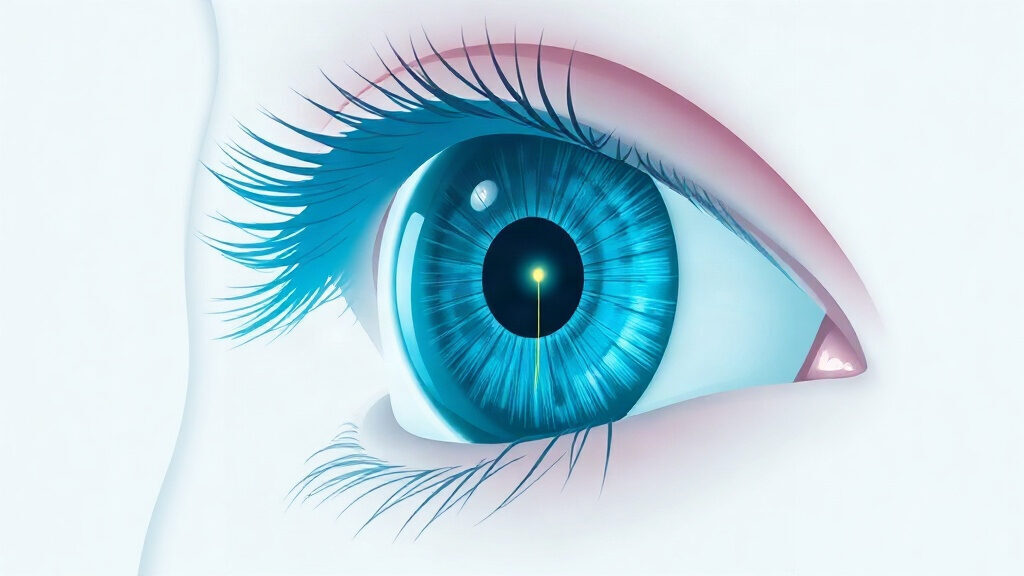
Blue light affects sleep through a pathway separate from vision. In 2002, Samer Hattar’s team described retinal ganglion cells containing melanopsin, intrinsically sensitive to light and connected to the suprachiasmatic nucleus, the brain’s master clock (Hattar et al., 2002, PubMed). These cells are not used to see shapes: they measure the amount of ambient light to tell the body whether it is daytime.
A year earlier, George Brainard had run 627 nighttime melatonin suppression tests in 72 volunteers, using monochromatic lights from 420 to 600 nm. Peak efficacy fell between 446 and 477 nm, right in the blue range (Brainard et al., 2001, PubMed). Here is how the chain of events unfolds:
- melanopsin captures blue-rich light and sends a “daytime” signal to the suprachiasmatic nucleus;
- the master clock slows the pineal gland, which produces less melatonin, the hormone that signals night;
- the onset of nighttime secretion shifts later, which delays the feeling of sleepiness;
- alertness rises at the very moment of exposure, which pushes people to stay up later.
This system is useful in the morning: the blue component of daylight sets the clock and helps you fall asleep earlier in the evening. It becomes a problem when the “daytime” signal arrives at 11 p.m. To learn more about this morning role, read our article on morning light and the circadian clock.
What science says about blue light and sleep
Science confirms a real effect of evening light on melatonin, but the glow of screens is only part of the story. Room lighting often weighs more. In an analysis of 116 volunteers aged 18 to 30, ordinary light of less than 200 lux switched on before bedtime delayed melatonin onset in 99% of them and shortened its secretion by about 90 minutes (Gooley et al., 2011, PubMed).
Individual sensitivity varies enormously. In 55 participants exposed to intensities from 10 to 2,000 lux for 5 hours in the evening, the average dose that halved melatonin was only 24.6 lux. Light at 30 lux delayed melatonin onset by 77 minutes, and light at 50 lux by 109 minutes. The most sensitive participant reacted from 6 lux, the least sensitive at 350 lux (Phillips et al., 2019, PubMed).
For the light emitted by the screens themselves, two trials are the reference. In Basel, 13 young men exposed for 5 hours to an LED-backlit computer screen showed a blunted rise in melatonin and reduced sleepiness compared with a screen emitting less blue (Cajochen et al., 2011, PubMed). In Boston, reading for several evenings on a backlit e-reader rather than a printed book lengthened the time needed to fall asleep, lowered melatonin, delayed the clock and reduced alertness the next morning (Chang et al., 2015, PubMed).
Beyond color, what really matters is the amount captured by melanopsin, measured in “melanopic lux.” A Swiss trial in 72 men varied this component while keeping screen brightness constant: less melanopic light shortened sleep onset and protected evening melatonin, with a dose-dependent effect (Schöllhorn et al., 2023, PubMed). An international consensus derived numerical thresholds from this work, shown in the table below (Brown et al., 2022, PubMed).
| Time | Recommended threshold at eye level | Goal |
|---|---|---|
| Daytime | At least 250 melanopic lux | Strengthen the “daytime” signal and alertness |
| Evening, from 3 hours before bedtime | 10 melanopic lux at most | Let melatonin rise |
| During sleep | 1 melanopic lux at most | Avoid small nighttime light signals |
Regarding eye health, the French food and environmental safety agency (Anses) concluded in 2019 that intense blue-wavelength light is toxic to the retina and may contribute over the long term to age-related macular degeneration. These conclusions mainly concern strong exposures and very blue-rich sources, not normal phone use. The agency also notes sleep-disrupting effects “even at very low levels, in the evening or at night,” particularly in children, whose lens filters blue less than that of adults or older people.
In practice: glasses, night mode, filters, do they really work?
The consumer products sold as blue filters have a low level of evidence. The most recent Cochrane review pooled 17 randomized trials, each with 5 to 156 participants. It concludes that the effect of filtering lenses on sleep remains unknown: of six trials, three report an improvement and three no difference, with “very low” certainty (Singh et al., 2023, PubMed). According to the available data, these lenses do not reduce short-term eye strain either.
Phone night mode gives a similar result. In a randomized trial, 167 students aged 18 to 24 used their iPhone for one hour before bedtime for 7 nights, with or without Night Shift, or did not use a phone at all. Actigraphy showed no difference in sleep between the three groups. Among those who usually slept more than 6.8 hours, only the no-phone group slept better (Duraccio et al., 2021, PubMed). A logical outcome: night mode slightly reduces the blue component, but not the stimulation of the content or the room lighting.
Amber glasses, which block far more blue than standard “blue-blocking” lenses, show a more favorable but still fragile signal. In 14 adults with insomnia, wearing them 2 hours before bedtime for one week improved insomnia scores and sleep time compared with clear lenses (Shechter et al., 2018, PubMed). A trial of 14 people is not enough to support a general recommendation.
| Solution | What the studies show | Level of evidence |
|---|---|---|
| Dimming and warming room lighting | Less melatonin delay (Gooley 2011, Phillips 2019) | Good in the laboratory |
| Stopping screens before bedtime | Better sleep than night mode in good sleepers (Duraccio 2021) | Moderate |
| Amber glasses 2 hours before bedtime | Improvement in 14 people with insomnia (Shechter 2018) | Low |
| Commercial “blue-blocking” lenses | Effect on sleep unknown, 17 trials (Cochrane 2023) | Very low |
| Phone night mode alone | No measured difference in 167 adults (Duraccio 2021) | Low, null result |
This topic belongs to the altered intercellular communication pillar, because the master clock uses hormonal and nervous signals to synchronize the clocks of every organ. Our guide to the circadian clock details the other time cues: meals, physical activity and regular schedules.
Protocol: 7 habits to limit evening blue light
The most effective step against evening blue light is to reduce all light, not only the light from screens. The recommendations below follow the 2022 consensus thresholds and the advice of the French agency Anses, with no expensive equipment:
- Go outside in the morning: a walk before noon provides more than 1,000 lux, even under a gray sky, and makes the clock less sensitive to evening light.
- Switch to warm lighting after dinner: “warm white” bulbs of 2,700 kelvins or less, and a low lamp rather than a ceiling light.
- Aim for dim light 3 hours before bedtime, which matches the 10 melanopic lux threshold: you can still read comfortably with an amber bedside lamp.
- Turn off screens at least 30 minutes before sleep, as the printed book remains the reference in trials.
- If a screen is still needed, lower its brightness and blue output to the minimum and hold it farther from your face: distance reduces the light reaching your eyes.
- Make the bedroom completely dark: cover standby lights, often LEDs rich in blue, or wear a sleep mask.
- Keep a dim red or orange light for getting up at night, rather than switching on the ceiling light.
After 60, the issue often shifts toward too little light during the day: fewer outings, poorly lit interiors. The lens, which yellows with age, filters more blue, which could weaken the “daytime” signal received by the clock. Generous morning exposure then matters as much as keeping evening light low. If falling asleep remains difficult despite these habits, talk to your doctor before turning to melatonin. To receive our science summaries on sleep, subscribe to our health newsletter.
Frequently asked questions about blue light
Does blue light from screens really keep you awake?
It delays sleep onset, modestly in most adults. In the laboratory, reading on a backlit e-reader rather than a printed book lengthens the time needed to fall asleep and lowers melatonin (Chang et al., 2015). Room lighting often weighs more than the screen, and stimulating content (messages, videos, games) also pushes back bedtime. Sensitivity varies widely: from 6 to 350 lux depending on the person.
Do blue light glasses improve sleep?
The evidence remains insufficient. The 2023 Cochrane review, covering 17 randomized trials, rates the effect of filtering lenses on sleep as unknown, with three positive and three neutral trials out of six. Amber glasses, which filter much more, improved the sleep of 14 people with insomnia in a small 2018 trial. Dimming evening lighting remains the best-supported measure.
Is smartphone night mode enough to protect sleep?
No, according to the strongest trial on the question. In 167 students followed for 7 nights with actigraphy, using an iPhone with Night Shift gave no advantage over an iPhone without the filter (Duraccio et al., 2021). Among participants sleeping more than 6.8 hours, only stopping phone use entirely before bedtime improved sleep quality. Night mode slightly reduces blue, not stimulation.
How long before bedtime should you avoid blue light?
The 2022 international consensus recommends staying below 10 melanopic lux from 3 hours before your usual bedtime, then below 1 lux during sleep (Brown et al., 2022). In practice: warm, dim lighting after dinner, screens off at least 30 minutes before sleep, and a completely dark bedroom. In the morning, on the contrary, aim for at least 250 melanopic lux, ideally outdoor daylight.
Does blue light damage the eyes?
At high intensity, yes. The French agency Anses concluded in 2019 that intense blue light is toxic to the retina and may contribute over the long term to age-related macular degeneration. Normal screen use delivers a far lower intensity than the sun. Children remain more exposed, because their lens filters blue less than that of adults or older people.
Medical disclaimer. The information on this page is provided for informational purposes only and does not constitute medical advice. It does not replace a consultation. Persistent sleep problems (difficulty falling asleep, frequent awakenings, daytime sleepiness) warrant medical advice. Ask a healthcare professional before changing your diet, taking dietary supplements such as melatonin or starting a new practice, especially if you have an eye condition, are pregnant or are under treatment. Dietary supplements do not replace a balanced diet or medical follow-up.