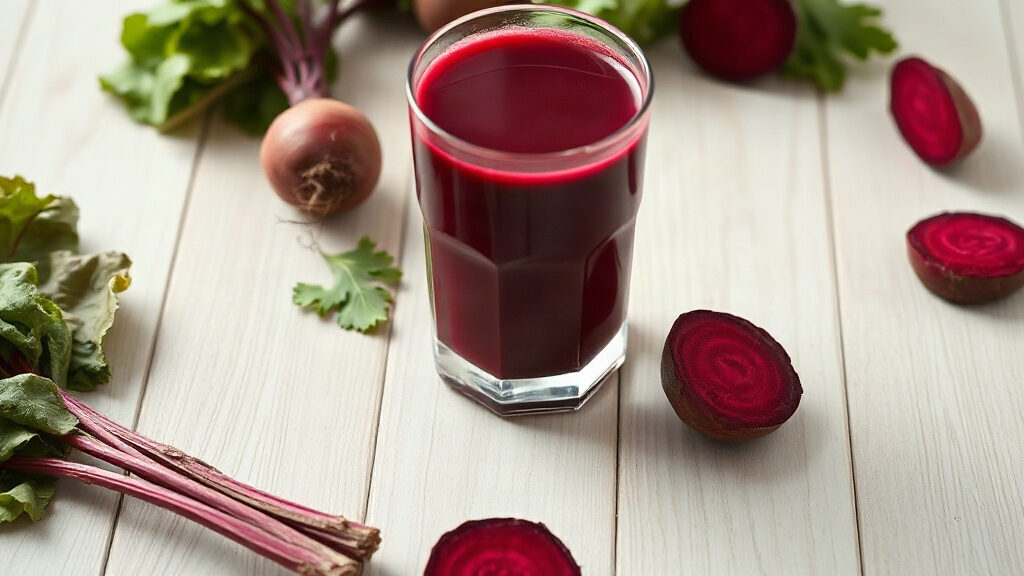
Beetroot juice lowers blood pressure, but the effect depends on the nitrate dose and on the person drinking it. Since 2008, randomized trials in London, Newcastle and Gothenburg have measured this drop in healthy volunteers, adults with hypertension and older adults. The figures range from 4 to 8 mmHg of systolic pressure, depending on the amount consumed and on whether blood pressure is already treated. Here is the useful dose, the profiles that respond best, those that do not respond, and the precautions to know before counting on this root vegetable.
In brief – Beetroot juice is made from a root vegetable rich in inorganic nitrate, and it lowers systolic blood pressure by 4 to 8 mmHg in randomized trials. The effective dose lies between 250 and 500 mL (about 8.5 to 17 fl oz) of juice a day, or 300 to 800 mg of nitrate, the equivalent of 200 to 300 g (7 to 10.5 oz) of raw beetroot. The mechanism relies on tongue bacteria converting nitrate into nitrite, then into nitric oxide, a vasodilator. The effect is clearest in adults with untreated hypertension, in people with prehypertension and after age 65. It becomes weak or absent in patients already well controlled by medication. A daily antiseptic mouthwash cancels the effect. People prone to oxalate kidney stones and those taking vasodilator drugs should seek medical advice before daily use.
Beetroot and blood pressure: what exactly are we talking about?
Red beetroot (Beta vulgaris, called beets in the US) is among the vegetables richest in dietary nitrate, with more than 250 mg per 100 g (3.5 oz) of raw root according to the analysis by Hord et al., published in 2009 in the American Journal of Clinical Nutrition. This nitrate is the same compound found in spinach, arugula or celery. It has nothing to do with nitrate drugs (nitroglycerin) or with the nitrites added to cured meats.
Concentrated beetroot juice is the test product in most clinical trials, because it allows nitrate to be dosed precisely and makes it possible to produce a placebo that tastes identical but contains no nitrate. The results apply to the whole vegetable, provided comparable amounts are eaten. The actual content varies with soil, season and variety, by a factor of up to three in the study by Hord et al.
How the nitrate in beetroot juice lowers blood pressure
Swallowed nitrate does nothing by itself. It is absorbed in the gut, concentrated in saliva, then reduced to nitrite by anaerobic bacteria living on the tongue. This nitrite, back in the stomach and the bloodstream, is converted into nitric oxide, a molecule that relaxes the artery wall. This enterosalivary circuit was demonstrated in humans by Amrita Ahluwalia’s team in London.
- Absorption: nitrate reaches the blood 30 to 60 minutes after ingestion.
- Oral reduction: tongue bacteria convert about 20% of the nitrate into nitrite.
- Nitric oxide production: plasma nitrite peaks 2 to 3 hours after intake, which coincides with the maximum drop in blood pressure.
- Associated effects: endothelial function improved by about 20% and arterial stiffness fell by 0.59 m/s after 4 weeks in the Kapil 2015 trial.
This mechanism explains a little-known vulnerability. In the study by Kapil et al. (2013, n=19), 7 days of chlorhexidine mouthwash cut oral nitrite production by 90% and raised blood pressure by 2 to 3.5 mmHg in healthy volunteers. To learn more about this vascular messenger, see our article on ways to boost nitric oxide, as well as our pillar page on altered intercellular communication, where nitric oxide signaling is a central example.
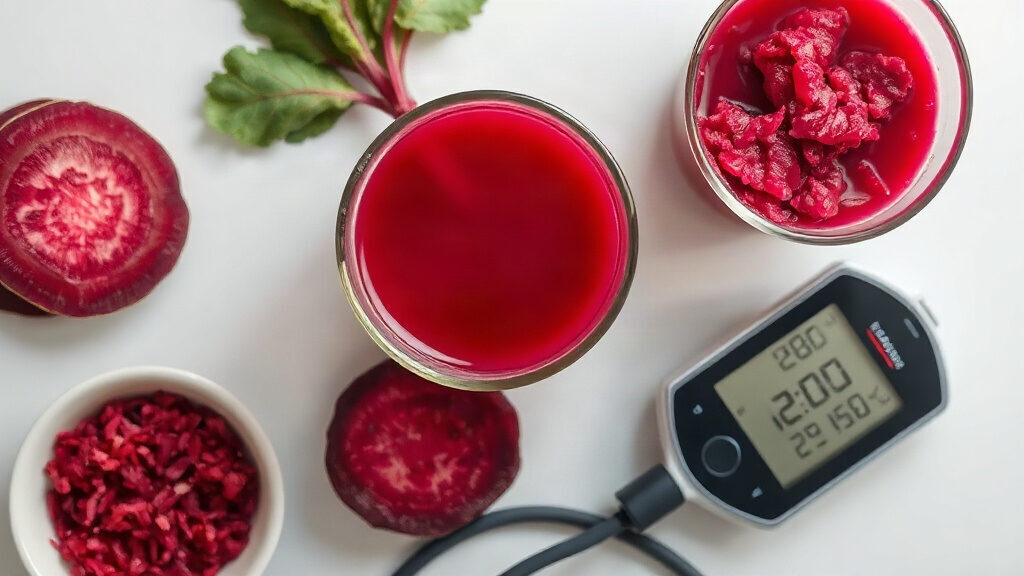
What the science says about beetroot juice: measured effect, dose and duration
Placebo-controlled randomized trials converge on an average drop of 4 to 5 mmHg in systolic pressure, with a dose-dependent effect. The first demonstration dates from 2008: in healthy volunteers, 500 mL of beetroot juice lowered blood pressure by 10.4/8 mmHg at the peak, about 3 hours after ingestion (Webb et al. 2008, Hypertension).
The meta-analysis by Siervo et al. (2013), which pools 16 crossover trials and 254 participants, puts the effect at -4.4 mmHg systolic and -1.1 mmHg diastolic, with a significant relationship between daily nitrate dose and the size of the drop (PubMed 23596162). The interventions lasted from 2 hours to 15 days.
The reference trial in people with hypertension remains the one by Kapil et al. (2015): 68 patients, 250 mL of juice a day for 4 weeks, versus a nitrate-free placebo. Clinic blood pressure fell by 7.7/2.4 mmHg, 24-hour ambulatory pressure by 7.7/5.2 mmHg and home blood pressure by 8.1/3.8 mmHg, with no loss of effect over the weeks (PubMed 25421976). Two more recent meta-analyses confirm the order of magnitude in hypertensive patients: -4.95 mmHg systolic across 7 trials and 218 patients (Benjamim et al. 2022), then -5.31 mmHg across 11 trials and 349 patients, for daily intakes of 200 to 800 mg of nitrate (Grönroos et al. 2024). In this last analysis, the effect on diastolic and ambulatory pressure does not reach significance, and the authors rate the certainty of evidence as low.
| Study | Population | Dose and duration | Systolic drop |
|---|---|---|---|
| Webb 2008 | Healthy volunteers | 500 mL of juice, single dose | -10.4 mmHg at peak (3 h) |
| Siervo 2013 (meta-analysis) | 254 adults, 16 trials | Variable, 2 h to 15 days | -4.4 mmHg |
| Kapil 2015 | 68 hypertensive patients, treated or untreated | 250 mL of juice a day, 4 weeks | -7.7 mmHg (clinic and ambulatory) |
| Bondonno 2015 | 27 treated hypertensive patients | Nitrate-rich juice, 1 week | No significant effect |
| He 2021 (meta-analysis) | Older adults, 22 trials | Inorganic nitrate, single dose to several weeks | -3.9 mmHg |
| Grönroos 2024 (meta-analysis) | 349 hypertensive patients, 11 trials | 200 to 800 mg of nitrate a day | -5.31 mmHg |
To put these figures in context: a 5 mmHg drop in systolic pressure is roughly what a substantial salt reduction or regular physical activity achieves, and it remains smaller than the effect of a standard dose of blood pressure medication. The World Health Organization points out that one adult in three worldwide lives with hypertension, often without knowing it (WHO fact sheet on hypertension). The NHS explains the diagnostic thresholds and the standard treatments (NHS, high blood pressure).
Who beetroot juice works for, and who it does nothing for
The response to nitrate from beetroot depends first on baseline blood pressure. The meta-analysis by He et al. (2021), focused on older adults, finds a drop of 3.9 mmHg systolic and 2.6 mmHg diastolic across 22 trials, with a stronger effect after 65, in people with obesity (BMI above 30) and in prehypertension. In participants already diagnosed with hypertension and treated, the effect is no longer significant in this analysis (PubMed 33905826).
The trial by Bondonno et al. (2015) points the same way: in 27 patients whose hypertension is controlled by treatment, one week of nitrate-rich beetroot juice produced no additional drop (PubMed 26135348). Kapil 2015, which included 34 treated patients, nevertheless observed a drop in both subgroups. The likely difference lies in duration (4 weeks versus 1) and in the initial level of control: the lower blood pressure already is, the less room nitrate has to act.
Vascular age matters too. In the analysis by Siervo et al. (2015) of 85 participants aged 55 to 76, beetroot reduced nighttime systolic variability by 2.8 mmHg before 65, but not after (PubMed 25937622). These results, seemingly at odds with He 2021, are a reminder that individual response varies widely, depending on the ability to convert nitrate and on the health of the artery wall.
| Profile | Expected response | Level of evidence |
|---|---|---|
| Adult with prehypertension (130-139 / 85-89 mmHg) | Systolic drop of 4 to 5 mmHg | Meta-analyses, moderate evidence |
| Untreated hypertension | Systolic drop of 5 to 8 mmHg over 4 weeks | Kapil 2015, Grönroos 2024, low to moderate evidence |
| Hypertension well controlled by medication | Weak or no effect in the short term | Bondonno 2015, He 2021 |
| Adult over 65 | Drop of 3 to 4 mmHg, variable response | He 2021, Siervo 2015 |
| Person with normal blood pressure | Temporary drop lasting a few hours | Webb 2008 |
| Daily user of antiseptic mouthwash | Effect canceled | Kapil 2013 |
Before relying on beetroot juice, you first need to know your own numbers. Our article on the blood pressure number that should raise a flag explains how to measure correctly at home. Nitrate pairs well with the other plant-based lever for blood pressure, potassium, covered in our guide potassium: benefits, dosage and precautions.
What dose of beetroot juice to aim for, and in what form
The dose validated by trials is 250 mL (about 8.5 fl oz) of beetroot juice a day, or roughly 400 mg of nitrate (6.4 mmol in Kapil 2015). Grönroos 2024 places the active range between 200 and 800 mg of nitrate daily. As a whole vegetable, that means 150 to 300 g (5.3 to 10.6 oz) of raw beetroot, depending on its content. The 70 mL (2.4 fl oz) concentrated shot used in several trials provides 300 to 400 mg of nitrate.
| Form | Amount | Approximate nitrate | Note |
|---|---|---|---|
| Grated raw beetroot | 150 to 200 g | 300 to 500 mg | Content varies with soil and season |
| Steamed beetroot | 200 to 250 g | 250 to 450 mg | Boiling leaches part of the nitrate into the water |
| Pressed juice | 250 mL | 300 to 450 mg | Dose used in the Kapil 2015 trial |
| Concentrate (shot) | 70 mL | 300 to 400 mg | Format of sports trials, nitrate stated on the label |
- Timing: the maximum effect comes 2 to 3 hours after intake. Drinking it in the morning covers the daytime rise in blood pressure.
- Consistency: the lasting drops (Kapil 2015) were obtained with daily intake for 4 weeks, with no tolerance developing.
- Mouth: avoid daily antiseptic mouthwash (chlorhexidine), which blocks the conversion of nitrate.
- Measurement: keep a home blood pressure log before and after 4 weeks, morning and evening, to see the real effect.
- Alternatives: arugula, spinach, celery and lettuce provide comparable amounts of nitrate and add variety.
Two precautions deserve attention. Beetroot is rich in oxalates: people who have had calcium oxalate kidney stones should talk to their doctor before eating it daily. Pink urine or stools (beeturia) after a beetroot meal are harmless and affect 10 to 14% of people. Finally, a regular nitrate intake can add to the effect of a vasodilator or of existing blood pressure treatment: the decision to add a dietary measure to a treatment is made with the prescriber, never in place of the medication. If you feel dizzy, our article on low blood pressure after 60 helps explain the causes.
To receive this kind of figure-based reading of the studies every week, subscribe to the UltraSanté health newsletter.
Frequently asked questions about beetroot juice and blood pressure
How much beetroot juice or beetroot a day lowers blood pressure?
Clinical trials used 250 mL of beetroot juice a day, or about 400 mg of nitrate, for 4 weeks. As a whole vegetable, this corresponds to 150 to 300 g of raw or steamed beetroot, depending on its nitrate content. The Grönroos 2024 meta-analysis places the active range between 200 and 800 mg of nitrate daily, with no proven benefit beyond that.
How long does beetroot take to affect blood pressure?
A single dose lowers blood pressure within 2 to 3 hours of intake, with a peak that follows the rise of nitrite in the blood (Webb 2008). The effect of one dose wears off within 24 hours. For a stable drop, studies show a sustained benefit with daily intake over 4 weeks, with no tolerance (Kapil 2015, 68 patients).
Why does beetroot not work for some people?
Three reasons stand out. Blood pressure already well controlled by medication leaves little room for nitrate (Bondonno 2015). Daily use of an antiseptic mouthwash kills the tongue bacteria that convert nitrate into nitrite (Kapil 2013). Finally, aging of the artery wall reduces the response to nitric oxide in some people over 65 (Siervo 2015).
What is the difference between beetroot juice and whole beetroot?
Juice concentrates nitrate in a small volume and allows precise dosing, which is why clinical trials use it. Whole beetroot provides the same nitrate, plus fiber and fewer free sugars per serving. You need to eat 150 to 300 g to reach the dose used in studies. Boiling leaches part of the nitrate into the cooking water, while steaming preserves it better.
Can beetroot juice replace blood pressure medication?
No. The average drop achieved, 4 to 8 mmHg systolic, remains smaller than that of a blood pressure drug and varies widely from one person to another. The authors of the meta-analyses describe dietary nitrate as a possible complement to treatment, with low to moderate certainty of evidence. Any change to a treatment should be discussed with the prescribing doctor, based on home blood pressure readings.
Medical disclaimer. The information on this page is provided for informational purposes only and does not constitute medical advice. It does not replace a consultation. Ask a healthcare professional before changing your diet, taking dietary supplements or starting a new practice, especially if you have a medical condition, are pregnant or are under treatment. Dietary supplements do not replace a balanced diet or medical follow-up.