
Lithium is not only a treatment for bipolar disorder: it also circulates in trace amounts in our water and food, and researchers are now asking whether a lithium deficiency could speed up brain aging. In August 2025, a Harvard team showed in the journal Nature that levels of this metal fall in the brain as soon as the first memory problems appear. In mice, depriving the animals of it accelerates the lesions of Alzheimer’s disease. In humans, however, no deficiency has been demonstrated to date, and self-medication exposes people to a substance with a narrow safety margin.
In brief – Lithium is a trace element found in small amounts in water and food that, inside neurons, slows down GSK-3, an enzyme involved in Alzheimer’s disease. In 2025, Harvard researchers measured 27 metals in 348 human brains. Only this one was depleted in the prefrontal cortex of people with mild cognitive impairment or Alzheimer’s disease. In mice, a lithium deficiency that halved brain levels sharply increased amyloid plaques, synapse loss and memory decline. In humans, the evidence remains indirect: regions where tap water contains more lithium, patients on long-term treatment, and small clinical trials that are encouraging but mixed. No trial has yet shown that lithium intake prevents dementia. Blood levels do not reflect brain levels, and the supplements sold online have never been evaluated in humans for this purpose.
What is lithium?
Lithium, the third element of the periodic table, is the lightest of all metals. Rocks and soils contain it everywhere, water dissolves varying amounts depending on local geology, and plants then absorb it through their roots. According to a review published in 2002, grains and vegetables are the main dietary sources. Drinking water can also provide a significant intake in some regions (Schrauzer, 2002).
Its nutritional status is still debated. In rats and goats fed diets low in lithium, mortality, reproductive problems and behavioral abnormalities increased. The same author proposed a provisional intake of 1,000 µg per day for a 70 kg (154 lb) adult, while noting that no deficiency disease has been characterized in humans. No agency has endorsed this figure: the dietary reference values of the European Food Safety Authority (EFSA) for vitamins and minerals include no value for this element.
At much higher doses, lithium salts have been the long-term treatment for bipolar disorder for decades. This drug has a narrow therapeutic margin: treatment aims for a minimum blood concentration of 0.5 to 0.8 mEq/L, and the NHS explains that regular blood tests are needed so that the level is neither too high nor too low. According to the Harvard team, these doses raise blood levels about 1,000 times above the natural level. The whole question of brain aging plays out between these two worlds: the traces in our food and the medicine.
How lithium acts on neurons
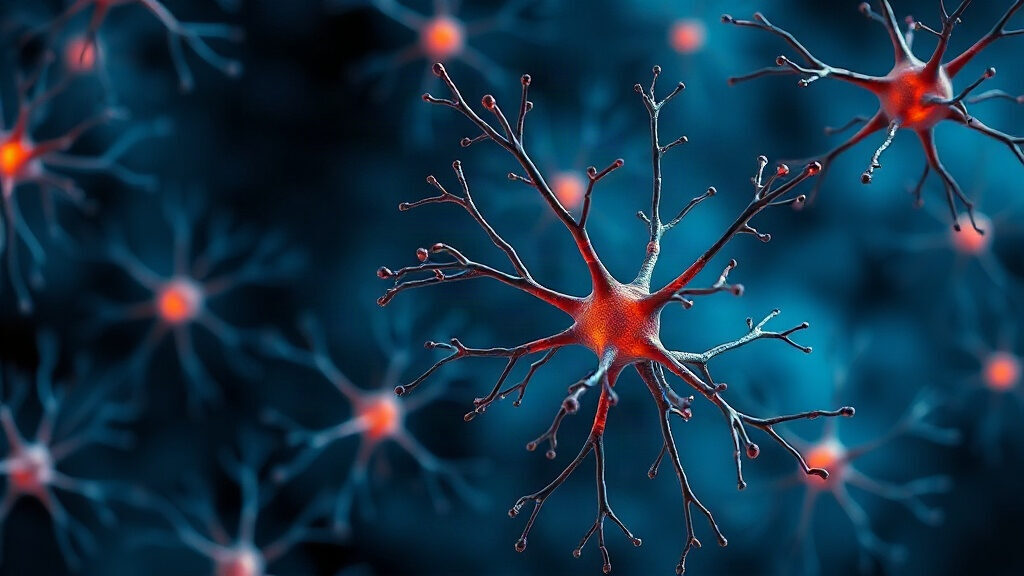
Lithium slows down glycogen synthase kinase 3 (GSK-3), an enzyme that adds phosphate groups to tau protein, one of the two hallmarks of Alzheimer’s disease. This mechanism was described in 1996 in frog embryos, where lithium mimicked the effect of a loss of GSK-3β (Klein and Melton, 1996). The following year, in cultured human neurons, it reduced tau phosphorylation and promoted the assembly of microtubules, the internal skeleton of neurons (Hong et al., 1997).
Other pathways add to this main action. The studies published since then describe four of them:
- Inhibition of GSK-3β, which limits tau hyperphosphorylation and the disruption of transport inside neurons.
- Stimulation of autophagy, the recycling of damaged proteins, through an mTOR-independent pathway that involves inositol monophosphatase (Sarkar et al., 2005).
- Control of microglia, the brain’s immune cells: in mice deprived of this element, they switch to an inflammatory state and clear amyloid deposits less effectively.
- Protection of synapses, axons and myelin, whose loss accelerates in lithium-deficient animals.
The cellular recycling described by the Cambridge team in 2005 is one of the major mechanisms of aging, detailed in our article on autophagy. One last point intrigues researchers: in affected brains, amyloid plaques capture the available lithium. Less free lithium could then promote new plaques, which would create a vicious circle that has yet to be confirmed in humans.
Lithium deficiency and Alzheimer’s: what the science says
No study has shown to date that lithium deficiency causes Alzheimer’s disease in humans, but several types of data point in that direction. The strongest come from a study published in Nature in 2025, supplemented by observational studies and small clinical trials.
The Harvard study published in Nature
The researchers measured 27 metals in the prefrontal cortex and blood of deceased older adults from the ROS and MAP cohorts in Chicago. Among 348 brains (177 without cognitive impairment, 66 with mild cognitive impairment and 105 with Alzheimer’s disease), only lithium was significantly reduced, starting at the mild impairment stage. The cerebellum, which the disease largely spares, did not show this drop, and a second cohort of 43 brains confirmed the result. Blood levels, on the other hand, did not differ between groups (Aron et al., 2025).
In mice, a diet-induced lithium deficiency cut cortical levels by about 50%. The animals accumulated more amyloid plaques and phosphorylated tau, lost synapses and myelin, and declined faster cognitively. A very low dose of lithium orotate, 30 µg per liter of drinking water, prevented these lesions and the memory loss. The animals’ kidney and thyroid markers (urea, creatinine, TSH) did not change.
This part about orotate is already being debated. In 2026, three researchers pointed out that this salt most likely dissociates in the stomach and that its fate in the body resembles that of the carbonate used in psychiatry. In their view, insisting on one particular form could raise safety problems (Hajek et al., 2026).
Lithium in tap water: associations, not proof
In Denmark, a study compared the water consumed by 73,731 people with dementia and by 733,653 controls. Above 15 µg/L, the risk of dementia was 17% lower than between 2 and 5 µg/L (IRR 0.83). Between 5.1 and 10 µg/L, by contrast, it was 22% higher, and the authors acknowledge that geographic factors may blur the link (Kessing et al., 2017).
Other countries report mixed results. In Scotland, where water contains very little (1.26 µg/L on average), no protective effect appeared among 37,597 people followed (Duthie et al., 2023). In Japan, across 808 cities and wards, the inverse association applied only to women (Muronaga et al., 2022). In the United States, among about 62 million Medicare beneficiaries, the counties with the most lithium in their water had 4% fewer dementia cases (Hwang et al., 2026). The link with mortality remains uncertain. These ecological studies compare areas, not individuals.
Patients on long-term lithium and dementia risk
People who take this drug for bipolar disorder offer a second clue. In Denmark, patients who had purchased it at least once had a 47% higher risk of dementia. Those who continued the treatment, however, returned to the level of the general population (Kessing et al., 2008). In Brazil, Alzheimer’s disease affected 5% of 66 treated older patients, compared with 33% of 48 untreated patients (Nunes et al., 2007).
A British cohort of 29,618 patients over 50, including 548 treated with lithium, found a risk of dementia almost cut in half (HR 0.56). The reduction reached 45% for Alzheimer’s disease and 64% for vascular dementia. The authors nevertheless urge caution before extending this result to the general population (Chen et al., 2022).
Clinical trials: small and mixed
A 10-week German trial in 71 patients with mild Alzheimer’s disease showed no effect on memory or on biomarkers (Hampel et al., 2009). In Brazil, 61 people with mild cognitive impairment received low-dose lithium or a placebo for two years. The placebo group declined, while the treated group remained stable (Forlenza et al., 2019).
The first meta-analysis, with three trials and 232 participants, concluded that cognitive decline was modestly slowed, with a standardized mean difference of -0.41 (Matsunaga et al., 2015). A Brazilian trial testing a microdose of 300 µg per day for 15 months also reported a stable MMSE score (Nunes et al., 2013). These studies remain too small to change recommendations.
| Type of study | Example | Main result | Limitation |
|---|---|---|---|
| Post-mortem human brains | Aron 2025, 348 brains | Only metal reduced from the stage of mild cognitive impairment | Association, no causal link |
| Lithium-deficient mice | Aron 2025 | More plaques, more tau and more memory loss | Animal model |
| Tap water | Kessing 2017, 73,731 cases | 17% lower risk of dementia above 15 µg/L | Non-linear relationship, ecological study |
| Very low-lithium water | Duthie 2023, 37,597 people | No protective effect | Levels too low to draw conclusions |
| Treated patients | Chen 2022, 29,618 patients | 44% lower risk of dementia | Specific psychiatric population |
| Randomized trials | Matsunaga 2015, 3 trials | Modestly slower cognitive decline | 232 participants in total |
Lithium in practice: orders of magnitude and who is concerned
The dose changes everything: between the body’s natural content and a therapeutic blood level, the gap reaches a factor of about 1,000, according to the Harvard team. The amounts cited in studies range from nanograms to milligrams.
| Situation | Amount | Source |
|---|---|---|
| Blood of an older person without cognitive impairment | 1.5 to 10 ng per mL | Aron 2025 |
| Tap water in Scotland (average) | 1.26 µg per liter | Duthie 2023 |
| Tap water in Denmark (median among controls) | 12.2 µg per liter | Kessing 2017 |
| Water given to the protected mice at Harvard | 30 µg per liter | Aron 2025 |
| Proposed daily intake, with no official value | 1 mg per day | Schrauzer 2002 |
| 120 mg orotate tablet sold online | About 4.6 mg of elemental lithium | Pauzé 2007 |
| Treatment of bipolar disorder | 0.5 to 0.8 mEq per liter of blood, or 3.5 to 5.5 mg per liter | NHS |
For the general population, no test can currently detect a lithium deficiency in the brain. The Harvard study illustrates this: blood levels remained normal in people whose cortex was depleted. A blood test will therefore tell you nothing about the health of your brain, and no laboratory offers a validated test for this purpose.
People already treated for bipolar disorder have nothing to change: observational data even suggest a possible cognitive benefit, which remains to be confirmed. Those who notice unusual forgetfulness should first talk to their doctor, as we explain in our guide to memory loss after 60. The proven levers of prevention are gathered in our article on Alzheimer’s prevention.
The buildup of misfolded proteins links amyloid, tau protein and cellular recycling. This mechanism is presented in our pillar page Loss of proteostasis.
Protecting your brain without self-supplementing with lithium
The most prudent course in 2026 is not to buy lithium supplements and to act on proven risk factors. The orotate sold online has never been tested in humans for memory. In 2007, an 18-year-old woman swallowed 18 tablets of 120 mg bought online. She developed nausea and tremors, with a blood lithium level of 0.40 mEq/L (Pauzé and Brooks, 2007).
At therapeutic doses, the side effects are well known. A meta-analysis of 385 studies found hypothyroidism about six times more frequent than with placebo, with an odds ratio of 5.78 (McKnight et al., 2012). It also noted a reduced ability of the kidneys to concentrate urine, and weight gain. After 65, the main danger comes from drug combinations. In Ontario, among 10,615 treated patients over 66, 413 were hospitalized for lithium toxicity. The risk was multiplied by 5.5 in the month after a loop diuretic was added and by 7.6 after an ACE inhibitor (Juurlink et al., 2004).
| Criterion | Prescription lithium salts | Orotate sold online |
|---|---|---|
| Framework | Prescription drug with a narrow therapeutic margin | Product bought outside the medical system, with no follow-up |
| Dose | Adjusted for a blood level of 0.5 to 0.8 mEq/L | About 4.6 mg of elemental lithium per 120 mg tablet |
| Monitoring | Blood lithium, kidney function and thyroid at regular intervals | None |
| Data on memory | A few small trials in people with mild cognitive impairment | No human trials |
| Documented risks | Hypothyroidism, less concentrated urine, toxicity with certain diuretics | Toxicity in case of overdose, unsupervised interactions |
From a longevity standpoint, the useful lessons of this research come down to a few concrete steps:
- Do not buy orotate or any other lithium-based supplement without medical advice, even when it is marketed as a microdose.
- If you are treated with lithium salts, never stop on your own, and tell every prescriber about any new diuretic, blood pressure drug or anti-inflammatory.
- Stick to the schedule of blood lithium tests and kidney and thyroid checks, and drink more during heat waves.
- Eat whole grains and vegetables every day, the main dietary sources of this element, without expecting a proven effect on memory.
- Act on the risk factors for dementia listed by the WHO: high blood pressure, diabetes, hearing loss, smoking, physical inactivity and social isolation.
- See a doctor without delay if forgetfulness interferes with daily life.
The stakes are considerable: in France, 1 to 1.2 million people live with Alzheimer’s disease and 225,000 new cases are diagnosed every year, according to French national estimates. Researchers are now calling for long-term trials at very low doses. Until their results are in, lithium remains a research lead, not a prevention measure. To follow these trials, sign up for our newsletter.
Frequently asked questions about lithium and the brain
Does lithium deficiency cause Alzheimer’s disease?
This has not been shown in humans. In 2025, a Harvard study found less lithium in the cortex of people with mild cognitive impairment or Alzheimer’s disease. In mice, an induced lithium deficiency worsened the lesions. In humans, it is an association: the drop could also be a consequence of the disease, since amyloid plaques capture this metal.
Can a blood test detect lithium deficiency?
No. In the Harvard study, blood levels in people with Alzheimer’s disease or mild cognitive impairment did not differ from those of healthy people, even though their cortex was depleted. Blood lithium testing is used only to monitor treatment for bipolar disorder. No validated test can currently detect a shortage in the brain.
Should you take lithium orotate to protect your memory?
No. Lithium orotate has only been tested in mice for this purpose. No human trial has evaluated its effectiveness or its long-term safety in older adults. Researchers point out that it most likely releases the same ion as the drug: at high doses, it therefore carries the same risks for the kidneys and thyroid.
Which foods contain lithium?
Grains and vegetables are the main dietary sources, according to a 2002 review. Drinking water also provides some, in amounts that vary widely with local geology. The average level is 1.26 µg per liter in Scotland, compared with more than 15 µg per liter in some Danish municipalities. In France, no official nutritional reference value exists for this element.
Does drinking lithium-rich water protect against dementia?
Nothing proves it. In Denmark, municipalities whose water exceeded 15 µg per liter had 17% fewer dementia cases, but the risk was higher between 5 and 10 µg per liter. In Scotland, no effect appeared. These studies compare areas and do not justify recommending any particular water.
What is the difference between lithium as a drug and lithium in food?
The dose. Treatment for bipolar disorder targets a blood concentration of 0.5 to 0.8 mEq per liter, about 1,000 times the natural level. It requires regular monitoring of the blood, kidneys and thyroid. The traces supplied by water and food remain thousands of times lower and require no monitoring.
Medical disclaimer. The information provided here is for informational purposes only and does not constitute medical advice. It does not replace a consultation. Ask a healthcare professional before changing your diet, taking dietary supplements or starting a new practice, especially if you have a medical condition, are pregnant or are under treatment. Dietary supplements do not replace a balanced diet or medical follow-up. Lithium is a drug with a narrow therapeutic margin: never take a supplement that contains it without medical advice. Do not change or stop treatment with lithium salts without your doctor’s approval.