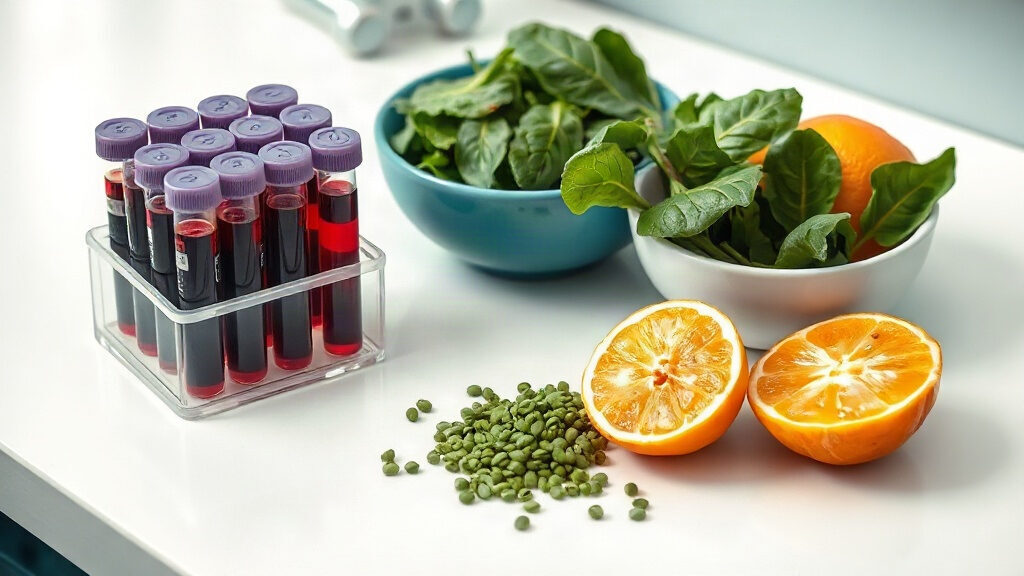
Homocysteine levels measure a sulfur-containing amino acid that the body makes from methionine, which comes from dietary protein. The blood test, expressed in micromoles per liter (µmol/L), reflects your status in vitamins B9, B12 and B6 and how well your kidneys work. The normal level is not the same at 20 and at 70, nor in men and in women. A moderate excess, common after 60, is associated with a higher risk of stroke and cognitive decline.
In brief – Homocysteine is an intermediate amino acid of methionine metabolism, and homocysteine levels in the blood mainly reflect your stores of folate (vitamin B9) and vitamin B12. In adults, most laboratories place the normal value between 5 and 15 µmol/L. The figure rises with age. In the US NHANES III survey (8,086 people), the upper limit went from 9.9 µmol/L in boys aged 12 to 19 to 15.3 µmol/L in men aged 60 and over, and from 7.2 to 11.6 µmol/L in women. About two thirds of high levels were explained by a vitamin deficiency. An excess therefore first reveals a lack of B vitamins, kidney impairment, a medication or a genetic trait. B vitamins correct the number, but the large trials did not reduce heart attacks, only strokes, and only slightly.
Homocysteine levels: definition and reference values
Homocysteine is an amino acid that is not part of any protein: it is a transit product, formed when methionine has given up its methyl group. In the blood, it circulates mostly bound to albumin. Laboratories therefore measure total homocysteine (free and bound forms), written tHcy in the scientific literature.
The most complete reference comes from the NHANES III survey, conducted in the United States between 1991 and 1994, before flour was fortified with folic acid. The authors calculated reference intervals (5th and 95th percentiles) in people without folate or vitamin B12 deficiency and with normal creatinine (Selhub et al., 1999). The upper limit rises with age and remains higher in men at every age.
The Norwegian Hordaland study measured homocysteine in 16,176 adults aged 40 to 67. It confirms this slope: an average of 10.8 µmol/L in men aged 40 to 42 versus 12.3 µmol/L at 65 to 67, and 9.1 versus 11.0 µmol/L in women (Nygård et al., 1995).
| Group | Men (µmol/L) | Women (µmol/L) | Source |
|---|---|---|---|
| 12 to 19 years | 4.3 to 9.9 | 3.3 to 7.2 | NHANES III, 5th-95th percentiles |
| 40 to 42 years | 10.8 (mean) | 9.1 (mean) | Hordaland, n = 12,266 |
| 65 to 67 years | 12.3 (mean) | 11.0 (mean) | Hordaland, n = 3,318 |
| 60 years and over | 5.9 to 15.3 | 4.9 to 11.6 | NHANES III, 5th-95th percentiles |
| “High” threshold used by NHANES III | 11.4 and above | 10.4 and above | 95th percentile of 20 to 39 year olds |
To convert units, 1 µmol/L equals 0.135 mg/L. Each laboratory publishes its own reference ranges, often a single upper limit of 15 µmol/L for adults, which does not take age into account.
How the body makes and recycles homocysteine
Homocysteine sits at the crossroads of the methylation cycle, the circuit that supplies methyl groups to DNA, proteins and neurotransmitters. When this cycle runs short of vitamins, homocysteine levels build up in the blood. The main steps are as follows:
- methionine from food becomes S-adenosylmethionine (SAMe), the cell’s universal methyl donor.
- after donating its methyl group, SAMe turns into S-adenosylhomocysteine (SAH), then into homocysteine.
- the remethylation pathway converts it back into methionine through methionine synthase, which requires vitamin B12 and 5-methyltetrahydrofolate (the active form of vitamin B9) produced by the MTHFR enzyme.
- in the liver, a second remethylation pathway uses betaine, supplied by beets and whole wheat or made from choline.
- the transsulfuration pathway, which depends on vitamin B6, turns it into cystathionine and then cysteine, a precursor of the antioxidant glutathione.
This circuit links homocysteine directly to epigenetics. SAH, its immediate precursor, slows the enzymes that place methylation marks on DNA. A high level therefore signals a methylation cycle running at reduced speed, one of the mechanisms studied in aging. The kidneys also help clear it, which explains why it rises when kidney function declines.

What the science says about high homocysteine levels
High homocysteine levels predict mortality, stroke and dementia in observational studies. Yet lowering the number with B vitamins does not protect the heart. This nuance, established by more than 70,000 participants in randomized trials, changes how the test should be read.
Mortality and cardiovascular disease
Among 4,766 Norwegians aged 65 to 67 followed for 4.1 years, each 5 µmol/L increase was associated with 49% higher total mortality. Above 20 µmol/L, the risk of cardiovascular death was 3.5 times higher than with a level below 9 µmol/L (Vollset et al., 2001). The Homocysteine Studies Collaboration meta-analysis pooled 30 studies and 5,073 coronary events. After adjustment, a 25% lower level, about 3 µmol/L, corresponded to 11% fewer heart attacks and 19% fewer strokes (Homocysteine Studies Collaboration, 2002). The authors concluded it was “at most a modest” predictor in healthy people.
Dementia and brain atrophy
In the Framingham cohort, 1,092 people with an average age of 76 and no dementia at baseline were followed for 8 years. Homocysteine above 14 µmol/L nearly doubled the risk of Alzheimer’s disease. This result held after adjustment for age, APOE genotype and other vascular factors (Seshadri et al., 2002). An international consensus of nine experts considers a level above 11 µmol/L a modifiable risk factor for cognitive decline, with a relative risk of 1.15 to 2.5 depending on the study (Smith et al., 2018).
The VITACOG trial tested this hypothesis in 271 people over 70 with mild cognitive impairment. After 24 months of folic acid (0.8 mg), vitamin B12 (0.5 mg) and vitamin B6 (20 mg), the brain lost 0.76% of its volume per year versus 1.08% on placebo. In participants whose homocysteine exceeded 13 µmol/L, atrophy was reduced by 53% (Smith et al., 2010). A follow-up analysis showed that the benefit was limited to people above the median of 11 µmol/L (Douaud et al., 2013). Two caveats apply: the primary endpoint was an MRI image, not a diagnosis of dementia, and the lead author holds patents on the use of B vitamins in Alzheimer’s disease.
Supplementation trials on the heart
The HOPE-2 trial gave 2.5 mg of folic acid, 50 mg of B6 and 1 mg of B12 to 5,522 vascular patients for 5 years. Homocysteine fell by 2.4 µmol/L, with no effect on the primary endpoint (18.8% versus 19.8% of events), but with 25% fewer strokes (Lonn et al., 2006). The most recent Cochrane review covers 15 trials and 71,422 participants. It finds no effect on heart attack or mortality, but a small drop in strokes, from 5.1% to 4.3% (Martí-Carvajal et al., 2017). In China, where flour is not fortified, the CSPPT trial added 0.8 mg of folic acid to a blood pressure drug in 20,702 adults. The result: 2.7% first strokes versus 3.4% over 4.5 years (Huo et al., 2015).
| Trial | Population | Effect on the level | Clinical outcome |
|---|---|---|---|
| HOPE-2 (2006) | 5,522 vascular patients, aged 55 and over | Drop of 2.4 µmol/L | No effect on heart attack or death, strokes down 25% |
| Cochrane (2017) | 15 trials, 71,422 participants | Variable drop depending on doses | Heart attack and mortality unchanged, strokes from 5.1% to 4.3% |
| CSPPT (2015) | 20,702 Chinese adults with hypertension | Folic acid 0.8 mg/day | First strokes from 3.4% to 2.7% |
| VITACOG (2010) | 271 older adults with mild cognitive impairment | Vitamins B9, B12 and B6 | Slower brain atrophy, largest effect above 13 µmol/L |
The most cautious reading: homocysteine works as a marker of vitamin status and vascular health more than as a target to treat for the heart. The brain and stroke remain the two areas where lowering homocysteine levels shows a signal.
What high homocysteine levels reveal in practice
High homocysteine levels first reveal a lack of B vitamins. Among 1,160 Framingham survivors aged 67 to 96, 29.3% exceeded 14 µmol/L. A deficiency in B9, B12 or B6 explained 67% of these cases (Selhub et al., 1993). Vitamin B12 deficiency is the first lead to explore after 60, because intestinal absorption of this vitamin declines with age.
Clinical biologists classify the excess into three levels. Most abnormal results in adults fall into the first category.
| Level (µmol/L) | Interpretation | Causes to look for |
|---|---|---|
| 5 to 15 | Normal in adults (lower limit in young people) | None, unless suggestive symptoms |
| 15 to 30 | Moderate excess | B9 or B12 deficiency, smoking, early kidney impairment, medications, MTHFR variant |
| 30 to 100 | Intermediate excess | Severe B12 deficiency, advanced kidney failure |
| Over 100 | Severe excess | Homocystinuria (rare genetic disease), major deficiency |
The causes of an excess fall into four families. Nutritional deficiencies come first: a vegan diet without supplements, low intake of green vegetables, alcohol use disorder. Chronic diseases follow, especially kidney failure and hypothyroidism. Several medications play a role: metformin and proton pump inhibitors reduce B12 absorption, methotrexate blocks folate, and some antiepileptic drugs and levodopa also raise the level.
Genetics completes the picture. The C677T variant of the MTHFR gene, present on about 38% of chromosomes in the population studied, reduces the enzyme’s activity and raises the level in homozygous carriers (Frosst et al., 1995). This variant matters most when folate intake is low. Lifestyle counts too. In the Hordaland study, homocysteine rose with each daily cigarette. A heavy smoker aged 65 had 4.8 µmol/L more than a 40-year-old nonsmoking woman.
This marker belongs in a broader checkup, to be read alongside other risk factors. Our feature on Alzheimer’s disease prevention details the other cognitive levers, and the pillar page on epigenetic alterations places the methylation cycle within the biology of aging.
Tips for keeping homocysteine levels in the normal range
Normal homocysteine levels rest first on a regular intake of folate and vitamin B12. The United States made folic acid fortification of flour mandatory in 1998. Afterward, the share of adults above 13 µmol/L fell from 18.7% to 9.8% in the Framingham Offspring cohort (Jacques et al., 1999). France does not fortify its flour, so the plate does most of the work there.
- Eat leafy green vegetables (spinach, lamb’s lettuce, watercress), legumes and citrus fruits, the main sources of vitamin B9 according to the NIH Office of Dietary Supplements.
- Cover B12 needs with animal products (fish, eggs, dairy) or with a systematic supplement if you follow a vegan diet.
- Quit smoking, whose effect on homocysteine is dose-dependent.
- Limit alcohol, which disrupts the absorption and storage of folate.
- Have your vitamin B12 checked if you take metformin or a proton pump inhibitor long term.
- Recheck a high result on a second blood sample before drawing any conclusion, along with folate, B12 and creatinine tests.
The sample is preferably taken fasting. The tube must be centrifuged quickly or kept on ice, because red blood cells keep releasing homocysteine at room temperature and skew the result upward.
Do not take high-dose folic acid without checking your vitamin B12 first: it corrects the anemia of B12 deficiency without repairing nerve damage, which then keeps progressing silently. Supplementation should be decided with a doctor, all the more so since the World Health Organization points out that high blood pressure is a major risk factor for stroke, well ahead of homocysteine. To receive our monthly summaries on blood markers, sign up for our health newsletter.
Frequently asked questions about homocysteine levels
What are normal homocysteine levels?
In adults, most laboratories consider homocysteine levels between 5 and 15 µmol/L normal. The limit depends on age and sex: in the NHANES III survey, it reaches 15.3 µmol/L in men aged 60 and over and 11.6 µmol/L in women of the same age, versus less than 10 µmol/L in adolescents. An expert consensus considers that above 11 µmol/L, cognitive risk increases in older adults.
Why does homocysteine rise with age?
The level rises with age because vitamin B12 absorption declines, folate intake often drops and kidney function slows. In the Norwegian Hordaland study, the average went from 10.8 µmol/L in men aged 40 to 12.3 µmol/L at 65. Women have lower levels than men, but the gap narrows after menopause.
Which deficiency raises homocysteine levels?
A deficiency in vitamin B9 (folate) or vitamin B12 is the most common cause of a high level. Among older adults in Framingham, insufficient B9, B12 or B6 status explained 67% of values above 14 µmol/L. B12 deficiency mainly affects older people, vegans who do not take a supplement and patients on long-term metformin or proton pump inhibitors.
Should you take B vitamins when homocysteine is high?
A proven B9 or B12 deficiency should be corrected, on prescription. However, taking B vitamins solely to lower the number does not protect against heart attack: the 2017 Cochrane review (71,422 participants) shows no effect on heart attack or mortality, with a small drop in strokes. The benefit on brain atrophy mainly concerns older adults above 11 to 13 µmol/L.
What is the difference between high homocysteine and homocystinuria?
Moderately high homocysteine, between 15 and 30 µmol/L, is common and mostly linked to vitamins, the kidneys or smoking. Homocystinuria is a rare genetic disease, often caused by cystathionine beta-synthase deficiency, with levels above 100 µmol/L. It appears in childhood with eye, bone and vascular problems and requires follow-up in a specialized center.
Medical disclaimer. The information on this page is provided for informational purposes only and does not constitute medical advice. It does not replace a consultation. Ask a healthcare professional before changing your diet, taking dietary supplements or starting a new practice, especially if you have a medical condition, are pregnant or are under treatment. Dietary supplements do not replace a balanced diet or medical follow-up.