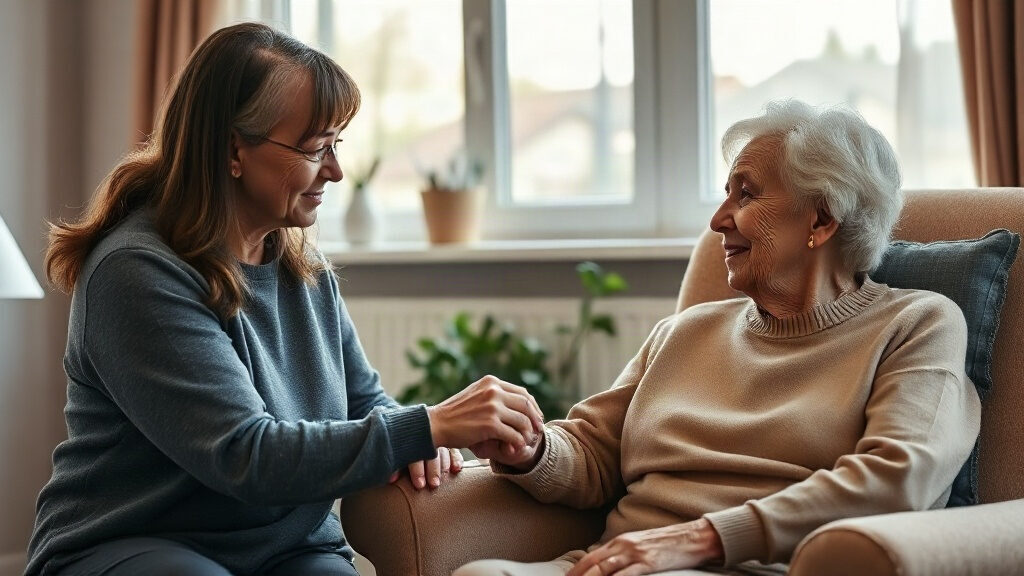
A family caregiver supports a sick, disabled or very old loved one every week, without being paid for it. In France, 9.3 million people described themselves this way in 2021, according to DREES, the statistics department of the French health ministry. When the load becomes heavy and lasting, it leaves measurable marks. Researchers see more depression, rising inflammation, slower immune defenses and a higher cardiovascular risk. The studies also show that helping in itself does not damage health. What weighs is the strain it creates when the caregiver is left alone.
In brief – A family caregiver is a non-professional who gives regular help to a loved one losing independence. When this load settles in for the long term, it acts on the body like chronic stress. Meta-analyses find a clear excess of depression and perceived stress among caregivers, and a more modest effect on physical health. Among spouse caregivers who reported feeling strained, 4-year mortality was 63% higher (Schulz and Beach, 1999, n=819). Levels of interleukin-6, a marker of inflammation, rose four times faster in caregivers of people with Alzheimer’s disease followed for 6 years. But large recent cohorts add nuance: without overload, a caregiver does not live a shorter life, and sometimes lives longer. The deciding factor is therefore perceived stress, which respite, psychological support and physical activity can reduce.
Family caregiver: definition and figures in France
A family caregiver is anyone who regularly helps an older, sick or disabled relative or friend with daily activities, on a non-professional basis. In France, a 2015 law on adapting society to an aging population gave official status to this “close caregiver”, who may be a spouse, a child, a parent, a neighbor or a friend.
The Everyday Life and Health survey, published by DREES in February 2023, draws a precise portrait of caregiving in France. One adult in six is involved, or 8.8 million people, plus 500,000 minors. The share peaks between ages 55 and 64, when one person in four helps a loved one, often while still working.
| Indicator | Value | What it means |
|---|---|---|
| People providing care | 9.3 million | 8.8 million adults and 500,000 minors aged 5 and over |
| Share of adults | 1 in 6 | The situation touches almost every family |
| Most affected age group | 55 to 64 | 1 person in 4, often still in paid work |
| Share of women | 56% | Versus 52% women in the adult population |
| Emotional support | 6.4 million | The most common form of help |
| Help with daily living | 5.7 million | Washing, meals, shopping, paperwork |
The same survey found that caregivers report good or very good health less often than the rest of the population, whatever the age group. This gap remains an association: on its own, it does not tell us whether caregiving harms health or whether other factors are involved.
How the family caregiver role weighs on the body
The burden of caregiving acts mainly through chronic stress, which keeps the body on alert for months or years. The hormonal stress axis, which releases cortisol, stays switched on, and the immune system shifts toward low-grade inflammation. This “silent inflammation” goes hand in hand with many age-related diseases.
Several pathways combine in a caregiver:
- Chronic stress that disrupts cortisol and blood pressure.
- A gradual rise in interleukin-6 (IL-6), a pro-inflammatory molecule linked to cardiovascular disease, type 2 diabetes and frailty.
- A slower immune response, visible in wound healing and in the response to vaccines.
- Broken sleep, interrupted by the loved one waking at night, by care tasks and by worry.
- Postponed self-care: canceled medical appointments, abandoned exercise, meals eaten on the run.
At the cellular level, prolonged stress also shows up in telomeres, the caps that protect the ends of chromosomes and shorten with each cell division. Shorter telomeres are a recognized marker of cellular aging, even though they are not enough to predict an individual’s health.
What science says about family caregiver health
The strongest data concern mental health. The meta-analysis by Pinquart and Sörensen (84 articles) found clear differences between caregivers and non-caregivers for depression (g = 0.58) and perceived stress (g = 0.55), compared with a smaller gap for physical health (g = 0.18) (Pinquart and Sörensen, 2003). The differences were larger among people caring for someone with dementia.
On the physical side, another meta-analysis of 23 studies confirms a slightly higher risk in caregivers, clearer for stress hormones and antibodies (Vitaliano et al., 2003). Janice Kiecolt-Glaser’s team pinned down the mechanisms in people caring for a relative with Alzheimer’s disease:
- Over 6 years, IL-6 rose about four times faster in 119 caregivers than in 106 non-caregivers, and this steeper slope persisted several years after the spouse’s death (Kiecolt-Glaser et al., 2003).
- A small 3.5 mm (0.14 in) wound took 48.7 days to heal in 13 female caregivers, compared with 39.3 days in 13 matched controls (Kiecolt-Glaser et al., 1995).
- The antibody response to the flu vaccine was weaker in 32 caregivers than in 32 controls of the same age (Kiecolt-Glaser et al., 1996).
Telomeres tell the same story. Among 58 healthy mothers, most of whom were caring for a chronically ill child, the most stressed women had shorter telomeres, equivalent to at least ten extra years of aging, and the number of years spent caregiving mattered (Epel et al., 2004).
A caregiver’s heart is affected when caregiving is intense. In the Nurses’ Health Study (54,412 women), caring for an ill spouse at least 9 hours a week was associated with a 1.82-fold coronary risk (Lee et al., 2003). In a US cohort of 8,472 married adults over 50, caring for a spouse at least 14 hours a week raised the risk of cardiovascular disease by 35%, and by 95% when the situation lasted (Capistrant et al., 2012).
| Study | Population | Main finding |
|---|---|---|
| Pinquart and Sörensen, 2003 | 84 articles, meta-analysis | Depression g = 0.58, stress g = 0.55, physical health g = 0.18 |
| Kiecolt-Glaser, 2003 | 119 caregivers, 106 controls, 6 years | IL-6 rising about 4 times faster |
| Epel, 2004 | 58 mothers | Telomeres: at least 10 extra years of aging in the most stressed |
| Lee, 2003 | 54,412 US nurses | At least 9 h a week for a spouse: coronary risk x 1.82 |
| Capistrant, 2012 | 8,472 married adults over 50 | Lasting care of at least 14 h a week: cardiovascular risk x 1.95 |
| Schulz and Beach, 1999 | 819 spouses aged 66 to 96 | Strained caregivers: 4-year mortality +63% |
Family caregiver life expectancy: the decisive role of perceived stress
For a caregiver, helping a loved one does not shorten life in itself: perceived strain is what makes the difference. The landmark study by Schulz and Beach followed 392 spouse caregivers and 427 non-caregivers aged 66 to 96. Those who provided care while reporting mental or emotional strain had 63% higher mortality at 4 years, while those caring without strain showed no excess (relative risk 1.08) (Schulz and Beach, 1999).
More recent cohorts go further. In the US REGARDS study, 3,503 caregivers compared with 3,503 matched non-caregivers had an 18% lower death rate over 6 years (Roth et al., 2013). Among 1,069 older women, caregivers with low stress lived longer than non-caregivers, whereas high stress raised mortality by 81% in the first three years (Fredman et al., 2010).
Two explanations coexist for this caregiver paradox. People who become caregivers are often healthier to begin with, since you need to be fit to help. Caregiving also brings meaning, movement and social ties. For a caregiver, the goal is therefore not to stop helping, but to avoid facing alone a load that exceeds one’s resources.
In practice: spotting family caregiver burnout
Caregiver burnout sets in slowly and often goes unnoticed, including by the person affected. Health services such as the NHS urge carers to seek support early, because caregivers rarely see a doctor for themselves.

| Sign | What it may reflect | What to do |
|---|---|---|
| Sadness, loss of interest for more than 2 weeks | Depressive episode | See your primary care doctor |
| Irritability, impatience with the loved one | Emotional overload | Arrange for someone to take over, even occasionally |
| Short or fragmented sleep for weeks | Sleep debt, chronic stress | Ask for night-time help or short-term respite care |
| Canceled personal medical appointments | Neglecting one’s own health | Reschedule checkups, vaccines and screenings |
| Withdrawal, no more outings or friends | Social isolation | Contact a caregiver association or support group |
| Increased use of alcohol or sleeping pills | Coping with stress | Talk to a health professional |
Depression often affects caregivers and, after 60, it can take misleading forms such as fatigue or physical complaints: its warning signs after 60 are worth knowing. Sleep is the other weak spot, and a few simple adjustments help to get deep sleep back even when nights are interrupted. These mechanisms belong to the altered intercellular communication pillar, which links stress, inflammation and aging.
Protocol: 7 ways to protect your health as a family caregiver
The most effective lever for a caregiver is to reduce the load and the perceived stress, not to “hold on” longer. The interventions that have been tested often combine several actions. In the REACH II trial, 642 caregivers of people with Alzheimer’s disease received 12 home and telephone sessions over 6 months: clinical depression affected 12.6% of the supported group versus 22.7% of the control group (Belle et al., 2006).
- Plan regular respite: adult day care, short-term residential stays, in-home care. In 2024, France’s National Authority for Health (HAS) published recommendations dedicated to respite for caregivers.
- Check your rights: in France, caregiver leave, the daily caregiver allowance, and help from the town hall or the local département.
- Keep up 30 minutes of physical activity on most days (brisk walking is enough), because exercise dampens the stress response and protects the heart.
- Protect your sleep by asking someone to cover nights as soon as waking up becomes a daily event.
- Keep up your own medical follow-up, including vaccines, since the vaccine response can be weaker under chronic stress.
- Join a caregiver support group or see a psychologist: talking about the load reduces the feeling of isolation.
- Try a short relaxation practice. In a pilot trial, 39 caregivers practiced 12 minutes of meditation a day for 8 weeks: depressive symptoms fell and telomerase activity rose by 43%, versus 3.7% with relaxing music (Lavretsky et al., 2013). This result still needs to be confirmed in larger groups.
For a caregiver, accepting help is no admission of failure. A rested caregiver can support the person they care for longer and in better conditions. To receive the latest studies on stress and aging every month, subscribe to our health newsletter.
Frequently asked questions
What is a family caregiver?
A family caregiver is a person who regularly helps an older, sick or disabled loved one with daily life, without being paid as a professional. It may be a spouse, a child, a parent or a friend. In France, DREES counted 9.3 million of them in 2021, including 8.8 million adults, with a peak between ages 55 and 64.
Why is a family caregiver more prone to depression?
The caregiving load creates chronic stress, often combined with fragmented sleep, isolation and giving up leisure activities. A meta-analysis of 84 articles finds a clear excess of depression (g = 0.58) and perceived stress in caregivers compared with non-caregivers. The gap is larger when the loved one has dementia.
Does being a family caregiver shorten life expectancy?
Not in itself. Among spouses aged 66 to 96, only those who reported feeling strained had 63% higher mortality at 4 years. In the REGARDS cohort, 3,503 caregivers even had an 18% lower death rate than comparable non-caregivers. The risk factor is perceived overload, not the act of helping.
How can you tell if a family caregiver is burned out?
The most frequent signs are fatigue that no longer goes away, sleep problems, irritability, lasting sadness, skipping one’s own medical appointments and withdrawing from others. When several of these signs last more than two weeks, it helps to talk to your primary care doctor and arrange for someone to take over.
What support exists for a family caregiver in France?
Several schemes exist: caregiver leave, the daily caregiver allowance, support and respite platforms, adult day care and short-term residential stays. Town halls, départements and caregiver associations point people toward local solutions. France’s National Authority for Health (HAS) recommends that professionals identify caregivers early so they can offer them this kind of relief.
Medical disclaimer. The information on this page is provided for informational purposes only and does not constitute medical advice. It does not replace a consultation. If you are a caregiver and feel exhausted, persistently sad or have trouble sleeping, talk to your doctor. If you are in distress or having suicidal thoughts, call or text 988 (US and Canada) or call 116 123 (UK and Europe), free and available 24 hours a day. Ask a healthcare professional before starting a new practice, especially if you have a medical condition or are under treatment.