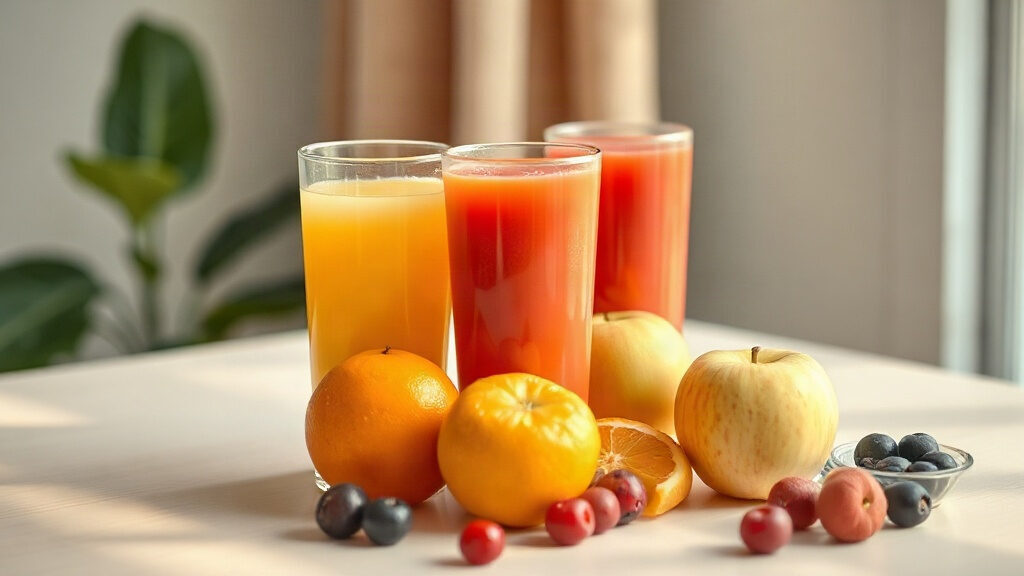
Fruit juice still carries the image of a healthy breakfast habit: one glass of orange juice, and the day starts with a dose of vitamins. Over the past decade or so, large American and French cohorts have added nuance to that picture. They measure what a daily glass changes for weight, blood sugar, the heart and life expectancy. Here is the state of the evidence in 2026, and how to drink juice the smart way.
In brief – Fruit juice is a drink made by pressing or reconstituting fruit, which keeps its sugars, part of its vitamins and polyphenols, but almost none of its fiber. A 200 ml (about 7 fl oz) glass of pure orange juice provides around 18 g of free sugars, more than a third of the 50 g daily limit set by the WHO. In healthy adults, a small daily glass is not associated with higher cardiovascular risk: a meta-analysis of 21 cohorts and 35 trials even links up to 170 ml a day to fewer cardiovascular events. Beyond that, the signals reverse: type 2 diabetes risk up 7% per daily glass, and higher mortality above 250 ml a day in two cohorts. Whole fruit remains the better choice, because it is more filling. The French benchmark: no more than one glass of juice a day, preferably freshly squeezed, and never in place of a piece of fruit.
Fruit juice: definition and what the label tells you
In Europe, the name “fruit juice” is protected by Directive 2001/112/EC, revised in 2012. Since that revision, adding sugar is forbidden: all the sugar in such a juice therefore comes from the fruit itself. Nectars and fruit drinks follow other rules, and that is where most of the nutritional difference on the supermarket shelf lies.
| Category | Fruit content | Added sugar | What to know |
|---|---|---|---|
| Homemade squeezed juice | 100% | No | Maximum vitamin C if drunk quickly, pulp retained. |
| Pure juice (fresh or pasteurized) | 100% | Forbidden | Fruit pressed then packaged, with no added water. |
| Juice from concentrate | 100% | Forbidden | Juice dehydrated then rehydrated with water, profile close to pure juice. |
| Nectar | 25 to 50% minimum depending on the fruit | Allowed | Fruit, water and sugar: often sweeter than pure juice. |
| Fruit drink | Often 10 to 12% | Allowed | Nutritionally close to a flavored soda. |
A 200 ml glass of pure orange juice contains about 90 kcal and 18 g of sugars, split between sucrose, glucose and fructose. It also provides vitamin C (around 80 mg, the reference intake for an adult), potassium, folate and flavonoids such as hesperidin. The fiber, however, stays almost entirely in the pulp and peel discarded during pressing. Filling that glass takes roughly three oranges, which few people would eat in one sitting.
Why fruit juice does not replace whole fruit: 4 mechanisms
Juice and whole fruit contain the same sugars, but the body does not receive them in the same way. The World Health Organization classifies the sugars in juices as “free sugars”, in the same category as table sugar and honey, whereas the sugars in whole fruit are not. Four mechanisms explain this difference:
- The matrix disappears. In the fruit, sugars are locked inside cells surrounded by fiber. Once pressed, they reach the gut free and fast, which places a greater demand on insulin.
- Satiety drops. In a trial of 58 adults, a whole apple eaten before a meal reduced total calorie intake by 15% compared with no snack, and was more filling than applesauce or apple juice with the same calories (Flood-Obbagy and Rolls, 2009).
- The amount is concentrated. One glass of juice gathers the sugars of two to three fruits, swallowed in under a minute, with no chewing.
- Fructose reaches the liver all at once. Its breakdown produces uric acid, which explains the observed link between fructose-rich drinks and gout.
From a longevity standpoint, these repeated spikes of liquid sugar put pressure on nutrient-sensing pathways, such as insulin signaling, which aging research links to metabolic health. This link remains mechanistic reasoning: no study has directly measured the effect of a glass of juice on the pace of aging. On the other hand, some of the benefits of fruit survive pressing, notably the polyphenols, which clearly sets a pure juice apart from a soda.
What science says about fruit juice and health
The studies converge on one point: the dose decides the verdict. At around one small glass a day, 100% juice shows no clear harmful effect in adults; above 250 ml (about 8.5 fl oz) a day, unfavorable associations pile up. Most of these are observational studies, which show associations, not causes.
Type 2 diabetes: a modest but repeated signal
In three cohorts of American health professionals (187,382 people, 12,198 cases of diabetes), three extra glasses of juice per week were associated with an 8% higher risk of type 2 diabetes (HR 1.08). Conversely, three weekly servings of blueberries lowered that risk by 26%, grapes by 12% and apples or pears by 7% (Muraki et al., 2013). A meta-analysis of 17 cohorts found a 7% higher risk per daily glass after accounting for body weight, a result its authors consider exposed to bias (Imamura et al., 2015). Another meta-analysis separates the two product families: sweetened juices raise the risk by 28%, while 100% juices have no significant effect (RR 1.03) (Xi et al., 2014).
Weight: mostly a matter of calories
The most comprehensive meta-analysis, published in 2024, pools 42 studies. In children, each daily glass of 100% juice is associated with a 0.03-point rise in BMI. In adults, weight gain (+0.21 kg, about 0.5 lb) appears only in cohorts not adjusted for total calorie intake, and the 19 randomized trials show no significant effect (Nguyen et al., 2024). Juice therefore causes weight gain when it adds to usual calories, not through an effect of its own. In children aged 1 to 6, an earlier meta-analysis noted a small effect, absent after age 7 (Auerbach et al., 2017).
Heart and blood pressure: the positive point
An Italian meta-analysis of 21 prospective studies and 35 randomized trials links low to moderate intake of 100% juice to fewer strokes (up to 200 ml a day) and fewer cardiovascular events (up to 170 ml, about 6 fl oz, a day). In the trials, systolic pressure fell by 3.14 mmHg and diastolic by 1.68 mmHg, with no effect on weight, lipids or blood sugar (D’Elia et al., 2021). Hesperidin from oranges appears to contribute: in 24 overweight men aged 50 to 65, 500 ml of orange juice a day for 4 weeks lowered diastolic pressure, as did isolated hesperidin (Morand et al., 2011).
Mortality, cancer, gout: associations to read with caution
Among 13,440 Americans aged 45 and over followed for 6 years, each additional 355 ml (12 fl oz) serving of juice was associated with a 24% higher all-cause mortality (Collin et al., 2019). In the NHANES survey (40,074 adults), drinking 250 ml or more of 100% juice a day went hand in hand with 30% higher mortality (Zhang et al., 2022). A meta-analysis of 13 studies covering 1.5 million people, however, judges this link with mortality uncertain (Pan et al., 2022).
In France, the NutriNet-Santé cohort (101,257 adults) associates each 100 ml daily increment of 100% juice with a 12% higher overall cancer risk, a result the Inserm researchers say needs to be replicated (Chazelas et al., 2019). Among 78,906 nurses followed for 22 years, a daily orange juice was linked to a 41% higher risk of gout, or 14 extra cases per 100,000 people per year (Choi et al., 2010). Conversely, orange juice was associated with 12% fewer kidney stones in three cohorts totaling 194,095 people (Ferraro et al., 2013).
| Outcome | Reference study | Main result | Strength of evidence |
|---|---|---|---|
| Type 2 diabetes | Imamura 2015, 17 cohorts | +7% per daily glass | Moderate, possible bias |
| Adult weight | Nguyen 2024, 42 studies | No effect in trials, +0.21 kg without calorie adjustment | Moderate |
| Blood pressure | D’Elia 2021, 35 trials | Systolic -3.14 mmHg | Good for a modest effect |
| Cardiovascular events | D’Elia 2021, 21 cohorts | Fewer events up to 170 ml a day | Observational |
| All-cause mortality | Zhang 2022, NHANES | +30% above 250 ml a day | Weak, link judged uncertain by Pan 2022 |
| Cancer | Chazelas 2019, NutriNet-Santé | +12% per 100 ml daily | Weak, needs replication |
In practice: which fruit juice to choose, and for whom
For a healthy adult, the French benchmark is simple: no more than one glass of fruit juice a day, preferably freshly squeezed fruit. France’s National Nutrition and Health Program (PNNS) specifies that this glass does not count as a portion of fruit, and the Harvard Nutrition Source likewise favors whole fruit over juice. The WHO, for its part, recommends keeping free sugars below 10% of calories, or 50 g a day on 2,000 kcal. The table below compares juice with other breakfast options.
| Option | Sugars (approx.) | Fiber | Satiety | Place in a longevity diet |
|---|---|---|---|---|
| 1 whole orange (150 g, 5.3 oz) | 13 g, not free sugars | About 3 g | Good | Daily, with no strict limit |
| Glass of squeezed juice (200 ml) | 18 g of free sugars | Traces | Low | 1 glass a day maximum |
| Glass of pure juice from a carton (200 ml) | 18 g of free sugars | Traces | Low | 1 glass a day maximum |
| Glass of nectar (200 ml) | Often more, added sugar | Traces | Low | Occasional |
| Can of soda (330 ml, 11 fl oz) | About 35 g of free sugars | None | Very low | Best avoided |
Some situations call for more caution. With diabetes, prediabetes or insulin resistance, juice raises blood sugar quickly: it is best kept for correcting a hypoglycemic episode, on medical advice. Tracking your fasting blood glucose helps spot a drift before diabetes sets in. With gout, limiting fructose-rich drinks is part of the standard advice. Grapefruit juice interacts with many medications, including some statins: ask your pharmacist.
For children, the American Academy of Pediatrics advises against any juice before age 1 and limits it afterward, because of the calories and the risk of tooth decay (Heyman and Abrams, 2017). To understand how fast sugars weigh on metabolic aging, see our feature on carbohydrates and blood sugar and the pillar page on deregulated nutrient sensing.
Drinking fruit juice in moderation: 7 practical tips
Juice has a place in a healthy diet as long as it stays a measured pleasure, not a drink for quenching thirst. These benchmarks follow from the studies cited above and from French recommendations:
- Eat your fruit rather than drinking it: whole fruit counts as a portion, juice does not.
- Limit yourself to one 150 to 200 ml glass of juice a day, the amount associated with favorable cardiovascular results.
- Drink it with a meal, alongside protein and fiber, rather than on an empty stomach or in small sips all morning.
- Choose pure juice or freshly squeezed juice, and read the product name: “nectar” and “fruit drink” signal added sugar.
- Keep the pulp in your juice, as it retains a little fiber and some polyphenols.
- Dilute juice with still or sparkling water to cut the sugar dose while keeping the taste.
- For hydration, water remains the only essential drink; juice does not replace it.
One last benchmark for your teeth: the acidity of juices attacks tooth enamel. Drinking them with meals and waiting half an hour before brushing your teeth limits this erosion. To follow the studies that matter in nutrition and longevity each month, subscribe to the UltraSanté health newsletter.
Frequently asked questions about fruit juice
Is one glass of fruit juice a day too much?
No. For a healthy adult, a glass of 150 to 200 ml a day is not associated with higher cardiovascular risk in meta-analyses. It is also the limit set by France’s National Nutrition and Health Program. Unfavorable associations with diabetes and mortality appear mainly above 250 ml a day. Whole fruit remains the better choice, because it provides fiber and is more filling.
Does fruit juice count as a portion of fruit?
No. France’s National Nutrition and Health Program specifies that juice, even freshly squeezed, does not count toward the five daily portions of fruit and vegetables. It is high in sugars and low in fiber, like nectars and flavored drinks. The WHO also classifies the sugars in juices as free sugars, to be kept below 10% of daily calories.
What is the difference between pure juice, juice from concentrate and nectar?
Pure juice and juice from concentrate contain 100% fruit and no added sugar, which has been banned since the 2012 European revision. The concentrate has simply been dehydrated and then rehydrated. Nectar contains only 25 to 50% fruit depending on the species, topped up with water and often sugar. It is therefore usually sweeter than pure juice.
Is homemade squeezed orange juice better than carton juice?
In terms of sugars, they are equivalent: about 18 g for a 200 ml glass in both cases. Juice squeezed and drunk right away keeps more vitamin C and pulp. A chilled pure juice is still a reasonable choice. Either way, quantity matters more than how it is made: one glass a day at most.
Should you avoid fruit juice if you have diabetes?
It is best to limit it sharply. In liquid form, fruit sugars pass quickly into the blood and raise blood sugar more than whole fruit does. Large cohorts associate regular consumption with a higher risk of type 2 diabetes. People with diabetes mainly use it to correct a hypoglycemic episode, following their doctor’s instructions.
Medical disclaimer. The information on this page is provided for informational purposes only and does not constitute medical advice. It does not replace a consultation. If you have diabetes, gout or kidney disease, ask your doctor how much juice is right for you. Grapefruit juice alters the effect of several medications: check with your pharmacist before drinking it if you are under treatment. Ask a healthcare professional before changing your diet, taking dietary supplements or starting a new practice, especially if you have a medical condition, are pregnant or are under treatment. Dietary supplements do not replace a balanced diet or medical follow-up.