Having dry eyes after 60 affects nearly one person in five past the age of 80, with a gritty feeling, burning or, paradoxically, tears that run for no reason. This disorder of the eye’s surface is not simply an unavoidable part of aging: it has identified causes, and some of them can be corrected. Here are the 5 causes documented by research, what common remedies are really worth and the signs that mean you should see a doctor.
In brief – Dry eye disease, or dry eyes, is a disorder of the eye’s surface in which the tear film becomes unstable, too salty and a source of inflammation. In the Beaver Dam cohort (3,722 adults), its frequency rose from 8.4% before age 60 to 19.0% after age 80 (Moss et al., 2000). Five causes are proven. The first is aging of the meibomian glands, found in 86% of patients examined in a clinic setting (Lemp et al., 2012). Next come the decline in sex hormones, certain medications such as diuretics or antihistamines, reduced blinking in front of screens and general diseases such as diabetes. Sharp pain, a drop in vision, a single red eye or an associated dry mouth warrant a prompt appointment.
Definition: what are dry eyes?
This condition is a chronic disease of the ocular surface, not just a lack of tears. The international TFOS DEWS II report defines it as a loss of balance in the tear film, accompanied by symptoms, tear instability, hyperosmolarity and inflammation (Craig et al., 2017). Doctors also call it dry eye disease or keratoconjunctivitis sicca.
The tear film has three layers. A thin layer of mucus anchors the tears to the cornea, a watery layer produced by the lacrimal gland supplies moisture, and an oily layer secreted by the meibomian glands, along the eyelid margins, prevents evaporation. When one of these layers fails, tears evaporate too quickly or are produced in insufficient quantity.
Typical symptoms are a feeling of sand in the eye, burning, stinging, vision that blurs and then clears after a blink, and discomfort by the evening. Heavy watering is also part of the picture: the irritated eye triggers reflex tears, which are watery and do not protect the surface. Having dry and watery eyes at the same time is therefore not a contradiction.
Mechanism: how the vicious circle sets in
The heart of the problem is tear hyperosmolarity: when tears evaporate too fast, their salt concentration rises and damages the cells of the cornea. The TFOS DEWS II pathophysiology report describes a vicious circle in which this damage sustains inflammation, which in turn harms the mucus-producing cells (Bron et al., 2017). The more the surface is damaged, the more unstable the tear film becomes.
- Excessive evaporation: the oily layer becomes too thin or too thick when the meibomian glands get blocked.
- Aqueous deficiency: the lacrimal gland produces less with age, under the effect of certain medications or an autoimmune disease.
- Local inflammation: inflammatory mediators build up in the tears and keep the discomfort going.
- Damage to corneal nerves: corneal sensitivity changes, which can amplify pain or, on the contrary, weaken the blink reflex.
- Friction: poorly lubricated eyelids irritate the cornea with every blink.
This chronic low-grade inflammation ties in with a general mechanism of aging, the disruption of signals between cells, explained in our pillar page Altered intercellular communication. In a person with dry eye disease, two forms often coexist: the evaporative form and the aqueous-deficient form, which an ophthalmologist tells apart with simple tests.
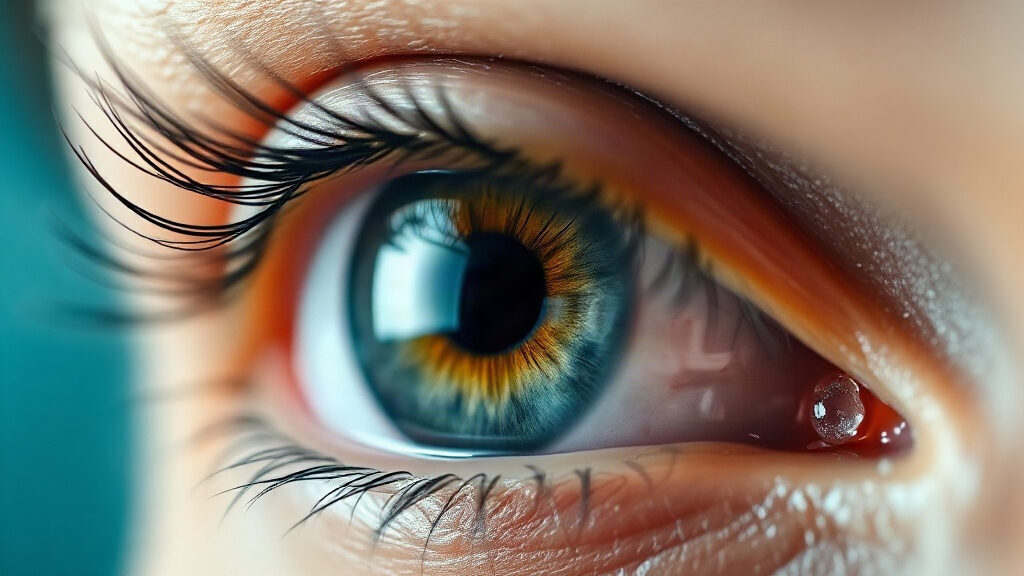
Dry eyes after 60: the 5 proven causes
Age is the leading risk factor: in the Beaver Dam study, which followed 3,722 adults aged 48 to 91, 14.4% reported eye dryness, with 8.4% before age 60 and 19.0% after age 80 (Moss et al., 2000). The TFOS DEWS II epidemiology review confirms that frequency increases with each decade and remains higher in women (Stapleton et al., 2017). Behind age, five concrete causes explain most cases.
1. Clogged meibomian glands
Meibomian gland dysfunction is the most common cause of dry eyes. In an American clinic cohort, 86% of patients with dry eye disease showed signs of this dysfunction, versus only 23 patients out of 159 with pure aqueous deficiency (Lemp et al., 2012). With age, these glands atrophy and their secretion thickens, which lets tears evaporate. Red eyelid margins, crusts on waking and blurred vision that improves with blinking point toward this cause.
2. Declining sex hormones
Androgens maintain the meibomian glands and the lacrimal gland, which explains why eye dryness is more frequent in women after menopause (Sullivan et al., 2017). In the Women’s Health Study, frequency rose from 5.7% before age 50 to 9.8% after age 75 among 39,876 women (Schaumberg et al., 2003). In men, it climbed from 3.90% between ages 50 and 54 to 7.67% after age 80 (Schaumberg et al., 2009).
Menopausal hormone therapy does not protect. Among 25,665 postmenopausal women, estrogen alone was associated with a 1.69-fold risk of dry eye disease, and combined estrogen and progestin with a 1.29-fold risk. Each additional 3 years of use added 15% to the risk (Schaumberg et al., 2001). This is an observed association, which does not justify stopping a treatment without medical advice. The other effects of this period are covered in our article on the levers for aging well after menopause, and the National Institute on Aging offers a detailed guide to menopause.
3. Everyday medications
Several families of medications reduce tear production, and older adults often take more than one. Over 5 years, 13.3% of the 2,414 Beaver Dam participants without initial complaints developed the condition, with a higher risk among those taking antihistamines or diuretics (Moss et al., 2004). In men, antidepressants, antihypertensives and treatments for benign prostate enlargement were also associated with dryness (Schaumberg et al., 2009, cited above).
A 2011 review lists medications with anticholinergic effects among the main culprits: antidepressants, antipsychotics, anti-Parkinson drugs and antihistamines (Wong et al., 2011). Eye drops used long term, especially for glaucoma, also play a role: their preservatives irritate the eye’s surface, and cataract surgery can worsen existing dryness (Gomes et al., 2017).
4. Screens and slower blinking
In front of a screen, we blink much less, which lets tears evaporate between blinks. A British study measured an average fivefold drop in blink rate during screen work (Patel et al., 1991). A French meta-analysis of 16 studies and 11,365 screen workers estimates the frequency of dry eye disease at 49.5%, but at only 11.6% with the strictest diagnostic criteria (Courtin et al., 2016).
After 60, tablets, television and prolonged reading produce the same effect. The problem comes from the fixed gaze and incomplete blinking, not from blue light. The American Academy of Ophthalmology explains what is really known about blue light and the eye, and our article on blue light and sleep reviews what screens change about your nights.
5. General diseases
Several diseases common after 60 come with eye dryness. In the Beaver Dam cohort, arthritis multiplied the risk by 1.91, thyroid disease by 1.41, diabetes by 1.38 and current smoking by 1.82 (Moss et al., 2000, cited above). A meta-analysis of 23 studies and 5,566 participants finds dry eye disease more frequent in people with diabetes, with an odds ratio of 2.30. The risk is higher after 10 years of diabetes or with an HbA1c above 7% (Chen et al., 2025).
Sjögren’s syndrome deserves a special mention. This autoimmune disease, which mainly affects women after 50, attacks the tear and salivary glands. Dry, gritty eyes combined with a persistent dry mouth, difficulty swallowing dry bread or joint pain should prompt a discussion of this diagnosis with your doctor.
What science says about remedies for dry eyes
Artificial tears relieve most people with dry eye disease, but no formula clearly stands out. The 2016 Cochrane review pooled 43 trials and 3,497 participants. It concluded that over-the-counter artificial tears are probably safe and similarly effective, with a level of evidence rated as low (Pucker et al., 2016). The right product is therefore the one you tolerate and use regularly.
Omega-3 supplements have not lived up to their promise. In the DREAM trial, published in the NEJM, 535 patients with moderate to severe dry eye disease received 3,000 mg per day of EPA and DHA or an olive oil placebo for 12 months. The symptom score fell by 13.9 points on omega-3 and by 12.5 points on placebo, a non-significant difference (Asbell et al., 2018). Oily fish remain valuable for the heart and brain, as our article on the omega-3 index points out, but they are not an answer to eye dryness.
The TFOS DEWS II management report recommends a stepwise approach: first education, environment and artificial tears, then eyelid care, then anti-inflammatory treatments prescribed by an ophthalmologist (Jones et al., 2017). It also stresses that many available treatments still lack solid trials.
| Remedy | What studies show | For whom |
|---|---|---|
| Artificial tears | Safe, similar efficacy across products, low-quality evidence (Cochrane 2016, 43 trials) | First step for everyone |
| Preservative-free tears | Preservatives irritate the ocular surface (TFOS DEWS II 2017) | Use more than 4 times a day, multiple eye drops |
| Warm compresses and eyelid hygiene | Recommended in the stepwise approach (TFOS DEWS II 2017) | Red eyelids, blocked meibomian glands |
| Omega-3 supplements | No benefit versus placebo (DREAM 2018, n=535) | Not indicated for eye dryness |
| Prescription anti-inflammatories | Ophthalmology step after simple measures fail | Moderate to severe forms |
In practice: when to see a doctor for dry eyes
Most cases of eye dryness can be managed with a family doctor and a pharmacist, but some signs call for an eye examination. Ordinary dryness affects both eyes, varies during the day and does not lastingly reduce vision. Anything outside this pattern should be checked, because keratitis, uveitis or acute glaucoma can begin as an irritated eye.
Dry eye disease does not cause blindness in the vast majority of cases, but it degrades functional vision: reading, night driving, screen work. The WHO estimates that at least 2.2 billion people live with a vision impairment, a large share of which is preventable or untreated. A checkup with an ophthalmologist also helps screen for other age-related diseases, such as age-related macular degeneration.
| Situation | Timing | Who to see |
|---|---|---|
| Intense pain, sudden loss of vision, very red eye | The same day | Eye emergency department |
| A single red and painful eye, strong sensitivity to light | Within 24 hours | Ophthalmologist |
| Dry, irritated eyes with dry mouth or joint pain | Within the following weeks | Family doctor, to check for Sjögren’s syndrome |
| Discomfort that persists after a month of artificial tears | Scheduled appointment | Ophthalmologist |
| Dryness that started with a new medication | At the next appointment | Prescribing doctor or pharmacist |
Tips: 7 daily habits to relieve dry eyes
Simple measures form the first step recommended by TFOS DEWS II, and they are often enough in mild forms. Their individual effectiveness has rarely been tested in controlled trials: they aim to reduce evaporation and protect the eye’s surface, without claiming to cure the disease.
- Apply the 20-20-20 rule in front of a screen: every 20 minutes, look 6 meters (20 feet) away for 20 seconds, blinking fully.
- Place the screen slightly below eye level, which reduces how wide the eyelids open and limits evaporation.
- Keep indoor humidity at a reasonable level in winter and avoid direct airflow from heating, air conditioning or car vents.
- Place a warm compress on closed eyelids for a few minutes, then gently massage the eyelid margins, if the meibomian glands are involved.
- Choose preservative-free artificial tears if you use them often.
- Have your doctor or pharmacist review your list of medications, and never stop a treatment on your own.
- Quit smoking, since current smoking was associated with a 1.82-fold risk in the Beaver Dam study.
These habits fit into a broader prevention strategy: treating eye dryness early limits the inflammatory vicious circle and preserves reading comfort, a factor of independence after 60. If the discomfort persists, an ophthalmologist has higher-step treatments available.
Frequently asked questions about dry eyes
Why do we get dry eyes as we age?
With age, the meibomian glands atrophy and produce a thicker oil, so tears evaporate faster. The lacrimal gland also secretes less, due to the decline in sex hormones. In the Beaver Dam study, the frequency of eye dryness rose from 8.4% before age 60 to 19.0% after age 80 (Moss et al., 2000).
Can dry eyes be caused by a medication?
Yes. Antihistamines and diuretics increased the risk of onset over 5 years in the Beaver Dam cohort (Moss et al., 2004). Antidepressants, some antihypertensives, prostate treatments and eye drops containing preservatives are also involved. Never stop a treatment on your own: the doctor can sometimes lower the dose or choose another drug.
What is the difference between dry eyes and conjunctivitis?
Dry eye disease causes chronic discomfort in both eyes, which varies during the day and worsens in front of a screen or in dry air. Infectious or allergic conjunctivitis starts more suddenly, with marked redness, sticky discharge or intense itching. A single red, painful eye with reduced vision suggests neither one and warrants a prompt ophthalmology opinion.
Do omega-3s relieve dry eyes?
The strongest data say no. In the DREAM trial (NEJM, 2018), 535 patients took 3,000 mg of EPA and DHA per day or a placebo for 12 months. Symptoms fell by 13.9 points on omega-3 and by 12.5 points on placebo, with no significant difference. Eating oily fish remains useful for general health, but not as a treatment.
When should you see an ophthalmologist for dry eyes?
See a doctor the same day in case of intense pain, sudden loss of vision or a very red eye. A single painful eye with sensitivity to light warrants an appointment within 24 hours. Discomfort that persists after a month of properly used artificial tears, or eye dryness combined with a dry mouth, deserve a scheduled checkup.
To receive a weekly selection of studies on health and longevity, explained without jargon, sign up for our health newsletter.
Medical disclaimer. The information on this page is provided for informational purposes only and does not constitute medical advice. It does not replace a consultation. Intense eye pain, a sudden loss of vision or a red and painful eye require an emergency eye examination. Never stop or change a treatment without the advice of the doctor who prescribed it. Ask a healthcare professional before changing your diet, taking dietary supplements or starting a new practice, especially if you have a medical condition or are under treatment. Dietary supplements do not replace a balanced diet or medical follow-up.