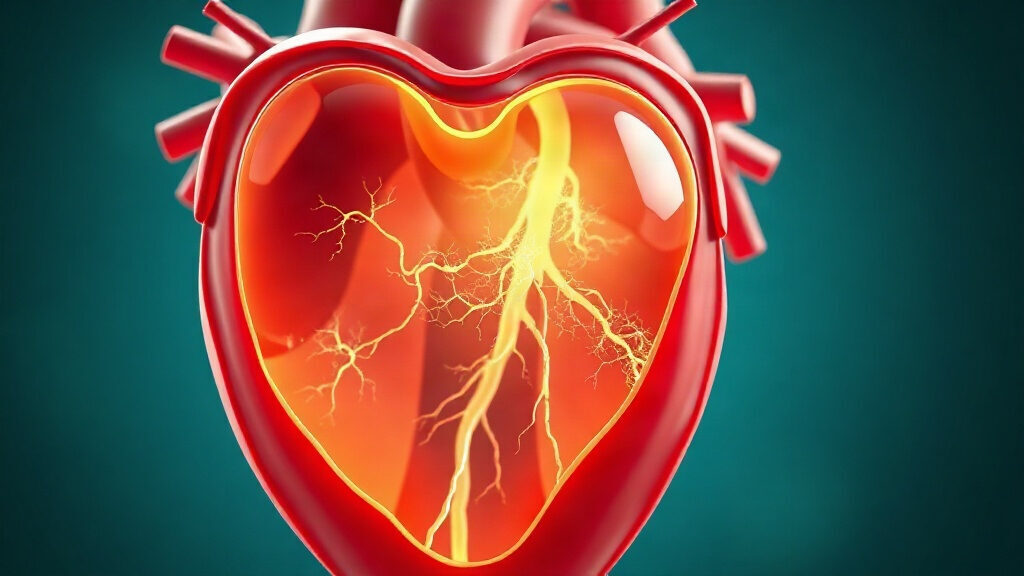
Amyloidosis is a group of diseases in which a misfolded protein clumps into insoluble fibrils that build up between cells. When these deposits invade the heart muscle, the walls thicken, stiffen and the heart struggles to fill. Long classified as a rare disease, the transthyretin form actually affects 6 to 13% of patients over 60 hospitalized for heart failure with preserved ejection fraction. Here are the mechanisms, the signs that should raise concern and the treatments validated by randomized trials since 2018.
In brief – Amyloidosis is a deposition disease in which an unstable protein (transthyretin or immunoglobulin light chains) forms amyloid fibrils that infiltrate organs, the heart in particular. Three forms reach the myocardium: AL amyloidosis, driven by a clone of plasma cells, wild-type transthyretin amyloidosis, which appears with age, and the hereditary form, caused by a mutation in the TTR gene. The deposits thicken the walls of the left ventricle, impair filling and disrupt electrical conduction. Bilateral carpal tunnel syndrome, hearing loss or unexplained low blood pressure often precede cardiac involvement by several years. Since 2016, a bone scintigraphy scan combined with blood tests has been enough to diagnose the transthyretin form in most cases, without a heart biopsy. Three drugs (tafamidis, acoramidis, vutrisiran) reduced mortality in randomized trials published in the New England Journal of Medicine between 2018 and 2025.
Amyloidosis: definition and the forms that affect the heart
Amyloidosis is defined by the presence, in tissues, of insoluble protein fibrils with a beta-sheet structure that stain with Congo red. More than 30 human proteins can form these fibrils, but only three infiltrate the heart to a significant degree. The NHS describes these forms in its patient guidance on amyloidosis.
- AL amyloidosis: immunoglobulin light chains produced by a clone of abnormal plasma cells. Its incidence is around 10 cases per million people per year in the Olmsted County cohort followed by Kyle from 1950 to 1989. It progresses fast and is both a hematological and a cardiological emergency.
- Wild-type transthyretin amyloidosis (ATTRwt): transthyretin, a normal protein made by the liver to carry thyroxine and vitamin A, becomes unstable with aging without any mutation. It mainly affects men after age 70.
- Hereditary transthyretin amyloidosis (ATTRv): more than 130 mutations in the TTR gene weaken the protein. It is inherited in an autosomal dominant pattern and is often associated with peripheral neuropathy.
Amyloid deposits fall under loss of proteostasis, one of the twelve biological hallmarks of aging described by López-Otín. The same failure to fold and clear proteins is at work in Alzheimer’s disease (beta-amyloid and tau) and in Parkinson’s disease (alpha-synuclein). The heart is no exception: wild-type transthyretin aggregates all the more readily as cellular quality-control systems decline with age.
How amyloidosis deposits weaken the heart muscle
The fibrils wedge themselves between the heart’s muscle cells and gradually replace supple tissue with a rigid matrix. The left ventricle thickens (a wall of 12 mm or more, about 0.5 inch, on echocardiography) without this hypertrophy reflecting a stronger muscle. The result is a stiff heart that fills poorly during diastole: this is the picture of heart failure with preserved ejection fraction, with breathlessness on exertion, swollen legs and fatigue.
Four mechanisms combine, according to the European Society of Cardiology review coordinated by Garcia-Pavia in 2021:
- Interstitial infiltration: the deposits push cardiomyocytes apart and raise filling pressure.
- Direct toxicity: the oligomers that precede the fibrils trigger oxidative stress and the death of heart cells, especially in the AL form.
- Damage to the conduction system: atrioventricular blocks, atrial fibrillation and fainting result from infiltration of the electrical pathways.
- Dysautonomia: infiltration of the autonomic nerves causes orthostatic hypotension, which makes standard heart failure treatments poorly tolerated.
The deposits also spread to the valves, the pericardium and the small coronary vessels. The process is dynamic: without treatment, the thickening progresses measurably within 12 to 24 months, which is why early diagnosis matters.

What the science says: amyloidosis is far more common than once thought
The wild-type transthyretin form accounts for a sizable share of heart failure in older adults. In the Spanish study by González-López (Eur Heart J, 2015), 120 patients aged 60 and over hospitalized for heart failure with preserved ejection fraction and a thickened wall underwent DPD scintigraphy: 13.3% had transthyretin cardiac amyloidosis, and none had been diagnosed before.
The Mayo Clinic community cohort confirms the effect of age. AbouEzzeddine (JAMA Cardiol, 2021) screened 286 patients aged 60 and over: 6.3% were affected, 10.1% of men versus 2.2% of women. Prevalence rose from 0% between ages 60 and 69 to 21% beyond age 90. Systematic screening identified five times as many cases as usual clinical diagnosis (1.3%).
Severe aortic stenosis also hides deposits. Among 151 patients with an average age of 84 undergoing transcatheter valve replacement, Castaño (Eur Heart J, 2017) found 16% positive scintigraphy scans. These patients had a thicker septum (1.3 versus 1.1 cm, or 0.51 versus 0.43 inch) and a lower stroke volume.
Diagnosis was simplified by Gillmore (Circulation, 2016) in 1,217 patients: grade 2 or 3 cardiac uptake on bone scintigraphy, combined with the absence of a monoclonal protein in blood and urine, has a positive predictive value of 100% for transthyretin amyloidosis. A heart biopsy is therefore no longer necessary in most cases.
On the treatment side, three placebo-controlled randomized trials have changed the prognosis of transthyretin cardiac amyloidosis. Tafamidis, which stabilizes the transthyretin tetramer, reduced all-cause mortality from 42.9% to 29.5% over 30 months in 441 patients (Maurer, NEJM, 2018, hazard ratio 0.70). Acoramidis, another stabilizer, achieved a win ratio of 1.8 on a hierarchical endpoint in 632 patients (Gillmore, NEJM, 2024). Vutrisiran, an RNA interference drug that blocks liver production of transthyretin, reduced the risk of death by 35% at 42 months in 655 patients (Fontana, NEJM, 2025, hazard ratio 0.65).
| Drug | Mechanism | Trial, year | Patients | Main result |
|---|---|---|---|---|
| Tafamidis | Stabilization of the transthyretin tetramer | ATTR-ACT, 2018 | 441 | Mortality 29.5% versus 42.9% at 30 months (HR 0.70) |
| Acoramidis | Tetramer stabilization, enhanced binding affinity | ATTRibute-CM, 2024 | 632 | Win ratio 1.8 on mortality, hospitalizations, NT-proBNP and 6-minute walk |
| Vutrisiran | RNA interference, silencing of liver synthesis | HELIOS-B, 2025 | 655 | All-cause death HR 0.65 at 42 months, cardiovascular events HR 0.72 |
In practice: recognizing the warning signs before the heart
The deposits reach tendons, nerves and the inner ear several years before the heart, which opens a window for screening. French national guidelines published in 2021 for primary care physicians list these “red flags”. Their combination in a breathless man over 70 justifies an echocardiogram and an NT-proBNP blood test. This preventive reading echoes the approach described in our feature on loss of proteostasis, the biological pillar shared by amyloidosis, Alzheimer’s and Parkinson’s.
| Warning sign | Form most often involved | What it reflects |
|---|---|---|
| Bilateral carpal tunnel syndrome, often operated on 5 to 10 years earlier | Wild-type transthyretin | Deposits in the sheath of the wrist flexor tendons |
| Lumbar spinal stenosis, spontaneous rupture of the biceps tendon | Wild-type transthyretin | Infiltration of ligaments and tendons |
| Hearing loss, trigger finger, Dupuytren’s contracture | Wild-type transthyretin | Involvement of the skin, connective tissue and inner ear |
| Tingling in the feet, diarrhea or constipation, low blood pressure on standing | Hereditary (ATTRv) | Peripheral and autonomic neuropathy |
| Enlarged tongue, bruising around the eyes, protein in the urine | AL | Light-chain deposits in skin, mucosa and kidneys |
| Intolerance to beta-blockers, blood pressure that drops despite a thickened heart | All | Dysautonomia and low cardiac output |
On echocardiography, concentric wall thickening with a low or normal voltage electrocardiogram, when hypertrophy should increase voltage, points strongly toward amyloidosis. The contrast with high blood pressure, the leading cause of heart wall thickening, is detailed in our article on the blood pressure number to watch.
| Criterion | AL | Wild-type transthyretin | Hereditary transthyretin |
|---|---|---|---|
| Protein involved | Immunoglobulin light chains | Normal transthyretin, unstable with age | Mutated transthyretin (TTR gene) |
| Usual age | 60 to 75 | Over 70 | 30 to 70 depending on the mutation |
| Sex | Both sexes | Mostly men | Both sexes |
| Diagnosis | Biopsy and typing required | Bone scintigraphy + absence of monoclonal protein | Scintigraphy + genetic testing |
| Specific management | Chemotherapy targeting the plasma cell clone | Stabilizers (tafamidis, acoramidis) or RNA interference | RNA interference (patisiran, vutrisiran), stabilizers |
| Speed of progression without treatment | Fast, within months | Slow, over years | Variable |
Protocol: what to do when amyloidosis is suspected
Screening relies on routine tests, ordered in a precise sequence and interpreted by a specialized center. In France, the Cardiogen network coordinates the reference and expert centers, including the national center at Henri-Mondor Hospital. The usual pathway includes:
- See a doctor if progressive breathlessness, swelling or fainting spells occur, especially after age 70 and with a history of carpal tunnel or lumbar spinal surgery.
- Echocardiogram and NT-proBNP as first-line tests: thickened walls, impaired filling, elevated biomarker.
- Screening for a monoclonal protein (electrophoresis, immunofixation, free light chains) to rule out an AL form, which requires a biopsy and urgent hematological care.
- Bone scintigraphy with DPD or HMDP: grade 2 or 3 cardiac uptake without a monoclonal protein confirms the transthyretin form.
- Genetic testing of the TTR gene to distinguish the wild-type from the hereditary form, with genetic counseling for the family if a mutation is found.
- Follow-up with an electrocardiogram and Holter monitoring twice a year, because conduction disorders may call for a pacemaker.
Specific treatment depends on the form and belongs exclusively to the expert center. No dietary supplement or diet dissolves the deposits. On the other hand, blood pressure control, adapted physical activity and restorative sleep remain the cardiovascular prevention levers that apply to everyone. To follow research advances on the proteins of aging, subscribe to the UltraSanté health newsletter.
Frequently asked questions about amyloidosis
What is the difference between amyloidosis and amyloid?
Amyloid refers to the substance: insoluble beta-sheet protein fibrils that stain with Congo red. Amyloidosis refers to the disease caused by their accumulation in an organ. There is therefore a single amyloid substance with a shared structure, but more than 30 diseases depending on the protein of origin: transthyretin, light chains, beta-amyloid in the brain. The French term “amylose” is the strict equivalent of amyloidosis.
Why does carpal tunnel syndrome sometimes signal cardiac amyloidosis?
Unstable transthyretin first settles in the tendon sheaths of the wrist, a poorly vascularized tissue, before reaching the myocardium. French national guidelines list bilateral carpal tunnel syndrome among the warning signs of the wild-type transthyretin form. The gap between wrist surgery and the first cardiac symptoms often exceeds 5 years, which opens a useful screening window in men over 65.
How is amyloidosis of the heart diagnosed without a biopsy?
With a DPD or HMDP bone scintigraphy scan combined with a search for a monoclonal protein in blood and urine. In the Gillmore study (Circulation, 2016, 1,217 patients), grade 2 or 3 cardiac uptake with a negative monoclonal work-up had a positive predictive value of 100% for the transthyretin form. If a monoclonal protein is present, a biopsy remains essential so that an AL form is not missed.
Is transthyretin amyloidosis a disease of aging?
Yes for the wild-type form, which occurs without any mutation. Normal transthyretin loses its stability with age, while the cellular systems that fold and clear proteins decline. In the Mayo Clinic cohort published in 2021, prevalence among heart failure patients rose from 0% between ages 60 and 69 to 21% after age 90. It illustrates loss of proteostasis, one of the biological hallmarks of aging.
Can cardiac amyloidosis be slowed once diagnosed?
Yes, for the transthyretin form, thanks to drugs tested against placebo. Tafamidis lowered mortality from 42.9% to 29.5% over 30 months (Maurer, NEJM, 2018) and vutrisiran reduced the risk of death by 35% at 42 months (Fontana, NEJM, 2025). These treatments slow the progression of the deposits without making them disappear, hence the value of a diagnosis before advanced heart failure. The AL form is treated with chemotherapy targeting the plasma cell clone.
Medical disclaimer. The information provided here is for informational purposes only and does not constitute medical advice. It does not replace a consultation. Unusual breathlessness, swollen legs, fainting spells or palpitations call for prompt medical attention. Ask a healthcare professional before changing your diet, taking dietary supplements or starting a new practice, especially if you have a medical condition, are pregnant or are under treatment. Dietary supplements do not replace a balanced diet or medical follow-up.