Single-leg balance can be measured in 10 seconds, barefoot and without support, and it reveals a great deal about health after 50. In 2022, a Brazilian cohort of 1,702 adults aged 51 to 75 showed that people unable to hold the position for 10 seconds had a 1.84 times higher risk of death over 7 years. The test is free, easy to do at home, and balance can be trained at any age.
In brief – Single-leg balance is a functional test that measures, in a few seconds, how well vision, the inner ear, sensation in the feet, the muscles and the brain work together. In the Araujo study (2022, 1,702 adults aged 51 to 75), the 20.4% of participants unable to hold 10 seconds had a 1.84-fold higher risk of death after adjustment for age, sex, BMI and disease. Reference values drop sharply after 60: an average of 41 seconds between 50 and 59, 32 between 60 and 69, and 21 between 70 and 79 (eyes open, 45-second ceiling). This link remains an association: it does not prove that balance itself extends life. Balance exercises, however, do reduce the number of falls by 24%, according to the 2019 Cochrane review (108 trials, 23,407 participants).
Single-leg balance: what the test involves
The single-leg balance test consists of standing on one foot for as long as possible, without holding on to anything, then recording the time achieved. Physical therapists also call it the one-leg stance or unipedal stance. Several versions of the test exist, and their results are not interchangeable.
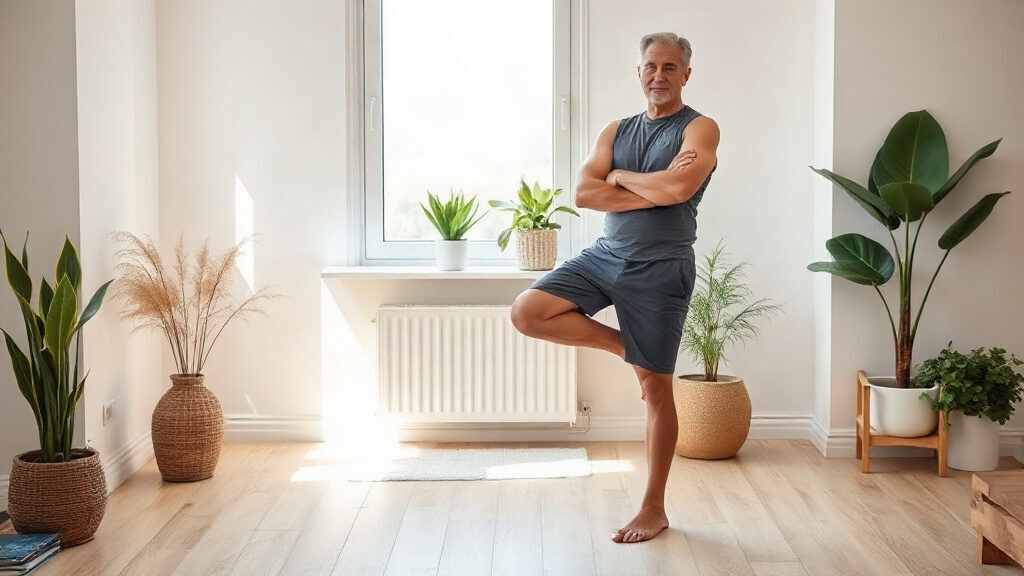
The 10-second version, used by Claudio Gil Araujo’s team in Rio de Janeiro, is done barefoot. The top of the free foot rests behind the calf of the standing leg, and the participant must hold for 10 seconds on the foot of their choice with no other support. The result of this version is binary: pass or fail.
The clinical version by Springer (2007) times how long a person can stand, arms crossed over the chest, up to a ceiling of 45 seconds. The trial stops as soon as the person uncrosses their arms, puts down or moves the raised foot, shifts the standing foot or, in the eyes-closed version, opens their eyes. The best of three trials is kept. This is the version of the single-leg balance test that provides normal values by age group.
A third, shorter variant only requires 5 seconds. It was used in the Albuquerque study on falls in people over 60. These differences in protocol explain why a balance time should always be compared with the norm from the same test.
What standing on one leg draws on: the mechanism
Standing on one leg forces the brain to correct tiny body sways continuously, several times per second. On two feet, the base of support is wide and forgiving. On a single foot, it shrinks to the size of a sole, and any failing sensory or motor system shows up immediately. The test therefore probes several systems at once:
- Vision, which locates the body in space. Closing the eyes divides balance time by 3 to 7 depending on age, according to the Springer norms.
- The vestibular system of the inner ear, which detects head movements and gravity.
- Proprioception, meaning the sensors in the feet, ankles and knees that report on joint position.
- The strength of the ankle muscles and the gluteus medius, which stabilizes the pelvis when one leg lifts.
- The brain, in particular the white matter that connects the motor and sensory centers with the cerebellum.
With age, each link in this chain wears down a little. The loss of fast muscle fibers (sarcopenia) slows the reflexes that catch a stumble. Sensation in the soles of the feet declines, especially with diabetes or neuropathy. Small vascular lesions in the brain disrupt signal transmission. The Finnish study by Era (2006), carried out in 7,979 people aged 30 and over, showed on a force platform that postural stability starts to decline in young adulthood, then that this decline speeds up around 60 (Era et al., 2006).
The one-leg test therefore works as a summary: it does not measure one organ, it measures the quality of their coordination. This integrative dimension is what interests aging research.
What the science says about single-leg balance
Being unable to hold single-leg balance for 10 seconds is associated with almost double the mortality in people aged 51 to 75. The Araujo study, published in the British Journal of Sports Medicine, followed 1,702 adults (68% men) tested between 2008 and 2020. At baseline, 20.4% failed the test. After a median follow-up of 7 years, 17.5% of them had died, versus 4.6% of those who passed. After adjustment for age, sex, BMI and disease, the risk of death remained 1.84 times higher, with a confidence interval of 1.23 to 2.78 (Araujo et al., 2022). The authors themselves point out two limitations: recent falls and physical activity level were not controlled for.
The signal appears as early as age 53. The British 1946 birth cohort tested 2,766 people at that age, then tracked their mortality up to age 66. Standing balance on one leg appeared more strongly linked to the risk of death than grip strength or chair rise speed. Participants unable to perform any of the three tests had a death rate 8.4 times higher than those who completed all of them (Cooper et al., 2014). An earlier meta-analysis by the same team confirmed that standing balance, walking speed, grip strength and chair rising all predict mortality in older people living at home (Cooper et al., 2010).
On falls, the data are older but consistent. In Albuquerque, 316 volunteers over 60 (mean age 73) were followed for 3 years. Failing to stand on one leg for 5 seconds was the only independent risk factor for an injurious fall, with a relative risk of 2.13 (Vellas et al., 1997). The test did not, however, predict all falls, including the most minor ones. Among 53 patients aged 50 and over, those who had fallen in the past year held on average 9.6 seconds, compared with 31.3 seconds for the others. A time under 30 seconds identified 91% of fallers (Hurvitz et al., 2000).
The most unexpected link concerns the brain. In Japan, Yasuharu Tabara’s team gave MRI scans to 1,387 middle-aged and older adults. Single-leg balance under 20 seconds affected 9.7% of people with no lacunar infarction, but 34.5% of those with at least two. The proportions were similar for microbleeds (10.1% versus 30.0%). A short time was also linked to lower cognitive function, independently of these lesions (Tabara et al., 2015). These lesions were silent: the participants believed they were in good health.
| Study | Participants | Test | Main finding |
|---|---|---|---|
| Araujo 2022, Brazil | 1,702 adults, aged 51 to 75 | 10 s on one foot | Failure: risk of death x1.84 over 7 years |
| Cooper 2014, United Kingdom | 2,766 adults tested at age 53 | Balance time | Stronger link with mortality than grip strength |
| Vellas 1997, United States | 316 adults, mean age 73 | 5 s on one foot | Failure: injurious fall x2.13 |
| Hurvitz 2000, United States | 53 patients aged 50 and over | 30 s threshold | Fallers 9.6 s versus 31.3 s |
| Tabara 2015, Japan | 1,387 adults, brain MRI | 20 s threshold | 34.5% short times with 2 or more lacunes |
All of these studies are observational. They show that poor balance often accompanies a body that is already frail, without proving that it is the cause.
In practice: normal single-leg balance values by age
After 60, an eyes-open single-leg balance time of around 30 seconds is average, and a time under 10 seconds should prompt a medical visit. The most detailed reference values come from Springer and colleagues, who tested 549 healthy adults aged 18 to 99 using the arms-crossed protocol with a 45-second ceiling (Springer et al., 2007). Differences between men and women were not significant.
| Age group | Eyes open (seconds) | Eyes closed (seconds) |
|---|---|---|
| 18 to 39 | 44.7 | 15.2 |
| 40 to 49 | 41.9 | 12.7 |
| 50 to 59 | 41.2 | 8.3 |
| 60 to 69 | 32.1 | 4.4 |
| 70 to 79 | 21.5 | 3.1 |
| 80 to 99 | 9.4 | 1.9 |
These averages hide wide individual variation: between 60 and 69, the standard deviation exceeds 16 seconds. A single result therefore matters less than how it changes from one year to the next. A rapid decline, or a clear gap between the right and left leg, deserves more attention than a figure slightly below average.
Araujo’s 10-second test gives an even simpler benchmark. According to data published by the team, the failure rate climbs quickly with age:
| Age | Failure on the 10-second test |
|---|---|
| 51 to 55 | Nearly 5% |
| 56 to 60 | 8% |
| 61 to 65 | Nearly 18% |
| 66 to 70 | Nearly 37% |
| 71 to 75 | About 54% |
Single-leg balance is best read alongside other functional tests. Grip strength reflects overall muscle strength, and walking speed reflects endurance and coordination. Together, the three draw a far more reliable aging profile than any single number. On the biological side, the loss of muscle strength and responsiveness ties in with stem cell exhaustion, one of the hallmarks of aging that limits muscle repair.
Figures from France show what is at stake. In France, more than 20,000 people aged 65 and over died in connection with a fall in 2024, and around 175,000 were hospitalized, according to national public health data; the NHS guide to falls describes the same risk in older adults. The WHO estimates that 842,000 people died from falls worldwide in 2023, 71% of them aged 60 and over. It lists physical exercise that challenges balance among the effective prevention measures (WHO, fact sheet on falls).
Protocol: how to test, then train, your balance on one leg
The single-leg balance test can be done safely at home if you follow a few simple rules. Here is a method inspired by the published protocols:
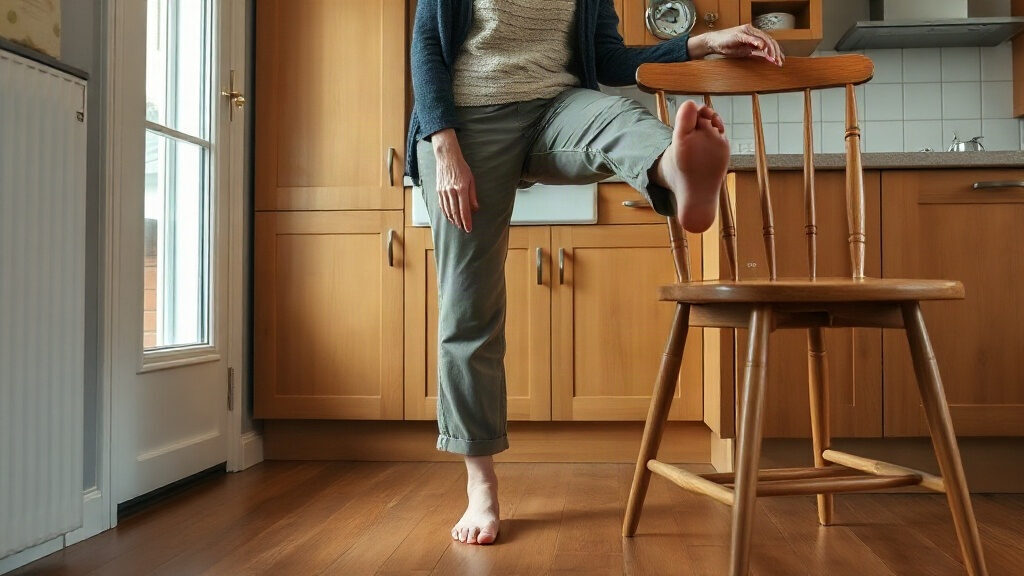
- Stand barefoot on a hard floor, next to a countertop or the back of a sturdy chair.
- Ask someone close to you to keep time and stay within arm’s reach, especially after 70 or if you experience dizziness.
- Cross your arms over your chest, fix your gaze on a point in front of you, then lift one foot without resting it against the other leg.
- Stop the timer as soon as you uncross your arms, put the raised foot down or move the standing foot.
- Do three trials per leg and note the best one. Repeat every three months, under the same conditions.
To reproduce Araujo’s version, rest the top of the free foot behind the opposite calf and aim for 10 seconds. Only try the eyes-closed version if you can hold more than 30 seconds with your eyes open, and always next to a support.
Single-leg balance improves with training, and this is where prevention becomes concrete. The 2019 Cochrane review by Sherrington pooled 108 randomized trials and 23,407 participants living at home, with a mean age of 76. Balance and functional exercises reduce the number of falls by 24%. Programs that add muscle strengthening probably reduce them by 34% (Sherrington et al., 2019). The 2022 world guidelines for fall prevention call for all older adults to receive physical activity advice, and for screening to be offered as soon as a risk appears (Montero-Odasso et al., 2022).
| Level | Exercise | Goal before moving to the next level |
|---|---|---|
| 1 | On one foot, one hand resting on the back of a chair | 30 seconds per leg without tensing up |
| 2 | On one foot, hands hovering above the support without touching it | 30 seconds per leg |
| 3 | On one foot while brushing your teeth | 2 minutes, switching legs halfway through |
| 4 | On one foot while slowly turning your head from left to right | 20 seconds per leg |
| 5 | On a cushion or a folded towel, close to a support | 20 seconds per leg |
A few principles make training more effective:
- Practice standing on one leg at least three times a week: the effective trials in the Cochrane review often totaled more than 3 hours of exercise per week.
- Combine balance work with leg strengthening, such as chair rises, calf raises on tiptoe and short lunges.
- Vary the activities: tai chi and dancing train balance in motion, which the static test does not measure.
- Have your eyesight, hearing and any medications that cause dizziness checked, because they directly affect stability.
Gains on the one-leg test remain modest on the stopwatch in the short term. The 2011 Cochrane review by Howe (94 studies, 9,917 participants), for example, found an improvement of 1.64 seconds with eyes closed after a strengthening program (Howe et al., 2011). The real goal is not to break a record, but to reduce the risk of falling in everyday life.
Frequently asked questions about single-leg balance
How long should you hold single-leg balance at 60?
Between 60 and 69, the average is 32 seconds with eyes open and 4.4 seconds with eyes closed, according to the Springer norms (549 adults, arms crossed, 45-second ceiling). Holding at least 10 seconds is the minimum threshold used in the Araujo study. A result below this threshold, or a rapid decline from one year to the next, is worth discussing with your doctor.
Why is single-leg balance linked to mortality?
This test sums up the state of several systems: muscles, nerves, vision, inner ear and the small blood vessels of the brain. When one of them declines, stability on one leg deteriorates. The Araujo study (1,702 adults) associates failing the 10-second test with a 1.84 times higher risk of death. This is an association: poor balance often signals frailty that is already present.
How can you improve single-leg balance after 50?
Practice balance exercises at least three times a week, progressing from support with one hand to no support, then to an unstable surface. Leg strengthening complements this work. According to the 2019 Cochrane review, programs that combine balance and strengthening probably reduce the number of falls by 34%.
What is the difference between the eyes-open and eyes-closed test?
With eyes open, the brain relies on vision to stabilize itself. With eyes closed, it only has the inner ear and the sensors in the feet and joints. The time held then drops sharply: 8.3 seconds on average between 50 and 59, compared with 41.2 seconds with eyes open. This version is better at revealing a subtle sensory deficit.
Should you worry if you cannot stand on one foot for 10 seconds?
This result is not a diagnosis, but it warrants a checkup, especially before 70. After 71, more than half of the people in the Araujo study failed the test. Your doctor can look for a treatable cause: neuropathy, a vision problem, a medication that causes dizziness, or muscle loss. A supervised exercise program then makes it possible to improve.
Can you do the balance test alone at home?
Yes, provided you stand next to a stable support, barefoot, on a hard floor with no obstacles around you. After 70, or if you have had a recent fall, experience dizziness or take medication for high blood pressure, it is better to have someone stay within arm’s reach. Stop immediately if you feel pain or unwell.
Medical disclaimer. The information provided here is for informational purposes only and does not constitute medical advice. It does not replace a consultation. Ask a healthcare professional before changing your diet, taking dietary supplements or starting a new practice, especially if you have a medical condition, are pregnant or are under treatment. Balance tests and exercises carry a risk of falling: always do them next to a stable support, and seek medical advice if you experience dizziness, have had recent falls or take a treatment that affects blood pressure. Dietary supplements do not replace a balanced diet or medical follow-up.