Grip strength is the force your hand produces when it squeezes an object, measured in kilograms with a dynamometer. This three-second test, used in large international cohorts, predicts mortality better than systolic blood pressure. After 50, it declines gradually in most adults. Four numerical thresholds, drawn from studies covering more than 600,000 people, show where you stand and when to act.
In brief – Grip strength is a marker of muscle health that reflects whole-body strength and predicts the risk of death, frailty and loss of independence. It peaks around age 30 to 40, at about 51 kg (112 lb) in men and 31 kg (68 lb) in women (12 British studies, n=49,964). In the PURE study (139,691 adults, 17 countries), every 5 kg (11 lb) lost is associated with 16% higher mortality. The European consensus EWGSOP2 sets less than 27 kg in men and less than 16 kg in women as the threshold for probable sarcopenia. Between these two markers, the Fried frailty criteria place the warning zone at about 29-32 kg for men and 17-21 kg for women, depending on BMI. The good news: strength training combined with adequate protein intake improves grip by 5.45 kg on average in people with sarcopenia.
Grip strength: definition and measurement
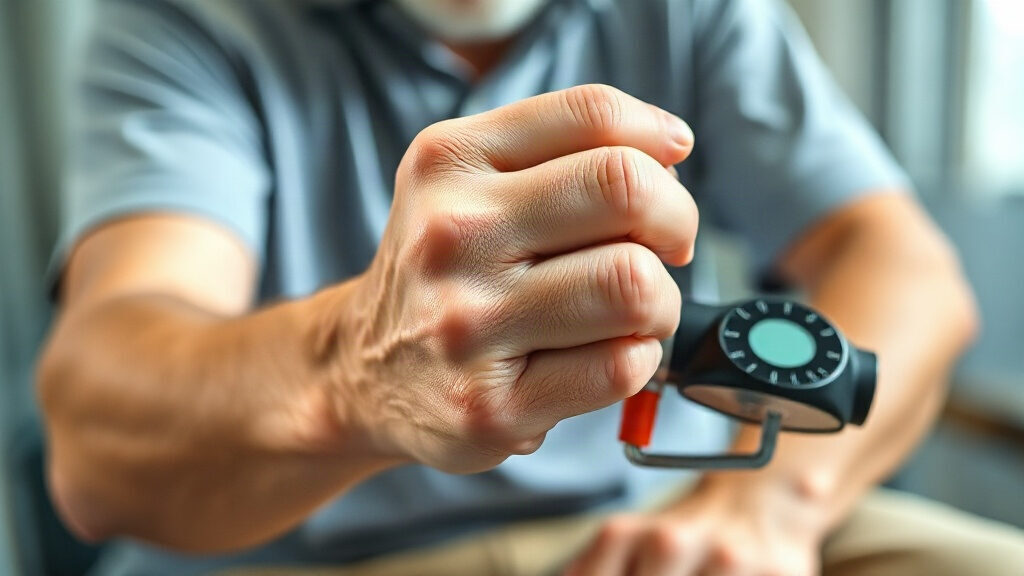
Handgrip strength is the maximal isometric force that the hand and forearm exert when squeezing. It is measured with a handheld dynamometer, the Jamar model being the reference in clinical research, and the result is expressed in kilograms.
The movement recruits around twenty muscles of the forearm and hand, yet it reflects far more than the hand alone. Richard Bohannon’s review (2019) shows that handgrip force correlates with overall body strength, bone density, the risk of falls and fractures, malnutrition, depression and cognitive decline (Bohannon, 2019). For this reason, geriatricians call it a biomarker of aging.
The measurement is only reliable when the protocol is standardized. The Southampton team found that studies vary widely in posture, number of trials and the hand tested, which makes the figures hard to compare (Roberts et al., 2011). Their protocol recommends a seated position, the elbow bent at 90 degrees and three trials per hand, keeping the best value.
Why grip weakens with age: the mechanisms
The decline in grip after 50 reflects sarcopenia, the combined loss of muscle mass and muscle quality. It starts quietly in midlife and speeds up after 65. Several biological processes contribute to it:
- The gradual loss of motor neurons: some muscle fibers lose their nerve supply, and not all of them are reinnervated.
- Selective atrophy of fast type II fibers, the ones that produce explosive force.
- Exhaustion of satellite cells, the muscle stem cells that repair the tissue after exertion.
- Chronic low-grade inflammation that slows muscle protein synthesis.
- Anabolic resistance: after 65, more protein per meal is needed to trigger the same muscle synthesis.
Aging shrinks the pool of muscle stem cells and their ability to regenerate tissue; the World Health Organization describes aging as the gradual build-up of molecular and cellular damage that erodes physical capacity over time (WHO, ageing and health). A sedentary lifestyle, a low-protein diet and hospital stays clearly accelerate this decline.
What the science says about grip strength
Grip strength is one of the best-documented predictors of mortality in epidemiology. In the PURE study, conducted in 139,691 adults aged 35 to 70 in 17 countries, every 5 kg decrease came with 16% higher all-cause mortality and 17% higher cardiovascular mortality, over a median follow-up of 4 years (Leong et al., 2015). It proved more predictive than systolic blood pressure.
The UK Biobank confirms the link between grip and mortality in 502,293 participants aged 40 to 69, followed for 7.1 years. For every 5 kg lower, the risk of death rose by 20% in women and 16% in men, with similar increases for cardiovascular and respiratory disease (Celis-Morales et al., 2018). Adding the grip measure to a standard risk score improved its accuracy.
The signal appears as early as midlife. In the Honolulu Heart Program, 6,089 healthy men aged 45 to 68 had their grip measured, then were followed for 25 years. Those in the weakest third had a 2.87 times higher risk of walking very slowly at the end of follow-up, and more than twice the risk of needing help with personal care (Rantanen et al., 1999). In people over 60, a meta-analysis of 34 studies links weak grip to a 1.79-fold risk of death (Rijk et al., 2016).
These studies are observational: they show an association, not causation. A weak grip may reflect an existing illness, inactivity or malnutrition. No trial has yet shown that gaining kilos on the dynamometer, on its own, lengthens life expectancy.
The 4 grip strength thresholds to know after 50
Four markers help you interpret your result, from the most favorable to the most worrying. They come from European and North American populations and apply to a measurement taken with a standard protocol.
Threshold 1, your young-adult peak. Data from 12 British studies (49,964 participants) put peak median grip at 51 kg (112 lb) in men between 29 and 39, and at 31 kg (68 lb) in women between 26 and 42. It holds steady until midlife, then declines (Dodds et al., 2014). The higher your reserve at 50, the wider your margin before the warning thresholds.
Threshold 2, a loss of 5 kg. In both PURE and the UK Biobank, this gap of 5 kg (11 lb) corresponds to a 16 to 20% rise in the risk of death. Measuring your grip every year lets you spot this drop before it shows up in daily life.
Threshold 3, the frailty zone. Linda Fried’s frailty phenotype, built on 5,317 adults aged 65 and over, classifies as weak the grip of the weakest fifth of the population, at equal BMI (Fried et al., 2001). In practice, this means about 29 to 32 kg (64 to 71 lb) in men and 17 to 21 kg (37 to 46 lb) in women.
Threshold 4, probable sarcopenia. The European consensus EWGSOP2 sets the cutoff at less than 27 kg (60 lb) in men and less than 16 kg (35 lb) in women. Below these values, the doctor looks for reduced muscle mass to confirm the diagnosis (Cruz-Jentoft et al., 2019).
| Threshold | Men | Women | What it means | Source |
|---|---|---|---|---|
| 1. Young-adult peak | 51 kg (age 29-39) | 31 kg (age 26-42) | Your starting reserve | Dodds 2014 |
| 2. Loss of 5 kg | +16% mortality | +20% mortality | A drop worth monitoring | Leong 2015, Celis-Morales 2018 |
| 3. Frailty zone | About 29 to 32 kg | About 17 to 21 kg | Weakness relative to BMI | Fried 2001 |
| 4. Probable sarcopenia | Less than 27 kg | Less than 16 kg | Medical assessment advised | EWGSOP2, 2019 |
In practice: how to test your grip strength
The test can be done at the doctor’s office, with a physical therapist or with a home dynamometer, whose accuracy varies between models. For results you can compare from one year to the next, always use the same device and the same protocol.
- Sit on a chair without armrests, feet flat, back straight.
- Keep your arm by your side, elbow bent at 90 degrees, wrist neutral.
- Squeeze as hard as you can for 3 seconds, without jerking.
- Do three trials per hand, alternating, with one minute of rest.
- Write down the best value obtained, whichever hand it came from.
A single dynamometer reading matters less than its trend over time. Walking speed offers a second, complementary marker, also linked to longevity (see our article on walking speed and longevity). If your result falls below threshold 3 or 4, our guide to muscle loss details the signs that should prompt a medical visit. The topic belongs to the aging of regenerative reserves, covered in our pillar on stem cell exhaustion.
| Intervention | Effect on grip | Level of evidence |
|---|---|---|
| Strength and balance training with protein intake | +5.45 kg on average | High (network meta-analysis, 96 studies) |
| Strength training alone | Strength gain, variable effect on mass | Moderate to high |
| Walking or cardio alone | Small effect on strength | Moderate |
| Protein supplements without exercise | Limited effect | Low |
Tips to preserve your grip strength
The best-supported strategy combines resistance exercise and protein. A network meta-analysis of 96 studies (7,596 participants with sarcopenia) ranked the combination of strength training, balance work and protein supplementation first, with an average gain of 5.45 kg (12 lb) in handgrip force (Yan et al., 2025). The same approach also improved walking speed by 0.20 m/s (about 0.66 ft/s).
- Do strength training at least twice a week, working the whole body and not only the hands: our guide to strength training after 50 offers a suitable progression.
- Add grip exercises: carrying heavy bags over 20 to 30 meters (65 to 100 feet), hanging from a bar, squeezing a ball or a hand gripper.
- Aim for 1.0 to 1.2 g of protein per kilogram of body weight per day after 65, spread over three meals, according to the PROT-AGE expert group (Bauer et al., 2013).
- Include balance exercises, which boost the functional benefit of strength training.
- Limit long periods of sitting and stay active during and after a hospital stay.
- Retest your grip once a year, under the same conditions.
The first strength gains appear within a few weeks, because the nervous system first learns to recruit existing fibers more efficiently. Muscle mass follows more slowly. If you have joint pain in the hand, osteoarthritis or heart disease, have the program approved by a healthcare professional.
Frequently asked questions about grip strength
What is normal grip strength at 60?
There is no single value, only reference points. The peak sits around 51 kg in men and 31 kg in women between 30 and 40, then grip strength declines gradually. At 60, a result clearly above 27 kg in men and 16 kg in women stays outside the sarcopenia zone defined by the European consensus EWGSOP2.
Why does grip strength predict mortality?
Grip reflects overall muscle strength, which is itself tied to nutritional status, physical activity, inflammation and chronic disease. In the PURE study (139,691 adults), every 5 kg decrease was associated with 16% higher mortality. This is an association: a weak hand often signals health that is already compromised.
How can you increase grip strength after 50?
Strength training two to three times a week, combined with balance exercises and adequate protein intake, gives the best results. A meta-analysis of 96 studies published in 2025 measured an average gain of 5.45 kg with this approach. Carrying loads, hanging from a bar and squeezing a ball round out the program.
What is the difference between grip strength and muscle mass?
Strength measures what the muscle produces; mass measures how much muscle there is. Since 2019, the European consensus has made strength the primary criterion for sarcopenia, because it better predicts falls, dependency and mortality. You can lose strength well before any visible loss of muscle volume.
Is a home dynamometer reliable?
Consumer devices give a useful trend, but their readings can differ by a few kilos from the Jamar model used in studies. To track your progress, keep the same device, the same seated position and the same protocol of three trials per hand. A result close to a threshold deserves a measurement at a clinic.
Medical disclaimer. The information on this page is provided for informational purposes only and does not constitute medical advice. It does not replace a consultation. Ask a healthcare professional before changing your diet, taking dietary supplements or starting a new practice, especially if you have a medical condition, are pregnant or are under treatment. Dietary supplements do not replace a balanced diet or medical follow-up.