Magnesium threonate is a form of magnesium bound to L-threonic acid, designed at MIT in 2010 to raise magnesium levels in the brain. Sold under the brand names Magtein or ClariMem, it promises sharper memory and deeper sleep. Six controlled human trials exist to date, often small and funded by the manufacturers. Here is what they really show, the dose that was studied and the precautions to know before taking it.
In brief – Magnesium threonate is a magnesium salt bound to L-threonic acid that, in rats, raises brain magnesium and synapse density in the hippocampus. In humans, four placebo-controlled trials funded or run by industry report a slight gain in memory or sleep quality, with 44 to 109 participants and 3 to 12 weeks of follow-up. An independent 12-week trial in 109 women found no effect on pain, sleep, mood or cognition. Studied doses range from 1 to 2 g of salt per day, which is only about 70 to 145 mg of elemental magnesium. This form remains a promising but unproven option for the brain, and a poor choice for correcting a deficiency, because each capsule delivers little magnesium. It is not recommended for people with kidney failure.
Magnesium threonate: definition and origin
Also called magnesium L-threonate, it combines one magnesium ion with two molecules of L-threonic acid, a natural breakdown product of vitamin C. Researchers refer to it as MgT or L-TAMS. It was developed by an MIT team linked to neuroscientist Guosong Liu, who then took the product forward at the company Neurocentria. This tie between the discoverers and the manufacturer explains some of the reservations discussed below.
This form was designed for a specific reason: other magnesium salts (oxide, citrate, bisglycinate) correct blood magnesium well, but barely change brain magnesium in animals. Threonate is therefore a supplement targeted at the nervous system, not a basic source of the mineral.
Magnesium itself is an essential mineral. The NIH Office of Dietary Supplements notes that about half of the body’s magnesium is stored in bone and that it helps regulate muscle, heart and nerve function (NIH ODS, magnesium fact sheet). Recommended intakes are around 300 to 420 mg per day for adults, depending on sex and on the reference body.
How magnesium threonate acts on the brain
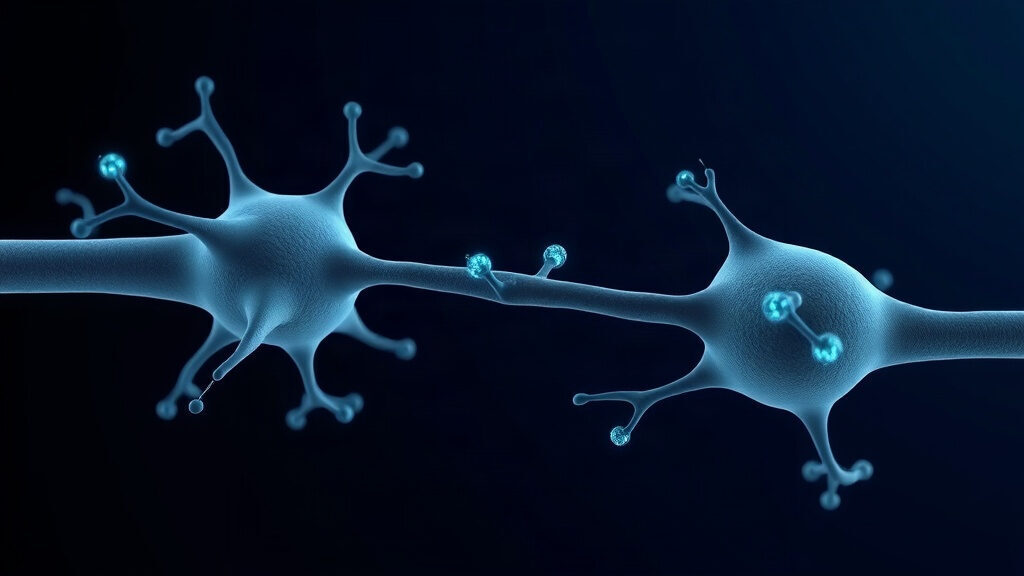
This compound acts first on synapses, the contact points between neurons. The founding study, published in Neuron in 2010, showed in rats that it raises brain magnesium, hippocampal synapse density and memory performance, including in aged animals (Slutsky et al., 2010). The mechanisms described in this animal work are as follows:
- At rest, magnesium blocks the NMDA receptor, which filters out background “noise” and strengthens useful signals during learning.
- A rise in magnesium inside neurons increases the expression of NR2B-type NMDA receptors, which are involved in synaptic plasticity.
- The number of neurotransmitter release sites increases, while the release probability of each individual site decreases.
- L-threonic acid, naturally present in cerebrospinal fluid, enters neurons through glucose transporters (GLUT) and raises their magnesium content.
This last point comes from a 2016 study on cultured neurons: other magnesium salts tested under the same conditions did not have this effect (Sun et al., 2016). Threonate would thus be an active player in its own right, not just a carrier. These results come from cells and rodents, and all of them were produced by the team behind the product.
In a mouse model of Alzheimer’s disease, the compound reduced amyloid plaques and synapse loss (Li et al., 2014). An earlier version of this work, published in The Journal of Neuroscience in 2013, was retracted at the authors’ request (retraction notice, 2014). This rarely mentioned detail is a good reason to read “anti-Alzheimer” claims with a great deal of caution.
What science says about magnesium threonate in humans
Human evidence on magnesium threonate is encouraging but fragile: six randomized placebo-controlled trials of 44 to 109 participants, four of them linked to the manufacturer. None lasted longer than 12 weeks, and none measured dementia risk or long-term cognitive decline.
Memory in people aged 50-70. The first trial enrolled 44 adults aged 50 to 70 who reported memory problems, anxiety and sleep complaints (Liu et al., 2016). After 12 weeks at 1.5 to 2 g per day, the overall cognitive score improved more than with placebo (effect size of 0.91). The authors translated this gain into a “brain age” 9.4 years younger. The trial was designed and written by Neurocentria, and the brain age figure is a statistical extrapolation, not a biological measurement.
Cognition in younger adults. A 2025 Australian trial followed 100 adults aged 18 to 45 who slept poorly, taking 2 g per day of Magtein for 6 weeks (Lopresti and Smith, 2025). The composite cognitive score improved more than with placebo, just reaching significance, but the Raven reasoning test did not change. Objective sleep measures from a smart ring did not differ between groups. The study was funded by the manufacturer.
Sleep. In 80 adults aged 35 to 55 with sleep problems, 1 g per day for 21 days improved deep and REM sleep scores measured by an Oura ring, as well as mood on waking (Hausenblas et al., 2024). Some of the authors work for AIDP, a distributor of the product. These scores are calculated by the ring’s algorithm, not by polysomnography.
Combination formula. In China, 109 adults received a blend of threonate, phosphatidylserine and vitamins C and D for 30 days, with a gain on a clinical memory test (Zhang et al., 2022). Because it was a blend, the effect cannot be attributed to threonate alone.
The negative result. A Chinese hospital trial with no declared industry ties gave the supplement for 12 weeks to 109 women who had undergone breast cancer surgery (Ni et al., 2023). At 6 months, 31% of treated patients still had chronic pain, compared with 26% on placebo. No effect was seen on anxiety, depression, sleep or cognition.
Cancer-related pain. In 83 patients with advanced cancer on morphine, the supplement slowed the increase in opioid doses: 21.2 mg more per day at 90 days, versus 40.4 mg on placebo (Wu et al., 2023). This result applies to a tightly supervised medical setting and cannot be transposed to self-medication.
| Trial | Participants | Dose and duration | Main result | Link to the manufacturer |
|---|---|---|---|---|
| Liu 2016 | 44 adults aged 50 to 70 | 1.5 to 2 g/day, 12 weeks | Improved overall cognition | Yes (Neurocentria) |
| Zhang 2022 | 109 adults aged 18 to 65 | 2 g/day of a blend, 30 days | Improved memory, effect cannot be isolated | Commercial formula |
| Hausenblas 2024 | 80 adults aged 35 to 55 | 1 g/day, 21 days | Improved sleep and mood scores | Yes (AIDP) |
| Lopresti 2025 | 100 adults aged 18 to 45 | 2 g/day, 6 weeks | Modestly improved cognition, objective sleep unchanged | Yes (funding) |
| Wu 2023 | 83 patients on opioids | 1.5 to 2 g/day, 90 days | Less morphine needed | None declared |
| Ni 2023 | 109 surgical patients (women) | 12 weeks | No effect on pain, sleep or cognition | None declared |
For context, the evidence on magnesium in general is also modest. A meta-analysis of three trials in 151 older adults with insomnia found that they fell asleep 17 minutes faster, with the quality of evidence rated low to very low (Mah and Pitre, 2021). In the Rotterdam cohort (9569 participants followed for 7.8 years), both too low and too high blood magnesium were associated with a roughly 30% higher risk of dementia (Kieboom et al., 2017). This is an association, not proof that a supplement protects the brain.
In practice: when to consider magnesium threonate
This form only makes realistic sense for a specific brain-related goal, in an adult who already gets enough magnesium from food. It is not suited to correcting a deficiency, cramps or fatigue caused by a lack of minerals, because it provides little elemental magnesium: about 7 to 8% of its weight. Two grams of the salt therefore supply close to 144 mg of magnesium, compared with more than 300 mg for a standard dose of oxide or citrate.
Magnesium forms are not interchangeable: it depends on the goal. Citrate is better absorbed than oxide, which remains poorly soluble (Lindberg et al., 1990). Our guide to choosing your form of magnesium covers each one in detail. The table below sums up the essentials.
| Form | Elemental magnesium (approx.) | Best documented use | Digestive tolerance |
|---|---|---|---|
| Oxide | 60% | Laxative effect, inexpensive source | Frequent diarrhea |
| Citrate | 16% | Correcting an insufficient intake | Moderate |
| Bisglycinate | 14% | Daily intake for sensitive guts | Good |
| Threonate | 7 to 8% | Memory and sleep (preliminary evidence) | Good in trials |
For sleep, threonate has not been compared directly with other forms. Our article on magnesium and sleep reviews the available data. A memory complaint that settles in after age 60 calls for medical advice first, as explained in our report on memory loss after 60. The role of signals between cells in aging is covered on our pillar page on altered intercellular communication.
| Situation | Value | Why |
|---|---|---|
| Healthy adult with a mild concentration complaint | Worth a trial, no guarantee | Modest gains in short trials |
| Deficiency or low dietary intake | Low | Too little elemental magnesium per dose |
| Worsening memory problems | Not a first-line option | A medical checkup comes before any supplement |
| Kidney failure | Not recommended | Risk of magnesium buildup |
| Pregnancy or breastfeeding | Not studied | No specific safety data |
Magnesium threonate dose and practical advice
The dose tested in trials is 1 to 2 g of salt per day, or about 70 to 145 mg of elemental magnesium, often split between midday and evening. No trial in healthy adults lasted longer than 12 weeks. Here is a cautious way to approach it, to be checked with a healthcare professional:
- Check your plate first: leafy greens, nuts and seeds, legumes, whole grains and dark chocolate cover a good share of needs (food composition databases such as USDA FoodData Central list their content).
- Read the label: tell the amount of salt (for example 2000 mg of threonate salt) apart from the amount of elemental magnesium (about 144 mg).
- Add up all your supplements: EFSA sets 250 mg per day as the limit for added magnesium above which digestive problems become more frequent.
- Set a trial period of 6 to 12 weeks, with a simple marker to track (time to fall asleep, everyday forgetfulness), then stop if nothing changes.
- Take magnesium 2 to 4 hours apart from certain medicines: levothyroxine, bisphosphonates, and tetracycline or fluoroquinolone antibiotics.
Side effects reported in the trials are rare and mild, and they were no more frequent than with placebo in the 2016 study. The main danger concerns the kidneys: when they filter poorly, magnesium builds up and can cause weakness, a drop in blood pressure and heart rhythm problems. The NHS advises against taking more supplements than you need and recommends asking a pharmacist or doctor if you have any doubt or notice an unexpected effect (NHS, vitamins and minerals).
For prevention, the best-established levers for the brain lie elsewhere. Among 6001 UK Biobank participants, a high dietary magnesium intake was associated with larger brain volumes (Alateeq et al., 2023). A plant-rich diet, physical activity, regular sleep and blood pressure control rest on far stronger data than any capsule.
Frequently asked questions about magnesium threonate
What is the difference between magnesium threonate and bisglycinate?
Magnesium threonate is bound to L-threonic acid and targets the brain, with about 7 to 8% elemental magnesium. Bisglycinate is bound to glycine, provides close to 14% magnesium and is mainly used to make up for an insufficient intake. To correct a deficiency, bisglycinate or citrate is a better fit. Threonate has not been compared directly with other forms in humans.
Does magnesium threonate really improve memory?
This form modestly improved memory scores in three trials lasting 6 to 12 weeks, in 44 to 109 adults. These studies are small and linked to the manufacturer. An independent 12-week trial found no effect on cognition. No study shows that it lowers the risk of dementia. Current data are promising but not sufficient to draw conclusions.
When during the day should you take magnesium threonate?
In the trials, it was often taken in two doses, one at midday and one in the evening, or as a single evening dose when the goal was sleep. No trial has compared different timings. Taking it with a meal limits digestive discomfort. It should be taken 2 to 4 hours apart from levothyroxine and certain antibiotics.
Does magnesium threonate have side effects?
Published trials report rare and mild side effects, with no clear difference from placebo in the 2016 study of people aged 50-70. The main risk concerns people whose kidneys do not work well, in whom magnesium can build up in the blood. In case of kidney failure, pregnancy or long-term medication, medical advice is essential before taking it.
How much magnesium does a magnesium threonate capsule provide?
This salt contains about 7 to 8% elemental magnesium. A 2 g dose of the salt therefore provides close to 144 mg of magnesium, less than half of the recommended intake for adults. That is why labels often list the amount of threonate separately from the amount of magnesium. Add this figure to any other supplements you take.
Medical disclaimer. The information on this page is provided for informational purposes only and does not constitute medical advice. It does not replace a consultation. Ask a healthcare professional before changing your diet, taking dietary supplements or starting a new practice, especially if you have a medical condition, are pregnant or are under treatment. Dietary supplements do not replace a balanced diet or medical follow-up.