Low blood pressure after 60 rarely shows up as a single reading on a home monitor. It reveals itself on standing up, after a meal or during a heat wave: vision going dark, legs giving way, sometimes a fall. In the Cardiovascular Health Study (Rutan 1992, 5,201 participants aged 65 and over), 16 to 18% of the people examined had orthostatic hypotension. Five documented causes explain most cases: aging of the baroreflex, medications, dehydration, digestion and diseases of the autonomic nervous system. Here is what the studies measure for each one, and the practical steps that follow from them.
In brief – Low blood pressure, or hypotension, is a drop in blood pressure large enough to deprive the brain of a stable blood supply, causing dizziness, blurred vision or faintness. After 60, its most common form is orthostatic hypotension: a loss of at least 20 mmHg in systolic pressure (or 10 mmHg in diastolic) within 3 minutes of standing up (Freeman 2011 consensus). Five causes are established by the studies: aging of the baroreflex, which slows the adaptation of blood vessels; medications, especially beyond three antihypertensive drugs (risk doubled, Kamaruzzaman 2010); dehydration, encouraged by a blunted sense of thirst; digestion, which diverts blood toward the gut; and diseases of the autonomic nervous system such as Parkinson’s disease (30% of patients affected) or diabetes. This drop in pressure is not harmless: it is associated with 50% more deaths (Ricci 2015, 121,913 people) and 73% more falls (Mol 2019). A blood pressure reading taken lying down and then standing is enough to detect it.
Low blood pressure: definition and thresholds after 60
Hypotension means a blood pressure too low to keep the organs, and the brain in particular, properly supplied with blood. The classic threshold of 90/60 mmHg only means something when symptoms come with it. After 60, it is the sudden drops, on standing up or after a meal, that cause faintness and falls, far more than the resting value.
The international consensus published by Freeman et al. (2011) sets the definition of orthostatic hypotension: a drop of at least 20 mmHg in systolic pressure, or 10 mmHg in diastolic, within 3 minutes of moving from lying down to standing. The postprandial form, described by Jansen and Lipsitz (1995), corresponds to a systolic drop of 20 mmHg or more within two hours of a meal.
| Form | Definition | Typical moment | Common signs |
|---|---|---|---|
| Orthostatic | Drop of 20 mmHg (systolic) or 10 mmHg (diastolic) within 3 minutes of standing | Getting out of bed, rising from a chair, prolonged standing | Dizziness, vision going dark, weak legs, fall |
| Postprandial | Systolic drop of 20 mmHg or more within 2 hours after a meal | 30 to 90 minutes after breakfast or lunch | Drowsiness, weakness, feeling faint at the table |
| Constitutional | Resting pressure below 90/60 mmHg, stable, without sudden swings | Permanent, often since youth | None, or fatigue; harmless if symptom-free |
Frequency rises with age. In the Cardiovascular Health Study (Rutan et al., 1992), which measured pressure lying down and then after 3 minutes of standing in 5,201 Americans aged 65 and over, 16.2% had orthostatic hypotension without symptoms, and 18.2% when readings interrupted by dizziness were counted. Among 85 patients admitted to a geriatric ward in the Netherlands (Vloet et al., 2005, mean age 80), the postprandial form affected 67% of patients and the orthostatic form 52%.
Mechanism: why blood pressure drops more easily with age
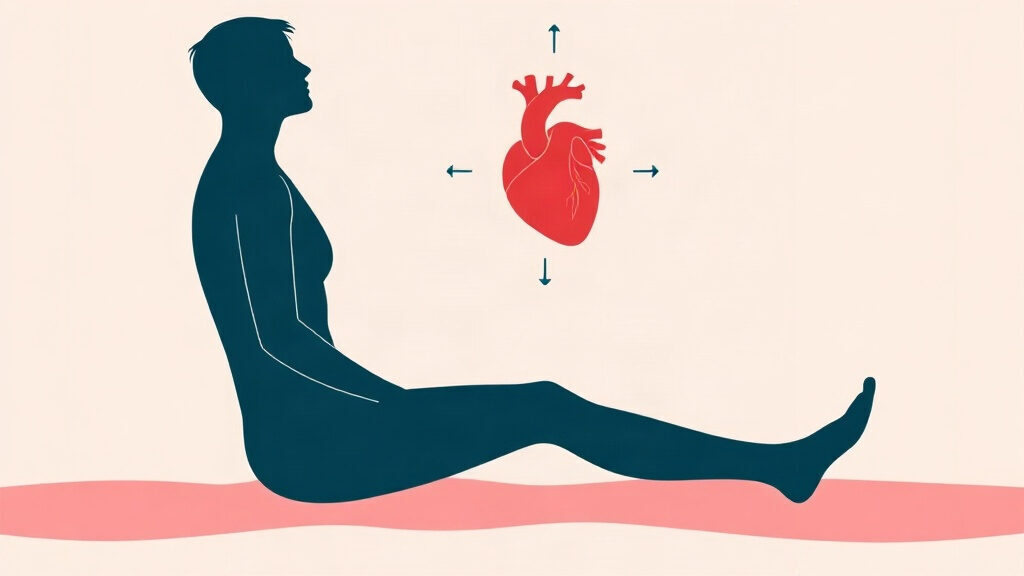
The body has a thermostat for blood pressure, the baroreflex. Sensors located in the aortic arch and the carotid arteries detect any drop in pressure and order, in under a second, a faster heartbeat and a tightening of the blood vessels. On standing up, about half a liter (roughly a pint) of blood moves down into the legs and abdomen; without this reflex, pressure in the brain collapses.
With age, this reflex loses sensitivity. The review by Monahan (2007) shows that the vagal component of the baroreflex, the part that adjusts heart rate, weakens in older subjects under the effect of arterial stiffness and oxidative stress. The body then buffers pressure swings less well. This loss of dialogue between sensors, nerves and vessels falls under altered intercellular communication, one of the twelve fundamental mechanisms of aging.
Several age-related changes add up:
- Stiffer arteries: the baroreceptors, located in the vessel wall, deform less and signal the drop in pressure later.
- A less responsive heart: the rise in heart rate in response to nerve stimulation diminishes (Monahan 2007).
- Kidneys that concentrate urine less and a blunted thirst: blood volume defends itself less well against water loss (Phillips 1984).
- A high resting pressure: isolated systolic hypertension is associated with 35% more cases of orthostatic hypotension (Rutan 1992, odds ratio 1.35). A stiff artery runs high at rest and compensates poorly when standing.
What the science says: the 5 proven causes of low blood pressure after 60
Cause 1: aging of the baroreflex
Aging on its own produces orthostatic hypotension in close to one person in six after 65 (Rutan 1992, 5,201 participants), and prevalence rises with each age bracket. The review by Low (2008), from the Mayo Clinic, puts it between 5 and 30% in healthy older subjects depending on the measurement conditions: time of day, length of standing, number of readings.
Cause 2: medications, especially beyond three
Medications top the list of modifiable causes. In the British Women’s Heart and Health Study (Kamaruzzaman et al., 2010), 28% of women aged 60 to 80 had orthostatic hypotension, and taking three or more antihypertensive drugs doubled the risk compared with no treatment (odds ratio 2.24). Among 342 older American veterans (Poon and Braun, 2005), prevalence rose from 35% with no causative medication to 65% with three or more. Hydrochlorothiazide, a diuretic, came first (65% of treated patients), ahead of lisinopril, trazodone (an antidepressant) and terazosin, an alpha-blocker prescribed for the prostate.
This finding is no license to stop treatment on your own. The meta-analysis by Juraschek et al. (2023), covering 29,235 participants in hypertension trials (mean age 69), shows that intensive treatment reduces mortality and cardiovascular events by 17% in people who already had orthostatic hypotension, just as much as in the others. An earlier analysis by the same group (Juraschek 2021) even concludes that more intensive treatment lowers the risk of hypotension measured in the seated position. The answer lies in an adjustment with the doctor, never in stopping abruptly.
Cause 3: dehydration and blunted thirst
After 65, the brain signals thirst less. In the study by Phillips et al. (1984), published in the New England Journal of Medicine, seven men aged 67 to 75 deprived of water for 24 hours showed higher plasma osmolality and sodium than seven men aged 20 to 31, yet felt less thirsty and drank less afterwards, without correcting their deficit. A reduced blood volume makes the drop in pressure on standing worse, especially during a heat wave, a fever, diarrhea or diuretic treatment.
Drinking, by contrast, acts fast. Jordan et al. (2000) measured that a 480 ml glass (about 16 fl oz) of tap water raises systolic pressure by 11 mmHg within 30 minutes in healthy older subjects, and by 33 to 37 mmHg in patients with severe autonomic failure, with no effect at all in young subjects. This response, triggered by a sympathetic reflex, makes water the first step against morning hypotension.
Cause 4: meals and postprandial hypotension
Digestion diverts blood toward the gut, and an older person’s heart compensates poorly for that diversion. Jansen and Lipsitz (1995) describe postprandial hypotension as even more common than the orthostatic form in older people with hypertension, with syncope, falls, angina and strokes as consequences. An insufficient sympathetic response and the release of vasodilating gut peptides explain the phenomenon. Among the 85 geriatric patients of Vloet 2005, the mean systolic drop reached 34 mmHg after the meal, with drowsiness the most frequent sign. Large meals, rich in fast carbohydrates, and alcohol amplify the phenomenon. Caffeine, often recommended, has no solid evidence behind it according to the same authors.
Cause 5: diseases of the autonomic nervous system
Some diseases directly damage the nerves that control the blood vessels. In Parkinson’s disease, the meta-analysis by Velseboer et al. (2011), pooling 25 studies, puts the prevalence of orthostatic hypotension at 30.1% of patients. Long-standing diabetes causes an autonomic neuropathy with the same effect, and the Low 2008 review notes that orthostatic hypotension in a person with diabetes comes with a clear excess mortality. A prolonged vitamin B12 deficiency can also injure these nerves and is easily corrected once identified.
| Cause | Mechanism | Key figure | Source |
|---|---|---|---|
| Aging of the baroreflex | Less sensitive pressure sensors, less responsive heart | Orthostatic hypotension in 16 to 18% of people over 65 | Rutan 1992, n = 5,201 |
| Medications | Diuretics, alpha-blockers, some antidepressants, stacking of antihypertensive drugs | Risk doubled beyond 3 antihypertensive drugs (OR 2.24) | Kamaruzzaman 2010 |
| Dehydration | Blunted thirst, kidneys that concentrate less, reduced blood volume | Less thirst and less intake after 24 h without water in 67 to 75 year olds | Phillips 1984 |
| Meals | Blood diverted to the gut, insufficient compensation | 67% of geriatric patients, mean drop of 34 mmHg | Vloet 2005 |
| Diseases of the autonomic nervous system | Damaged vasomotor nerves (Parkinson’s, diabetes) | 30.1% of Parkinson’s patients | Velseboer 2011, 25 studies |
These pressure drops weigh on prognosis. The meta-analysis by Ricci et al. (2015), 13 studies and 121,913 people followed for 6 years, links orthostatic hypotension to 50% more deaths from all causes (relative risk 1.50), with an excess of heart failure, coronary disease and stroke. The meta-analysis by Mol et al. (2019), 50 studies and 49,164 older people, measures 73% more falls (odds ratio 1.73). In the ARIC cohort (Rawlings et al., 2018, 11,709 adults followed for 25 years), the risk of dementia rose by 54% and that of ischemic stroke doubled. These are associations: hypotension often signals vascular or neurological frailty as much as it causes it. Falls remain the second leading cause of accidental death worldwide, with 684,000 deaths a year according to the WHO, and people over 60 are the first victims.
In practice: spotting low blood pressure and discussing it with your doctor
Screening comes down to one home measurement: pressure after 5 minutes lying down, then at 1 and 3 minutes standing. A drop of 20 mmHg (systolic) or 10 mmHg (diastolic) signals orthostatic hypotension and deserves a consultation, even without symptoms. Our article on the blood pressure number that should raise concern details the measurement technique and the targets by age.
The following signs justify prompt medical advice:
- vision going dark or dizziness every time you stand up, or faintness after prolonged standing;
- marked drowsiness or weakness 30 to 90 minutes after meals;
- a fall or near-fall with no explanation, especially at night or on waking;
- symptoms that appeared after a new medication or a change in dose;
- clear worsening in summer, during a fever or a stomach bug.
The doctor first looks for a reversible cause: medication, dehydration, anemia, a rhythm disorder. Hypotension combined with a tremor or urinary problems points toward a neurological condition. The NHS lists low blood pressure among the causes to look for in any older person who has had a fall.
| Step | How | Measured effect | Source |
|---|---|---|---|
| Drink 480 ml (16 fl oz) of water | On waking, or 30 minutes before prolonged standing | +11 mmHg systolic within 30 minutes in older subjects | Jordan 2000 |
| Compression of the legs and abdomen | Bandages or compression stockings put on before getting up | 90% of patients symptom-free when standing, versus 53% without compression | Podoleanu 2006, randomized trial |
| Smaller, more frequent meals | Reduced portions, fewer fast carbohydrates, no alcohol at lunch | Postprandial drop reduced | Jansen and Lipsitz 1995 |
| Prescription review | With the doctor: timing of doses, diuretic, alpha-blocker | Prevalence of 35% with no causative medication versus 65% with three or more | Poon 2005 |
Daily protocol: 7 steps against low blood pressure
These steps are meant for people whose hypotension has been confirmed by a measurement and discussed with their doctor. They complement treatment; they do not replace it.
- On waking, drink a large glass of water (400 to 500 ml, about 14 to 17 fl oz) and wait a few minutes before getting up.
- Get up in two stages: sit on the edge of the bed for a minute, then stand while holding on to something, tensing the calves before the first step.
- Drink about 1.5 liters (around 50 fl oz) a day, more in hot weather or fever, unless medically restricted (heart or kidney failure). Our guide to hydration after 60 details the useful benchmarks.
- Split up meals and limit white bread, fast sugars and alcohol at lunch; stay seated for 30 minutes after eating rather than standing.
- Put on compression stockings before setting foot on the floor, if dizziness persists despite the previous measures.
- Raise the head of the bed slightly, which reduces the pressure gap between night and getting up.
- Bring your doctor the full list of your medications (sleeping pills, antidepressants and prostate treatments included) and a week’s record of blood pressure lying down and standing.
Hypotension that has appeared recently, or that is getting worse, must be investigated: the most useful step is then the consultation, not the glass of water. To receive our summaries on prevention after 60 every week, the UltraSanté health newsletter is free.
Frequently asked questions about low blood pressure after 60
What is the difference between hypotension and constitutional low blood pressure?
Constitutional low blood pressure is a resting pressure below 90/60 mmHg, stable for years, without symptoms: it needs no treatment and does not increase mortality. The hypotension that causes problems after 60 is a sudden drop, on standing up or after a meal, of 20 mmHg or more. It is the swing, not the baseline figure, that triggers dizziness, falls and faintness.
How do you measure orthostatic hypotension at home?
Lie down for 5 minutes, then measure the pressure at the arm with a validated monitor. Stand up and measure again after 1 minute, then after 3 minutes, without moving. A drop of 20 mmHg in systolic or 10 mmHg in diastolic confirms the diagnosis, according to the Freeman 2011 consensus. Write down the values and the symptoms for a week, preferably in the morning, and bring the record to your doctor.
Why do I feel dizzy after meals at 70?
Digestion draws blood toward the gut, and an older person’s heart compensates more slowly for this redistribution. Systolic pressure can drop by 20 to 30 mmHg within the next two hours, especially after a large meal, one rich in fast carbohydrates or washed down with alcohol. Vloet 2005 found this phenomenon in 67% of geriatric patients. Splitting up meals and staying seated after eating reduces this dizziness.
Should you stop your blood pressure medication if you feel dizzy on standing?
No, never without medical advice. The Juraschek 2023 meta-analysis, covering 29,235 participants, shows that treating hypertension protects people who already have a pressure drop on standing just as much as everyone else. The doctor can move the dose to the evening, reduce a diuretic or replace an alpha-blocker. Stopping abruptly exposes you to a pressure rebound and a risk of stroke.
Does salt help against blood pressure that is too low?
A higher salt intake is one of the measures proposed in severe autonomic failure, under medical supervision, because it increases blood volume. After 60, most people concerned also have hypertension at rest or when lying down, which salt makes worse. The decision therefore rests with the doctor. Drinking water, getting up in two stages and wearing compression stockings remain the first-line steps.
Medical disclaimer. The information presented here is provided for informational purposes only and does not constitute medical advice. It does not replace a consultation. Never change a treatment for high blood pressure without your doctor’s advice. Ask a healthcare professional before changing your diet, taking dietary supplements or starting a new practice, especially if you have a medical condition, are pregnant or are under treatment. Dietary supplements do not replace a balanced diet or medical follow-up.