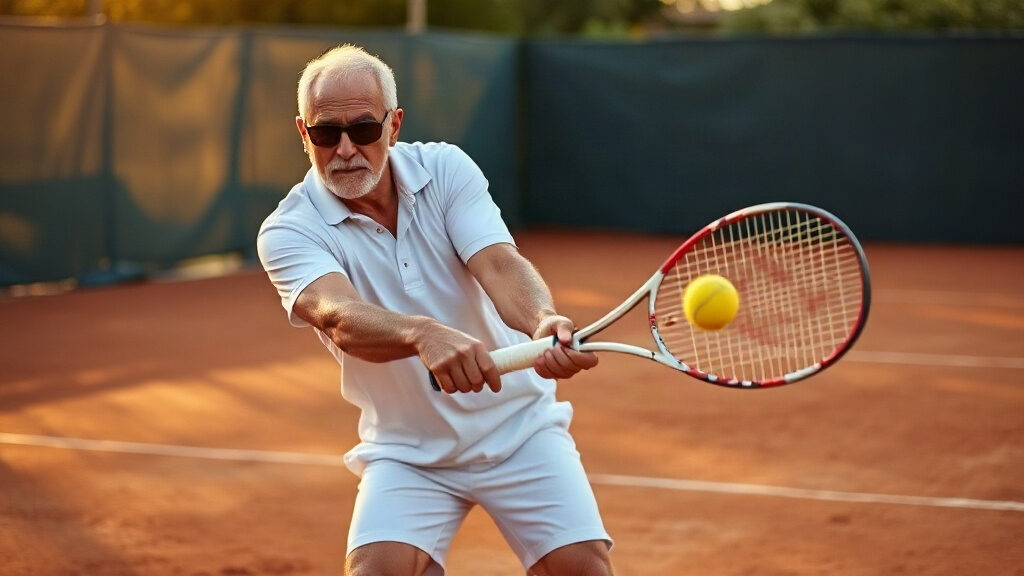
The link between tennis and longevity comes from a Danish study published in 2018: players lived on average 9.7 years longer than sedentary adults, ahead of badminton, soccer and running. The researchers followed 8,577 residents of Copenhagen for 25 years. The gap probably reflects a mix of intermittent effort, bone loading, cognitive stimulation and social connection. What remains is to separate the share due to the sport from the share due to the players’ profile, then to see how to play after 50 without getting injured.
In brief – Tennis is an intermittent racket sport that combines short, intense bursts of effort, coordination and social interaction, and large cohorts rank it among the activities most closely linked to longevity. In the Copenhagen City Heart Study (8,577 adults, 25 years of follow-up), players lived 9.7 years longer than sedentary people. In a British cohort of 80,306 adults, racket sports were associated with 47% lower all-cause mortality and 56% lower cardiovascular mortality. These studies are observational: players are often wealthier, less likely to smoke and healthier at the outset, which inflates the measured gap. The plausible link between tennis and longevity rests on a combination of endurance, bone and cognitive stimulation, and social ties. Two or three sessions a week, playing doubles if your knees or heart require it, put you in the range of 2.6 to 4.5 hours of sport per week associated with the lowest risk of death.
Tennis and longevity: what exactly are we talking about?
Tennis is played as singles or doubles and alternates rallies of a few seconds with breaks between points. This interval structure sets it apart from continuous endurance sports such as swimming or cycling. According to the 2024 Compendium of Physical Activities (Herrmann et al., 2024), a singles match costs 8.0 MET, or eight times the energy expended at rest.
Above 6 MET, effort is classified as vigorous in the World Health Organization (WHO) guidelines. A singles match therefore counts as vigorous activity, whereas a relaxed game of doubles stays in the moderate zone. This flexibility explains why tennis is played from age 8 to 90: you adjust the intensity by changing the format, the partner or the court surface.
| Activity | Intensity (MET) | WHO category |
|---|---|---|
| Singles tennis | 8.0 | Vigorous |
| Recreational tennis, moderate effort | 6.8 | Vigorous |
| Doubles tennis | 4.5 to 6.0 | Moderate |
| Recreational badminton | 5.5 | Moderate |
| Recreational squash | 7.3 | Vigorous |
| Table tennis | 4.0 | Moderate |
These values are averages: a beginner who barely runs expends less energy than a club player who keeps moving from shot to shot. Their main use is to place the sport relative to the 150 minutes of moderate activity per week recommended by the World Health Organization, a threshold that 31% of adults fail to reach.
Why tennis might extend life: five mechanisms
No single mechanism explains the link between tennis and longevity observed in players. Reviews devoted to tennis players instead describe a cluster of adaptations, measured in regular players compared with less active people of the same age.
- The heart and mitochondria. Repeated bursts of effort challenge aerobic capacity (VO2max) and the mitochondrial density of muscles, two markers linked to survival.
- Body composition. Regular players show less body fat and a more favorable lipid profile in the 2007 review, which covered 17 cardiovascular studies.
- The skeleton. Ball impacts load the bone of the playing arm: in 88 veteran players with a mean age of 63.8, bone mineral content of the radius was 13% higher on that side (Ireland et al., 2014).
- The brain. Anticipating a trajectory, choosing a shot and getting back into position within a second turns the court into an “open-skill” exercise, more protective for cognitive function than repetitive effort, according to a review by Yamasaki (2023).
- Social connection. You never play alone: a partner, a club, Sunday doubles. And the quality of social relationships weighs on mortality as much as classic risk factors do.
The first mechanism falls under the pillar of mitochondrial dysfunction: a muscle trained with intervals better maintains its stock of mitochondria with age. The other four act in parallel, which makes tennis hard to replace with a single gym exercise.
Tennis and life expectancy: what the science says
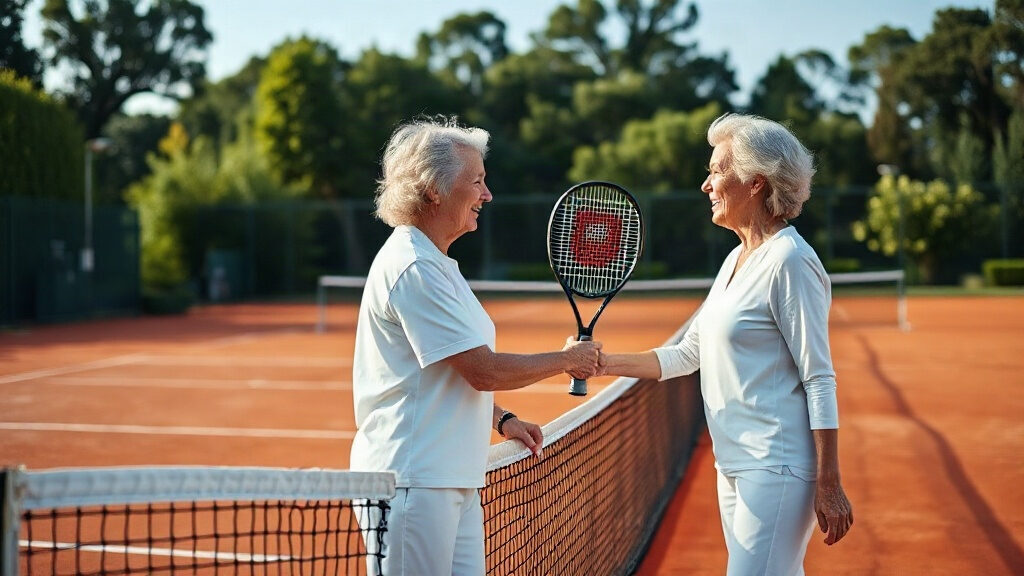
Three large cohorts place tennis or racket sports among the activities most strongly associated with a longer life. The most cited is the Copenhagen City Heart Study (Schnohr et al., 2018): 8,577 participants surveyed between 1991 and 1994, then followed until 2017. After adjustment for measured confounders, players gained 9.7 years of life expectancy compared with sedentary participants.
The authors themselves point out that the most social sports come out on top, and that the causal link remains uncertain. A second analysis of the same cohort (Schnohr et al., 2021, n=8,697) shows a U-shaped curve: the lowest risk of death corresponds to 2.6 to 4.5 hours of sport per week. That risk is 51% higher in inactive people and 18% higher beyond 10 hours a week.
In the United Kingdom, the study by Oja et al. (2017) pooled 80,306 adults with a mean age of 52. Racket sports (tennis, badminton, squash) were associated with 47% lower all-cause mortality (HR 0.53) and 56% lower cardiovascular mortality (HR 0.44). Running and soccer did not reach statistical significance in the same analysis.
In the United States, the analysis of the Nurses’ Health Study and the Health Professionals Follow-Up Study (Han et al., 2026) covers 111,467 health professionals followed for more than 30 years. The highest level of tennis or squash goes with 15% lower mortality (HR 0.85). The effect is more modest than in Copenhagen, and the variety of activities also counts: the most eclectic participants had 19% lower mortality.
| Study | Population | Main result | Limitation |
|---|---|---|---|
| Schnohr 2018, Denmark | 8,577 adults, 25 years | +9.7 years of life expectancy | Activity reported only once, at baseline |
| Oja 2017, United Kingdom | 80,306 adults | All-cause mortality HR 0.53 | Racket sports grouped together |
| Han 2026, United States | 111,467 health professionals | All-cause mortality HR 0.85 | Health professionals, a poorly representative population |
| Schnohr 2021, Denmark | 8,697 adults | Lowest risk at 2.6-4.5 h of sport per week | All sports combined |
A systematic review of 69 studies (Oja et al., 2015) underlines how weak these data are: apart from running and soccer, the sport-by-sport evidence remained “inconclusive” for lack of rigorous trials. The review devoted to the health benefits of tennis (Pluim et al., 2007) reaches the same nuance: players are in better health, but they also chose this sport, often with a higher socioeconomic status.
The review by Marks (2006), focused on veteran players, notes better aerobic capacity, higher bone density, less fat and preserved reaction time. It adds that no study has managed to isolate the specific effect of the racket from that of the other activities players take part in.
Tennis in practice: who is it for, and in what form?
Tennis suits most healthy adults, provided the format is adapted to age and joints. Singles delivers the highest intensity; doubles keeps the coordination and the conviviality with fewer sprints. Variants such as padel or table tennis widen the options, but do not yet have mortality data of their own.
The Danish ranking helps place the sport among other leisure activities. It compares each activity with the sedentary group, after adjustment for the main confounders.
| Sport | Years of life gained vs sedentary | Social dimension |
|---|---|---|
| Tennis | 9.7 | Strong (partner required) |
| Badminton | 6.2 | Strong |
| Soccer | 4.7 | Strong (team) |
| Cycling | 3.7 | Variable |
| Swimming | 3.4 | Low |
| Jogging | 3.2 | Low to medium |
| Calisthenics | 3.1 | Medium |
| Health club (gym) | 1.5 | Low |
This gradient suggests that the playing partner matters as much as energy expenditure. The meta-analysis by Holt-Lunstad et al. (2010), covering 148 studies and 308,849 participants, links strong social relationships to a 50% greater likelihood of survival. The same logic sheds light on the results observed with dancing, another activity done with other people.
The choice of format depends mainly on cardiovascular and joint health. The table below summarizes the practical differences between singles and doubles.
| Criterion | Singles | Doubles |
|---|---|---|
| Intensity | 8.0 MET, vigorous | 4.5 to 6.0 MET, moderate |
| Sprints and changes of direction | Many | Fewer |
| Stress on knees and ankles | High | Moderate |
| Social dimension | One partner | Three partners |
| Suitable profile | Trained player, no heart disease | Returning to sport, over 60, early osteoarthritis |
The main obstacle after 45 remains the elbow. Lateral epicondylitis, the famous “tennis elbow,” affects 1.3% of the general population aged 30 to 64, with a peak between 45 and 54, according to a Finnish study of 4,783 people (Shiri et al., 2006). Smoking tripled the risk (OR 3.4). Our article on tendinitis explains how inflammation sets in within the tendon.
Protocol: playing tennis for your health after 50
The dose associated with the lowest risk of death in the Copenhagen cohort comes down to two or three sessions of 60 to 90 minutes a week. The rest is about injury prevention and consistency over the years, not performance.
- Aim for 2.6 to 4.5 hours of sport per week in total, racket sports included, without going beyond 10 hours.
- See a doctor before returning to singles after 50, or if you have unusual breathlessness, chest pain or a history of heart problems.
- Warm up for 10 minutes: light jogging, shoulder rotations, then slow rallies from mid-court.
- Choose a lightweight racket, soft strings and lower-pressure balls to spare your elbow.
- Prefer clay or a cushioned synthetic surface over hard courts if your knees are fragile.
- Add strength training twice a week, as the WHO recommends.
- Keep one or two regular partners: showing up week after week is what makes the habit last.
Taking up tennis late is still worthwhile. In women who started playing as adults, the humerus of the playing arm still had 9% more bone mineral content than the other arm, compared with 19% in those who had started as children (Kontulainen et al., 2002). The adaptation is smaller, but it exists.
To receive the studies that matter on physical activity and longevity every month, sign up for our health newsletter.
Frequently asked questions about tennis and longevity
Why is tennis linked to a longer life?
Tennis combines intermittent effort that keeps the heart and mitochondria in shape, impacts that stimulate bone, constant cognitive demand and built-in social connection. In the Copenhagen City Heart Study, players lived 9.7 years longer than sedentary people. This figure comes from an observational study: the players’ more favorable profile explains part of the gap.
Does tennis really add 10 years to your life?
No, not in any proven way. The 9.7-year figure comes from a single Danish cohort of 8,577 people, in which sport was reported only once. The British and American cohorts found mortality reductions of 47% and 15%, real but more modest. No randomized trial has measured the life expectancy of people randomly assigned to play tennis.
How many hours of tennis per week are good for your health?
An analysis of the Copenhagen cohort puts the lowest risk of death between 2.6 and 4.5 hours of sport per week, all activities combined. Two or three sessions of 60 to 90 minutes are therefore enough. Beyond 10 hours a week, the risk rose slightly, by 18% compared with the optimal zone.
Can you take up tennis after 60?
Yes, after medical advice if you have a history of heart problems or symptoms during exertion. Doubles, at 4.5 to 6.0 MET, offers moderate intensity with fewer sprints. Bones still respond to a late start: in women who began playing as adults, the dominant humerus kept 9% more mineral content.
What is the difference between singles and doubles tennis for health?
Singles reaches 8.0 MET, a vigorous intensity that puts more demand on the heart, knees and ankles. Doubles stays moderate, between 4.5 and 6.0 MET, but keeps the coordination and multiplies partners. Mortality studies do not distinguish between the two formats: the best one is the one you will keep playing for years.
How can you avoid tennis elbow when playing after 50?
Lateral epicondylitis peaks between 45 and 54 and smoking triples its risk. To limit it, choose a lightweight racket with soft strings, power your forehand with your legs rather than your wrist, warm up your forearms and shoulders, and cut back your playing time at the first sign of elbow pain.
Medical disclaimer. The information on this page is provided for informational purposes only and does not constitute medical advice. It does not replace a consultation. Singles tennis is an intense physical activity: before returning to a vigorous sport, especially after 50, or if you have cardiovascular disease, high blood pressure, diabetes, chest pain, unusual breathlessness, discomfort during exertion or are under treatment, ask a doctor, who may suggest a cardiac checkup. Stop exercising immediately and call emergency services (911 in the US, 999 in the UK, 112 in Europe) if you feel chest pain, palpitations or dizziness while playing.