
Stroke signs are worth knowing by heart: in France, a stroke strikes someone every four minutes, more than 140,000 new cases a year according to Inserm, the national health research institute. Three signs are enough to spot it in a loved one or a stranger: a face that droops, an arm that falls, speech that becomes slurred. That is the FAST test, whose last letter gives the instruction: call emergency services right away (911 in the US and Canada, 999 in the UK, 112 in Europe). Every minute without treatment destroys about 1.9 million neurons, which is why it pays to learn these signs before you need them.
In brief – Stroke signs are the sudden symptoms of a stroke, a neurological emergency that occurs when an artery in the brain becomes blocked or bursts, depriving neurons of oxygen. The FAST test sums up the three most common stroke signs: Face drooping (a lopsided smile), Arm weakness (an arm or leg that can no longer hold up) and Speech difficulty (slurred or incomprehensible words). The letter T gives the instruction: Time to call emergency services (911, 999 or 112, and 15 in France). A single sign is enough, even if it fades after a few minutes. In a US cohort of 3,498 patients, these three signs picked up 88.9% of strokes and transient ischemic attacks. Time matters, because thrombolysis and thrombectomy lose effectiveness with every passing hour. Calling emergency services rather than going to the emergency room on your own gets the patient sent straight to a specialized stroke unit.
What is a stroke?
A stroke happens when blood stops reaching part of the brain, either because an artery becomes blocked or because it bursts. Deprived of oxygen and glucose, the neurons in that area start to die within minutes. MedlinePlus, the health service of the US National Library of Medicine, describes stroke as an emergency for this reason: brain cells start dying within a few minutes, and the damage can quickly become lasting.
There are two main forms. Ischemic stroke, also called cerebral infarction, results from a clot blocking an artery and accounts for about 80% of cases. Hemorrhagic stroke, caused by a burst artery, accounts for 20% of cases according to Inserm. A third situation is often misleading: the transient ischemic attack (TIA), a blockage that clears on its own within minutes and whose signs disappear completely.
In France, more than 112,000 patients are hospitalized every year for a stroke, according to the national public health agency. About one adult in 50 has had one over the past ten years, which adds up to more than a million people. Inserm describes stroke as the leading cause of acquired physical disability in adults and the second leading cause of dementia after Alzheimer’s disease. About 20% of patients die within the following year.
The average age at onset is 74, but a quarter of patients are under 65 and 10% are under 45. Worldwide, the Global Burden of Disease study counted 11.9 million new strokes and 7.3 million deaths in 2021, making stroke the third leading cause of death (GBD 2021 Stroke Collaborators, 2024). The lifetime risk of stroke from age 25 reaches 24.9%, roughly one person in four, in men and women alike (Feigin et al., 2018).
Why stroke signs appear so suddenly
Stroke signs appear all at once because each region of the brain controls a specific function and stops working as soon as it runs short of blood. The middle cerebral artery, frequently involved, supplies precisely the areas that drive movements of the face and arm, as well as language. These three functions form the basis of the FAST test.
The controls are crossed: damage to the left hemisphere paralyzes the right side of the body, and vice versa. In the vast majority of right-handed people, language depends on the left hemisphere. A left-sided stroke therefore often combines weakness on the right side with speech problems. Inserm points out that symptoms can also start during sleep and only be discovered on waking.
Several mechanisms lead to the blockage or rupture of a brain artery. Inserm describes five main ones:
- A clot formed in the heart during atrial fibrillation, a common rhythm disorder after 65, that travels up to the brain.
- The rupture of an atheromatous plaque in an artery of the neck or brain, which triggers the formation of a clot on the spot.
- Small vessel disease of the brain, promoted by high blood pressure and diabetes.
- A dissection of the carotid or vertebral arteries, the leading cause of cerebral infarction in young adults.
- For hemorrhages, high blood pressure that weakens the deep arteries, and cerebral amyloid angiopathy, which is common in older people.
This diversity explains why a stroke is never treated blindly. Only brain imaging, CT or MRI, can tell a clot from a hemorrhage, and the two call for opposite treatments.
| Form | Mechanism | Share of cases | How the signs evolve |
|---|---|---|---|
| Ischemic stroke (cerebral infarction) | A clot blocks an artery in the brain | About 80% | Sudden signs, often on one side, that persist |
| Hemorrhagic stroke | An artery bursts in the brain or in the membranes around it | About 20% | Sudden signs, sometimes with a violent headache and vomiting |
| Transient ischemic attack (TIA) | An artery becomes blocked, then clears on its own | Often unrecognized | Identical signs that disappear within minutes, with a high risk of recurrence |
The FAST test: the 3 stroke signs according to science
The FAST test (Face, Arm, Speech, Time), adapted in France as VITE, derives from the Cincinnati Prehospital Stroke Scale. This scale checks three items: facial droop, drift of an outstretched arm and the quality of speech. In 171 patients examined in the emergency department, an abnormality in just one of the three items detected a stroke with 66% sensitivity and 87% specificity. Sensitivity rose to 88% for anterior circulation strokes, the most common kind (Kothari et al., 1999).
The test then proved itself in the field. In Newcastle, UK, ambulance crews trained in FAST made the correct diagnosis in 79% of the stroke patients they cared for. They got 46% of patients admitted within three hours of the first signs, compared with 12% of patients referred by their family doctor (Harbison et al., 2003).
F for face drooping
Ask the person to smile or show their teeth. If one corner of the mouth stays still or droops, the face is lopsided: that is the first warning sign. The lower eyelid or the fold between the nose and the mouth may also flatten on one side. Sudden numbness of half of the face counts too.
A for arm weakness
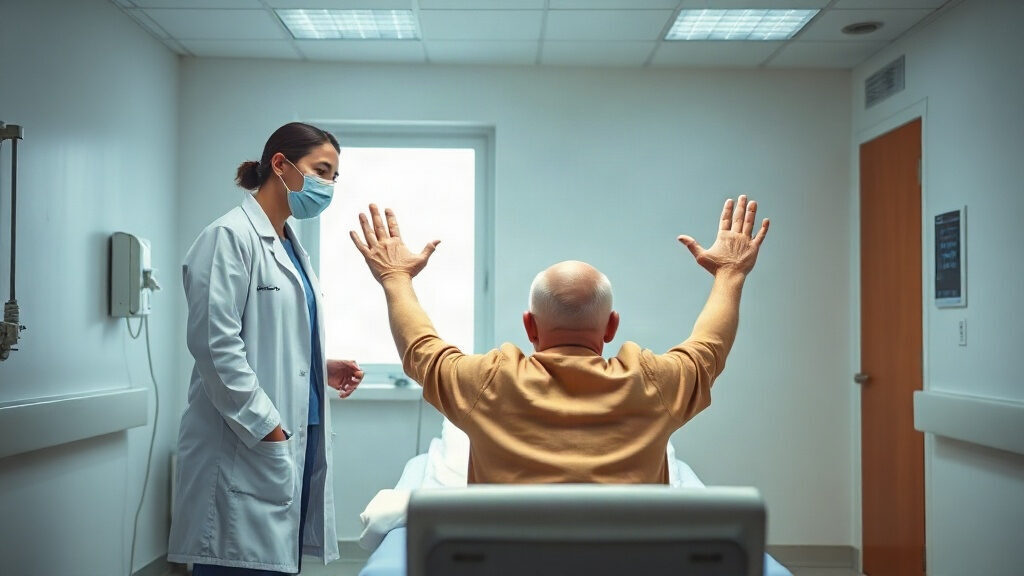
Ask the person to raise both arms in front of them, palms facing up, and hold them there for ten seconds, eyes closed if possible. An arm that drifts down, rotates or will not lift signals weakness on one side. The same weakness can affect a leg and cause a fall or a gait in which the leg swings outward. A hand that suddenly drops an object should also raise the alarm.
S for speech difficulty
Ask the person to repeat a simple sentence, such as “the weather is nice today.” A slurred voice, distorted words, words swapped for others or a sentence they cannot get out are all stroke signs. A person who no longer understands what is said to them also has a language disorder, called aphasia.
T for time: call emergency services
A single one of the three signs is enough to call emergency services, without waiting for the other two to appear: 911 in the US and Canada, 999 in the UK. In France the number is 15, and 112, the European emergency number, works across the European Union. Deaf or hard-of-hearing people can text 911 where the service exists in the US, use the registered emergencySMS service to 999 in the UK, or reach 114 by text or video call in France. If the signs fade during the call, keep the alert going anyway.
| Letter | Sign to look for | How to check it | What should raise the alarm |
|---|---|---|---|
| F | Face drooping | Ask the person to smile or show their teeth | One corner of the mouth droops or does not move |
| A | Arm weakness | Raise both arms straight out for ten seconds | One arm drifts down, rotates or does not lift |
| S | Speech difficulty | Repeat a simple sentence | Distorted words, slurred voice, incomprehensible sentence |
| T | Time to call | Dial 911, 999 or 112 (in France, 15, or 114 by text) | A single sign is enough, even a passing one |
Stroke signs the FAST test can miss
The FAST test does not cover every stroke. A Cincinnati study of 3,498 patients showed that FAST identified 88.9% of strokes and TIAs. It missed 8.9% of cerebral infarctions, but 30.6% of intracerebral or subarachnoid hemorrhages (Kleindorfer et al., 2007). At a Kentucky center, 14.1% of 736 patients with ischemic stroke showed no FAST sign on arrival. By adding balance and vision problems, the BE-FAST version brought that proportion down to 4.4% (Aroor et al., 2017).
Inserm and the World Health Organization list other signs that warrant the same emergency call when they come on suddenly:
- Sudden loss of vision in one eye, loss of half of the visual field or double vision.
- A sudden problem with balance or walking, with a feeling of being drunk without having had a drink.
- Numbness or loss of sensation on one side of the body.
- A sudden, intense and unusual headache, often described as the worst of one’s life (our article on headaches that should worry you explains this warning sign).
- Sudden confusion or abnormal drowsiness.
What these signs have in common is their sudden onset, within seconds or minutes. A symptom that sets in gradually over several days calls instead for a prompt visit to the doctor.
Why call emergency services at the first sign of stroke
Calling emergency services saves time, and that time is measured in neurons. In an ischemic stroke affecting a large artery, the brain loses on average 1.9 million neurons, 14 billion synapses and 12 km (7.5 miles) of nerve fibers every minute. Compared with normal aging, the brain deprived of blood ages 3.6 years for each hour without treatment (Saver, 2006).
Inserm recommends calling emergency services, 15 in France, rather than getting to the emergency room by your own means. The dispatching doctor sends the patient directly to a hospital equipped with a CT or MRI scanner and a stroke unit. France’s National Authority for Health (HAS) states it without ambiguity in its guideline updated in October 2025: any sudden neurological deficit, brief or lasting, requires an immediate call to the SAMU emergency service. The NHS gives the same instruction in the UK: call 999 for signs of stroke, even if they have stopped, and do not drive yourself to the hospital.
Two treatments can limit the after-effects of a cerebral infarction, and both depend on the clock. Thrombolysis dissolves the clot through an infusion and is normally given within 4.5 hours of the first signs. A meta-analysis of 9 trials and 6,756 patients shows that its benefit shrinks as the delay grows (Emberson et al., 2014). It carries a risk of fatal brain hemorrhage (2.7% versus 0.4% without treatment), which is why its use is strictly regulated.
Thrombectomy removes the clot with a catheter inserted at the groin. In five trials including 1,287 patients, it clearly reduced disability at 90 days: treating 2.6 patients was enough for one of them to gain at least one level of independence (Goyal et al., 2016). Here again, the benefit melts away with time (Saver et al., 2016).
| Treatment and timing | Measured outcome | Source |
|---|---|---|
| Thrombolysis within 3 hours | 32.9% of patients without significant disability, versus 23.1% without treatment (odds ratio 1.75) | Emberson 2014, 6,756 patients |
| Thrombolysis between 3 and 4.5 hours | 35.3% versus 30.1% (odds ratio 1.26) | Emberson 2014 |
| Thrombolysis beyond 4.5 hours | 32.6% versus 30.6%, difference not significant | Emberson 2014 |
| Thrombectomy at 3 hours | Odds ratio of 2.79 in favor of less disability | Saver 2016, 1,287 patients |
| Thrombectomy at 6 hours | Odds ratio of 1.98 | Saver 2016 |
| Thrombectomy at 8 hours | Odds ratio of 1.57, not significant in these trials | Saver 2016 |
Inserm notes that thrombolysis still reaches only about 10 to 15% of patients admitted to most stroke units, mainly because of arrival delays. It increases by 30% the number of patients who recover or keep only minimal after-effects. Even outside these time windows, admission to a stroke unit remains decisive. A Cochrane review of 29 trials and 5,902 patients links these units to fewer deaths (odds ratio 0.76) and less dependency one year after the stroke (Langhorne et al., 2020). Inserm puts this benefit at one death avoided for every 20 patients hospitalized.
A TIA requires the same emergency call
Stroke signs that disappear within minutes are not reassuring: they often point to a transient ischemic attack, which heralds a full cerebral infarction. According to Inserm, the risk of recurrence reaches 5% in the first 48 hours and 10% at one month. In a California cohort of 1,707 patients, 10.5% had a stroke within 90 days of a TIA, and half of those strokes occurred in the first two days (Johnston et al., 2000).
Fast care changes this outlook. In Oxford, the EXPRESS study cut the time to treatment from 20 days to less than one day, and the 90-day stroke risk fell from 10.3% to 2.1%, an 80% reduction (Rothwell et al., 2007). In the international TIAregistry, coordinated from Paris and covering 4,789 patients seen urgently by specialists, the one-year stroke risk was only 5.1% (Amarenco et al., 2016).
What to do while waiting for help
The minutes between the call and the arrival of help are for preparing care, not for attempting a treatment. The emergency dispatcher guides each step over the phone. Here are the actions that genuinely help the medical team:
- Dial 911, 999 or 112 (15 in France) and say “suspected stroke,” describing the signs you have seen.
- Note the exact time the signs began or, failing that, the time the person was last seen normal. This time determines access to thrombolysis and thrombectomy.
- Give nothing to drink or eat, because swallowing may be affected and food or liquid could go down the wrong way.
- Give no medication, not even aspirin. A hemorrhage accounts for one stroke in five, and only imaging can tell it apart from a clot.
- Lay the person down with their head slightly raised on a pillow. If they lose consciousness but are still breathing, place them in the recovery position.
- Gather their prescriptions, especially any anticoagulant treatment, and stay with them until help arrives.
Also avoid calling your family doctor first or waiting for a relative’s opinion. This detour delays imaging, whereas HAS guidelines in France call for an immediate emergency call for any sudden neurological deficit.
Lowering your stroke risk: the measured levers
Most strokes depend on factors you can act on. The INTERSTROKE study, conducted in 32 countries with 26,919 participants, attributes 90.7% of stroke risk to ten modifiable factors (O’Donnell et al., 2016). This association does not prove that correcting each factor removes the matching risk, but trials confirm the effect of the main levers.
High blood pressure comes first. It nearly triples the risk (odds ratio 2.98) and accounts for 47.9% of the attributable risk in INTERSTROKE. A meta-analysis of 123 studies and 613,815 participants shows that each 10 mmHg drop in systolic pressure lowers stroke risk by 27% (Ettehad et al., 2016). Our guide to the blood pressure numbers that should raise the alarm helps you interpret your own readings.
Atrial fibrillation comes next, especially with age. In the Framingham cohort, it multiplied stroke risk almost fivefold, and its share of strokes rose from 1.5% between ages 50 and 59 to 23.5% between 80 and 89 (Wolf et al., 1991). This rhythm disorder often goes unnoticed, yet well-managed anticoagulant treatment cut this risk by 64% in a meta-analysis of 29 trials (Hart et al., 2007). Knowing how to take your resting pulse helps you spot an irregular rhythm to report to your doctor.
| Factor | Measured risk | Documented lever |
|---|---|---|
| High blood pressure | Odds ratio 2.98, 47.9% of attributable risk (INTERSTROKE) | Each 10 mmHg drop in systolic pressure lowers the risk by 27% |
| Atrial fibrillation | Risk multiplied almost fivefold (Framingham) | Anticoagulant: 64% fewer strokes (Hart 2007) |
| Lack of physical activity | Regular activity associated with an odds ratio of 0.60 | Move every day, walking included |
| Current smoking | Odds ratio 1.67, 12.4% of attributable risk | Quitting smoking, with support if needed |
| Heavy alcohol use | Odds ratio 2.09 for heavy or episodic drinking | Cut down quantities and binge drinking episodes |
From a longevity standpoint, preventing stroke protects the brain as much as lifespan, since stroke is the second leading cause of dementia. The most useful habits are simple and easy to check:
- Measure your blood pressure at least once a year after 40, and more often if your numbers are borderline.
- Check that your pulse is regular and report any irregularity or palpitations.
- Stop smoking, whatever your age.
- Walk or do some physical activity on most days of the week.
- Get screened for sleep apnea if you snore loudly and feel drowsy during the day, since Inserm lists it among vascular risk factors.
- Teach the FAST test to the people around you, because a relative is often the one who raises the alarm.
Chronic inflammation of the arteries links these factors together, a mechanism explained in our pillar Altered intercellular communication. To receive our monthly summaries on brain and artery health, sign up for our health newsletter.
Frequently asked questions about stroke signs
What does the FAST acronym mean for a stroke?
FAST, known as VITE in France, sums up the three most common stroke signs and what to do. F for face drooping, with a lopsided smile. A for arm weakness, when an arm or a leg can no longer hold up. S for speech difficulty. T for time: call emergency services (911, 999, 112 or 15 in France). A single sign is enough to raise the alarm.
Should you call emergency services if stroke signs disappear within minutes?
Yes. Signs that fade suggest a transient ischemic attack, which often comes before a cerebral infarction. According to Inserm, the risk of recurrence reaches 5% within 48 hours and 10% at one month. France’s National Authority for Health (HAS) calls for an emergency call for any sudden neurological deficit, brief or lasting. Fast care sharply reduces this risk.
Why call emergency services rather than going straight to the emergency room?
The emergency dispatcher sends the patient to a hospital with brain imaging and a stroke unit, and alerts the team before arrival. The CT or MRI scan can then be done right on admission. A car trip to an emergency room without this equipment wastes precious time, while the brain loses about 1.9 million neurons per minute.
Which stroke signs can the FAST test miss?
The FAST test picks up about nine strokes out of ten, but it mainly misses problems with balance and vision. Sudden loss of vision in one eye, double vision, sudden dizziness with an unsteady gait or a sudden, unusual headache also justify an immediate emergency call, even without the three classic signs.
Can you give aspirin to someone having a stroke?
No. About one stroke in five is hemorrhagic, and aspirin would worsen the bleeding. Only brain imaging can tell a clot from a hemorrhage. While waiting for help, give no medication, no drink and no food, because swallowing may be affected. Note the time the signs began and gather the person’s prescriptions.
Can a stroke affect a young person?
Yes. The average age at onset is 74, but according to Inserm, a quarter of patients are under 65 and 10% are under 45. In young adults, dissection of a neck artery is one of the main causes of cerebral infarction. The signs and what to do stay the same: the FAST test and an immediate emergency call.
Medical disclaimer. The information provided here is for informational purposes only and does not constitute medical advice. It does not replace a consultation. Ask a healthcare professional before changing your diet, taking dietary supplements or starting a new practice, especially if you have a medical condition, are pregnant or are under treatment. Dietary supplements do not replace a balanced diet or medical follow-up. If you notice a drooping face, a weakening limb, a speech problem or any other sudden neurological sign, call emergency services immediately (911 in the US and Canada, 999 in the UK, 112 in Europe, 15 in France, or 114 by text for deaf or hard-of-hearing people in France), even if the signs disappear.