Constipation after 60 is common: constipation affects about one adult in seven, and it becomes clearly more frequent after the age of 60. Infrequent stools, straining, the feeling of not being finished: this bowel disorder almost always has identifiable causes, from too little fiber to the medications taken every day. Here are the 6 causes documented by research, the signs that call for a prompt medical visit and the measures whose effectiveness has been tested in controlled trials.
In brief – Chronic constipation is a bowel disorder that combines infrequent stools (fewer than three a week), hard stools or stools that are difficult to pass, for at least three months. It affects 14% of adults according to a meta-analysis of 261,040 people, and it is more frequent in women and in older people. Six causes of constipation after 60 are well documented: too little fiber, insufficient hydration, reduced physical activity, medications, poor coordination of the pelvic floor muscles and certain diseases such as hypothyroidism, diabetes or Parkinson’s disease. Fiber, especially psyllium at more than 10 g a day for at least four weeks, raises the response rate from 41% to 66%. Blood in the stool, unexplained weight loss or a recent change in bowel habits after 50 warrant a prompt medical visit.
Constipation: definition and medical criteria
Doctors speak of chronic constipation when bowel movements have been a problem for at least three months, with first symptoms that began six months earlier. The Rome IV criteria, published by an international group of gastroenterologists (Mearin et al., 2016), require at least two of the following signs, present in more than one bowel movement out of four:
- fewer than three spontaneous bowel movements a week;
- significant straining;
- hard or lumpy stools (types 1 and 2 on the Bristol stool scale);
- a feeling of incomplete evacuation or of a blockage at the anus;
- the need for manual maneuvers to pass stool.
This framework avoids two common mistakes about constipation. Having a bowel movement every other day without discomfort is not abnormal: the usual range runs from three stools a week to three a day. Conversely, someone who goes to the toilet every day but strains for a long time may have what is called outlet constipation, linked to evacuation rather than to a slow colon.
Constipation becomes more frequent with age. A meta-analysis of 45 studies covering 261,040 adults estimates its worldwide prevalence at 14%, with a risk multiplied by 2.22 in women and a steady rise decade after decade (Suares and Ford, 2011). A Mayo Clinic review dedicated to older adults underlines its burden on quality of life and on healthcare costs (Gallegos-Orozco et al., 2012).
The 6 proven causes of constipation after 60
Constipation after 60 rarely comes from a single factor: two or three causes usually add up, in a colon whose motility slows down a little with age. The six causes below are the ones that studies link most firmly to the disorder.
1. Too little fiber
Fiber holds water in the stool, increases its bulk and feeds colon bacteria, which ferment it into short-chain fatty acids able to stimulate intestinal motility. ANSES, the French food safety agency, recommends 30 g of fiber a day for adults, a level that most people in France do not reach, which promotes constipation. With age, a smaller appetite, dental problems and a softer, more refined diet often reduce this intake even further.
2. Insufficient hydration
The sense of thirst fades with age, and many older adults drink less to limit getting up at night. A colon that receives less water reabsorbs more of it, which hardens the stool and sustains constipation. In an Italian trial of 117 constipated adults fed 25 g of fiber a day, drinking 2 liters (about 68 fl oz) of mineral water increased stool frequency and reduced laxative use more clearly than drinking freely (Anti et al., 1998). Participants were 18 to 50 years old and the water came on top of the fiber: the trial does not say whether drinking more is enough on its own.
3. Reduced physical activity
Movement stimulates contractions of the colon, and the sedentary lifestyle that often follows retirement, an illness or a hospital stay slows transit and promotes constipation. A meta-analysis of 9 randomized trials (680 participants) finds that exercise, especially aerobic exercise such as walking or qigong, multiplies by 1.97 the likelihood of improvement in constipation symptoms (Gao et al., 2019). The authors report a high risk of bias in the included trials: the signal is favorable, but its exact size remains uncertain.
4. Medications
Everyday treatments are among the most frequent causes of constipation, and among the easiest to correct. In a Norwegian survey of 4,622 adults, 13.8% had constipation, and simply taking medications raised the prevalence by 2.5 points; furosemide, levothyroxine and ibuprofen were associated with it (Fosnes et al., 2011). The drug families most often involved:
- opioid painkillers (codeine, tramadol, morphine);
- drugs with an anticholinergic effect, including some antidepressants, antihistamines and treatments for overactive bladder;
- iron and calcium supplements;
- certain blood pressure drugs, such as verapamil and diuretics;
- aluminum-based antacids.
After 60, taking several treatments adds up these effects and worsens constipation. Never stop a medication on your own: your doctor or pharmacist can suggest an alternative or a dose adjustment.
5. Poor pelvic floor coordination
In some patients, the colon works normally but evacuation is blocked: when pushing, the pelvic floor muscles and the anal sphincter contract instead of relaxing. This disorder, called dyssynergic defecation, shows up as prolonged straining, incomplete emptying and sometimes the need to press on the perineum. This form of constipation responds poorly to laxatives but well to biofeedback therapy: in a randomized trial of 77 patients, this technique corrected dyssynergia and increased the number of complete spontaneous bowel movements more than sham feedback or standard treatment (Rao et al., 2007).
6. Certain diseases
Constipation that sets in for no obvious reason can reflect a general disease. The most frequent ones after 60:
- hypothyroidism, which slows down the whole metabolism;
- diabetes, whose neuropathy can affect the nerves of the digestive tract;
- Parkinson’s disease;
- depression and some cognitive disorders;
- too much calcium or too little potassium in the blood.
The link between constipation and Parkinson’s disease is the best documented. In the Honolulu Heart Program, 6,790 men aged 51 to 75 were followed for 24 years: those who had fewer than one bowel movement a day had a 2.7 times higher risk of Parkinson’s than those who had one a day (Abbott et al., 2001). This is an association: the authors see it as a possible early sign of the disease process, not its cause.
Constipation and long-term health: what the science says
Chronic constipation is associated with slightly higher mortality, but prospective studies show no increase in colorectal cancer. In a cohort of 3,359,653 US veterans, the 7.1% of patients with constipation had, after adjustment, 12% higher mortality, an 11% higher risk of coronary heart disease and a 19% higher risk of ischemic stroke (Sumida et al., 2019). These figures describe an association: constipation may reflect frailer health, a sedentary lifestyle or heavy treatments. Researchers also point to the role of the microbiome, covered in our feature on the gut microbiome and longevity.
The fear of cancer comes up often. A meta-analysis of 28 studies found no increase in colorectal cancer in people with constipation in cross-sectional surveys and cohorts; the link seen in case-control studies is thought to come from recall bias (Power et al., 2013). The warning sign is therefore not long-standing, stable constipation, but a recent change in bowel habits.
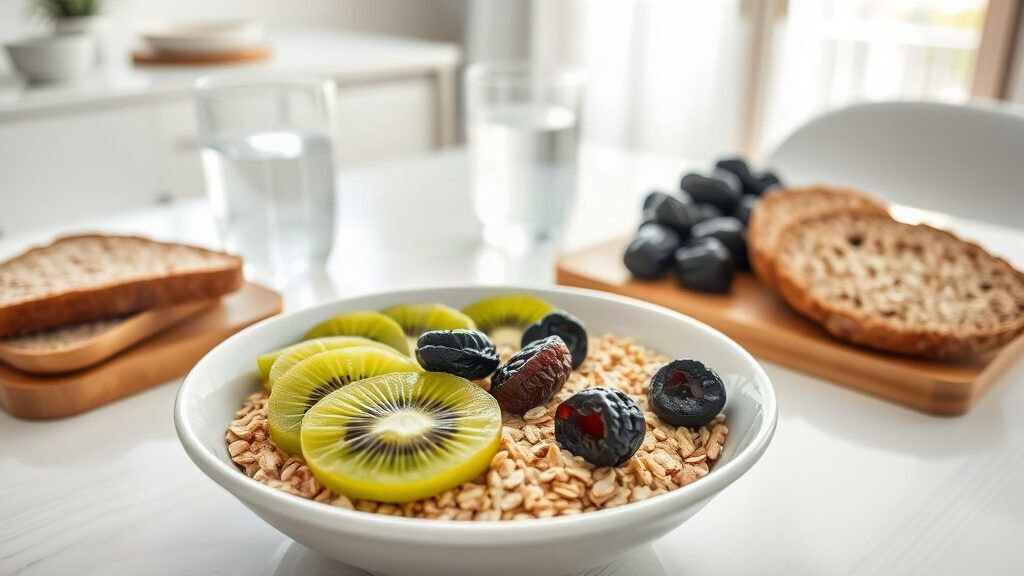
Against constipation, the strongest evidence concerns fiber. A meta-analysis of 16 randomized trials (1,251 participants) shows that 66% of people respond to fiber supplementation, compared with 41% in control groups; psyllium and pectin are effective above 10 g a day and after at least four weeks (van der Schoot et al., 2022). A second review of 23 studies (1,714 participants) finds that fruit, kiwi first, adds 0.36 bowel movements a week compared with psyllium, that rye bread does better than white bread and that mineral-rich water improves treatment response by 47% (van der Schoot et al., 2024).
| Study | Population | Main result |
|---|---|---|
| Suares and Ford, 2011 | 45 studies, 261,040 adults | Prevalence of 14%, higher in women and with age |
| Sumida et al., 2019 | 3,359,653 veterans | Mortality +12%, ischemic stroke +19% (association) |
| Power et al., 2013 | 28 observational studies | No increase in colorectal cancer in cohorts |
| van der Schoot et al., 2022 | 16 trials, 1,251 participants | Response to fiber 66% vs 41%, above 10 g a day |
| Gao et al., 2019 | 9 trials, 680 participants | Exercise: improvement multiplied by 1.97, high bias |
| Abbott et al., 2001 | 6,790 men followed for 24 years | Fewer than one stool a day: Parkinson’s risk x2.7 |
In practice: when to see a doctor for constipation after 60
Constipation that appears or changes suddenly after 50, or that comes with blood, weight loss or severe pain, warrants a medical visit without delay. These warning signs call for a search for a colon lesion, a bowel obstruction or fecal impaction, a plug of hard stool that is common in bedridden older people.
| Sign | What it may indicate | When to see a doctor |
|---|---|---|
| Swollen, painful belly, vomiting, no passing of gas | Bowel obstruction | Emergency room the same day |
| Red blood or black stools | Hemorrhoids, polyp, colon lesion | Within the following days |
| Unexplained weight loss, fatigue, anemia | Digestive or general disease | Promptly, with blood tests |
| Recent, lasting change in bowel habits after 50 | Polyp or cancer to rule out | Promptly, colonoscopy if advised |
| Watery diarrhea after several days without a stool | Fecal impaction | Promptly, especially if there is confusion |
| Constipation that started with a new treatment | Medication side effect | At the next appointment or with the pharmacist |
Colorectal cancer, which the NHS calls bowel cancer, remains common: in France, 47,582 new cases were recorded in 2023. The French national organized screening program offers people aged 50 to 74 an immunochemical stool test to do at home every two years, and a colonoscopy in case of a positive result or a family history.
Without any warning sign, an appointment with your primary care doctor is justified if constipation persists after four weeks of lifestyle measures, if heavy straining dominates (a clue to dyssynergia) or if laxatives become necessary every week. The doctor reviews the prescriptions, examines the abdomen and may order a TSH test, a blood glucose test and a calcium level. The role of the gut in the dialogue between organs is presented in our pillar on intercellular communication.
Tips to relieve constipation after 60
Lifestyle measures are the first treatment for constipation, and they need at least four weeks to show their effect. The measures backed by measured data:
- increase fiber gradually, over two to three weeks, to limit bloating;
- drink about 1.5 liters (about 50 fl oz) a day, unless a doctor has restricted fluids because of the heart or kidneys;
- walk every day, ideally 30 minutes, even split into shorter bouts;
- sit on the toilet at a set time, within half an hour after breakfast, when the gastrocolic reflex is strongest;
- rest your feet on a small stool to get closer to a squatting position;
- have your prescriptions reviewed by your doctor or pharmacist;
- avoid long-term use of stimulant laxatives without medical advice.
| Lever | What the trials show | Practical benchmark |
|---|---|---|
| Psyllium | Response rate 66% vs 41% (16 trials) | More than 10 g a day, at least 4 weeks, with a large glass of water |
| Kiwi and other fruit | +0.36 bowel movements a week compared with psyllium | Fresh fruit at every meal |
| Prunes | As effective as psyllium in the 2024 review | 50 g (about 1.8 oz) morning and evening in a 2011 trial |
| Whole-grain rye bread | +0.43 bowel movements a week compared with white bread | Replace white bread |
| Mineral-rich water | Treatment response improved by 47% | Part of the day’s drinks |
Psyllium, the best-studied soluble fiber, should be taken apart from medications so as not to hinder their absorption; its doses and precautions are detailed in our article on psyllium. If these measures are not enough, the doctor may suggest an osmotic laxative, suitable for prolonged use in older people. To receive our reviews on digestive health and healthy aging, subscribe to our health newsletter.
Frequently asked questions about constipation after 60
How many days without a bowel movement is normal after 60?
Having a bowel movement three times a week is within the normal range at any age. Constipation is diagnosed when stools become less frequent, hard or difficult to pass for at least three months. Several days without a stool with a swollen belly, pain or vomiting, or unusual watery diarrhea in an older person, require prompt medical advice to rule out a bowel obstruction or fecal impaction.
Which medications cause constipation in older adults?
The most frequent are opioid painkillers, anticholinergic drugs (some antidepressants, antihistamines and bladder treatments), iron, calcium, verapamil, diuretics and aluminum-based antacids. In a Norwegian survey of 4,622 adults, starting a treatment raised the prevalence of constipation by 2.5 points. A suspected medication should not be stopped on your own: your doctor can adjust it.
Does constipation increase the risk of colon cancer?
A meta-analysis of 28 studies found no increase in colorectal cancer in people with constipation in cohorts and cross-sectional surveys. What should raise concern is a recent, lasting change in bowel habits after 50, blood in the stool or unexplained weight loss. In France, organized screening offers an immunochemical stool test every two years between the ages of 50 and 74.
Which foods really help against constipation?
Controlled trials mainly support psyllium above 10 g a day for at least four weeks, kiwi, prunes, whole-grain rye bread and mineral-rich waters. In a review of 23 studies, fruit added 0.36 bowel movements a week compared with psyllium. Fiber should be increased gradually, with enough fluids, to limit bloating.
Why is constipation after 60 more common?
Several causes add up with age: less fiber and water, less physical activity, more medications, a less coordinated pelvic floor and diseases such as hypothyroidism, diabetes or Parkinson’s disease. A meta-analysis of 261,040 adults puts the prevalence at 14%, with a steady rise decade after decade and a risk multiplied by 2.22 in women.
Medical disclaimer. The information on this page is provided for informational purposes only and does not constitute medical advice. It does not replace a consultation. Constipation accompanied by blood in the stool, severe abdominal pain, vomiting, no passing of gas or unexplained weight loss requires prompt medical advice. Never stop or change a treatment without medical advice, and do not use laxatives over a long period without the guidance of a healthcare professional. Ask a healthcare professional before changing your diet or taking dietary supplements, especially if you have a medical condition, are pregnant or are under treatment. Dietary supplements do not replace a balanced diet or medical follow-up.