Climbing stairs pushes the heart rate to nearly 160 beats per minute over about ten floors, an intensity close to a brisk jog. This everyday movement has been measured in the lab, tested in controlled trials and tracked in cohorts of several hundred thousand adults. Here is what each floor asks of the heart, what studies observe on VO2 max, cholesterol and cardiovascular risk, and how many floors to aim for each day.
In brief – Climbing stairs is a vigorous-intensity physical activity, at around 9.6 METs, that works the heart harder than walking while taking only a few minutes a day. Over 11 floors, heart rate reaches an average of 159 beats per minute, and each step climbed costs about 0.11 kcal. In controlled trials, a few daily climbs for 6 to 12 weeks improve aerobic capacity by 7 to 17% in sedentary adults. In the UK Biobank cohort (458,860 adults), climbing more than 5 flights a day is associated with a 16 to 23% lower risk of atherosclerotic cardiovascular disease. These observational data do not prove cause and effect, and stairs alone do not cover the recommended amount of physical activity. Chest pain, unusual breathlessness or a painful knee call for medical advice before starting any program.
Climbing stairs: defining a vigorous everyday effort
Climbing stairs means lifting your entire body weight against gravity, step after step, which makes it one of the most demanding daily activities for the cardiovascular system. Physiologists express this demand in METs, the unit that compares the energy cost of an activity with that of rest (1 MET). Above 6 METs, an activity is classified as vigorous.
A team in Singapore measured this effort in the field in 103 volunteers, on an 11-floor public staircase: 180 steps of 15 cm (6 in) each and a total rise of 27 meters (89 ft) (Teh and Aziz, 2002). On the way up, intensity reached 9.6 METs, oxygen uptake 33.5 ml/kg/min and heart rate 159 beats per minute. On the way down, the effort fell back to 4.9 METs and 107 beats per minute.
Going up the stairs therefore belongs to the vigorous category, while going down stays moderate. The World Health Organization recommends that adults get 150 to 300 minutes of moderate activity per week, or 75 to 150 minutes of vigorous activity, or a combination of both (WHO, physical activity fact sheet). Every minute spent on the stairs counts toward that total, just like a minute of running.
Researchers have a name for this kind of short burst slipped into the day: vigorous intermittent lifestyle physical activity, or VILPA. It covers stair climbs, very fast walking to catch a bus or carrying heavy shopping bags, with no sportswear and no gym.
Climbing stairs: what each floor asks of your heart
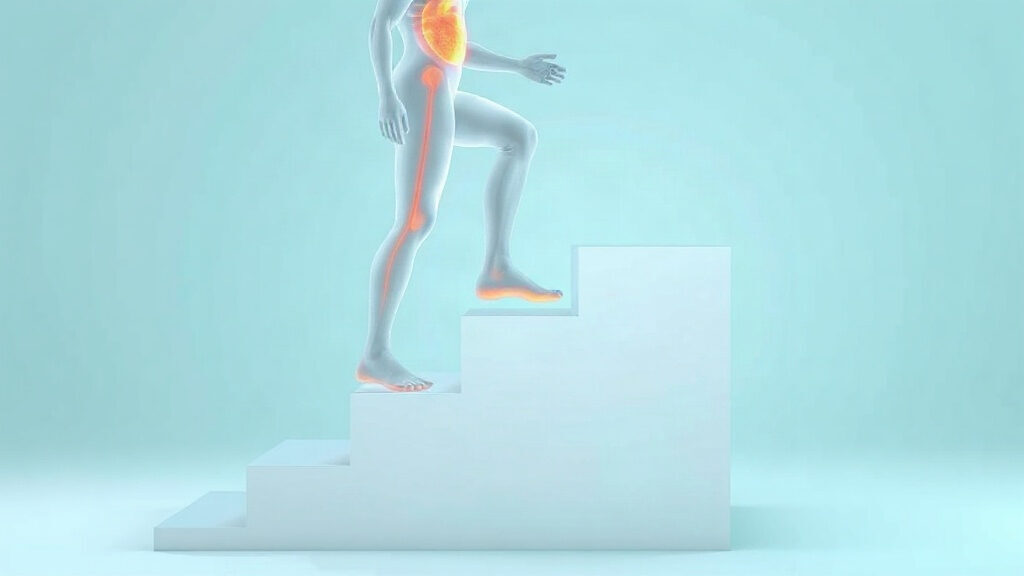
On every floor, the leg muscles demand far more oxygen, and the heart responds by beating faster and pumping more blood with each contraction. The quadriceps, glutes and calves do the vertical work. Their oxygen demand rises within seconds, much faster than during a walk on level ground.
Taking the stairs day after day triggers several adaptations documented by exercise physiology:
- the volume of blood ejected with each beat increases, which slows the resting pulse;
- the leg muscles develop more capillaries and more mitochondria, the power plants of the cells;
- VO2 max, the maximum amount of oxygen the body can use, improves;
- muscle sensitivity to insulin improves, which helps regulate blood sugar after meals;
- LDL cholesterol falls slightly in some trials, with no measurable effect on HDL.
One detail matters when reading the studies: researchers count in “flights”, meaning runs of about 10 steps. A building floor often has more: on the staircase measured in Singapore, there were 16 steps per floor. The table below converts these benchmarks into energy cost, based on the 0.11 kcal measured per step climbed.
| Benchmark | Number of steps | Approximate rise | Energy spent going up |
|---|---|---|---|
| 1 flight (as used in studies) | 10 | 1.5 m (5 ft) | about 1.1 kcal |
| 1 building floor | 16 | 2.5 m (8 ft) | about 1.8 kcal |
| UK Biobank threshold: 5 flights a day | 50 | 7.5 m (25 ft) | about 5.5 kcal |
| 3 vigorous floors (Jenkins 2019 trial) | 60 | 9 m (30 ft) | about 6.6 kcal |
| 11 floors (field measurement) | 180 | 27 m (89 ft) | 19.7 kcal measured |
The calorie count stays modest: the cardiovascular value lies in the intensity reached in very little time, not in the calories. A few flights put the heart in the vigorous zone in less than a minute, something few everyday movements can do.
Climbing stairs and heart health: what the science says
Controlled trials show that over 6 to 12 weeks, a few minutes a day on the stairs is enough to improve aerobic capacity in sedentary people. Large cohorts, for their part, link this habit to a lower cardiovascular risk, with important nuances.
The first landmark trial dates from 2005. Fifteen sedentary young women were randomly assigned to a control group or to a group that climbed a 199-step public staircase, from 1 climb a day in week 1 up to 5 climbs by the end of the program (Boreham et al., 2005). After 8 weeks, their VO2 max had risen by 17.1% and their LDL cholesterol had dropped by 7.7% compared with the control group.
McMaster University in Canada then tested even shorter formats. Three 20-second stair sprints, 3 times a week for 6 weeks, improved VO2 max by 12%, or about 1 MET (Allison et al., 2017). A gentler version, three bouts of 60 seconds going up and down a single flight, produced a 7% gain. In a second trial, three vigorous 3-floor climbs spread across the day also raised VO2 max, with a gain the authors described as modest (Jenkins et al., 2019).
The test closest to real life took place at the Geneva University Hospitals. A simple poster campaign encouraged 77 inactive employees to take the stairs rather than the elevator (Meyer et al., 2010). They went from 4.5 to 20.6 floors a day. After 12 weeks, their estimated aerobic capacity had risen by 9.2%, their waist circumference had shrunk by 1.7% and their LDL cholesterol by 3.0%. At 6 months, momentum had dropped to 7.2 floors a day, but a 5.9% gain persisted.
On the cohort side, the largest study followed 458,860 UK Biobank adults for a median of 12.5 years (Song et al., 2023). Compared with people who reported never using the stairs, the risk of atherosclerotic cardiovascular disease was 16% lower for 6 to 10 flights a day and 23% lower for 16 to 20 flights. Between 1 and 5 flights, no clear difference appeared. Above all, participants who had stopped between the two assessments had a 32% higher risk than people who had never taken the stairs.
Other data point the same way, less strikingly. As early as 1986, a follow-up of 16,936 Harvard alumni linked walking, stair climbing and sport to lower mortality (Paffenbarger et al., 1986). In the same cohort, 8,874 men with a median age of 65 who climbed at least 35 floors a week had 16% lower all-cause mortality, with no clear reduction in cardiovascular mortality (Rey-Lopez et al., 2019). A 2026 meta-analysis pooling 9 studies and 480,479 participants associates climbing stairs with 39% lower cardiovascular mortality (Paddock et al., 2026).
A UK Biobank analysis, however, calls for caution. In 280,423 participants, climbing 6 to 10 flights a day at home was not associated with lower cardiovascular mortality, and the effect on all-cause mortality remained small, on the order of 44 to 55 extra days of survival (Sanchez-Lastra et al., 2021). The authors see the likely imprint of confounding factors: taking the stairs is easier for people who are already in good health. Finally, in 25,241 adults who did no sport, three daily bouts of vigorous effort lasting 1 to 2 minutes, such as going up the stairs at a good pace, were associated with 48 to 49% lower cardiovascular mortality (Stamatakis et al., 2022).
| Study | Design and sample size | Practice assessed | Main result |
|---|---|---|---|
| Boreham 2005 | Randomized trial, 15 women | 1 to 5 climbs of 199 steps a day, 8 weeks | VO2 max +17.1%, LDL -7.7% |
| Allison 2017 | Trials, 31 sedentary women | 3 sprints of 20 s, 3 times a week, 6 weeks | VO2 max +12% |
| Meyer 2010 | Before-after study, 77 employees | Stairs instead of the elevator, 12 weeks | Aerobic capacity +9.2%, waist circumference -1.7% |
| Song 2023 | Cohort, 458,860 adults | Flights climbed per day, 12.5-year follow-up | Cardiovascular risk -16 to -23% above 5 flights |
| Sanchez-Lastra 2021 | Cohort, 280,423 adults | Flights climbed at home | No drop in cardiovascular mortality |
| Paddock 2026 | Meta-analysis, 480,479 participants | Stair climbing | Cardiovascular mortality -39% |
In practice: how many floors should you climb each day?
For the heart, the most solid benchmark is climbing stairs for more than 5 flights a day, about fifty steps or three building floors, at a brisk pace. This is the threshold from which the UK Biobank cohort observes a lower cardiovascular risk, and it matches the order of magnitude of the protocols that worked in trials.
Intensity matters more than volume. Going up slowly, pausing on every landing, still helps counter a sedentary lifestyle, but the VO2 max gains were obtained at a pace that leaves you out of breath. To understand why this aerobic capacity weighs so heavily on longevity, our guide to VO2 max sets out the figures. At the cellular level, these adaptations run through the muscle mitochondria, the subject of our pillar page on mitochondrial dysfunction.
Regularity matters as much as intensity. In the Geneva study, the habit dropped from 20.6 to 7.2 floors a day once the posters came down, and the UK Biobank shows that stopping erases the observed benefit. A format you can sustain all year beats an intense challenge abandoned after a month. Climbing stairs complements daily walking, whose benchmarks are detailed in our article on steps per day and longevity.
| Format | Time per day | Frequency | Measured gain | Best suited to |
|---|---|---|---|---|
| Workplace habit (Geneva) | About 20 floors spread out | Working days | Aerobic capacity +9.2% at 12 weeks | Beginners, office workers |
| Long climbs (Boreham) | 1 to 5 climbs of 2 minutes | 5 days a week | VO2 max +17.1% at 8 weeks | People with access to a long staircase |
| Exercise snacks (Jenkins) | 3 climbs of 3 floors | 3 days a week | Modest rise in VO2 max | Busy schedules |
| Sprints (Allison) | 3 bouts of 20 seconds all-out | 3 days a week | VO2 max +12% at 6 weeks | Healthy adults with no contraindication |
Protocol: climbing stairs safely, step by step
A good protocol starts low and progresses slowly: one or two floors at a pace that still lets you talk, then more steps and a brisker pace over the weeks. The longevity reading of these studies is practical: take the stairs at every opportunity instead of calling the elevator, rather than scheduling an extra workout.
- Weeks 1 and 2: climb 1 to 2 floors on each trip, holding the handrail, at a pace that lets you speak in full sentences.
- Weeks 3 to 6: aim for at least 5 flights a day, speeding up slightly on the last one.
- After 6 weeks, if all goes well: add 2 or 3 faster climbs of 1 to 3 floors, several hours apart.
- Place your whole foot on the step, keep your torso upright and look ahead rather than at your feet.
- Take the elevator down if your knees hurt: going down brakes your body weight and loads the joint more.
- Log your floors for a few days with a watch or pedometer that counts them, to check that you reach the threshold.
Some signs mean you should stop the climb and see a doctor: pain or tightness in the chest, disproportionate or new breathlessness, palpitations, dizziness or feeling faint. Breathlessness that appears with an effort that used to be easy deserves a checkup. People with heart disease, uncontrolled high blood pressure or knee osteoarthritis should have this program cleared by their doctor before increasing the intensity. To receive one study decoded this way every month, subscribe to our health newsletter.
Frequently asked questions about climbing stairs
How many floors should you climb each day to protect your heart?
In the UK Biobank cohort (458,860 adults), the risk of atherosclerotic cardiovascular disease falls from 6 flights a day, about 60 steps or 3 to 4 building floors. The lowest risk appears between 11 and 20 flights. These figures come from an observational study: they give an order of magnitude, not a proven dose.
Is climbing stairs more effective than walking?
Minute for minute, yes. Stair climbing demands about 9.6 METs, a vigorous intensity, whereas ordinary walking stays moderate. A few minutes on the stairs is therefore enough to stimulate the heart strongly. The two activities complement each other: walking brings daily volume, stairs bring intensity in very little time.
Does climbing stairs help you lose weight?
Stair climbing has a limited effect on weight. Each step climbed costs about 0.11 kcal, or nearly 20 kcal for 11 floors. In the Geneva study of 77 employees, switching to 20 floors a day reduced weight by 0.7% and waist circumference by 1.7% in 12 weeks. The main benefit is cardiovascular fitness, not the scale.
Why do you get out of breath climbing stairs?
Going up about ten floors drives the heart rate to around 159 beats per minute, so breathlessness is normal, especially in a sedentary person. It usually decreases after a few weeks of regular practice. New, sudden breathlessness with chest pain or palpitations, however, calls for prompt medical attention.
Can you climb stairs if you have heart disease?
Taking the stairs is often still possible, but only with the approval of your cardiologist, who sets the appropriate intensity. The effort quickly reaches a vigorous zone, which can exceed the recommended limits after a heart attack or with heart failure. Cardiac rehabilitation frequently includes stairs in a gradual, supervised way. Any chest pain means stopping and calling emergency services (911 in the US, 999 in the UK, 112 in Europe).
Medical disclaimer. The information provided here is for informational purposes only and does not constitute medical advice. It does not replace a consultation. Ask a healthcare professional before starting a new physical practice, especially an intense effort, if you have heart disease, high blood pressure, joint problems, are pregnant or are under treatment. Stop exercising immediately if you experience chest pain, feel faint, have palpitations or unusual breathlessness, and call emergency services (911 in the US, 999 in the UK, 112 in Europe) if these symptoms persist.