Red light therapy uses the visible band of the spectrum between 620 and 750 nanometers, extended by near-infrared light up to 1,100 nm. Since the 1960s, thousands of studies have documented photobiomodulation, meaning the biological response of cells to low-power red light. The key enzyme sits inside the mitochondria. Here is how it captures light, what controlled trials have actually measured on skin, joints and vision, and how to read the promises of lamps sold to the general public.
In brief – Red light therapy is the use of visible light from 620 to 750 nm which, at low power, is absorbed by cytochrome c oxidase in the mitochondria and increases ATP production. This mechanism, called photobiomodulation, was described by Tiina Karu as early as 1999 and then refined by Michael Hamblin. The effects measured in humans remain local: higher skin collagen density after 30 sessions (Wunsch 2014, 136 volunteers), knee osteoarthritis pain reduced by 14 mm on a 100 mm scale (Stausholm 2019, 22 trials, 1,063 patients), and color contrast sensitivity improved for one week after 3 minutes at 670 nm (Shinhmar 2021). Results depend on the dose (wavelength, energy in J/cm², duration) and do not extend to overall longevity. Consumer LEDs borrow the principle, but rarely the validated doses.
Definition: what are red light therapy and photobiomodulation?
Photobiomodulation is the set of cellular reactions triggered by low-intensity red or near-infrared light, with no thermal effect. In 2015 the term replaced the labels “low-level laser therapy” (LLLT) and “LED therapy”, which described the same phenomenon with different sources. The discovery dates back to 1967, when Hungarian physician Endre Mester observed faster hair regrowth in mice exposed to a ruby laser.
The useful spectrum is concentrated in an “optical window” where tissues absorb little: hemoglobin absorbs below 600 nm, water beyond 1,100 nm. In between, red light passes through the skin and reaches the cells underneath. Depth depends on wavelength, which explains why devices often combine visible red and infrared.
| Band | Wavelength | Estimated penetration | Usual targets |
|---|---|---|---|
| Visible red | 620 to 700 nm | 1 to 5 mm (0.04 to 0.2 in) | Skin, mucous membranes, retina |
| Deep red | 670 nm (the most studied) | 3 to 5 mm | Dermis, eye, wound healing |
| Near-infrared | 780 to 860 nm | 10 to 40 mm (0.4 to 1.6 in) | Muscles, tendons, joints |
| Infrared 904 nm | 904 nm (pulsed laser) | Up to 50 mm (2 in) | Knee, shoulder, spine |
Mechanism: how red light therapy acts on mitochondria
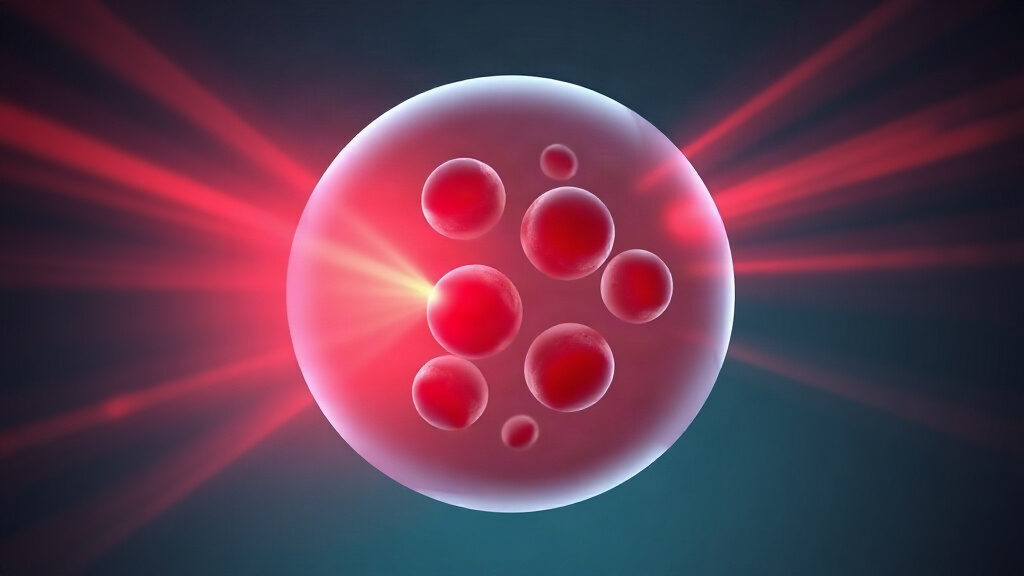
The main photoreceptor is cytochrome c oxidase, complex IV of the mitochondrial respiratory chain. Tiina Karu, of the Russian Academy of Sciences, established in 1999 that its copper and iron centers precisely absorb red and infrared photons (Karu 1999). Absorption releases the nitric oxide that was holding the enzyme back, and cellular respiration starts again. Michael Hamblin and Lucas de Freitas summarized the cascade that follows (de Freitas and Hamblin 2016):
- More ATP: once released from inhibition, cytochrome c oxidase consumes more oxygen and the cell has more energy to repair itself, divide or synthesize collagen.
- A brief spike in free radicals: this moderate rise in reactive oxygen species acts as a signal and activates transcription factors such as NF-kB in resting cells.
- Release of nitric oxide: small blood vessels dilate, and local blood flow increases for a few hours.
- Lower inflammatory cytokines: in immune cells that are already activated, Hamblin describes a reduction in TNF-alpha, IL-1 and IL-6 (Hamblin 2017).
- Effect on interfacial water: Glen Jeffery’s team (University College London) suggests that long wavelengths reduce the viscosity of the water around ATP pumps, which improves their efficiency.
The response to red light follows a bell-shaped curve. A dose that is too low does nothing, while a dose that is too high inhibits the cell. Clinical protocols range from 1 to 10 J/cm² per point, which amounts to a few minutes of exposure with a 20 to 100 mW/cm² source. This point explains a large share of the contradictory results between studies.
What the science says about red light therapy: human trials
The strongest evidence for red light covers three areas: skin, musculoskeletal pain and oral mucositis in patients treated with chemotherapy. For everything else (brain, hair, athletic performance), trials exist but remain small or heterogeneous.
Skin and collagen. Alexander Wunsch and Karsten Matuschka randomized 136 volunteers, 113 of whom were treated twice a week for 30 sessions with red light at 611 to 650 nm dosed at 9 J/cm². At the end, collagen density measured by ultrasound, skin roughness and blinded photographic assessment were significantly better than in the 23 controls (Wunsch 2014). Pinar Avci and Michael Hamblin reviewed the other dermatological applications, from wound healing to acne (Avci 2013).
Joint pain. The meta-analysis by Martin Bjørn Stausholm (University of Bergen) pooled 22 placebo-controlled trials, totaling 1,063 patients with knee osteoarthritis. Pain fell by 14.23 mm on a 100 mm scale at the end of treatment, and by 23.23 mm between 2 and 12 weeks after treatment ended for the recommended doses, 4 to 8 J per point at 785-860 nm (Stausholm 2019). No adverse effects were reported. Ron Clijsen reached a similar conclusion in 1,462 patients with various musculoskeletal disorders (Clijsen 2017).
Vision and retinal aging. Harpreet Shinhmar and Glen Jeffery exposed adults aged 37 to 70 to 670 nm red light for 3 minutes in the morning. Color contrast sensitivity, which declines with age, improved for one week after a single exposure, but only when the session took place in the morning (Shinhmar 2021). This time-of-day dependence fits what we know about the circadian clock and mitochondrial metabolism.
Oral mucositis. Since 2019, the MASCC and ISOO scientific societies have recommended photobiomodulation to prevent mouth lesions in patients receiving bone marrow transplants or radiation for head and neck cancer (Zadik 2019). This is the indication where red light has crossed the threshold into official guidelines.
| Indication | Main source | Sample size | Measured effect | Level of evidence |
|---|---|---|---|---|
| Knee osteoarthritis | Stausholm 2019, meta-analysis | 1,063 patients | Pain reduced by 14 to 23 mm out of 100 | High |
| Oral mucositis (oncology) | Zadik 2019, guidelines | Systematic review | Prevention of lesions | High (recommended) |
| Wrinkles and collagen | Wunsch 2014, randomized trial | 136 volunteers | Higher collagen density | Moderate |
| Muscle performance | Leal-Junior 2015, review of 13 trials | Small groups | About 5 more repetitions | Moderate, heterogeneous |
| Color vision after 40 | Shinhmar 2021 | Small sample | Contrast improved for 1 week | Preliminary |
| Brain, mood, sleep | Pilot studies | Dozens of subjects | Unconfirmed signals | Insufficient |
For athletic performance, the review by Ernesto Leal-Junior included 13 randomized trials: red or infrared light applied before exercise increased the number of repetitions by 5.47 on average and delayed fatigue, with the most consistent results for red and infrared wavelengths (Leal-Junior 2015). The heterogeneity of protocols prevented any meta-analysis of blood markers.
In practice: red light, mitochondria and aging
The link between red light and longevity runs through the mitochondrion, whose decline is one of the twelve hallmarks of aging. With age, cytochrome c oxidase loses activity, ATP drops, and tissues with high energy demand (retina, muscle, brain) are the first to suffer. UltraSanté has a pillar page on mitochondrial dysfunction, which places this mechanism among the other levers under study, such as PQQ or endurance exercise.
Nothing so far shows that red light extends life or slows overall aging in humans. Trials measure local functions: a denser dermis, a less painful knee, a retina that tells colors apart better. Exposing the face does not change the mitochondria of the liver. For skin, the factors that speed up the appearance of wrinkles, led by UV and smoking, weigh far more than any LED session.
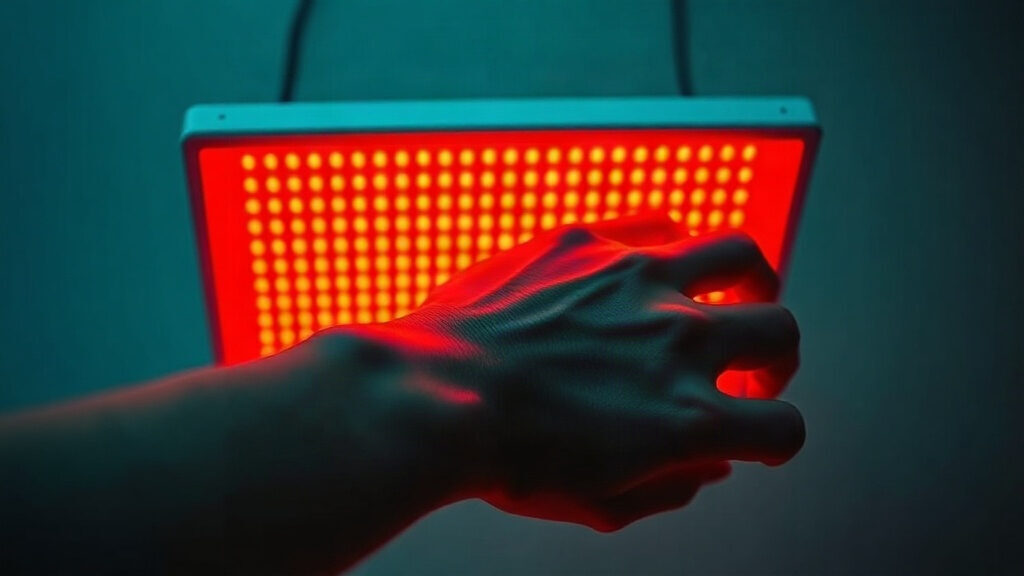
Consumer red light devices (masks, panels, flashlights) use red and infrared LEDs of highly variable power. Many display a theoretical irradiance, measured at contact, which drops sharply at 20 or 30 cm (8 or 12 in). LEDs with a strong blue component carry a risk of retinal toxicity and, as Harvard Health explains, disrupt sleep; this does not apply to pure red, but it does mean checking the actual spectrum of the device (Harvard Health, blue light has a dark side).
| Parameter | Clinical trials | Consumer devices |
|---|---|---|
| Wavelength | 630-670 nm (skin, eye), 785-904 nm (joints) | Often 630 + 850 nm combined |
| Dose per session | 4 to 10 J/cm² per area | Rarely stated |
| Irradiance | 20 to 100 mW/cm² measured at the skin | 5 to 50 mW/cm² depending on distance |
| Duration | 3 to 20 minutes per area | 10 to 20 minutes |
| Frequency | 2 to 3 times a week, 8 to 12 weeks | Variable, often daily |
| Eye protection | Goggles for lasers, controlled direct exposure in ophthalmology | Eyes closed, never stare for long |
Protocol: how to use red light therapy without getting it wrong
Sensible use of red light therapy starts from the indication, not from the device. The following points sum up what published protocols have in common.
- Choose the right wavelength: 630 to 670 nm for skin and mucous membranes, 800 to 900 nm for a muscle, a tendon or a deep joint.
- Respect the dose: aim for 4 to 10 J/cm² per area, which requires knowing the real irradiance at the distance of use. Doubling the duration does not improve the effect.
- Favor the morning for applications linked to mitochondria, as Shinhmar showed in 2021 on the retina.
- Schedule regular sessions: positive trials of red light use 2 to 3 sessions a week for at least 8 weeks, not a single exposure.
- Protect your eyes: never stare at a powerful red or infrared source. Retinal protocols are reserved for research and ophthalmology.
- Avoid contraindications: pregnancy, a known or suspected tumor area, photosensitizing medications, photosensitive epilepsy.
- See a doctor first for chronic pain or a persistent skin lesion: red light complements medical care, it does not replace it.
For the mitochondria themselves, the interventions with the broadest evidence remain endurance exercise, regular sleep and a plant-rich diet. Red light adds to these foundations when a specific indication justifies it.
Frequently asked questions about red light therapy
How does red light therapy act on cells?
Red and near-infrared photons are absorbed by cytochrome c oxidase, an enzyme in the mitochondria. This absorption releases the nitric oxide that was blocking the enzyme, restarts the respiratory chain and increases ATP production. A brief free radical signal and local vasodilation complete the response. Tiina Karu described this mechanism in 1999, and Michael Hamblin refined it.
What is the difference between red and infrared light?
Visible red light (620 to 700 nm) penetrates 1 to 5 mm and suits the skin, mucous membranes and retina. Near-infrared (780 to 904 nm) is invisible and passes through 1 to 5 cm (0.4 to 2 in) of tissue, which allows it to reach muscles, tendons and joints. Both bands activate the same mitochondrial enzyme. Devices often combine them to cover several depths.
How long does red light therapy take to show an effect on the skin?
In the randomized trial by Wunsch and Matuschka (2014), the 113 treated volunteers completed 30 sessions over 15 weeks, two per week, before collagen density and skin roughness were measured. Published protocols run for 8 to 12 weeks at minimum. A single session has no documented effect on wrinkles.
Is red light dangerous for the eyes?
A powerful red or infrared source should never be stared at directly, especially lasers and high-irradiance panels. Retinal trials use very low doses, controlled in the laboratory. For a consumer mask or panel, keep your eyes closed and respect the recommended distance. Health authorities mainly warn about LEDs with a strong blue component, so check the spectrum of the device.
Why do study results on red light vary so much?
The cellular response follows a bell-shaped curve: too little energy does nothing, too much energy inhibits the cell. Studies differ in wavelength, irradiance, duration and frequency of sessions. The meta-analyses by Stausholm (2019) and Clijsen (2017) show that trials following the doses recommended by the World Association for Laser Therapy obtain clearer effects than the others.
Medical disclaimer. The information on this page is provided for informational purposes only and does not constitute medical advice. It does not replace a consultation. Ask a healthcare professional before changing your diet, taking dietary supplements or starting a new practice, especially if you have a medical condition, are pregnant or are under treatment. Dietary supplements do not replace a balanced diet or medical follow-up.