Being always cold after 60 is not just a matter of temperament or a sweater that is too thin. With age, the body produces less heat and holds on to it less well, but a chilliness that settles in can also signal a sluggish thyroid, anemia or a narrowed artery. Here are the 6 causes documented by research, the tests that can settle the question and the signs that call for a prompt medical visit.
In brief – Being always cold after 60 is a common symptom that most often reflects a less responsive body thermostat: in 46 adults aged 65 to 89 exposed to mild cold, core temperature fell gradually, while it stayed stable in 36 young adults (DeGroot and Kenney, 2007). Six causes are documented: aging thermoregulation, muscle loss, hypothyroidism, anemia, circulation problems (peripheral artery disease, Raynaud’s syndrome) and certain medications such as beta-blockers. After 60, hypothyroidism shows fewer symptoms: 3.6 on average versus 6.2 before age 50 (Carlé et al., 2016). A new chilliness that gets worse or comes with fatigue, pallor, breathlessness or pain when walking warrants a blood test (TSH, blood count, ferritin) with your primary care doctor.
Definition: what does being “always cold” mean after 60?
Being always cold means feeling a persistent sensation of cold in a room where other people feel comfortable. Doctors speak of cold intolerance when this sensation is lasting and interferes with daily life. It can affect the whole body or stay limited to the extremities, with hands and feet that are always cold.
This symptom is not a disease in itself. It reflects an imbalance between the heat the body produces and the heat it loses. After 60, both sides of this balance shift: production falls along with muscle mass, and the skin is less effective at limiting losses. The useful question is therefore not “is this normal?” but “is this new, and are there other signs?”.
Feeling cold must also be distinguished from actual body temperature. A person can feel cold all the time with a normal core temperature, around 37 °C (98.6 °F). Conversely, an older person can cool down without noticing it, because temperature perception also dulls with age. This second situation is the one that exposes people to hypothermia.
Mechanism: why you feel always cold when heat production drops
The body maintains its core temperature through two levers: reducing heat loss and increasing heat production. A nerve center located in the hypothalamus constantly compares blood temperature with skin temperature, then triggers the appropriate responses. When one of these links weakens, the person ends up feeling chilly.
- Skin vasoconstriction: the small vessels of the skin narrow under the effect of noradrenaline, which keeps warm blood in the core of the body.
- Basal metabolism: muscles and organs produce heat continuously, largely under the control of thyroid hormones.
- Shivering: involuntary muscle contractions multiply heat production when the cold persists.
- Brown fat: this tissue, rich in mitochondria, burns fat to produce heat directly.
- Oxygen transport: red blood cells deliver to tissues the oxygen needed for any energy production, and therefore for heat.
- Behavior: putting on layers, moving around, turning up the heating, provided the cold is correctly perceived.
These mechanisms rely on how cells detect energy and hormonal signals, a theme developed in our pillar page on deregulated nutrient sensing. Each cause of chilliness described below affects at least one of these links.
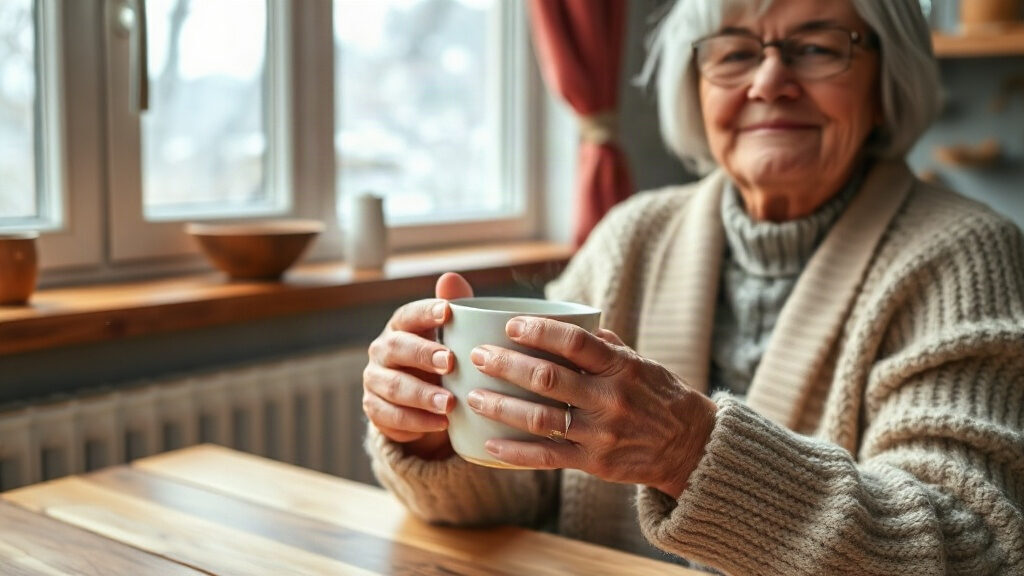
Always cold: the 6 causes backed by science
Six causes explain most situations in which a person over 60 feels cold all the time. The first two belong to normal aging; the next four point to a problem that can be screened for and treated. Several causes often add up in the same person.
1. A less responsive body thermostat
Aging delays and weakens the response to cold. In a Johns Hopkins University study, volunteers aged 55 to 71 only triggered vasoconstriction at a core temperature of 35.5 °C (95.9 °F), versus 36.2 °C (97.2 °F) in volunteers aged 18 to 23 (Frank et al., 2000, PubMed). Their noradrenaline only doubled, compared with a fourfold rise in the young, and their perception of cold was weaker.
At Penn State, 46 adults aged 65 to 89 were compared with 36 young adults of similar build during mild cold exposure. The older adults’ core temperature fell gradually from 35 minutes of exposure onward, their skin vasoconstriction was weaker (42% versus 53%) and their heat production lower (38.0 versus 41.9 W/m²) (DeGroot and Kenney, 2007, PubMed).
The review by Kenney and Munce adds an important nuance: once physical fitness, body composition and chronic diseases are taken into account, age alone only slightly impairs cold tolerance (Kenney and Munce, 2003, PubMed). In other words, a large part of age-related chilliness depends on modifiable factors: constant chilliness is not inevitable.
2. Less muscle, less heat
Muscles are the body’s main radiator, and losing them reduces heat production. An analysis of energy expenditure measured with doubly labeled water, from 8 days to 95 years of age, shows that expenditure adjusted for fat-free mass stays stable from 20 to 60 years, then declines in older adults (Pontzer et al., 2021, PubMed).
Sarcopenia, defined by the European EWGSOP2 consensus primarily by low muscle strength, deepens this deficit (Cruz-Jentoft et al., 2019, PubMed). Less muscle also means less effective shivering, and a person who has lost strength more often feels cold, even when well wrapped up. Our article on muscle loss details simple tests to spot it.
Brown fat follows the same slope. Among 1,972 patients examined by PET-CT scan, the likelihood of detecting active brown fat decreased with age, with beta-blocker use and, in the oldest patients, with body mass index (Cypess et al., 2009, PubMed). It was twice as common in women (7.5%) as in men (3.1%).
3. Always cold and tired: a slowed-down thyroid
Hypothyroidism slows the whole metabolism, and people who have it often feel cold. In the American NHANES III survey of 17,353 people, 4.6% of the population had hypothyroidism, including 4.3% with a mild form called subclinical (Hollowell et al., 2002, PubMed). TSH and thyroid antibodies increased with age and were more frequent in women.
The trap after 60 lies in how subtle the symptoms are. A Danish study compared 140 newly diagnosed people with 560 controls: patients aged 60 and over had 3.6 symptoms on average, versus 6.2 before age 50 (Carlé et al., 2016, PubMed). Only fatigue, breathlessness and wheezing remained more frequent than in older controls. Only a blood test measuring TSH can settle the matter. The role of iodine is detailed in our article on iodine and the thyroid.
4. Always cold and pale: an often subtle anemia
Less hemoglobin means less oxygen delivered to tissues: people with anemia often describe feeling cold, with pallor and breathlessness on exertion. In the NHANES III survey, 11.0% of men and 10.2% of women aged 65 and over were anemic, and more than 20% beyond age 85 (Guralnik et al., 2004, PubMed).
Among these anemic older adults, one third had a nutritional deficiency (iron, folate, vitamin B12), one third chronic inflammation or kidney disease, and one third unexplained anemia. The World Health Organization sets the diagnostic thresholds for anemia according to age and sex. To interpret iron stores, see our guide to low or high ferritin.
5. Narrowing circulation
Feet that are always cold, especially on one side only, can reveal peripheral artery disease of the legs. A global review of 34 studies and 112,027 participants estimates its prevalence at about 5.3% around age 45-49, and at about 18.4% in women and 18.8% in men aged 85-89 in high-income countries (Fowkes et al., 2013, PubMed). Smoking and diabetes are its main risk factors.
Raynaud’s syndrome produces a different picture: fingers that turn white, then blue in the cold, before reddening as they warm up. A meta-analysis of 33 studies (33,733 participants) estimates the prevalence of primary Raynaud’s at 4.85%, with a higher risk in women (OR 1.65) and with a family history (OR 16.6) (Garner et al., 2015, PubMed). Raynaud’s that appears after 60 should prompt a search for a secondary cause.
6. Certain medications and low body weight
Beta-blockers, prescribed for high blood pressure or heart conditions, leave some patients with cold hands and feet. A survey of 800 patients with hypertension showed that they increased the frequency of cold extremities in men, with propranolol, labetalol and oxprenolol leading the list (Steiner et al., 1982, PubMed). In the same survey, 74.8% of women complained of cold extremities.
Low body weight or unintentional weight loss also reduces the insulation provided by fat under the skin and the energy reserve available. Never stop a treatment on your own: if the chilliness appeared after a new prescription, simply mention it to your doctor, who can sometimes adjust the drug or the dose.
In practice: always cold, when should you see a doctor?
A long-standing, stable chilliness with no other symptom usually reflects normal aging and calls for everyday adjustments. Feeling cold when it is recent, getting worse or accompanied by other signs warrants an appointment with your primary care doctor. The table below summarizes the clues that point toward each cause.
| Cause | Associated signs | Useful test | Key figure |
|---|---|---|---|
| Aging thermoregulation | Long-standing, stable chilliness, no other complaint | No specific test | Vasoconstriction triggered at 35.5 °C versus 36.2 °C (Frank, 2000) |
| Muscle loss | Declining grip strength, difficulty rising from a chair | Strength test, walking speed | Energy expenditure declining after 60 (Pontzer, 2021) |
| Hypothyroidism | Feeling cold, fatigue, breathlessness, dry skin, constipation | TSH, then free T4 | 4.6% of the population (Hollowell, 2002) |
| Anemia | Feeling cold, pallor, breathlessness on exertion, palpitations | Complete blood count, ferritin, vitamin B12 | About 1 in 10 older adults (Guralnik, 2004) |
| Artery disease, Raynaud’s | One cold foot, calf pain when walking, white fingers | Ankle-brachial index | Nearly 18% at age 85-89 (Fowkes, 2013) |
| Medications, low weight | Cold that began after a new prescription, weight loss | Medication review, weighing | Cold extremities more frequent on beta-blockers (Steiner, 1982) |
Some signs call for a prompt visit, and others for an immediate call to emergency services (911 in the US, 999 in the UK, 112 in Europe). The NHS points out in its page on hypothermia that older people are among those most at risk.
| Situation | What to do |
|---|---|
| Long-standing, stable chilliness, no other symptom | Mention it at your next routine checkup |
| New chilliness for a few weeks, with fatigue or weight gain | Appointment with your primary care doctor for a blood test |
| Fingers turning white in the cold for the first time after 60 | Visit to look for a secondary cause |
| Cold, pale foot on one side, a wound that does not heal | Prompt visit, within the next few days |
| Foot or hand suddenly cold, pale and painful | Call emergency services right away |
| Body temperature below 35 °C (95 °F), confusion, unusual drowsiness | Call emergency services: suspected hypothermia |
Tips: how to suffer less from the cold every day
The most useful habits to feel less cold act on both sides of the heat balance: producing more heat and losing less of it. When the chilliness is recent, they complement the medical checkup without replacing it. Several rely directly on the studies cited above.
- Heat your home to at least 18 °C (64.4 °F): the WHO uses this threshold in its housing and health guidelines, and a 1986 review suggested 2 to 3 °C (3.6 to 5.4 °F) more for sedentary older people (Collins, 1986, PubMed).
- Maintain muscle mass: two strength sessions a week (chair rises, resistance bands, climbing stairs) increase heat production at rest.
- Eat enough protein, spread over three meals, to support muscle.
- Move every hour: sitting for long periods leaves your feet cold.
- Dress in thin layers, with a hat, warm socks and gloves, because the extremities lose a lot of heat.
- Choose hot drinks rather than alcohol: alcohol dilates the skin’s blood vessels and speeds up heat loss.
- Quit smoking, the leading avoidable factor in artery disease of the legs.
- Trust the thermometer rather than the sensation: perception of cold declines with age, and an indoor thermometer keeps the room from cooling down without you noticing.
From a longevity standpoint, chilliness is a useful warning signal. Feeling cold for the first time after 60 is a reminder to check three simple things: muscle strength, TSH and blood count. All three can be measured in one visit and one blood test.
Frequently asked questions about being always cold
Why do we feel always cold as we age?
With age, skin vasoconstriction kicks in later and more weakly, and heat production falls along with muscle mass. In volunteers aged 55 to 71, the vasoconstriction threshold was a core temperature of 35.5 °C, versus 36.2 °C in young people (Frank et al., 2000). Muscle loss and certain diseases common after 60 explain why some people feel cold sooner than others.
Can being always cold be a sign of hypothyroidism?
Yes, cold intolerance is one of the classic signs of hypothyroidism, but it is an unreliable clue after 60. A Danish study of 140 patients showed that people over 60 had 3.6 symptoms on average, versus 6.2 before age 50 (Carlé et al., 2016). Only a TSH blood test can confirm or rule out the diagnosis.
What is the difference between always cold hands and Raynaud’s syndrome?
Constantly cold hands keep a normal color or turn slightly pale. In Raynaud’s syndrome, the fingers turn clearly white, then blue, before reddening as they warm up, in attacks triggered by cold or stress. Primary Raynaud’s affects about 4.85% of the population (Garner et al., 2015). After 60, new Raynaud’s should be reported to your doctor.
Which blood tests should you ask for when you are always cold?
Your primary care doctor will usually order a TSH test for the thyroid, a complete blood count for anemia, and often ferritin and vitamin B12. Depending on the context, they may add fasting blood glucose and kidney function tests, because diabetes also damages the arteries of cold feet. Among anemic older adults, one third of cases stem from a nutritional deficiency that is easy to correct (Guralnik et al., 2004).
When does cold become dangerous after 60?
Cold becomes dangerous when core temperature drops below 35 °C (95 °F), the threshold for hypothermia. Warning signs include confusion, unusual drowsiness, slurred speech or shivering that stops while the person is still cold. In that case, call emergency services. For someone who feels cold all the time, keeping the home at 18 °C or more reduces this risk.
To receive a weekly selection of studies on health and longevity, explained without jargon, subscribe to our newsletter.
Medical disclaimer. The information on this page is provided for informational purposes only and does not constitute medical advice. It does not replace a consultation or a diagnosis. A new or worsening sensation of cold should be reported to your doctor. In case of confusion, unusual drowsiness, a body temperature below 35 °C (95 °F) or a limb that is suddenly cold, pale and painful, call emergency services (911 in the US, 999 in the UK, 112 in Europe). Never stop or change a treatment without the advice of the doctor who prescribed it. Ask a healthcare professional before changing your diet, taking dietary supplements or starting a new practice, especially if you have a medical condition or are under treatment.