MCT oil (medium-chain triglycerides) is gaining ground among athletes, intermittent fasting practitioners, and anyone looking for steadier energy throughout the day. Extracted from coconut or palm kernel oil, it differs from ordinary dietary fats by absorbing directly into the liver instead of traveling through the lymphatic system. Since the 2000s, several clinical trials have tested its effects on weight, the aging brain, and energy metabolism. Here is what the data actually show, without the marketing hype.
In brief – MCT oil is a dietary fat made of medium-chain fatty acids (6 to 12 carbon atoms) that converts quickly into ketone bodies, an energy source the liver and brain can use directly. A 16-week randomized trial (St-Onge & Bosarge, 2008, n=49) measured 1.67 kg (3.7 lb) more weight loss with this fat compared with olive oil. A meta-analysis of 749 participants (Mumme & Stonehouse, 2015) confirms a modest reduction in waist circumference and visceral fat compared with long-chain fats. In adults with memory problems, the resulting ketosis improved certain cognitive scores in people who did not carry the APOE4 gene (Reger et al., 2004). A 2021 meta-analysis, however, flags a possible rise in LDL compared with oils rich in unsaturated fat. This is neither a miracle remedy nor a product free of digestive risk: its use should stay gradual and supervised.
What Is MCT Oil?
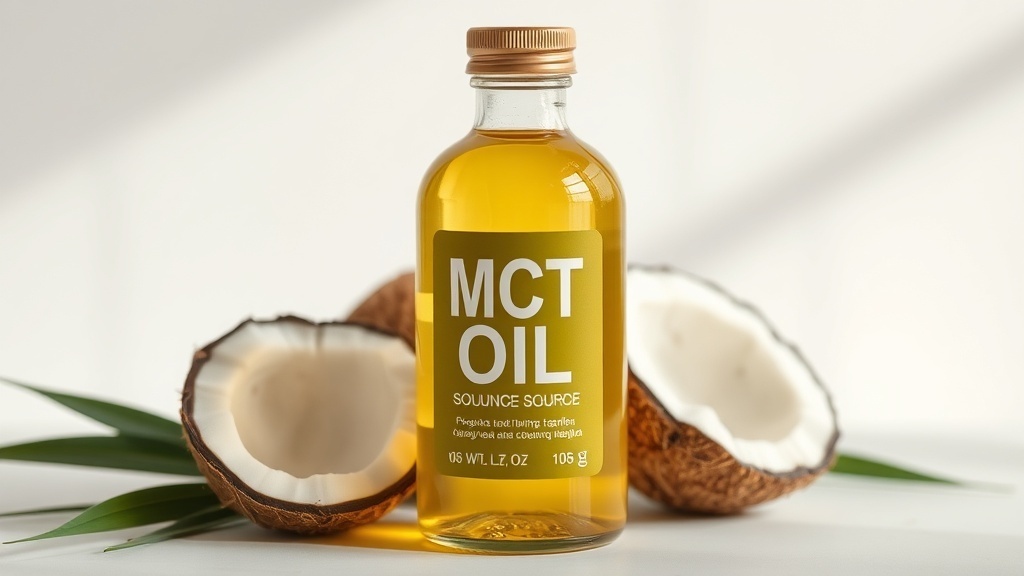
It refers to a concentrate of medium-chain triglycerides, fatty acids whose carbon chain runs 6 to 12 atoms long, compared with 14 to 18 atoms for the most common dietary fats. It is obtained by fractionating coconut or palm kernel oil, two plant oils naturally rich in fatty acids of this length.
Confusion with raw coconut oil is common. Coconut oil contains roughly 55% to 60% medium-chain fatty acids, mixed with longer-chain saturated fats such as lauric acid. The bottled product sold under this name is fractionated and concentrated, made up almost entirely of caprylic (C8) and capric (C10) acids, the two forms converted into ketone bodies the fastest.
Composition and Mechanism of Action
These medium-chain fatty acids do not follow the same metabolic route as long-chain fats. Once absorbed in the intestine, they pass directly into the portal vein toward the liver instead of being packaged into chylomicrons for the lymphatic system. The liver oxidizes them almost immediately, without needing the carnitine shuttle that long-chain fats require, which quickly produces ketone bodies (beta-hydroxybutyrate and acetoacetate) that the brain and muscles can use as fuel.
- Caproic acid (C6): present only in trace amounts, strong odor, rarely isolated in practice.
- Caprylic acid (C8): converts fastest into ketone bodies, the most well-documented ketogenic effect.
- Capric acid (C10): a good compromise between metabolic efficiency and digestive tolerance.
- Lauric acid (C12): slower oxidation, metabolic behavior closer to long-chain fats.
This rapid combustion explains the modest thermogenic effect seen in some studies, as well as the feeling of fullness some users report after a morning dose.
What the Science Says About MCT Oil
On body weight, a 16-week controlled trial compared a diet that included this fat with an equivalent diet using olive oil in 49 participants. The group receiving this fat finished the study 1.67 kg (3.7 lb) lighter, with lower total, trunk, and intra-abdominal fat mass (St-Onge & Bosarge, 2008, PMID 18326600). A meta-analysis of 13 randomized trials covering 749 participants confirms the trend: compared with long-chain fats, it is linked to 0.51 kg (1.1 lb) less body weight, 1.46 cm (0.6 in) less waist circumference, and a moderate reduction in visceral fat (Mumme & Stonehouse, 2015, PMID 25636220). These effects are real but limited: it replaces neither a calorie deficit nor regular physical activity.
On the aging brain, the interest stems from the ability of ketone bodies to supply an alternative fuel to glucose, whose use by the brain declines with age and even more so in Alzheimer’s disease. In 20 adults with mild memory problems, an oral dose significantly raised blood ketone levels and improved the ADAS-cog cognitive score in participants who did not carry the APOE4 gene (Reger et al., 2004, PMID 15123336). A PET imaging study also found that these triglycerides double the brain’s uptake of ketone bodies in Alzheimer’s patients, without changing glucose use (Croteau et al., 2018, PMID 29914035). These findings involve small samples and measure a brain mechanism, not a lasting clinical improvement of the disease itself.
On the cardiovascular side, a meta-analysis of 7 randomized trials found no significant overall effect on total cholesterol or LDL across all comparators. In a subgroup analysis, however, it found a rise in total cholesterol and LDL when it was compared with an oil rich in unsaturated fat, such as olive or sunflower oil (McKenzie et al., 2021, PMID 34255085). A reference toxicology review also concludes that it is generally well tolerated at typical dietary doses, with no carcinogenic risk identified in long-term animal studies (Traul et al., 2000, PMID 10685018).
The WHO recommends keeping total fat intake below 30% of daily energy intake, noting that the quality of the fatty acids consumed matters as much as the total amount (WHO, Healthy diet). This fat fits within that quality-focused approach, without replacing the unsaturated fats that remain the foundation of a heart-healthy diet.
In Practice: When and How to Use MCT Oil
MCT oil fits into three documented contexts: supporting a weight-loss diet that already runs a calorie deficit, supporting intermittent fasting or a ketogenic protocol to keep energy levels steady, and providing an occasional dose of ketone bodies for people with mild cognitive decline, under medical supervision. This lipid concentrate complements an overall nutrition strategy rather than replacing it, and fits well within a fasting-mimicking diet approach, where ketone body production already plays a central role.
The table below compares it with the two dietary oils it is most often measured against in studies.
| Criterion | MCT oil | Coconut oil | Olive oil |
|---|---|---|---|
| Origin | Fractionated coconut/palm kernel | Coconut flesh | Olive fruit |
| Medium-chain fatty acid content | About 95% to 100% | About 55% to 60% | Nearly none |
| Documented metabolic effect | Fast ketosis, mild thermogenic effect | Slower, more moderate ketosis | Established cardioprotective effect |
| Impact on LDL in direct comparison | Slight possible rise | More pronounced rise (saturated fat) | Favorable reference |
Metabolically, this type of fat shares features with mechanisms studied in insulin resistance: by supplying energy that does not directly depend on glucose, it may temporarily ease the insulin demand after a meal, an effect to interpret with caution and not to generalize to people with diabetes on treatment.
Protocol and Precautions
Introducing MCT oil into the diet should stay gradual: the digestive tract adapts poorly to a large dose all at once. The protocols used in clinical studies generally follow this same step-up logic.
- Start with a teaspoon (about 5 mL) mixed into a meal, never on an empty stomach for the first dose.
- Increase gradually over one to two weeks up to 1 to 2 tablespoons per day at most, depending on digestive tolerance.
- Spread the dose across the day rather than taking it all at once, to limit intestinal issues.
- Avoid it entirely in cases of liver disease, pancreatitis, or a history of ketoacidosis, and get medical advice if managing diabetes with SGLT2 inhibitors.
The most common side effects remain digestive: cramping, bloating, and diarrhea when the dose is increased too high too fast. They usually resolve by cutting back the amount. On the brain-health front, the energy supplied by these ketone bodies complements other levers studied for brain energy metabolism, such as creatine, without replacing medical care for cognitive decline.
Frequently Asked Questions About MCT Oil
What exactly is MCT oil?
It is a concentrate of medium-chain triglycerides, fatty acids of 6 to 12 carbon atoms obtained by fractionating coconut or palm kernel oil. It mainly contains caprylic (C8) and capric (C10) acids, the forms the liver converts into ketone bodies fastest, unlike ordinary long-chain dietary fats.
What is the difference between MCT oil and coconut oil?
Raw coconut oil contains roughly 55% to 60% medium-chain fatty acids, mixed with longer-chain saturated fats such as lauric acid. The fractionated, concentrated product sold under this name is made up almost entirely of C8 and C10, which makes it more ketogenic but also more costly to produce than whole coconut oil.
Does MCT oil really help you lose weight?
Clinical trials show a real but modest effect: about 0.5 kg (1.1 lb) less body weight and 1.5 cm (0.6 in) less waist circumference on average compared with long-chain fats, according to a meta-analysis of 749 participants. This effect assumes a diet already running a calorie deficit; it does not cause weight loss on its own outside that context.
Is MCT oil safe for the heart?
A 2021 meta-analysis finds no significant overall effect on cholesterol but notes a rise in LDL compared with oils rich in unsaturated fat, such as olive oil. It should therefore not replace those oils in daily meals, particularly for people who already have elevated cardiovascular risk.
What is the daily dose of MCT oil?
Study protocols generally start with a teaspoon (5 mL) with a meal, stepping up gradually to 1 to 2 tablespoons per day at most depending on digestive tolerance. Taking too much too fast, or on an empty stomach, can cause intestinal issues such as cramping, bloating, or diarrhea.
Can MCT oil replace olive oil day to day?
No. This lipid concentrate complements a diet but does not cover the same needs as oils rich in unsaturated fat, whose cardioprotective effect is better established. Official guidance on fat quality remains centered on those unsaturated fats, serving only as an occasional, targeted addition.
Medical disclaimer. The information provided here is for informational purposes only and does not constitute medical advice. It does not replace a consultation. Ask a healthcare professional before changing your diet, taking dietary supplements or starting a new practice, especially if you have a medical condition, are pregnant or are under treatment. Dietary supplements do not replace a balanced diet or medical follow-up.