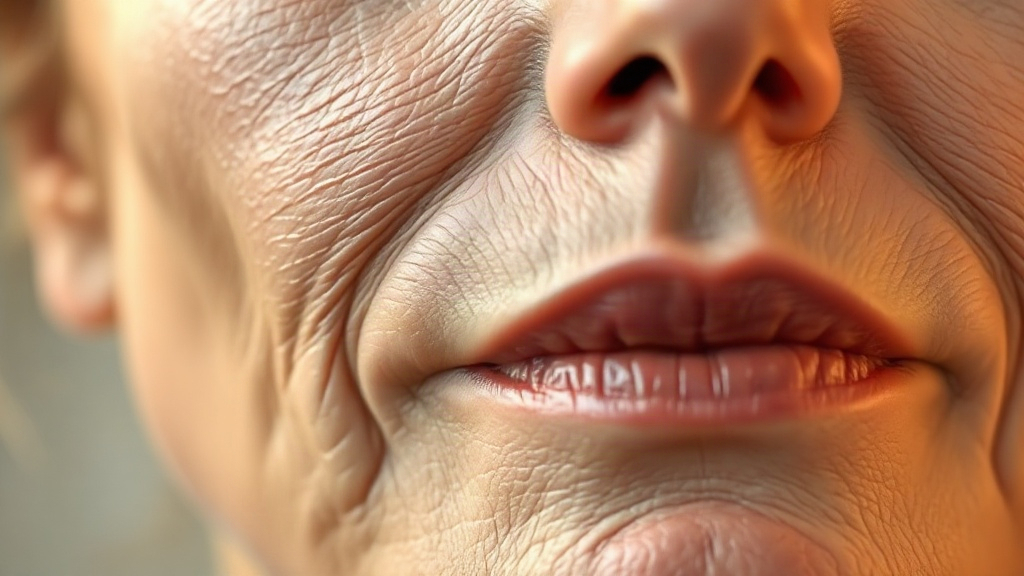
Wrinkle causes are far more about six daily, measurable exposures than about genetics. Dermatology and epidemiology cohorts have quantified their impact on facial skin: sun exposure, smoking, sugar, sleep, pollution and alcohol. This piece details the underlying biological mechanisms and the science backed benchmarks, without promising rejuvenation, only levers to slow down what can be slowed.
In brief – Wrinkles are skin folds that result from the progressive breakdown of collagen and elastin in the dermis. Six documented wrinkle causes speed up their appearance: sun exposure (UV), smoking, excess sugar (glycation), poor sleep, air pollution and alcohol. Each acts through a distinct mechanism, enzymatic collagen breakdown, stiffening of skin fibers, oxidative stress or low grade inflammation, but all converge on the same cellular process: senescence of dermal fibroblasts, which lose their ability to produce new collagen and instead secrete enzymes that destroy what remains. Limiting these exposures does not erase wrinkles that have already formed, but it measurably slows their progression.
Definition: What Exactly Are Wrinkles?
A wrinkle is a visible fold in the skin that forms when the dermis loses its ability to resist repeated pulling and compression. Dermatologists distinguish expression wrinkles, tied to facial muscle movement (forehead, crow’s feet, glabella), from static folds, present at rest, which reflect a structural loss in the dermis rather than simple muscle contraction. With age, both types coexist: the first, repeated over years, eventually etch themselves into a dermis that is already weakened.
The dermis loses about 1% of its collagen per year starting in a person’s thirties, according to structural dermatology research. This reference figure underlies any discussion of how external factors accelerate the process.
Mechanism: Why Skin Loses Its Firmness
Three dermal structures govern how wrinkles appear: collagen (resistance), elastin (flexibility) and hyaluronic acid (hydration). Their breakdown follows several distinct biological pathways that converge on the same visible result.
- Enzymatic breakdown: matrix metalloproteinases (MMPs) cut collagen and elastin fibers; their activity rises sharply with UV exposure and smoking.
- Glycation: excess glucose and fructose bind to dermal proteins and form advanced glycation end products (AGEs), which stiffen collagen and make it brittle.
- Oxidative stress: free radicals generated by pollution, alcohol and smoking damage the DNA and membranes of fibroblasts, the cells that manufacture collagen.
- Cellular senescence: damaged fibroblasts stop dividing but remain active, secreting inflammatory cytokines and degrading enzymes, a phenomenon called the senescence associated secretory phenotype (SASP).
A 2023 review of dermal fibroblast senescence (Zhang et al., Aging Cell) describes this mechanism as the common crossroads where most of the wrinkle causes below converge.
The Science: 6 Proven Wrinkle Causes
The following six factors have published data behind them, each with an identified mechanism and, for most, a measured effect on human skin.
Sun exposure (UV). UV radiation triggers expression of the metalloproteinases MMP-1, MMP-3 and MMP-9 in the epidermis and dermis from the very first repeated exposures, breaking down collagen faster than the skin can rebuild it (Quan et al. 2009, J Invest Dermatol Symp Proc). It is the best documented factor in what is called “extrinsic” skin aging.
Smoking. A study comparing smokers and nonsmokers found that pronounced facial wrinkles are significantly more common among smokers, even at the same age (Aizen & Gilhar 2001, Int J Dermatol). Smoking reduces blood flow to the skin’s capillaries and raises the same MMPs triggered by UV.
Sugar and glycation. Circulating glucose and fructose bind to collagen and elastin to form AGEs, rigid cross links that break down the dermis’s elasticity; this process accelerates under sun exposure (Chen et al. 2022, Front Med).
Poor sleep. A study of 60 women compared good and poor sleepers (5 hours or less versus 7 to 9 hours): the intrinsic skin aging score was twice as high among poor sleepers, who also recovered more slowly from sunburn (Oyetakin-White et al. 2015, Clin Exp Dermatol).
Air pollution. A cohort of 400 women aged 70 to 80 found a link between exposure to traffic related soot particles and signs of extrinsic skin aging, pigment spots foremost among them (Vierkötter et al. 2010, J Invest Dermatol).
Alcohol. A Mendelian randomization study of roughly 16700 people examined the link between alcoholic drink consumption and facial aging, a method that limits the confounding bias typical of standard observational studies (2024 Mendelian randomization study, J Cosmet Dermatol).
Sun exposure remains, according to the World Health Organization, the most avoidable cause of premature skin aging in the general population, a point worth repeating for anyone weighing which habit to change first (WHO fact sheet on ageing and health).
In Practice: Comparing the 6 Wrinkle Causes
The table below ranks the six factors by their dominant mechanism, to help prioritize the changes that pay off the most.
| Factor | Main mechanism | Practical lever |
|---|---|---|
| Sun exposure | MMP activation, collagen breakdown | Daily sun protection, avoid the sun between noon and 4 pm |
| Smoking | Reduced skin blood flow, MMPs | Quitting smoking (benefits measurable within months) |
| Excess sugar | Glycation, collagen stiffening | Limit added and fast absorbing sugars |
| Insufficient sleep | Slower skin repair, oxidative stress | 7 to 9 hours of regular sleep |
| Air pollution | Oxidative stress, fine particles | Evening skin cleansing, indoor air purification |
| Alcohol | Dehydration, liver and skin oxidative stress | Moderating consumption |
For the cellular mechanism common to all six factors, the cellular senescence pillar page explains how damaged cells keep fueling tissue inflammation. Smoking also affects other organs: the article Smoking: 10 Years of Life Lost, How to Regain Them quantifies its overall impact on life expectancy. On the protein structure targeted by glycation, the article Collagen: What Science Really Says offers further reading.
Protocol: Habits That Slow Down Wrinkles
No single habit erases wrinkles that have already formed; the realistic goal is to slow the ongoing breakdown and limit these cumulative wrinkle causes.
- Apply sun protection every day, even in overcast weather, on the face and neck.
- Cut back on smoking: benefits to skin blood flow appear within a few weeks of quitting.
- Limit added sugars and ultra processed foods, the main contributors to glycation.
- Keep a steady sleep schedule of 7 to 9 hours, avoiding chronically short nights.
- Cleanse the skin in the evening to remove pollution particles accumulated during the day.
- Moderate alcohol intake, which dehydrates the dermis and amplifies oxidative stress.
These habits act on extrinsic aging, the avoidable share of the process. Intrinsic aging, tied to chronological age and genetics, remains fixed: no product or protocol reverses it, and any claim to the contrary deserves skepticism.
Frequently Asked Questions About Wrinkles
How does sugar contribute to wrinkles?
Excess glucose and fructose bind to collagen and elastin in the dermis to form advanced glycation end products (AGEs). These cross links stiffen the fibers and reduce their natural elasticity. The process speeds up under sun exposure, which explains why a diet rich in fast absorbing sugars worsens wrinkles already encouraged by the sun.
Why does poor sleep speed up skin aging?
During deep sleep, skin repairs damage accumulated during the day and regulates its collagen production. A study of poor quality sleepers measured a skin aging score twice as high as that of good sleepers, along with slower recovery after skin damage such as sunburn.
What is the difference between expression wrinkles and static wrinkles?
Expression wrinkles appear only during facial muscle movement, such as on the forehead or around the eyes. Static wrinkles remain visible at rest and reflect a structural loss of collagen and elastin in the dermis. Over time, expression wrinkles, repeated again and again, become one of the wrinkle causes etched permanently into skin that is already weakened.
Does smoking cause wrinkles even after quitting?
Wrinkles that have already formed from smoking do not disappear once someone quits. Quitting does stop the process from worsening, though, by halting the drop in skin blood flow and the activation of collagen degrading enzymes, which slows the rest of the process.
Does air pollution cause wrinkles?
A cohort of 400 women found a link between exposure to fine particles from road traffic and signs of extrinsic skin aging, with a stronger effect on pigment spots than on wrinkles themselves. The mechanism at work is oxidative stress that fine particles generate in dermal cells.
Medical disclaimer. The information provided here is for informational purposes only and does not constitute medical advice. It does not replace a consultation. Ask a healthcare professional before changing your diet, taking dietary supplements or starting a new practice, especially if you have a medical condition, are pregnant or are under treatment. Dietary supplements do not replace a balanced diet or medical follow-up.