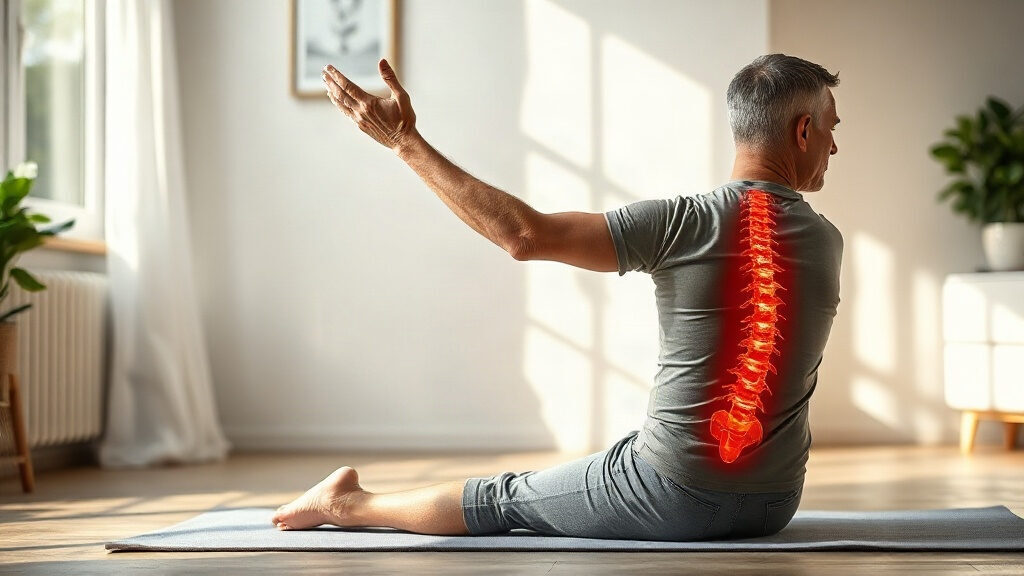
A herniated disc mostly affects adults between 40 and 60, when the discs between the vertebrae progressively lose their water content. It most often occurs in the lower back, after a lifting effort, a twisting movement, or sometimes with no identifiable cause. Understanding why the risk rises after 40 helps adjust daily habits before pain sets in.
In brief – A herniated disc is a bulge of the soft core of a spinal disc through its fibrous outer ring, which can compress a nerve root and cause radiating pain (sciatica or femoral neuralgia). It most often affects the lower lumbar spine (L4-L5, L5-S1) and becomes more common after 40, when discs dehydrate and lose elasticity. A meta-analysis of 11 cohorts shows that 66.66% of them resorb spontaneously without surgery. The best-documented prevention habits are strengthening the deep trunk muscles, quitting smoking (a confirmed recurrence factor), a lifting technique that keeps the back straight with bent knees, and staying physically active rather than resting strictly.
Definition: What Is a Herniated Disc?
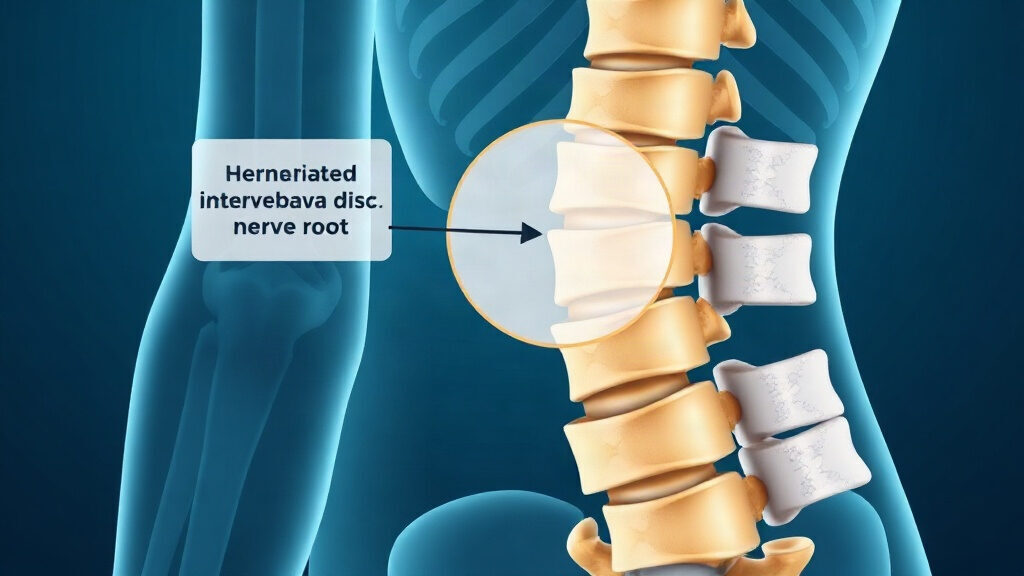
Each spinal disc is made up of a gel-like core, the nucleus pulposus, surrounded by a fibrous ring, the anulus fibrosus. A herniated disc forms when this core pushes through a crack in the ring and bulges outward. Depending on its extent, doctors distinguish protrusion (a contained bulge), extrusion (the core breaks through the ring), and sequestration (a fragment fully separates).
Compression or inflammation of a nearby nerve root explains the pain that radiates down the leg (sciatica) or along the front of the thigh (femoral neuralgia). Not every case causes pain: some are discovered by chance on imaging, with no symptoms at all.
Why the Risk Increases After 40
Disc degeneration accelerates from the forties onward because cells in the nucleus pulposus progressively enter senescence. A 2023 review published in Frontiers in Pharmacology describes a close relationship between the buildup of senescent cells in the disc core and the progression of its degeneration: these cells stop dividing but remain active and secrete enzymes that break down the surrounding matrix, worsening the disc’s loss of height and hydration (Xu et al. 2023, Frontiers in Pharmacology).
Other factors speed up this disc aging or raise the risk of recurrence:
- Smoking, linked to a recurrence risk nearly twice as high after a first episode.
- Repeatedly lifting heavy loads while twisting, especially bending from the back rather than the knees.
- Prolonged sedentary behavior, which weakens the trunk’s stabilizing muscles.
- Diabetes, which impairs microvascular flow and nutrition to the disc.
- Genetics, which accounts for part of the individual variability under similar lifestyles.
What the Science Shows
Most herniated discs improve on their own without surgery. A meta-analysis pooling 11 cohorts reports an overall spontaneous resorption rate of 66.66%: the herniated fragment is progressively broken down by immune cells and then reabsorbed, a mechanism that explains why so many patients improve with conservative treatment alone (Zhong et al. 2017, Pain Physician).
When pain persists despite several weeks of conservative treatment, the SPORT trial compared surgery with nonoperative treatment in 501 patients who were candidates for discectomy. At 2 years, the bodily pain score improved by 10.2 points more in the surgery group, and the physical function score by 12 points more, a gap already visible at 3 months (Weinstein et al. 2006, JAMA). Both groups improve: surgery speeds up and amplifies the result in well-selected patients, though this does not mean it is always necessary.
Smoking remains the most robust risk factor for recurrence after a first herniated disc: a meta-analysis of 17 studies links it to an odds ratio of 1.99, ahead of pre-existing disc protrusion (OR 1.79) and diabetes (OR 1.19) (Huang et al. 2016, Medicine). MedlinePlus notes that chronic back pain is frequently linked to irreversible breakdown of the spinal discs, which then stop cushioning the spine the way they should, with roughly 40% of chronic back pain cases tied to this degeneration (MedlinePlus, herniated disk).
In Practice: Which Approach Depending on the Situation
When this condition is suspected or confirmed, the approach depends on symptom intensity and how it evolves over time. The table below summarizes the three main options and their typical indications.
| Approach | Timing | What the data show | When to consider it |
|---|---|---|---|
| Conservative treatment (adapted activity, physical therapy, strengthening) | From the first symptoms | Spontaneous resorption in about 2 out of 3 cases | Moderate pain, no severe neurological deficit |
| Targeted injection or medication | After a few weeks without improvement | Temporary relief to support rehabilitation | Pain persisting despite conservative treatment |
| Surgery (discectomy) | After conservative treatment fails, or urgently if severe deficit | Faster, larger improvement at 2 years in the SPORT trial | Prolonged disabling pain, motor deficit, cauda equina syndrome |
Progressive muscle strengthening remains central to both prevention and recovery: our guide to strength training after 50 details a safe progression for rebuilding the abdominal and lower back muscles. Preserving joint mobility matters just as much, as shown in our article on freedom of movement. The link between disc degeneration and general joint aging is also documented in our feature on osteoarthritis and longevity, and the muscle loss that weakens back support is detailed in our article on muscle loss after 40.
Protocol: The Essential Habits After 40
Preventing a herniated disc or avoiding a recurrence relies on simple adjustments repeated daily, rather than a one-time program.
- Bend the knees and keep the back straight when lifting a load, never bending forward from the torso.
- Strengthen the deep trunk muscles two to three times a week (core bracing, lumbar stability exercises).
- Avoid prolonged sitting without a break: stand up and walk every 45 to 60 minutes.
- Quit smoking, one of the most solidly established recurrence factors in the literature.
- Maintain a stable weight to limit repeated mechanical load on the lumbar discs.
- Resume gradual physical activity as soon as acute pain eases, rather than prolonging strict rest.
Frequently Asked Questions
Can a herniated disc heal without surgery?
Yes, in most cases. A meta-analysis of 11 cohorts reports spontaneous resorption in 66.66% of patients, with the herniated fragment progressively broken down and cleared by immune cells. Surgery remains reserved for persistent disabling pain or neurological deficits.
What are the first warning signs in the lower back?
Lower back pain that radiates to the buttock and then the leg, sometimes down to the foot, suggests involvement of the sciatic nerve. Tingling, numbness, or muscle weakness in the leg should be taken seriously and warrant a prompt consultation.
Is strict rest recommended after this diagnosis?
No. Current recommendations favor a gradual return to movement as soon as acute pain allows. Strict, prolonged rest delays muscle recovery and does not speed up resorption of the disc fragment.
Does smoking really influence herniated disc risk?
Yes. A meta-analysis of 17 studies links smoking to an odds ratio of 1.99 for recurrence after a first episode, making it one of the best-documented modifiable risk factors, ahead of diabetes or pre-existing disc protrusion.
At what age does herniated disc risk really start to increase?
The risk climbs mainly between 30 and 50, a period when discs lose water and the buildup of senescent cells in the disc core accelerates. After 60, already very dehydrated discs become paradoxically less likely to herniate outright, even though spinal osteoarthritis takes over as a cause of pain.
Medical disclaimer. The information provided here is for informational purposes only and does not constitute medical advice. It does not replace a consultation. Ask a healthcare professional before changing your diet, taking dietary supplements or starting a new practice, especially if you have a medical condition, are pregnant or are under treatment. Dietary supplements do not replace a balanced diet or medical follow-up.