Alcohol is one of the most widely consumed psychoactive substances in the world, and its effects on the liver and arteries begin with the first drink, not only after heavy excess. In France, roughly 41,000 deaths a year are attributed to alcohol consumption, nearly 9,900 of them linked to cardiovascular disease. Below are the mechanisms at work in the liver and the cardiovascular system, what the reference studies on alcohol show, and the research backed thresholds worth knowing.
In brief – Alcohol is a hepatotoxic substance whose breakdown produces acetaldehyde, a carcinogenic compound that directly damages liver cells and the arterial wall. Contrary to the popular belief in a protective effect of red wine, Mendelian randomization studies show that no dose is associated with a net cardiovascular benefit: the risk of cirrhosis, high blood pressure and stroke rises in an almost linear fashion with the amount consumed. An analysis of nearly 600,000 drinkers places the threshold of minimal all cause mortality risk at around 100 g of pure ethanol per week, roughly 12 standard drinks. Cutting back, even moderately, measurably lowers blood pressure within a few weeks.
What is alcohol and how does it act in the body?
The ethanol in drinks is metabolized by the liver in two steps: alcohol dehydrogenase (ADH) first converts it into acetaldehyde, then aldehyde dehydrogenase (ALDH2) turns this toxic compound into acetate, which the body eliminates. This process draws primarily on liver enzymes, which explains why the liver absorbs most of the damage before other organs are even exposed. Acetaldehyde is classified as a Group 1 carcinogen by the International Agency for Research on Cancer: it forms adducts on DNA and cellular proteins, a genotoxic mechanism that affects hepatocytes as much as the cells lining blood vessel walls.
A standard drink delivers about 10 g of pure alcohol in France (roughly 0.35 oz), whatever the beverage: serving sizes are adjusted to the alcohol content to keep that amount constant.
| Drink | Standard volume | Average strength |
|---|---|---|
| Beer | 25 cl (8.5 fl oz) | 5% |
| Wine | 10 cl (3.4 fl oz) | 12% |
| Champagne | 10 cl (3.4 fl oz) | 12% |
| Whisky, vodka, spirits | 3 cl (1 fl oz) | 40% |
The liver: from fatty change to cirrhosis
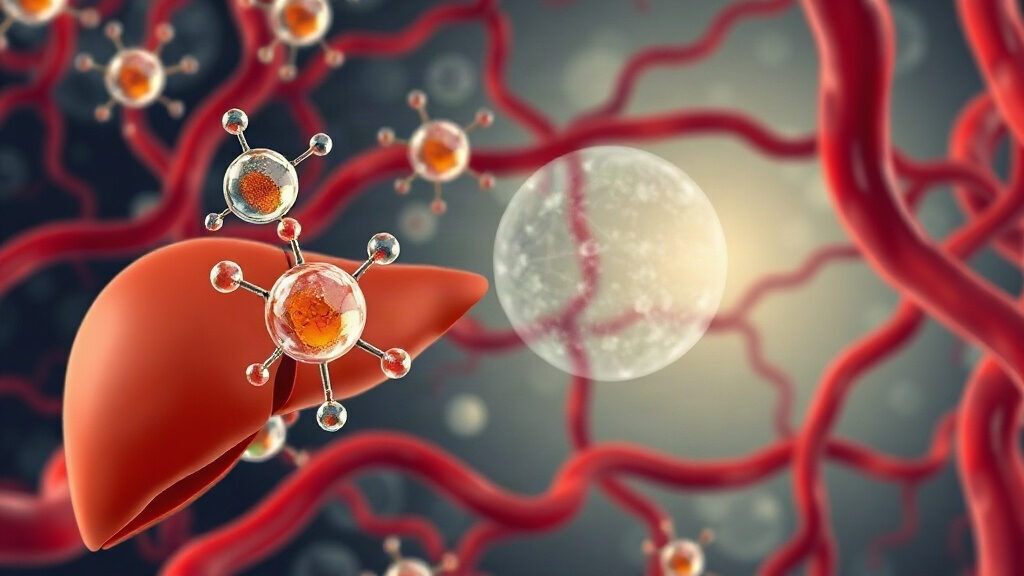
Regular alcohol consumption triggers a cascade of progressive liver injury, described by Osna, Donohue and Kharbanda in Alcohol Research: fat accumulates in hepatocytes (steatosis, reversible after a few weeks of abstinence), then inflammation sets in (alcoholic hepatitis), followed by fibrosis and finally cirrhosis, when scar tissue permanently replaces functional tissue (Osna et al., 2017). Three cellular mechanisms drive this progression:
- Oxidation of ethanol generates free radicals that damage hepatocyte membranes and deplete antioxidant glutathione reserves.
- Acetaldehyde activates Kupffer cells, the liver’s resident macrophages, which release pro-inflammatory cytokines such as TNF-alpha and IL-6.
- Chronic inflammation stimulates hepatic stellate cells, which drive the excess collagen production behind fibrosis.
Once cirrhosis has set in, five year survival ranges between 20% and 60% depending on the stage and whether drinking continues, according to the NIAAA’s overview of alcohol’s effects on the body (NIAAA).
The arteries: the end of the protective wine myth
For a long time, moderate alcohol consumption was presented as cardioprotective, based on observational studies skewed by the fact that non-drinkers often included former drinkers who were already unwell. Mendelian randomization studies, which use a genetic variant (rs1229984 in the ADH1B gene) associated with naturally lower drinking, avoid this bias. Among 261,991 people of European ancestry, carriers of this variant drank 17.2% less and had a 10% lower risk of coronary heart disease and a 17% lower risk of ischemic stroke, a result consistent with a causal effect of reduced consumption rather than a benefit of alcohol itself (Holmes et al., 2014).
On the arteries, three effects are documented: a dose dependent rise in blood pressure, progressive stiffening of the arterial wall linked to oxidative stress, and a higher risk of heart rhythm disorders. A meta-analysis of 13 studies covering 645,826 participants links high consumption to a 30% higher risk of atrial fibrillation compared with abstinence, with a more pronounced effect in men (Zhang et al., 2022).
What the science says about risk thresholds
The Global Burden of Disease Study, covering 195 countries between 1990 and 2016, concludes that the level of consumption that minimizes overall loss of health, across all causes and cancers, is zero drinks (GBD 2016 Alcohol Collaborators, 2018). A pooled analysis of 599,912 current drinkers across 83 prospective studies nonetheless places the threshold at which all cause mortality risk accelerates markedly at around 100 g per week, with a linear relationship between dose and stroke risk: each additional 100 g per week raises that risk by 14% (Wood et al., 2018). Above 350 g per week, lost life expectancy is estimated at 4 to 5 years compared with consumption below that threshold.
On blood pressure specifically, a meta-analysis of 36 randomized trials (2,865 participants) shows that halving an initial intake of six or more drinks a day lowers systolic pressure by 5.5 mmHg and diastolic pressure by 4 mmHg within a few weeks; below two drinks a day, the effect of a further reduction becomes statistically non-significant (Roerecke et al., 2017).
In practice: consumption guidelines and warning signs
Public health authorities in France recommend the “0, 2, 10” rule: no more than two drinks a day, not every day, and a maximum of ten drinks a week, with alcohol-free days built in. This threshold is not a “no risk” level, but a compromise between social enjoyment and reduced risk, in line with the NIAAA’s guidance on alcohol and health (alcohol’s effects on the body). Liver and cardiovascular risk does not depend on total volume alone: frequency matters as much as quantity, since the same total consumed in one evening (binge drinking) is more damaging to the arterial wall than the same amount spread across the week.
| Consumption level | Impact on the liver | Cardiovascular impact |
|---|---|---|
| Abstinence | No alcohol related liver risk | Lowest baseline for blood pressure and heart rhythm |
| 1 to 2 drinks/day, with alcohol-free days | Rare, reversible steatosis with occasional abstinence | Measurable but low hypertension risk |
| 3 to 6 drinks/day | Frequent steatosis, risk of alcoholic hepatitis | Significant rise in blood pressure |
| More than 6 drinks/day or repeated binge drinking | High risk of alcohol related fibrosis and cirrhosis | Sharp rise in atrial fibrillation and ischemic stroke |
The link between alcohol and cholesterol or blood pressure fits into a broader set of markers worth tracking: our article on blood pressure and the one on cholesterol help place these thresholds within the bigger picture of cardiovascular risk. For liver health, choline plays a complementary role documented in our article on choline, the brain and the liver.
Protocol: reducing the impact on the liver and arteries
Cutting back on drinking produces measurable effects within a few weeks, well before complete cessation. A few levers backed by the research cited above:
- Introduce at least two alcohol-free days a week, which gives the liver time to draw on its capacity for regeneration.
- Avoid binge drinking: spreading the same amount of alcohol across several days markedly reduces the impact on the arterial wall compared with a concentrated intake.
- Monitor blood pressure if consumption exceeds two drinks a day, since the drop in pressure after cutting back is documented within a few weeks.
- Pair reduced drinking with a diet rich in antioxidants and choline, which supports the liver’s detoxification capacity without substituting for cutting consumption itself.
These measures do not replace medical follow-up for consumption that has already been established for several years: a liver enzyme (transaminase) blood test and a liver ultrasound remain the only reliable tools for assessing the true state of the liver.
Frequently asked questions
Is there a level of alcohol with no health risk at all?
No. The Global Burden of Disease Study, conducted across 195 countries, concludes that the level that minimizes overall loss of health is zero drinks. The risk of cancer and cardiovascular disease rises from the very first dose, even though its size remains small at the lowest consumption levels compared with high levels.
Does red wine really protect the heart?
Mendelian randomization studies, which avoid the biases of observational research, do not confirm this protective effect. A reduction in consumption, even among moderate drinkers, is associated with a lower risk of coronary heart disease and ischemic stroke, which runs counter to the idea of a benefit specific to alcohol.
How long does the liver need to recover after cutting back on drinking?
Fatty liver, the first stage of alcohol related injury, generally regresses within a few weeks of abstinence or a significant reduction. More advanced stages, alcoholic hepatitis and fibrosis, require medical follow-up and a longer recovery, sometimes only partial depending on how long the damage has been present.
Is binge drinking more dangerous than an equivalent amount spread over time?
Yes, for the arteries in particular. Concentrating several drinks into one evening produces sharper spikes in acetaldehyde and blood pressure than the same amount spread across the week, which explains the link between heavy occasional drinking and atrial fibrillation risk.
What is the difference between steatosis, alcoholic hepatitis and cirrhosis?
These are three successive stages of the same process. Steatosis is a reversible buildup of fat, alcoholic hepatitis adds active tissue inflammation, and cirrhosis marks the permanent replacement of functional liver tissue by fibrous scar tissue, with five year survival varying widely by stage.
Medical disclaimer. The information provided here is for informational purposes only and does not constitute medical advice. It does not replace a consultation. Ask a healthcare professional before changing your diet, taking dietary supplements or starting a new practice, especially if you have a medical condition, are pregnant or are under treatment. Dietary supplements do not replace a balanced diet or medical follow-up.