Taurine is a sulfur-containing amino acid found in meat, fish and some energy drinks, and produced by the liver from cysteine. In June 2023, a study published in Science proposed that its decline drives aging in mice and monkeys, before a 2025 study contradicted that finding in humans. Here is what the evidence actually shows, species by species.
In brief – Taurine is a sulfur-containing amino acid synthesized by the liver and supplied by animal foods, involved in mitochondrial function, cellular calcium regulation and antioxidant defense. A landmark 2023 study in Science found that a decline in circulating taurine accompanies aging in mice, monkeys and humans, and that supplementation extends average lifespan by 10 to 12% in mice and improves several health markers in rhesus monkeys. A 2025 study of 137 men aged 20 to 93, however, found no link between circulating taurine and age, weakening its status as a universal biomarker of human aging. Clinical trials in humans, particularly in heart failure, remain limited and inconclusive.
Definition: what is taurine?
Taurine is a non-proteinogenic, sulfur-containing amino acid: it circulates freely in the body without being incorporated into proteins. The liver synthesizes it from two precursors, cysteine and methionine, with vitamin B6 as a cofactor, and diet provides a direct supplement through meat, fish, seafood and, in concentrated form, energy drinks.
It concentrates mainly in tissues with high metabolic activity: the heart, skeletal muscle, retina, brain and mitochondria. This distribution explains why its decline has been linked to the effects of aging in the animal models studied so far.
Mechanism: how does taurine act on cells?
Unlike most amino acids, it is not used as a building block for proteins, but acts as a cellular regulator, with several distinct functions documented in the literature:
- Modification of mitochondrial transfer RNAs, a step required for the correct synthesis of respiratory chain proteins: its severe deficiency is implicated in rare mitochondrial diseases such as MELAS syndrome.
- Stabilization of intracellular calcium in cardiac and skeletal muscle, with a role in muscle contraction.
- Conjugation of bile acids in the liver, which aids fat digestion.
- Cellular osmoregulation, particularly in the retina and brain.
- Indirect limitation of mitochondrial free radical production.
It is this close relationship with the mitochondria that led researchers toward the hypothesis that this compound plays a role in cellular aging.
What the science says about taurine and longevity
The study that sparked interest in taurine dates from June 2023. Published in Science, it reported that its circulating concentration declines with age in mice, monkeys and humans, and that restoring this level through supplementation increases both lifespan and healthspan in several species (Singh et al., 2023). The proposed mechanisms overlap with several known drivers of cellular aging: reduced senescence, protection against telomere shortening, and attenuation of mitochondrial dysfunction and chronic low-grade inflammation.
| Species studied | Observed effect |
|---|---|
| Roundworm (C. elegans) | Increased lifespan with supplementation |
| Female mice | +12% average lifespan |
| Male mice | +10% average lifespan |
| Middle-aged rhesus monkeys (6 months) | Less weight gain, reduced fasting glucose, improved bone density |
| Humans, aged 20 to 93 (n=137) | No association between circulating levels and age |
This last result has been directly challenged in humans. A 2025 study in Aging Cell, involving 137 men aged 20 to 93, found no association between circulating levels and age, muscle mass, strength, physical performance or mitochondrial function (Marcangeli et al., 2025). The authors conclude that, based on current data, it cannot be considered a reliable biomarker of human aging.
Clinically, human trials remain old and small in scale. A systematic review of eleven supplementation studies in heart failure patients found no significant effect on ejection fraction across causes, while noting isolated positive signals on exercise capacity in some small trials (McGurk et al., 2022). No large controlled trial has yet tested this effect on human longevity.
In practice: where to find taurine, and should you supplement?
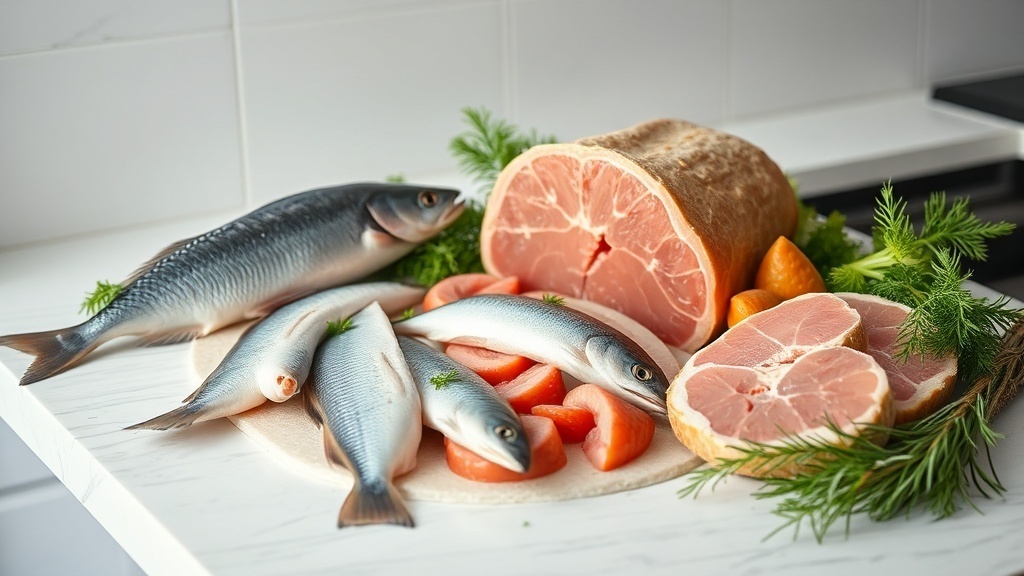
A healthy body synthesizes its own taurine from cysteine, with vitamin B6 as a cofactor; an outright deficiency remains rare in omnivorous adults. Diet provides a variable supplement depending on the source, summarized in the table below.
| Source | Content | Note |
|---|---|---|
| Seafood (mussels, oysters, scallops) | High | Among the most concentrated sources |
| Fish (tuna, salmon, mackerel) | Moderate to high | Varies by species and cooking method |
| Meat and poultry | Moderate | More present in dark meat (thighs, organ meats) |
| Energy drinks | Isolated concentrated dose (about 1 g per can) | A one-off intake, not comparable to a food source |
| Plant-based foods | Virtually none | It is absent from the plant kingdom |
Strict vegan diets therefore provide no dietary taurine, but endogenous liver synthesis generally compensates in healthy adults. No data currently support recommending systematic supplementation for longevity purposes: the 2023 study remains preliminary in humans, and its main biomarker finding was challenged two years later (Marcangeli et al., 2025). To place this topic within a broader view of cellular energy, our mitochondrial dysfunction pillar details the other mechanisms at play, and our article on MCT oil covers another nutritional lever targeting the same energy pathway. Our feature on spermidine and longevity presents a comparable candidate, with an equally preliminary level of human evidence.
Protocol: what human trials show, and precautions
Published clinical trials to date have tested taurine doses ranging from 500 mg to 6 g per day, over periods of two to forty-eight weeks, mainly in heart failure patients (McGurk et al., 2022). None of these protocols targeted longevity in a healthy general population, which limits their direct applicability.
- In adults without a medical condition, a varied diet including fish and seafood covers most needs, with no demonstrated need for supplementation.
- Available human data concern specific populations (heart failure, endurance exercise) and do not allow an anti-aging effect to be extrapolated to the general population.
- Kidney or liver impairment alters the metabolism of sulfur-containing amino acids: any supplementation should be discussed with a doctor in these situations.
- Energy drinks are not a recommended source: their caffeine and sugar content poses more risk than their taurine content offers benefit, according to the World Health Organization’s guidance on limiting added sugar intake.
Circulating taurine also rises after acute endurance exercise in humans, which partly explains athletes’ interest in this compound, without this proving any effect on longevity (Singh et al., 2023). Our overview of the omega-3 index presents another blood marker whose interpretation calls for the same methodological caution.
Frequently asked questions about taurine
What is taurine and what does it do?
Taurine is a non-proteinogenic, sulfur-containing amino acid synthesized by the liver from cysteine and supplied by animal foods. It plays a role in mitochondrial function, cellular calcium regulation, bile acid conjugation and protection against oxidative stress, with particularly high concentrations in the heart, muscle and retina.
Does taurine really slow aging?
A 2023 study published in Science showed that taurine supplementation extends lifespan in mice and improves several health markers in rhesus monkeys. A 2025 study, however, found no link between circulating levels and age in 137 men, which calls for caution about its relevance in humans.
What is the difference between taurine from food and from energy drinks?
Dietary taurine comes from fish, seafood and meat, in amounts that vary by source. Energy drinks provide a concentrated, isolated dose, about one gram per can, combined with caffeine and sugar. Health authorities do not flag a specific risk from this compound at these doses, but advise caution regarding the drink as a whole because of its sugar and caffeine content.
Should you take a taurine supplement for longevity?
No solid clinical data currently justify supplementation for longevity purposes in healthy adults. Existing trials have tested doses of 500 mg to 6 g per day in cardiac patients, with mixed results, and no large trial has tested this goal in the general population.
Who is at risk of taurine deficiency?
People following a strict vegan diet get no dietary taurine, since the molecule is absent from the plant kingdom, but their liver generally continues to synthesize it from cysteine. Patients with severe kidney or liver impairment may have disrupted metabolism of sulfur-containing amino acids, which should be monitored with a doctor.
Medical disclaimer. The information provided here is for informational purposes only and does not constitute medical advice. It does not replace a consultation. Ask a healthcare professional before changing your diet, taking dietary supplements or starting a new practice, especially if you have a medical condition, are pregnant or are under treatment. Dietary supplements do not replace a balanced diet or medical follow-up.