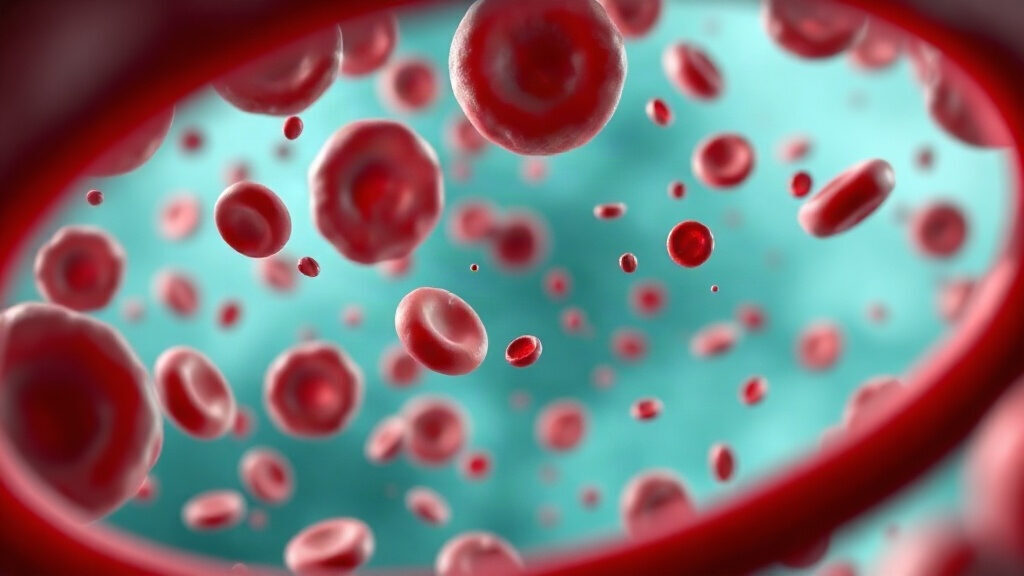
Your platelet count appears on every complete blood count (CBC), and most laboratories print the same reference range for everyone: 150 to 400 G/L (150,000 to 400,000 per microliter, the way US labs usually report it). Yet an Italian cohort of 40,987 people shows that women have more platelets than men from adolescence onward and that the count falls after 65. A result of 135 G/L therefore does not carry the same weight in a 75-year-old man as in a 30-year-old woman, and reading the number by age and sex is what tells you when it deserves a recheck.
In brief – Platelets are blood cell fragments that stop bleeding by forming the first plug over a break in a vessel wall, and the platelet count measures how many circulate in your blood. The standard laboratory range runs from 150 to 400 G/L, or 150,000 to 400,000 per microliter. Real values, however, depend on age and sex: among 40,987 Italians, the reference interval ran from 156 to 405 G/L in adult women and from 141 to 362 G/L in adult men, then from 140 to 379 G/L and from 122 to 350 G/L after 65. In the United States, women have on average 19 G/L more than men. A slightly low, stable count in an older man is often physiological. By contrast, a value below 100 G/L, above 400 G/L, or one that shifts markedly from one blood test to the next warrants medical advice. In large cohorts, both a low and a high platelet count are associated with higher mortality, without the count itself being the cause.
Platelet count: definition and normal range on a blood test
Platelets, also called thrombocytes, are small fragments without a nucleus that break off from large bone marrow cells called megakaryocytes. They measure 2 to 3 micrometers across, roughly a third the size of a red blood cell. Their main job is primary hemostasis: on contact with a damaged vessel, they stick to the wall, activate and then clump together to form what the National Heart, Lung, and Blood Institute describes as a “plug”, before coagulation strengthens the clot.
Their lifespan is short: about 7 days on average, which is why, as Cleveland Clinic explains, the body makes them continuously. The bone marrow has to produce billions of them every day to keep the count stable. On the lab report, the result is given in G/L (giga per liter, also written 109/L) or in thousands per mm³: 250 G/L means 250,000 platelets per microliter of blood.
The range used by almost every laboratory runs from 150 to 400 G/L, whatever the age and sex. Below 150 G/L, doctors speak of thrombocytopenia. Above 400 G/L, of thrombocytosis. These single cutoffs are convenient, but they wrongly flag some people as abnormal, especially older men.
How the body makes platelets and why their number changes with age
The number of platelets reflects a constant balance between production, storage and consumption. Each of these steps can move the number on your CBC:
- Production takes place in the bone marrow, where megakaryocytes, which derive from hematopoietic stem cells, split their cytoplasm into thousands of platelets.
- Thrombopoietin (TPO), a hormone made mainly by the liver, sets the output of this factory: chronic liver disease often lowers the count.
- The spleen permanently holds back a share of circulating platelets; an enlarged spleen traps more of them.
- Bleeding, a severe infection or the formation of clots uses up these cells faster than they are replaced.
- Inflammation stimulates production: in the Moli-sani cohort (18,097 adults), the count rose with white blood cells, CRP and D-dimers (Santimone 2011).
With age, the number of platelets declines slowly, but their behavior changes. In the main Italian reference study, the mean went from 252 G/L between 15 and 64 to 233 G/L after 64. Work by Davizon-Castillo and colleagues showed that platelets from frail older adults and from aged mice were more reactive and formed larger thrombi (Davizon-Castillo 2019, Blood). The culprit they identified is TNF-α, a molecule of the chronic inflammation linked to aging. In aged mice, the bone marrow also steered more of its stem cells toward the platelet lineage. This shift ties platelets to the hallmark of stem cell exhaustion: fewer in number, quicker to activate.
The gap between women and men appears around age 15 and lasts for life. The US NHANES survey found it even after accounting for iron deficiency and inflammation, which suggests a genetic or hormonal component that is still poorly understood.
Platelet count by age and sex: what the studies show
The best reference by age and sex comes from Biino and colleagues, who analyzed the blood counts of 40,987 Italians free of cancer, liver disease and inherited thrombocytopenia (Biino 2013, PLoS One). Counts were identical in boys and girls up to age 14. After that, women consistently had more. Between early childhood and old age, the decline reached 35% in men and 25% in women.
| Group | Age | Reference interval (G/L) | Difference from the 150-400 standard |
|---|---|---|---|
| Children, girls and boys | Under 15 | 176 to 452 | Higher ceiling: a count of 430 can be normal |
| Adult women | 15 to 64 | 156 to 405 | Close to the standard range |
| Adult men | 15 to 64 | 141 to 362 | Lower floor, lower ceiling |
| Older women | 65 and over | 140 to 379 | A count of 145 can be normal |
| Older men | 65 and over | 122 to 350 | A count of 130 is common and often physiological |
These figures match those of the US NHANES survey of 12,142 participants (Segal and Moliterno 2006). Women averaged 275 G/L versus 256 G/L for men. People aged 60 to 69 had 7 G/L less than young adults, and those aged 70 to 90 had 18 G/L less. Ancestry mattered too: a mean of 281 G/L in African Americans versus 260 G/L in Americans of European descent.
The number of platelets is also associated with survival. In the Moli-sani cohort, 21,563 adults were followed for 8.2 years on average (Bonaccio 2018, Platelets). A low count by age- and sex-specific cutoffs was associated with a 1.92-fold risk of death, even though 87.7% of these low values stayed above 100 G/L. A high count was not associated with any excess risk in this population.
In the oldest people, both extremes matter. Among 36,262 New York patients aged 65 and over, thrombocytopenia was associated with shorter survival (HR 1.45) and thrombocytosis even more so (HR 1.75) (Msaouel 2014, Haematologica). The Women’s Health Initiative found the same U-shaped curve in 159,746 postmenopausal women followed for 15.9 years (Kabat 2017).
| Study | Population | Main finding |
|---|---|---|
| Moli-sani, Bonaccio 2018 | 21,563 Italian adults, 8.2 years of follow-up | Low count for age and sex: mortality x 1.92; high count: no association |
| Bronx, Msaouel 2014 | 36,262 people aged 65 and over | Thrombocytopenia: HR 1.45; thrombocytosis: HR 1.75 |
| Women’s Health Initiative, Kabat 2017 | 159,746 postmenopausal women, 15.9 years of follow-up | Lowest and highest deciles associated with total, cardiac and cancer mortality |
| NHANES, Segal 2006 | 12,142 Americans | Women 275 G/L, men 256 G/L; 18 G/L lower after 70 |
These associations do not prove that platelets themselves shorten life. An abnormal count most often signals an underlying disease (liver, bone marrow, chronic inflammation, cancer) that on its own explains part of the excess risk.
Reading your platelet count in practice
A single out-of-range value should be rechecked before it is interpreted. The leading cause of a falsely low result is pseudothrombocytopenia: in the EDTA tube, platelets clump together and the analyzer fails to count the clumps. The laboratory spots it on a blood smear or repeats the count in a citrate tube. Context matters too: a recent infection, pregnancy or a medication can change the result for a few weeks.
| Platelet count | Medical term | What it most often means | Usual next step |
|---|---|---|---|
| Below 50 G/L | Marked thrombocytopenia | Higher bleeding risk, especially before surgery or another procedure | Prompt medical advice |
| 50 to 100 G/L | Moderate thrombocytopenia | Threshold used to diagnose immune thrombocytopenia (ITP) | Workup ordered by the doctor |
| 100 to 150 G/L | Mild thrombocytopenia | Often physiological in men over 65 if the number is stable | Recheck and comparison with earlier blood counts |
| 150 to 400 G/L | Laboratory standard range | Usual adult count | None |
| Above 400 G/L | Thrombocytosis | Iron deficiency, inflammation or infection in most cases | Search for the cause, repeat CBC |
| Above 400 G/L, persistent, no cause found | Unexplained thrombocytosis | May reveal a bone marrow disease or a cancer | In-depth workup, sometimes a hematologist’s opinion |
The 100 G/L threshold was set by an international working group to define ITP, an autoimmune disease in which the body destroys its own thrombocytes (Rodeghiero 2009, Blood). Low platelets sometimes show up as petechiae (tiny red dots on the legs), bleeding gums or unexplained bruising after 60, although such bruises have many other causes at that age.
A high count should first point to iron. In English general practice, iron deficiency was the new condition most often diagnosed after thrombocytosis: 4.5% of patients, a 4.9-fold higher risk (Clarke 2020). Measuring ferritin is therefore part of the basic workup. The same Exeter team also measured the link with cancer: in the year following thrombocytosis, 11.6% of men and 6.2% of women were diagnosed with cancer, mostly lung or colorectal (Bailey 2017). In men aged 60 and over, even “high normal” platelets (326 to 400 G/L) were followed by a cancer in 4.2% of cases (Mounce 2020).
Pregnancy lowers the count in a normal way. In 4,568 uncomplicated pregnancies, the mean went from 273 G/L outside pregnancy to 251 G/L as early as the first trimester, and 9.9% of women were below 150 G/L at delivery (Reese 2018, NEJM). Only 1.0% fell below 100 G/L, the threshold under which the authors recommend looking for another cause.
Platelets should always be read alongside the rest of the CBC. A drop combined with low hemoglobin points to anemia from a deficiency or to a bone marrow problem; a rise with high white blood cells and a high CRP points to inflammation.
| Cause | Effect on platelets | Clue on the blood test |
|---|---|---|
| Iron deficiency | Increase | Low ferritin, small red blood cells |
| Inflammation or infection | Temporary increase | High CRP and white blood cells |
| Spleen removal | Lasting increase | Known surgical history |
| Regular alcohol use | Decrease | Large red blood cells (high MCV), high GGT |
| Chronic liver disease | Decrease | Abnormal liver tests, enlarged spleen |
| Vitamin B12 or folate deficiency | Decrease | High MCV, often with anemia |
| Some medications (heparin, some antibiotics) | Decrease | Drop that started after treatment began |
| Pregnancy | Moderate decrease | Count rarely below 100 G/L |
Keeping your platelet count in range: practical advice
No daily habit has been shown to change the number of platelets in a healthy person. The useful levers are mostly about reading your results well and limiting whatever disrupts the bone marrow or fuels inflammation:
- Compare each result with your previous blood counts: a count stable at 135 G/L for ten years does not mean the same thing as a drop from 280 to 160 G/L in one year.
- Have an unusual number rechecked on a new blood sample, well clear of any infection, before drawing any conclusion.
- Tell your doctor about all your medications and supplements. Aspirin and clopidogrel do not lower the number of platelets: they reduce their ability to clump, which a normal count does not measure.
- Limit alcohol: regular drinking slows bone marrow production, and the count often recovers after stopping.
- Favor a Mediterranean-style diet. In Moli-sani, among 14,586 adults, those with the highest adherence were half as likely to belong to the group with the highest platelets (odds ratio 0.50) (Bonaccio 2014, Blood). This is an association, not a proven effect.
- Only correct an iron, vitamin B12 or folate deficiency after a blood test confirms it: taking iron blindly can delay the discovery of gastrointestinal bleeding.
- Seek prompt care if you notice tiny red dots on the skin, a prolonged nosebleed, bleeding gums or blood in the urine.
No food or supplement has been shown to raise the count in a healthy adult. True thrombocytopenia is managed by treating its cause, with a doctor, and never through self-medication.
Frequently asked questions about platelet count
What is a normal platelet count for a woman?
The laboratory range is 150 to 400 G/L for everyone. A study of 40,987 Italians suggests more precise cutoffs: 156 to 405 G/L in women aged 15 to 64, then 140 to 379 G/L after 65. Women have on average 19 G/L more than men, a gap that appears in adolescence and persists after menopause.
What is a normal platelet count for a man over 65?
In men aged 65 and over, the Italian reference interval runs from 122 to 350 G/L, compared with 141 to 362 G/L in younger men. A stable count around 130 G/L is therefore common at this age and often physiological. A rapid drop, a value below 100 G/L or unusual bleeding, however, warrants medical advice.
At what platelet count should you worry?
A count below 100 G/L or above 400 G/L always deserves medical advice, as does a clear change between two blood tests. Below 50 G/L, the risk of bleeding increases, especially before a procedure. Between 100 and 150 G/L, a simple recheck is often enough, comparing with earlier results and taking age and sex into account.
Why would platelets be high?
Thrombocytosis, above 400 G/L, is most often explained by iron deficiency, inflammation or a recent infection. In an English cohort of 39,850 patients, iron deficiency was the condition most often diagnosed afterward. A high, persistent count with no obvious cause calls for a workup, because it can reveal a bone marrow disease or a cancer.
Why do platelets fall during pregnancy?
During pregnancy, blood volume increases and some thrombocytes are used up in the placenta. In 4,568 uncomplicated pregnancies, the mean went from 273 to 251 G/L as early as the first trimester, and 9.9% of women were below 150 G/L at delivery. Below 100 G/L, another cause should be looked for.
Can diet raise your platelet count?
No food or supplement has been shown to increase platelets in a healthy person. When the count is low, the cause should be investigated with a doctor: vitamin B12 or folate deficiency, alcohol, a medication, liver disease or an autoimmune disease. Correcting a deficiency confirmed by a blood test can then bring the count back to normal.
Medical disclaimer. The information on this page is provided for informational purposes only and does not constitute medical advice. It does not replace a consultation. Ask a healthcare professional before changing your diet, taking dietary supplements or starting a new practice, especially if you have a medical condition, are pregnant or are under treatment. Dietary supplements do not replace a balanced diet or medical follow-up.