PRP injections use platelet-rich plasma, a preparation made from the patient’s own blood and offered in France by sports physicians, rheumatologists and dermatologists for arthritic knee pain, worn tendons or hair loss. The idea looks simple: concentrate the platelets and their growth factors, then place them where a tissue struggles to repair itself. Since 2010, however, randomized placebo-controlled trials have painted a nuanced picture that differs widely from one condition to the next.
In brief – PRP injections deliver platelet-rich plasma, a platelet concentrate obtained by spinning the patient’s own blood in a centrifuge, which releases growth factors meant to support tissue repair. Placebo-controlled trials give a mixed verdict. In knee osteoarthritis, the RESTORE trial (288 patients, 2021) found no difference in pain or cartilage volume at 12 months, and a 2025 meta-analysis from Lyon retained only a small benefit that fades after one year. For the Achilles tendon, two trials (54, then 230 patients) are negative. The most favorable signals concern lateral epicondylitis, or “tennis elbow,” and hair density, with modest effects. Preparations vary so much from one device to another that only 10% of orthopedic studies describe a reproducible protocol. PRP remains a second-line option, to be discussed after exercise and weight loss, which have the strongest evidence.
PRP injections: what platelet-rich plasma is
PRP refers to the fraction of blood plasma in which platelets have been concentrated, the cell fragments that trigger clotting and launch healing after an injury. The product is autologous: it comes from the blood of the person being treated, drawn a few minutes before the injection. It is neither a drug nor a stem cell therapy.
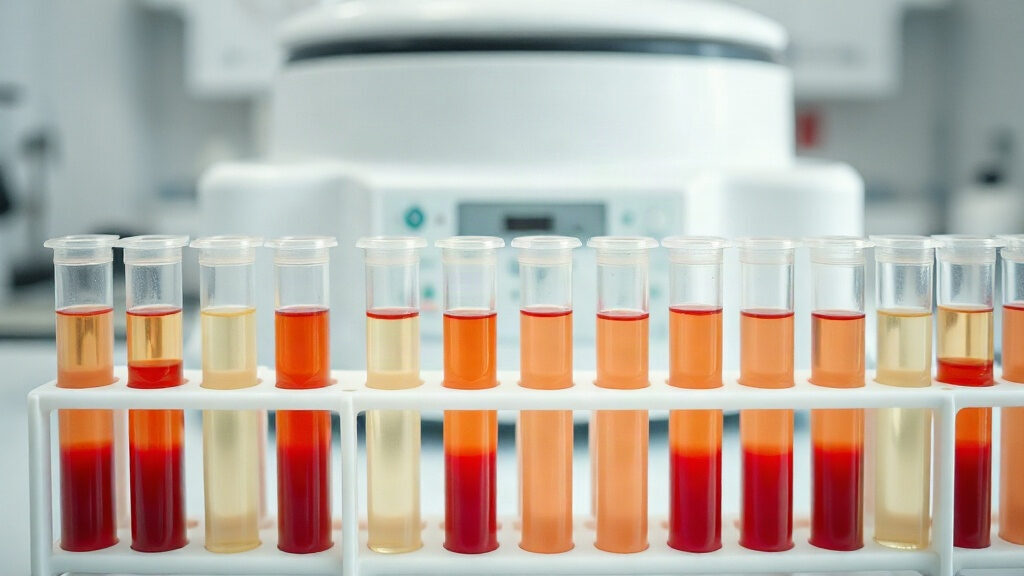
Preparation follows three steps. The clinician draws one or more tubes of blood, then places them in a centrifuge that separates the components by density. Red blood cells sink to the bottom of the tube, plasma stays on top, and the middle layer concentrates platelets and white blood cells. This fraction is drawn off and injected into the joint, the tendon or the scalp.
The same acronym actually covers very different products. The Cochrane review on soft tissue injuries stresses that preparation methods “vary and lack standardization” (Moraes et al., 2014). Two PRP injections given in two neighboring clinics can therefore contain amounts of platelets and leukocytes that bear no comparison.
Among the general public, the technique goes by other names: “plasma injection,” “enriched plasma,” or “vampire facial” when it is combined with facial microneedling. All these labels describe a variant of platelet-rich plasma, with the same questions about the evidence.
Mechanism: how PRP is supposed to work
PRP rests on a biological hypothesis: growth factors released by platelets would speed up the repair of a poorly vascularized tissue, such as a tendon or cartilage. Once activated, platelets empty their granules and release signaling proteins that recruit cells and stimulate matrix production. This chemical dialogue between cells belongs to a hallmark of aging we follow closely, altered intercellular communication.
The main messengers found in a platelet concentrate are well described in the lab:
- PDGF, platelet-derived growth factor, which attracts fibroblasts and makes them multiply;
- TGF-beta, which drives collagen production and modulates inflammation;
- VEGF, which promotes the formation of new small blood vessels;
- IGF-1, which supports the growth of cartilage and muscle cells;
- adhesion proteins such as fibronectin, which act as a temporary scaffold.
The step from test tube to patient remains the weak link. A systematic review of 105 orthopedic clinical studies published between 2006 and 2016 showed that only 11 of them (10%) described their preparation protocol precisely enough for another team to reproduce it. And 17 studies (16%) gave figures on the composition of the injected product (Chahla et al., 2017). Comparing trials often means comparing different products under the same name.
| Variable | Possible options | Why it matters |
|---|---|---|
| Leukocyte content | Leukocyte-poor or leukocyte-rich PRP | White blood cells add inflammatory molecules; in osteoarthritis, the leukocyte-poor form achieves better IKDC scores in a 2021 meta-analysis. |
| Platelet concentration | Varies with the kit and the centrifuge | Only 16% of studies measure the actual composition of the injected product. |
| Activation | Activated before injection or not activated | It determines when the growth factors are released. |
| Number of sessions | A single injection or a series of 2 to 4 | Schedules differ from one trial to another, which hampers comparisons. |
| Guidance | Located by palpation or under ultrasound | Guidance checks that the product actually reaches the targeted structure. |
What the studies really say about PRP injections
The most rigorous trials, run double-blind against a placebo injection, are mostly negative or modest. Two partial exceptions stand out: chronic lateral epicondylitis and hair density. The result depends above all on the comparator chosen, which explains the contradictory messages found online.
Knee osteoarthritis: an effect that depends on the comparator
Against placebo, PRP does no better at one year in the strongest trial. The Australian RESTORE trial assigned 288 people aged 50 and over, with mild to moderate medial knee osteoarthritis, to three weekly injections of a leukocyte-poor concentrate or three injections of saline (Bennell et al., 2021). At 12 months, pain had dropped by 2.1 points out of 10 in the treated group and by 1.8 points on placebo, a gap of 0.4 points judged not significant. Tibial cartilage volume had decreased by 1.4% versus 1.2%. Of 31 secondary outcomes, 29 showed no difference.
A meta-analysis led by the Hospices Civils de Lyon pooled 11 placebo-controlled trials, totaling 1,616 patients (Auroux et al., 2025). Pain was slightly lower in the treated groups at 3 months (a gap of 1.1 points out of 10) and at 6 months (2.0 points), with strong heterogeneity between studies. No benefit persisted at 12 months. The authors speak of “low efficacy” whose clinical relevance “is debatable.”
Against hyaluronic acid, the picture looks more flattering. A meta-analysis of 18 trials (811 patients on PRP, 797 on hyaluronic acid) reports a mean WOMAC score improvement of 44.7% with platelet-rich plasma versus 12.6% with hyaluronic acid (Belk et al., 2021). This comparator is itself weak: the 2019 American College of Rheumatology guideline notes that, in trials at low risk of bias, the effect of hyaluronic acid against saline “approaches zero.” Beating an almost inactive treatment does not demonstrate an efficacy of its own.
The same American guideline strongly recommends against PRP in knee and hip osteoarthritis, citing the heterogeneity of preparations and their lack of standardization (Kolasinski et al., 2020).
Tendons and muscles: placebo-controlled trials mostly negative
For the Achilles tendon, the two main randomized trials conclude there is no benefit. In chronic tendinopathy treated with eccentric exercises, 54 patients received either a PRP injection or saline: the VISA-A score improved by 21.7 points versus 20.5 points at 24 weeks (de Vos et al., 2010). The British PATH-2 trial then followed 230 adults after an acute Achilles tendon rupture (Keene et al., 2019). A central laboratory had verified that the injected concentrate was of good quality and rich in growth factors. At 24 weeks, calf strength reached 34.7% of the healthy side in the treated group versus 38.5% on placebo, with no significant difference.
Muscle did no better. In athletes with an acute hamstring injury, a PRP injection did not speed up return to play (Reurink et al., 2014). At one year, the risk of reinjury was not different either, with a hazard ratio of 0.89 and a confidence interval ranging from 0.38 to 2.13 (Reurink et al., 2015).
Lateral epicondylitis, or “tennis elbow,” gives the most positive signal. In a multicenter trial of 230 patients, all had a needle passed into the tendon, with or without a leukocyte-rich platelet concentrate (Mishra et al., 2014). At 12 weeks, pain fell by 55.1% versus 47.4%, a non-significant gap. At 24 weeks, the reduction reached 71.5% versus 56.1%, but only 119 patients were still being followed. A Dutch trial of 100 patients also compared PRP with an injected corticosteroid: at 2 years, the DASH function score had returned to its starting level with the corticosteroid, while it remained improved after the plasma (Gosens et al., 2011).
Taken together, the 2014 Cochrane review analyzed 19 small single-center trials, totaling 1,088 participants, across eight types of injury. It rates the quality of evidence as “very low” and finds no difference in function at 3, 6 or 12 months. Only a small short-term gain in pain appears, of 0.95 points out of 10, of “marginal” clinical interest according to the authors (Moraes et al., 2014).
Hair loss and the face: small samples and an infection risk
For androgenetic alopecia, PRP slightly increases hair density, in small samples. A meta-analysis of 9 randomized trials, totaling 238 patients, finds higher hair density than placebo at 3 and 6 months, but no difference in hair count or hair diameter (Zhang et al., 2023). In a New York trial of 35 participants, each half of the scalp received either PRP or saline (Shapiro et al., 2020). Density went from 151 to 171 hairs per square centimeter on the treated side, and from 151 to 167 on the placebo side, with no significant gap between the two areas.
For the face, controlled trials remain rare, and the main documented fact concerns safety. In New Mexico, US health authorities linked five HIV infections, diagnosed between 2018 and 2023, to “vampire facials” performed at an unlicensed spa that did not follow hygiene rules (Stadelman-Behar et al., 2024). The risk does not come from the plasma itself but from reused or poorly sterilized equipment.
| Condition | Reference study | Main result | Interpretation |
|---|---|---|---|
| Knee osteoarthritis, vs placebo | RESTORE, 2021 (288 patients) | Pain at 12 months: -2.1 vs -1.8 points; identical cartilage | No benefit shown at one year |
| Knee osteoarthritis, meta-analysis vs placebo | Auroux, 2025 (11 trials, 1,616 patients) | Pain gain of 1.1 to 2.0 points at 3 and 6 months, none at 12 months | Small, short-lived effect |
| Knee osteoarthritis, vs hyaluronic acid | Belk, 2021 (18 trials) | WOMAC improved by 44.7% vs 12.6% | Comparator itself barely active |
| Achilles tendinopathy | de Vos, 2010 (54 patients) | VISA-A +21.7 vs +20.5 points | No benefit |
| Achilles tendon rupture | PATH-2, 2019 (230 patients) | Calf strength 34.7% vs 38.5% of the healthy side | No benefit |
| Lateral epicondylitis | Mishra, 2014 (230 patients) | Pain -71.5% vs -56.1% at 24 weeks | Favorable signal, incomplete follow-up |
| Androgenetic alopecia | Zhang, 2023 (9 trials, 238 patients) | Density higher than placebo at 3 and 6 months | Modest effect, small samples |
| Face (“vampire facial”) | CDC, 2024 | 5 HIV infections linked to an unlicensed spa | Little evidence, risk when hygiene fails |
PRP injections in practice: when to bring them up
In practice, PRP is mainly worth discussing when lateral epicondylitis or knee osteoarthritis resists several months of well-conducted care, never as a first step. The American College of Rheumatology guideline puts at the top, with a strong rating, physical exercise, weight loss for people with overweight, tai chi, topical anti-inflammatories and corticosteroid injections. These options have been tested on thousands of patients.
The stakes are considerable for joint health over the years. According to the World Health Organization, 528 million people were living with osteoarthritis in 2019, including 365 million with knee involvement. The US National Institute of Arthritis and Musculoskeletal and Skin Diseases describes osteoarthritis as a disease that can damage every part of the joint, not just the cartilage. We detail the levers of prevention in our feature on osteoarthritis and longevity.
From a longevity standpoint, reading the trials leads to a concrete conclusion: the move with the best balance between evidence and risk is still movement itself. Cartilage feeds on cycles of compression and release, as we explain in our article on knee cartilage and exercise. For a painful tendon, progressive loading remains the foundation, described in our article on tendinitis. A PRP injection, if offered, complements this work and does not replace it.

| Option | ACR position (2019) | What the trials show | Point of caution |
|---|---|---|---|
| Exercise and strengthening | Strongly recommended | Benefit on pain and function, established by many trials | Requires regularity over several weeks |
| Weight loss for people with overweight | Strongly recommended | Benefit on pain and function in people with overweight | Lasting effort that needs support |
| Corticosteroid injection | Strongly recommended | Proven short-term efficacy | Effect wears off; limited number of injections |
| Hyaluronic acid | Conditionally recommended against | Effect close to zero against placebo in trials at low risk of bias | Frequent comparator in platelet-rich plasma studies |
| PRP | Strongly recommended against | No difference at 12 months against placebo in RESTORE | Preparations not standardized from one clinic to another |
Tips before getting PRP injections
A PRP injection should be prepared like any medical decision: knowing the precise diagnosis, the evidence available for that injury and the exact product that will be injected. Here are the points to check with the doctor who suggests it.
- Have the diagnosis confirmed by a clinical exam and, if needed, imaging, because results vary widely from one condition to another.
- Review the treatments already tried, especially rehabilitation and strengthening, over a long enough period.
- Ask what type of PRP will be used: leukocyte-poor or leukocyte-rich, with which device, in how many sessions, and whether the injection will be ultrasound-guided.
- Mention any anticoagulant treatment or platelet disorder, situations excluded from most trials.
- Insist on a medical setting, sterile single-use equipment and traceable care records, especially for cosmetic injections.
- Agree with the doctor on a simple criterion to judge the result at 3 and then 6 months, for example pain when walking or the distance covered.
One last point helps in interpreting how you feel afterward. In RESTORE, pain dropped by about 2 points out of 10 in both groups, including with plain saline. An improvement after a PRP injection therefore does not prove that the plasma worked: natural evolution, the effect of the procedure itself and the rehabilitation carried out in parallel all count for a lot.
Frequently asked questions about PRP injections
What is a PRP injection?
A PRP injection involves drawing a little of the patient’s blood, spinning it in a centrifuge to concentrate the platelets in the plasma, then injecting this fraction into a tendon, a joint or the scalp. The product is autologous: it comes from the patient themselves. Platelets release growth factors meant to support repair, but the composition varies greatly depending on the device used.
Do PRP injections relieve knee osteoarthritis?
Placebo-controlled trials are disappointing. In the RESTORE trial (288 patients, 2021), PRP did no better than saline on pain or cartilage at 12 months. A meta-analysis of 11 trials published in 2025 finds a small gain at 3 and 6 months, absent at one year. The American College of Rheumatology strongly recommends against PRP for this condition.
How long do the effects of PRP last?
In knee osteoarthritis, the benefit observed against placebo is limited to the first 6 months and disappears at 12 months, according to the 2025 Lyon meta-analysis. For lateral epicondylitis, a Dutch trial of 100 patients reports elbow function still improved 2 years after a PRP injection, whereas it had returned to baseline after a corticosteroid.
Does PRP make hair grow back?
PRP modestly increases hair density in androgenetic alopecia. A meta-analysis of 9 randomized trials (238 patients, 2023) finds higher density than placebo at 3 and 6 months, with no difference in hair count or thickness. In a trial of 35 people, the area treated with placebo improved almost as much as the treated area.
What are the risks of PRP injections?
When performed by a doctor with sterile equipment, a PRP injection mainly causes temporary pain and swelling at the injection site. The 2014 Cochrane review finds no more adverse effects than with control treatments. The serious risk comes from poor hygiene: in 2024, US authorities linked five HIV infections to an unlicensed spa.
What is the difference between PRP and hyaluronic acid?
PRP is a platelet concentrate made from the patient’s blood, whereas hyaluronic acid is an industrially manufactured lubricating gel. A meta-analysis of 18 trials finds PRP superior to hyaluronic acid in knee osteoarthritis. But hyaluronic acid itself has an effect close to zero against placebo in the most reliable trials, which puts this advantage into perspective.
Medical disclaimer. The information on this page is provided for informational purposes only and does not constitute medical advice. It does not replace a consultation. Ask a healthcare professional before changing your diet, taking dietary supplements or starting a new practice, especially if you have a medical condition, are pregnant or are under treatment. Dietary supplements do not replace a balanced diet or medical follow-up. A platelet-rich plasma injection is a medical procedure: it must be performed by a doctor, with sterile single-use equipment. A red, warm and swollen joint, or a fever in the days following an injection, calls for a prompt medical visit.