Unexplained bruising on the forearms or shins, with no memory of any bump, often worries people over 60. In the vast majority of cases, these marks reflect skin that has thinned and blood vessels that have grown more fragile with age, sometimes made worse by a blood-thinning drug. Some signs, however, call for a prompt medical visit. Here is how to tell the difference, backed by the research.
In brief – Unexplained bruising after 60 refers to bruises that appear after a minor knock, often forgotten, because the skin and the small vessels of the dermis become more fragile with age. In 101 older adults examined every day for six weeks, nearly 90% of accidental bruises were located on the arms and legs. Accumulated sun exposure, smoking, anticoagulants, aspirin and corticosteroids all increase these marks. Most are harmless and fade on their own within two to three weeks. You should see a doctor, however, if the bruises are numerous, large, located on the trunk or face, or come with bleeding from the gums or nose, blood in the urine, unusual fatigue or fever. A simple blood test (platelet count, clotting tests) can then rule out a blood disorder.
Unexplained bruising: what exactly are we talking about?
A bruise, or ecchymosis, is blood that has leaked out of small broken vessels and become trapped under the skin. Its color then shifts from reddish purple to green and then yellow as the hemoglobin is broken down. After 60, bruises are called “unexplained” when the person cannot remember any knock. In reality, light rubbing or pressure is often enough, and it leaves no memory behind.
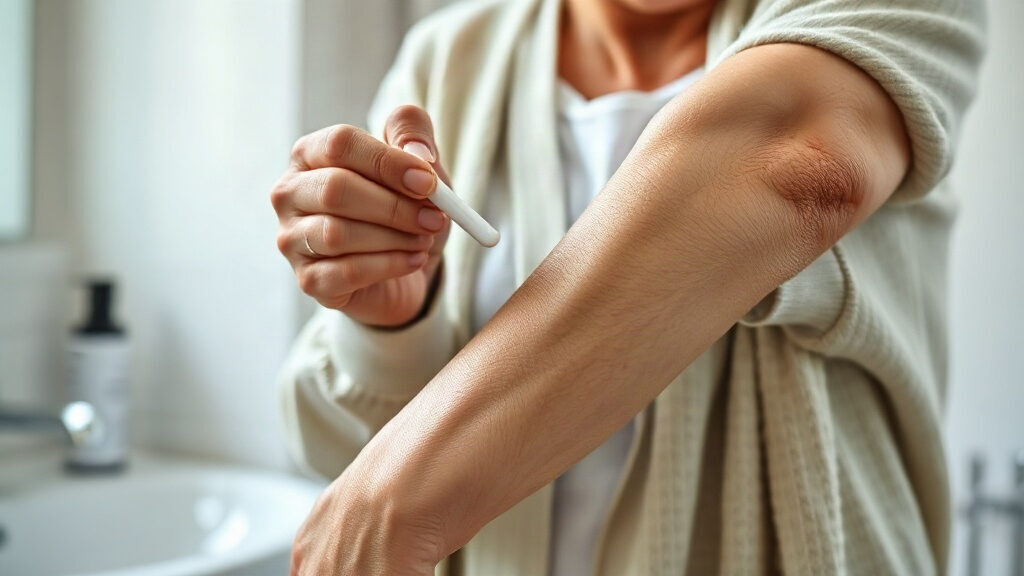
Dermatologists describe a form typical of older adults: senile purpura, also called actinic purpura or Bateman purpura. These are flat, purplish patches with sharp edges, found on the backs of the hands and the outer forearms. They sometimes leave a lasting brown discoloration. These marks are painless and do not signal a clotting disorder.
In 2007, the Geneva team of Gürkan Kaya and Jean-Hilaire Saurat grouped these signs under the term dermatoporosis, a chronic skin insufficiency comparable to what osteoporosis is for bone (Kaya and Saurat, 2007). It combines senile purpura, white star-shaped scars, very thin skin and skin tears at the slightest snag.
Mechanism: why bruises appear more easily with age
Bruises become more frequent after 60 because three layers of protection weaken at the same time: the skin, the tissue that supports the vessels and sometimes blood clotting. Each mechanism can act alone, but most often they add up.
- A thinner dermis. Collagen and hyaluronic acid in the dermis decline with age. Less well supported, the capillaries break under a pressure that would have no effect in a 30-year-old adult.
- Cumulative sun damage. Ultraviolet rays degrade the elastic and collagen fibers of areas exposed for decades. That is why senile purpura mainly affects the forearms and the backs of the hands.
- Less fat under the skin. The fatty cushion that absorbs shocks gets thinner, especially on the shins and forearms.
- Senescent cells. In aged skin, senescent fibroblasts produce less matrix and sustain local inflammation. This mechanism links bruising in older adults to cellular aging in general.
- Clotting altered by medication. Anticoagulants, antiplatelet drugs, anti-inflammatories and corticosteroids reduce the body’s ability to seal a small break in a vessel.
The link with medication shows up clearly in studies on dermatoporosis. In a Paris rehabilitation hospital, taking anticoagulants was associated with a 4.5-fold higher risk of dermatoporosis in people over 75 (Chanca et al., 2022).
What the science says about unexplained bruising after 60
Research shows that accidental bruises in older adults follow a predictable pattern, which helps spot the ones that stand out. The reference study followed 101 people aged 65 and over (mean age 83), examined every day at home or in a care facility for up to six weeks (Mosqueda et al., 2005). Nearly 90% of these marks were on the limbs. None were located on the neck, ears, buttocks, genitals or soles of the feet.
The same study debunked a common belief: color cannot be used to date a bruise. Sixteen bruises were already yellow within 24 hours of appearing. Participants taking drugs that affect clotting, or with reduced independence, more often had several bruises at once.
Dermatoporosis is common. It affected 27% of the 101 patients aged 75 and over (median age 86) in the Paris study cited above. Among them, 37% had a complication: a skin tear in 30% of cases, a dissecting hematoma in 7%. Smoking (8.7-fold risk), recreational sun exposure (4.2-fold) and age also emerged as independent factors. In Mexico, among 315 people aged 60 and over, prevalence reached 29%, with women making up 70% (Castillo-Cruz et al., 2023). Anticoagulants, antiplatelet drugs, oral corticosteroids and chronic kidney disease were associated with it.
Preventive aspirin deserves a separate mention. The ASPREE trial compared 100 mg of aspirin a day with a placebo in 19,114 healthy people aged 70 and over, followed for a median of 4.7 years (McNeil et al., 2018). Major hemorrhages rose from 6.2 to 8.6 per 1,000 person-years, a relative risk of 1.38. No significant cardiovascular benefit appeared. These results concern serious bleeding, not simple bruises, but they are a reminder that aspirin is never trivial after 70.
Vitamin C deficiency, rare but underestimated, can also show up as bruising. In an acute geriatric ward in Paris, 18 of 145 patients (12%) had clinical signs of scurvy, including petechiae or bruises (Raynaud-Simon et al., 2010). A biological deficiency was confirmed in 94% of them, compared with 30% of patients without signs. In the general US population, the NHANES 2003-2004 survey put vitamin C deficiency at 7.1% (n = 7,277), with blood levels one third lower in smokers (Schleicher et al., 2009).
In practice: harmless bruises or unexplained bruising to report?
A bruise on the forearm of an older adult taking an anticoagulant is almost always harmless; large hematomas on the trunk with bleeding gums are not. The table below sums up the criteria that guide the assessment, based on the studies cited.
| Criterion | Rather reassuring | Report to the doctor |
|---|---|---|
| Location | Forearms, backs of the hands, shins. | Trunk, back, face, neck, ears. |
| Size | A few centimeters. | Large (over 5 cm, about 2 in) or spreading. |
| Number | One or two, stable. | Many recent ones, with no explanation. |
| Associated signs | None. | Bleeding from the gums or nose, blood in the urine or stool, tiny red dots (petechiae). |
| General condition | Unchanged. | Fatigue, fever, night sweats, weight loss. |
| Context | Well-balanced anticoagulant treatment. | Start of a new medication, a fall, or marks the person cannot or dare not explain. |
The last criterion matters. Among 67 people aged 65 and over reported for physical abuse, 72% had bruises, often larger than 5 cm, on the face, the outer right arm or the back (Wiglesworth et al., 2009). These areas differ clearly from those of accidental bruises.
The causes to consider are few, and a doctor sorts them out easily. The visit always starts with the complete list of treatments, dietary supplements included.
| Cause | Clues | What the doctor does |
|---|---|---|
| Senile purpura (dermatoporosis) | Flat purplish patches on the forearms and hands, thin skin, white star-shaped scars. | Skin examination, advice on protection. |
| Anticoagulants, antiplatelet drugs | Multiple bruises on the limbs since the start of treatment. | Checks the dose, the INR for vitamin K antagonists, and interactions. |
| Corticosteroids (oral, inhaled, creams) | Skin that thins, bruises at the slightest contact. | Reassesses the dose and duration. |
| Vitamin C deficiency | Diet low in fruit and vegetables, bleeding gums. | Dietary assessment, blood test if needed. |
| Low platelets, blood disease | Petechiae, bleeding from mucous membranes, fatigue, fever. | Urgent complete blood count. |
| Liver disease | Alcohol use, jaundice, swollen belly. | Liver tests and clotting tests. |
For inhaled corticosteroids, a review describes skin thinning and easy bruising as effects linked to the daily dose and the duration of treatment (Guillot, 2002). For oral anticoagulants, MedlinePlus, from the US National Library of Medicine, outlines the precautions to follow and the bleeding signs that call for medical advice. Some supplements add to the risk: this is the case with ginkgo biloba, which should be mentioned to the doctor if you take an anticoagulant.
The skin aging that makes these bruises more frequent is part of the same process as wrinkles. To understand what speeds it up, read our article on the factors that accelerate wrinkles, and for the underlying biology, our pillar page on cellular senescence.
Protocol: limiting unexplained bruising day to day after 60
No treatment erases the bruises of senile purpura, but a few simple habits reduce their number and their complications. They target the skin, the home environment and medication.
- Wear long sleeves and full-length trousers when gardening, doing DIY or moving through cluttered spaces.
- Clear furniture corners, light hallways at night and secure rugs: fewer knocks means fewer marks and fewer falls.
- Protect forearms and hands from the sun. Cumulative ultraviolet damage weakens the dermis, as our guide to sunscreen explains.
- Quit smoking: in the Paris study, smoking raised the risk of dermatoporosis 8.7-fold.
- Moisturize the skin every day with a simple emollient to limit tears.
- Eat fresh fruit and vegetables at every meal to cover vitamin C needs; the NIH Office of Dietary Supplements notes that deficiency leads to scurvy.
- Bring the complete list of medications and supplements to every appointment, and never stop an anticoagulant on your own.
On a fresh bruise, a cold compress applied for 10 to 15 minutes, through a cloth, limits its spread. Creams combining retinaldehyde and hyaluronic acid fragments, studied by the Geneva team, remain leads that need confirmation in larger randomized trials (Kaya et al., 2019). The photoaging involved in dermatoporosis also explains why skin collagen becomes a prevention topic from your fifties onward.
To receive our weekly summaries on healthy aging, sign up for our health newsletter.
Frequently asked questions about unexplained bruising after 60
Why do you get bruises without bumping into anything after 60?
After 60, the skin thins, loses collagen and fat, and the small vessels of the dermis are less well supported. Light rubbing is enough to break them, without leaving any memory. Accumulated sun on the forearms, smoking and blood-thinning medications make it worse. These bruises, called senile purpura, are harmless and do not signal a clotting disorder.
When should unexplained bruising be a concern?
See a doctor if the bruises are numerous, large (over 5 cm, about 2 in), located on the trunk, back or face, or if they come with bleeding from the gums or nose, blood in the urine, tiny red dots on the skin, fatigue, fever or weight loss. A blood test with a platelet count and clotting tests can then rule out a blood-related cause.
Do anticoagulants cause bruises?
Yes, anticoagulants and antiplatelet drugs such as aspirin increase how often bruises appear, especially on the arms and legs. In a Paris study of people over 75, they were associated with a 4.5-fold higher risk of skin fragility. These bruises are no reason to stop treatment on your own: talk to your doctor, who will check the dose, interactions and, for vitamin K antagonists, the INR.
Which deficiency can cause bruising in older adults?
Vitamin C deficiency is the best-documented nutritional cause. At an advanced stage, scurvy, it causes bruises, tiny red dots around hair follicles and bleeding gums. In a geriatric ward, 12% of hospitalized patients showed signs of it, and 94% of them had a confirmed deficiency. A diet rich in fresh fruit and vegetables prevents it.
How long does a bruise take to fade in an older person?
A simple bruise usually fades within two to three weeks, sometimes more slowly after 60. Its color cannot be used to date it: in a study of 101 older adults, some bruises were already yellow within 24 hours. Senile purpura can leave a lasting brown mark. A bruise that grows, hardens or becomes painful should be shown to a doctor.
Medical disclaimer. The information on this page is provided for informational purposes only and does not constitute medical advice. It does not replace a consultation. Numerous or unexplained bruises, or bruises associated with other bleeding, warrant prompt medical advice. Never stop or change an anticoagulant, antiplatelet or corticosteroid treatment without your doctor’s approval. Ask a healthcare professional before changing your diet, taking dietary supplements or starting a new practice, especially if you have a medical condition, are pregnant or are under treatment. Dietary supplements do not replace a balanced diet or medical follow-up.