The hyperbaric chamber has made its way into anti-aging clinics, carried by a 2020 Israeli study reporting telomeres lengthened by more than 20% in 35 adults aged 64 and over. The treatment consists of breathing pure oxygen at a pressure two to three times higher than normal. This hospital treatment has been used for decades to treat carbon monoxide poisoning and diving accidents. The open question is what the trials actually say about the hyperbaric chamber and aging.
In brief – A hyperbaric chamber is a pressurized enclosure where you breathe pure oxygen at 2 or 3 atmospheres, which greatly increases the amount of oxygen dissolved in the blood. Its recognized indications are medical: carbon monoxide poisoning, decompression sickness, chronic wounds, radiation injuries and sudden hearing loss. On aging, a single Israeli team has published most of the human data: white blood cell telomeres lengthened by more than 20% (35 participants, no control group), gains in attention in a randomized trial of 63 people, and higher VO2max in 31 athletes aged 40 to 50. These results come from small samples, a demanding protocol (60 sessions of 90 minutes) and authors linked to a commercial company. A 2025 systematic review judges the anti-aging evidence limited. HBOT remains a medical treatment, not a validated longevity tool.
Definition: what is a hyperbaric chamber?
A hyperbaric chamber is a sealed room, made of steel or polymer, in which pressure is raised above atmospheric pressure while the patient breathes 100% oxygen. Doctors call it hyperbaric oxygen therapy (HBOT), but most people simply say hyperbaric chamber. MedlinePlus, the US National Library of Medicine’s health portal, explains that treatment for chronic conditions may be repeated over days or weeks. In France, a session lasts about 90 minutes, once or twice a day for 10 to 50 days depending on the condition, and the country has around twenty centers, mostly in hospitals.
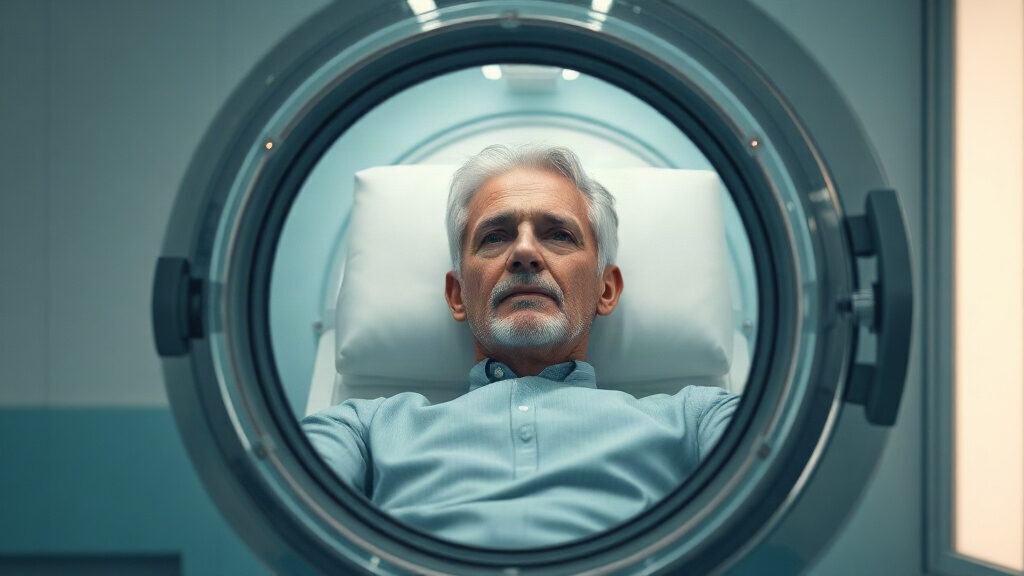
Medical hyperbaric chambers come in two main types. The multiplace chamber holds several seated patients, who breathe oxygen through a mask or a hood. The monoplace chamber, transparent and designed for one person lying down, is filled with oxygen. Alongside this medical equipment, inflatable “soft chambers” are sold to individuals and wellness centers: they reach about 1.3 atmospheres, often with enriched air rather than pure oxygen, which puts them outside the protocols tested in clinical trials.
The physics comes down to Henry’s law: the higher the pressure of a gas, the more of it dissolves in a liquid. At 2 atmospheres of pure oxygen, plasma carries far more dissolved oxygen than usual, independently of hemoglobin. That is what makes HBOT useful when hemoglobin is blocked by carbon monoxide or when a tissue receives too little blood.
Mechanism: how pressurized oxygen acts on cells
The anti-aging hypothesis behind HBOT rests on the “hyperoxic-hypoxic paradox”: repeated oxygen peaks, alternating with returns to normal air, trigger cellular signals usually caused by a lack of oxygen. Amir Hadanny and Shai Efrati, who formulated this concept, stress that cells read oxygen fluctuations, more than the absolute level, as hypoxia (Hadanny and Efrati, 2020). Hence the 5-minute air breaks every 20 minutes in their protocols.
Several biological pathways have been described, mostly in animals and in the laboratory:
- Signaling by reactive oxygen species: at a controlled dose, this mild oxidative stress activates healing and repair pathways, according to a review by Stephen Thom (Thom, 2009).
- Stem cell mobilization: in humans, one 2-hour session at 2 atmospheres doubled circulating CD34+ cells, and 20 sessions increased them eightfold, via nitric oxide (Thom et al., 2006).
- The growth of new blood vessels (angiogenesis), which improves the blood supply of poorly perfused tissues.
- Effects on mitochondria and on certain aging immune cells, still poorly documented in humans.
These mechanisms overlap with several biological hallmarks of aging, which is why researchers are drawn to hyperbaric oxygen. A 2022 review in Redox Biology notes, however, that no protocol broadly applicable to aging has yet been defined (Fu et al., 2022). Oxygen becomes toxic beyond a threshold: dose, duration and breaks matter as much as pressure.
What the science says about the hyperbaric chamber and aging
Almost all human data on aging come from a single team, at the Sagol Center of Shamir Medical Center in Israel, with samples of 13 to 63 people. Several authors work for AVIV Scientific, a company that runs hyperbaric clinics, and Shai Efrati is a shareholder: every paper declares it. This does not invalidate the results, but independent replication is needed before drawing conclusions.
Telomeres and senescent cells: the 2020 study
The most cited study followed 35 healthy adults aged 64 and over through 60 daily HBOT sessions at 2 atmospheres (Hachmo et al., 2020). Telomere length in several white blood cell populations rose by more than 20%, up to 29% for B cells at the 60th session. The proportion of senescent T helper cells fell by 37%.
Three limitations weigh heavily on this result. The trial had no control group. Telomeres were measured in isolated blood cells, whose composition varies from one blood draw to the next. Finally, a longer blood telomere has never been linked, after an intervention, to a longer life. The link between telomere length and aging is explained in our Telomere attrition pillar page.
Cognition: the only randomized trial in older adults
A randomized trial assigned 63 adults over 64 either to 60 HBOT sessions (33 people) or to a control group without sessions (30 people) for three months (Hadanny et al., 2020). Global cognitive function improved more in the treated group, with net effects of 0.745 on attention and 0.788 on information processing speed. Perfusion MRI showed increased blood flow in several frontal areas.
The control group received no sham session: participants knew whether they were treated, which leaves room for an expectation effect on cognitive tests. The trial says nothing about how long the effect lasts or about any impact on dementia risk.
Physical performance and mitochondria
The most methodologically robust work involved 37 amateur athletes aged 40 to 50, double-blinded against a sham session at 1.02 atmospheres of air (Hadanny et al., 2022). After 40 one-hour sessions at 2 atmospheres, VO2max rose more than with placebo (effect size 0.989), as did mitochondrial respiratory capacity measured in muscle. Only 31 athletes were analyzed, and the study did not include older adults.
Skin, single cases and a systematic review
A skin study involved 13 men with an average age of 68, with biopsies before and after three months of HBOT: collagen density and the number of small vessels increased, while senescent cells in the tissue decreased (Hachmo et al., 2021). An American neurosurgeon also published his self-experiment of 60 sessions, with “doubled” telomeres, but this is a single case (Maroon, 2022). The 2025 systematic review, which retained 15 papers out of 591, concludes that the evidence for anti-aging use, and for its cost, remains limited (Fisher et al., 2025).
| Study | Participants | Protocol | Main result | Main limitation |
|---|---|---|---|---|
| Hachmo 2020 | 35 adults aged 64 and over | 60 sessions, 2 ATA, 90 min | Blood telomeres +20% or more, senescent T helper cells -37% | No control group |
| Hadanny 2020 | 63 adults over 64, randomized | 60 sessions, 2 ATA, 90 min | Improved attention and processing speed | No sham session |
| Hadanny 2022 | 37 athletes aged 40 to 50, 31 analyzed | 40 sessions, 2 ATA, 60 min | Higher VO2max and mitochondrial respiration | Small sample, no older adults |
| Hachmo 2021 | 13 men aged 68 | 3 months of daily sessions | More skin collagen and blood vessels | Very small sample |
| Fisher 2025 | 15 studies retained | Systematic review | Anti-aging evidence judged limited | Heterogeneous studies |
In practice: recognized indications and anti-aging uses
Hyperbaric oxygen therapy is a validated treatment for a specific list of medical conditions, and aging is not one of them. The 10th European Consensus Conference on Hyperbaric Medicine (ECHM) ranked indications on three levels, from “strongly recommended” to “optional”, and for the first time listed situations where the technique is not indicated (Mathieu et al., 2017).
Two examples show what hyperbaric oxygen delivers in its proper indications. In carbon monoxide poisoning, three HBOT sessions within 24 hours reduced cognitive sequelae at six weeks: 25.0% versus 46.1% with normobaric oxygen, in 152 patients (Weaver et al., 2002). For diabetic foot ulcers, the Cochrane review of 12 trials (577 participants) found more frequent healing at six weeks, but not at one year (Kranke et al., 2015).
French public health guidance points out that hyperbaric oxygen has shown no benefit in multiple sclerosis, depression, autism, tinnitus or stress. The “longevity” hyperbaric sessions offered by private centers rarely follow the trial protocols: lower pressure, oxygen that is not pure, and fewer sessions.
| Criterion | Hospital chamber | Wellness soft chamber |
|---|---|---|
| Pressure | 2 to 3 atmospheres | About 1.3 atmospheres |
| Gas breathed | 100% oxygen through a mask or hood | Air or oxygen-enriched air |
| Supervision | Hyperbaric physician, prior examination, continuous monitoring | Variable, often no physician |
| Clinical evidence | Indications validated by consensus and randomized trials | A few small trials in young adults |
| Match with anti-aging studies | Close to the Israeli protocol (2 ATA, 90 min) | Not comparable |
The best-documented levers for slowing biological aging remain available without any chamber: physical activity, sleep, diet and social connection, as summarized in our feature on biological age. Senescent cells, which HBOT seems to reduce in the blood, can also be limited by simple habits, described in our article on senescent cells.
| Exposure | Available oxygen | Intended effect | Level of evidence on aging |
|---|---|---|---|
| Hyperbaric chamber at 2 ATA | Greatly increased | Repair signals through oxygen fluctuations | Small trials, a single team |
| Moderate altitude | Reduced | Adaptation to hypoxia (red blood cells, vessels) | Observational data |
| Regular endurance exercise | Normal | VO2max, mitochondria, heart | Many cohorts and trials |
The comparison with altitude hypoxia, whose effects on the heart and lungs are covered in our article on altitude, illustrates a common thread: the body responds as much to changes in oxygen as to its quantity.
Advice: how to assess a hyperbaric chamber offer
Before any HBOT session, the first question is a medical one. The risks are real, even if they remain rare in hospital centers. Among 2,334 patients treated at the Sagol Center, 17.4% had at least one adverse event, or 0.72% of sessions; middle ear barotrauma affected 9.2% of patients (Hadanny et al., 2016). At the Marseille hyperbaric center, among 2,610 patients, this ear injury affected 10.04% of people, with a higher risk after age 55 and in women (Edinguele et al., 2020).
- Insist on a prior medical examination by a physician trained in hyperbaric medicine: some lung, ear, nose and throat, or heart conditions rule out sessions.
- Learn to equalize your ears, as when diving or flying, and report any cold or sinusitis, which raises the risk of barotrauma.
- Be wary of figures promised on “age” or telomeres: no trial has shown any gain in life expectancy.
- Check the proposed protocol (pressure, pure oxygen or not, number of sessions) and compare it with the one used in the studies cited.
- Report your medications, any claustrophobia and treated diabetes, since hypoglycemia is one of the effects observed.
To follow new studies on hyperbaric oxygen and longevity technologies without falling for marketing, subscribe to our health newsletter.
Frequently asked questions about the hyperbaric chamber
Does a hyperbaric chamber really lengthen telomeres?
A 2020 study of 35 adults aged 64 and over measured blood telomeres lengthened by more than 20% after 60 sessions at 2 atmospheres. The trial had no control group and has not been replicated by an independent team. A longer blood telomere has never been linked, after an intervention, to a longer life.
What are the recognized indications for a hyperbaric chamber?
The validated indications are medical: carbon monoxide poisoning, decompression sickness, gas embolism, chronic wounds such as diabetic foot ulcers, late radiation injuries, sudden hearing loss, certain severe infections and extensive burns. The 2016 European consensus ranks them by level of evidence. Aging is not among them.
What are the risks of a hyperbaric chamber session?
The most common risk is middle ear barotrauma, which affected about 9 to 10% of patients in two large hospital series of more than 2,300 people. More rarely, seizures linked to oxygen toxicity, hypoglycemia, anxiety or temporary vision problems occur. A prior medical examination limits these risks.
What is the difference between a soft chamber and a medical chamber?
A medical chamber reaches 2 or 3 atmospheres with pure oxygen, under a physician’s supervision. A wellness soft chamber reaches about 1.3 atmospheres, often with air or enriched air. The Israeli aging studies used 2 atmospheres and pure oxygen: their results do not apply to soft chambers.
How many sessions did the aging studies use?
The telomere and cognition trials used 60 sessions of 90 minutes at 2 atmospheres, five days a week for three months, with a 5-minute air break every 20 minutes. The athlete study used 40 one-hour sessions. This demanding protocol has never been compared with physical exercise on the same markers.
Medical disclaimer. The information on this page is provided for informational purposes only and does not constitute medical advice. It does not replace a consultation. Hyperbaric oxygen therapy is a medical procedure that carries risks (ear barotrauma, oxygen toxicity, fire hazard) and has contraindications, particularly lung and ear, nose and throat conditions. Never undergo chamber sessions, whether in a hospital or a soft chamber, without a prior examination and the advice of a physician trained in hyperbaric medicine, especially if you have lung or heart disease, are pregnant, have epilepsy, have treated diabetes or are under treatment.