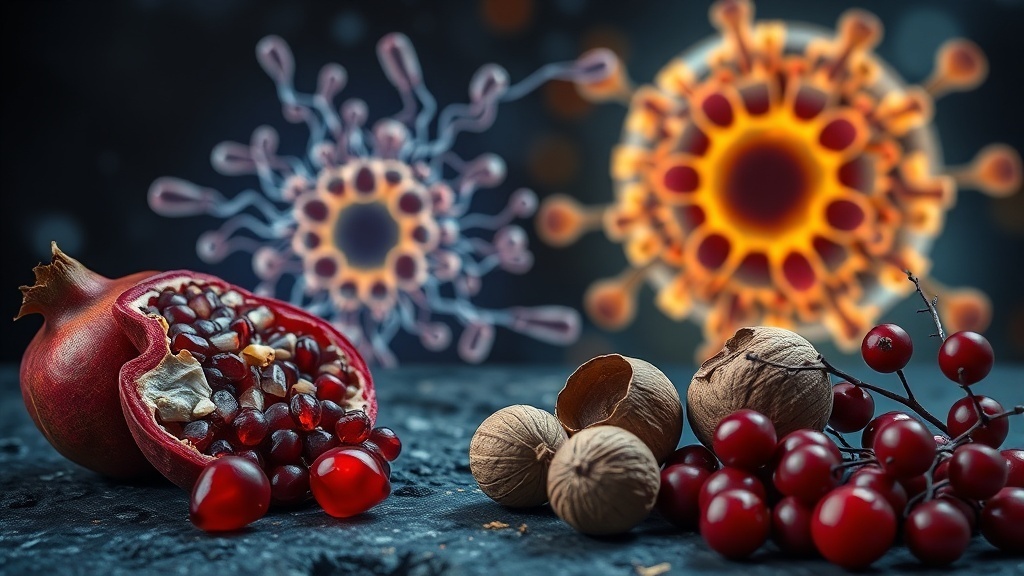
Urolithin A is not a fruit extract you take directly: it is a molecule your own gut microbiome makes from the ellagitannins in pomegranate, walnuts and berries, provided you host the right bacteria. Since 2016, researchers at EPFL (Ecole Polytechnique Federale de Lausanne) have shown that it reactivates mitophagy, the recycling of worn-out mitochondria, in worms, mice and then humans. This postbiotic is now drawing research interest for muscle and cellular energy after age 40.
In brief – Urolithin A is a postbiotic, a metabolite produced by certain gut bacteria from the ellagitannins found in pomegranate, walnuts and berries. It activates mitophagy, the process by which a cell clears out damaged mitochondria and regenerates new ones. Only 30 to 40% of adults naturally produce meaningful amounts of it, for lack of a suitable gut flora, which is why direct supplementation has drawn interest. A randomized trial published in 2022 (Singh et al., n=88) reported roughly a 12% increase in muscle strength after 4 months in middle-aged adults, with no notable adverse effect up to 1,000 mg per day. The evidence remains limited to a handful of short trials: no effect on human longevity has been demonstrated at this stage.
Definition: what is urolithin A?
It belongs to the urolithin family, compounds the body does not consume as such through diet. It results from the transformation, by certain bacteria in the colon, of the ellagitannins and ellagic acid found in pomegranate, walnuts, strawberries, raspberries and blackberries. This microbial-metabolite status is what earns it the label “postbiotic”: an active compound produced by the microbiome, distinct from probiotics (live bacteria) and prebiotics (their food source).
Not everyone produces it in useful amounts. According to a review by D’Amico and colleagues, only a minority of adults host the bacterial strains (notably of the genus Enterocloster) able to carry this conversion through to completion (D’Amico et al. 2021, Trends Mol Med, PMID 34030963). This is why research has turned toward direct supplementation with the purified compound rather than relying solely on eating pomegranate or walnuts.
Mechanism: how urolithin A acts on mitochondria
It targets a specific process: mitophagy. Every cell continuously renews its stock of mitochondria, the organelles that produce cellular energy as ATP. With age, this recycling slows and faulty mitochondria accumulate, notably in skeletal muscle.
- It stimulates the PINK1/Parkin pathways, which flag damaged mitochondria for removal.
- It then promotes the biogenesis of new, functional mitochondria.
- It modulates the expression of genes linked to skeletal muscle energy metabolism.
- It reduces certain inflammatory markers associated with mitochondrial aging.
The foundational study by Ryu and colleagues first showed, in the roundworm C. elegans and in rodents, that this supplementation extends the worm’s lifespan and improves muscle function in aging rodents (Ryu et al. 2016, Nature Medicine, PMID 27400265). These preclinical results prompted the move to human trials.

What the human evidence shows
The first human trial, led by Andreux and colleagues in sedentary adults aged 60 to 85, tested single then repeated doses over 4 weeks. It was well tolerated and shifted blood and muscle biomarkers consistent with better mitochondrial health, with no serious adverse event reported (Andreux et al. 2019, Nature Metabolism, PMID 32694802).
The strongest trial to date remains the one by Singh and colleagues, randomized and placebo-controlled over 4 months, in 88 non-athletic, middle-aged adults. Participants receiving 1,000 mg per day of the compound gained roughly 12% in upper-body muscle strength and improved their exercise endurance compared with placebo, alongside plasma markers suggesting more active mitochondrial metabolism (Singh et al. 2022, Cell Reports Medicine, PMID 35584623). This figure concerns muscle strength and endurance measured at 4 months, not a marker of longevity or mortality.
These trials remain modest in size and short relative to a human lifespan. No study has followed a cohort long enough to establish an effect on life expectancy or mortality in humans: extrapolating from worms and mice to a longer human lifespan is not demonstrated. The gut microbiome plays a central role in this conversion, a topic covered by the Harvard T.H. Chan School of Public Health’s overview of the human microbiome.
In practice: food sources and supplementation
Two paths exist for increasing exposure to it: foods rich in ellagitannins, or a direct, already-purified supplement (often sold as “Mitopure”). The first depends on each person’s gut microbiome; the second bypasses that variability by delivering the already-formed molecule.
| Approach | Examples | Amount produced | Main limitation |
|---|---|---|---|
| Foods rich in ellagitannins | Pomegranate, walnuts, strawberries, raspberries, blackberries | Variable, depends on the microbiome | Only 30 to 40% of adults produce notable amounts |
| Purified direct supplementation | Purified capsules (e.g. Mitopure) | Consistent, independent of the microbiome | Dosing and duration of use are still poorly standardized |
| Pomegranate juice or extract alone | Pomegranate juice, standardized extract | Low and irregular | Ellagitannin content varies widely between products |
This question of individual conversion connects to other levers studied to support cellular energy, such as PQQ or NAD+, two other approaches that target mitochondrial function through distinct mechanisms. For a broader view of the biological pillar involved, see the mitochondrial dysfunction page.
Protocol and practical advice
Published clinical trials used doses of 500 to 1,000 mg per day, for 4 weeks to 4 months, with no notable toxicity signal. No official public health protocol currently recommends it: these benchmarks come solely from research trials, not from a health authority.
- Favor food sources first (pomegranate, walnuts, berries), which also supply fiber and other polyphenols.
- If using a supplement, check that it is the purified compound rather than a plain, non-standardized pomegranate extract.
- Ask a doctor before starting any course, especially during pregnancy, breastfeeding, or with severe liver or kidney disease: safety data are lacking for these situations.
- Do not expect a noticeable effect before several weeks: trials measure changes starting at a minimum of 4 weeks.
This postbiotic fits into a broader approach to mitochondrial support, alongside better-established habits such as regular physical activity or intermittent fasting, which also stimulates cellular autophagy through other pathways.
Frequently asked questions
What exactly is urolithin A?
Urolithin A is a postbiotic: a molecule produced by certain gut bacteria from the ellagitannins in pomegranate, walnuts and berries. It is not directly present in these foods, but results from their transformation by the gut microbiome. It is studied for its role in mitophagy, the recycling of damaged mitochondria.
Why doesn’t everyone produce it?
Converting ellagitannins into urolithin A depends on specific gut bacteria, which are absent or scarce in part of the population. Available data suggest about 30 to 40% of adults produce significant amounts of it after eating pomegranate or walnuts; the rest produce very little, regardless of their diet.
What is the difference between urolithin A and NAD+ or PQQ?
All three molecules target mitochondrial function, but through different pathways. It activates mitophagy, the clearance of failing mitochondria. NAD+ serves as an essential cofactor for energy reactions and cellular repair enzymes. PQQ appears to act more on the biogenesis of new mitochondria. No trial has directly compared their effectiveness in humans.
Does urolithin A reverse aging or slow it down?
No human study demonstrates an overall anti-aging effect or a longer lifespan. Published trials focus on mitochondrial biomarkers and muscle strength over a few months, not on aging as a whole. Talking about rejuvenation would be an extrapolation the current data do not support.
How long before an effect can be felt?
In the trial by Singh and colleagues, muscle strength improvements were measured after 4 months of daily use. The trial by Andreux and colleagues reported blood biomarker changes as early as 4 weeks. No data document a perceptible effect in the short term, under one month.
Medical disclaimer. The information provided here is for informational purposes only and does not constitute medical advice. It does not replace a consultation. Ask a healthcare professional before changing your diet, taking dietary supplements or starting a new practice, especially if you have a medical condition, are pregnant or are under treatment. Dietary supplements do not replace a balanced diet or medical follow-up.